Whitehot Magazine
October 2026
"The Best Art In The World"
"The Best Art In The World"
October 2026
Autopsy of an Exquisite Corpse: An Interview with Meinzer and Victoria Reshetnikov - New York City
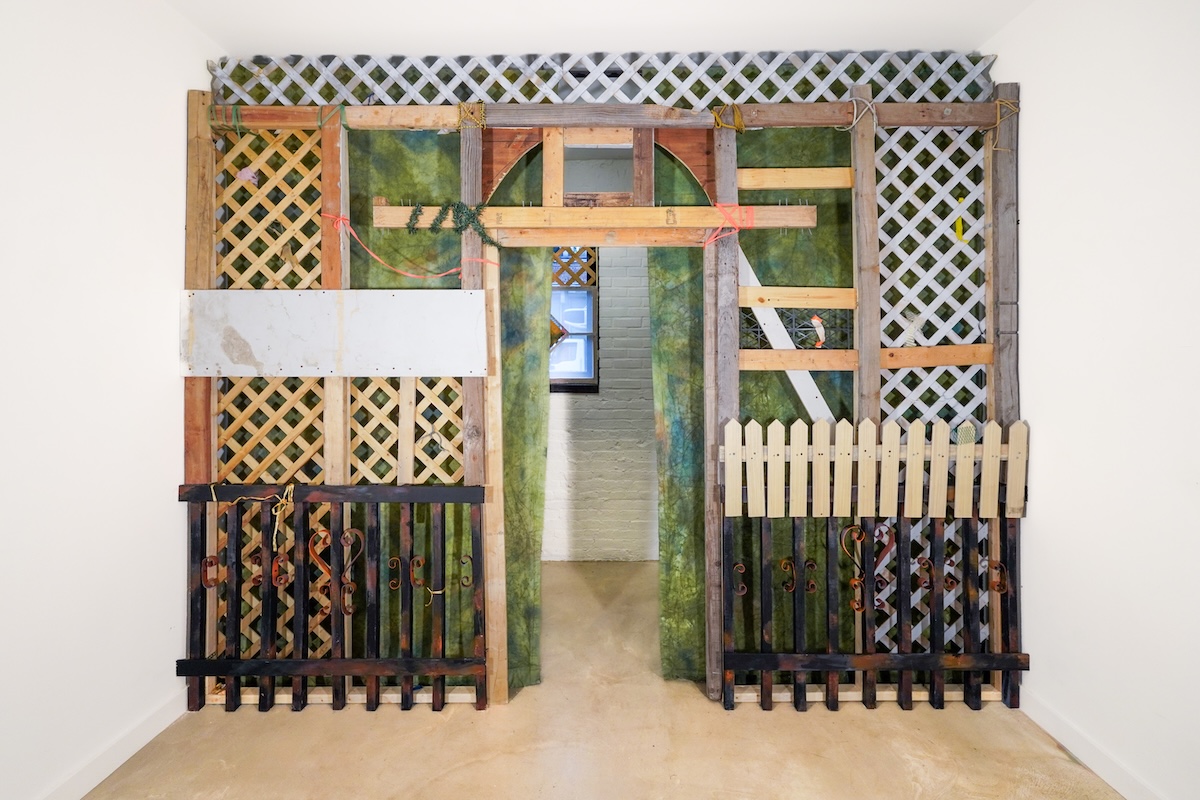
Meinzer and Victoria Reshetnikov, Hush Lobby, 2026. Wood cutoffs from 37th Avenue, Grand Street, and 48th Street, lattice from Facebook Marketplace, slats from 3 bedframes, deconstructed washing machine foundation from Middle Village, shipping palettes from Connecticut and a new Sunnyside grocery store, 3D printed custom parts, cords, produce netting, shoelaces, surveyor’s tape, plastic bags, braided strings, pine, canvas, tulle, fabric dye, colored pencil. 4 ⅛ x 11 ½ ft (wall form). Image courtesy of the artists.
By COLLEEN DALUSONG March 10th, 2026
Hush Lobby was a site-specific installation by Meinzer and Victoria Reshetnikov shown at theNextWave Gallery. In this conversation, the artists reflect on the dynamics of artistic collaboration, the tension between surveillance and privacy in a gallery setting, and the ensuing afterlife of an exhibition once it has been deinstalled.
Colleen Dalusong: This is your first time collaborating as artists. To start off this interview, can you talk about how you came up with the title 'Hush Lobby?'
Meinzer: Gameplay and chance was one of the foundations of our initial collaboration, and once we finished the show we were really interested in the sort of paradox we created between interior and exterior spaces. We wanted the title to both reflect that paradox and also take part in the gameplay that we implemented with the window frame pieces. The idea was that each artist produced a list of words that they felt were associated with the show, and then once the lists were exchanged, we each produced a list of two word combinations using one word from each artist’s list. We both came up with the title “Hush Lobby” and we kind of fell in love with the weirdness of it. “Lobby” really got to the strange liminality of the space, especially given that it was suspended in a gallery context. “Hush” pointed to the importance of it being a space to be alone, a space to find privacy or solitude.
CD: Do you recall the list of words that you each came up with?
MNZ: Here were my 10 words:
1. Muscle
2. Veil
3. Pull
4. Teeth
5. Shy
6. Swath
7. Pane
8. Crimp
9. Hush
10. Idle
Victoria Reshetnikov: And here were the ones I came up with:
1. Balcony
2. Bracket
3. Anchor
4. Lattice
5. Foyer
6. Lobby
7. Property
8. Stop
9. Rusted
10. Bevel
The process for the show became this semi-obfuscated back-and-forth, which started with the forms in the windows. I was responsible for the wooden structure, while Meinzer made the images and forms that accumulated on top of it. This process simultaneously juxtaposed and layered our practices, including the missteps and miscommunications. This was immediately exciting, and pushed me to consider how another person would interact with something I’m building, which inevitably informed the fabrication process. The game we designed to name the show followed this similar logic, which emphasized obfuscation, but also choreography, this time in wordplay and choice.
CD: The two of you are very good friends and it’s clear to see that there’s a really harmonious rapport which formed the basis of Hush Lobby, but you have incredibly different approaches to artmaking. In what ways do your artistic practices share similarities versus differences, and how do you feel this dynamic strengthens your collective voice when you collaborate on an artwork?
VR: We are both printmakers. We met in college at the Neiman Center for Print Studies almost 6 years ago now, where we learned about the way we each work in addition to the images we’re both interested in. The printshop taught me to think about how an image is born, through an emphasis on process over anything else. It also made me prioritize shared making spaces, where people are always providing organic feedback, or just peeking at what you’re working on. More recently I think we’ve both taken this printmaking logic and focused on different mediums, but the way we discuss and analyze each other’s work has been a mainstay since this first setting.
MNZ: I definitely agree about the influence of the printshop on each of our practices. It’s interesting because Victoria took the printmaking logic and applied it to sculpture whereas I applied it to painting. Printmaking is an interesting medium because the technical process of creating the matrix is often separated from the production of the image. This separation allows you to create in multiple modalities, where you can separate out the technical precision from the more free form muscle memory of wanting to create image or texture.
The idea of collaborating was really exciting for both of us, but because our practices feel so different from each other there was not an immediate path that made sense. Victoria’s work is really tactile and sculptural, and I’m very interested in the effect that material (and more specifically art objects) have on a space. We’re kind of figuring out the balance between those two dynamics still. I think in the future that the space choreography and the image need to be slightly more aligned, but I think the fact that we identified these two areas as each other’s sort of approach is helpful for our understanding about future collaborations.
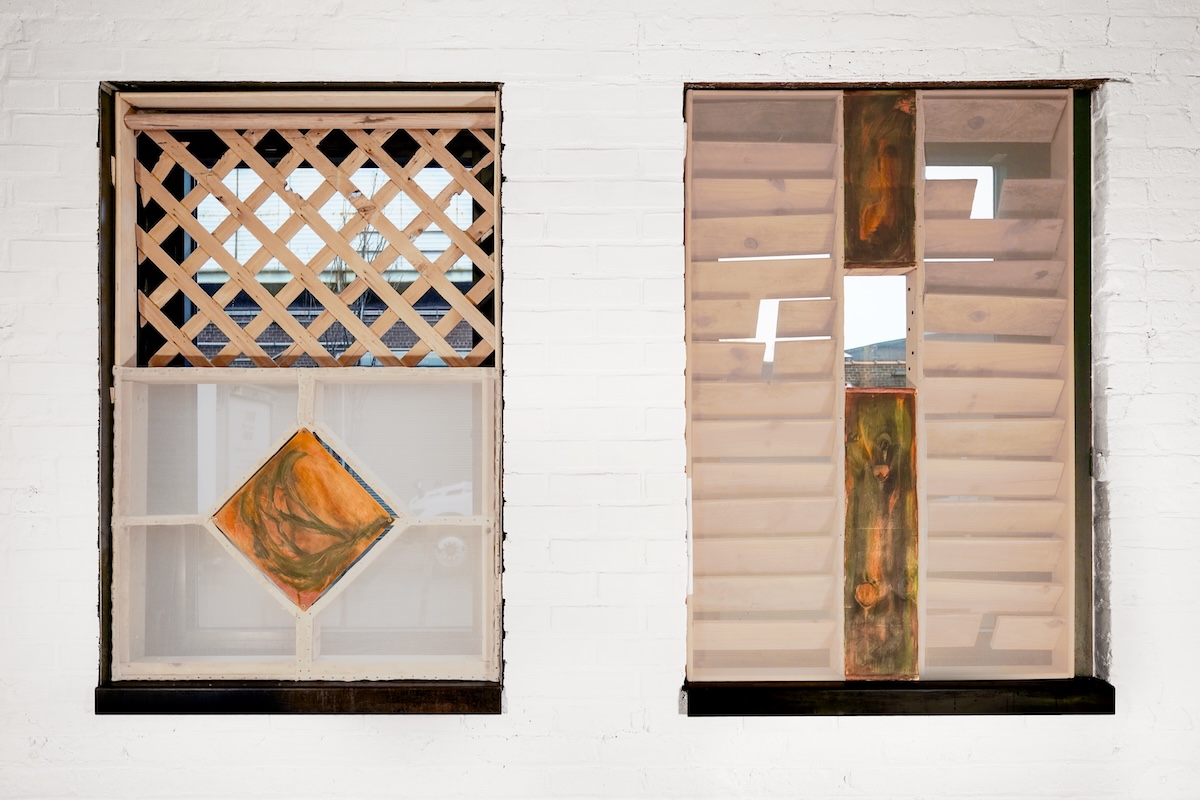 Meinzer and Victoria Reshetnikov, Hush Lobby, 2026. Wood cutoffs from 37th Avenue, Grand Street, and 48th Street, lattice from Facebook Marketplace, slats from 3 bedframes, deconstructed washing machine foundation from Middle Village, shipping palettes from Connecticut and a new Sunnyside grocery store, 3D printed custom parts, cords, produce netting, shoelaces, surveyor’s tape, plastic bags, braided strings, pine, canvas, tulle, fabric dye, colored pencil. 2 ⅞ x 4 ⅜ ft (window forms). Image courtesy of the artists.
CD: One of the goals of Hush Lobby was to act as a space for privacy, or specifically to be able to look at artwork without the worry of being looked at in turn. From what I understand, you would guide visitors to the gallery space, say they can stay as long as they like, and that they could find you in the conference room to talk about it afterwards. Do you think this approach was successful, and is there anything that you would do differently next time?
MNZ: I think we both quickly identified that this process gave it a bit of a strange amusement-like feel. I think in my perfect world we would have never even had an opening and instead would have just left a lockbox outside and people could let themselves into the space as they pleased. Obviously, that is a bit of a utopic situation. Even though Victoria and I weren’t actually in the room with the viewer, I think there was still this strange element where the viewer felt somehow surveilled knowing that we were waiting down the hall. It was definitely awkward. But I also think that even in the lockbox dream scenario, the element of surveillance might never be truly eliminated. I think if you want a piece that really achieves that, it has to be mounted in a more neutral public space, not a gallery space.
And honestly the fact that it didn’t work is the more interesting part to me. It’s not the first time I’ve tried to achieve the feeling of privacy in a fine arts space, and the more I talk about my work the more I see that this theme runs even deeper in my practice than I thought. Someone who visited the show pointed out that if I ever actually achieve that feeling I might feel bored, and I think that’s true.
VR: The orchestration for the space was something Meinzer was really interested in, but I am also very interested in this relationship between the object and viewer. Because Hush Lobby filled the entire room, I think being in there alone was a bodily experience. When we would talk about the work after with visitors in the conference room, or even when we would enter the gallery space with visitors after they spent time there by themselves, it felt like we were viewing the work at a distance, even if we were standing in it.
Formally, I was excited by how you couldn’t ever see Hush Lobby in full. Depending on what side of it you were on, the work also felt very different. I didn’t necessarily design the scrap wall to look inviting, but once you enter it, there is this comforting, soft quality, like you’re in a color field painting. This especially felt true because of how close the wall is to the back of the gallery space, creating an intimate, claustrophobic feeling. Even the acoustics changed, with the fabric padding dulling the construction noise outside and reducing the echo of our voices. Because of how the window forms ended up completely filling the window frames, Hush Lobby really felt like an enclosure. There is something incongruous about this which we’re aware of, but I am kind of captivated by how an object can generate these disparate feelings simultaneously.
CD: I’m really intrigued by the fact that you two made a point of discussing the exhibit with the visitors immediately after they had seen the show. Usually people just walk in, look at the art, then leave without saying a word to the gallery attendants. Sometimes when I see an exhibit, I need a bit of time to let my thoughts settle into something coherent enough to articulate. You must have heard some very raw reactions to Hush Lobby, and I’m wondering if there was any feedback in particular that stood out to you.
VR: This is true, we did unintentionally put pressure on our visitors to have an immediate response, which I’m sure informed how much time they spent in the space. It was almost as if the visitor was responsible for presenting the work back to us.
Also, because we had regular gallery hours, there were also these funny moments where we would have multiple unexpected visitors at the same time that had to be funneled into the single-occupancy space. It was a weird social game of hopscotch to introduce people to each other and “take turns” going in. When I was there alone, I was often running between the gallery and conference room having two conversations at once. Because of its choreography, Hush Lobby opened up these weird pockets where disparate visitors were forced to overlap and intersect.
MNZ: I agree, that the idea of talking to the visitors directly after they saw the space was quite strange. That realization was definitely made based on the feedback of our visitors, especially a friend of mine who very directly mentioned that she was acutely aware of our presence down the hall while she was in Hush Lobby.
The gallery is kind of off-the-beaten path, which was actually something that spawned the idea for a single-occupancy space, but the result was that amusement-park feel that I mentioned earlier. This is also because Victoria and I were completely responsible for the gallery’s regular hours and the appointments, so you didn’t have that kind of sterile intermediary of a gallery assistant that you might have at a Manhattan space. That kind of gets me thinking about Andrea Fraser’s Museum Highlights: A Gallery Talk (1989) and the sort of performativity of gallery assistants. There is a certain sensibility that is expected for that position; their presence is part of the choreography of the exhibition. It was kind of short sighted that we didn’t consider that our presence would affect the choreography of Hush Lobby as well.
CD: One of your visitors mentioned that there was a 'real estate' aspect to how Hush Lobby was shown, specifically in the context of giving virtual tours of the space over Facetime for friends who weren't able to physically come to the gallery. Can you talk about this unexpected comparison?
VR: Because the work was so architectural, it really did become like a real estate showing. This became especially clear to me after I had a facetime call with a visitor in the space, where I had full control over how she was experiencing the entire show through my phone camera. While Hush Lobby did reveal this connection, it’s one that can be felt in the art world at large, especially in sales-focused galleries. Eventually, when the artwork is completely commodified, it becomes an object to circulate and present, rather than to be looked at. Even though we couldn’t sell Hush Lobby, all the walkthroughs we had for the show pointed to this distinction.
CD: The conventional life-cycle of an exhibit is that you have the opening, the show runs for its allotted period of time, and hopefully the work is sold and brought into a collector’s home after the exhibit has ended. Like you said, Hush Lobby isn’t something that can be sold, but it definitely had an unusual beginning, middle, and afterlife. How do you think your own understanding of Hush Lobby changed over the course of the exhibit and its immediate aftermath?
VR: I was interested in how the way we handled Hush Lobby changed throughout the show. The material was first assembled from trash from our streets and studios. Once it became “the work,” I noticed the way we handled it changed, in a more precious, preservationist way. But once the show came down, the work’s handling returned to the way I handled the garbage when I first collected it, sort of carelessly. I vividly recall how we threw the window forms on top of each other in the back of a car after deinstall, when we had initially moved them individually from Meinzer’s studio, tulle side up. We also got in a bit of trouble because of where we dumped the material from the show after we were done; while I took a lot of wood from the street around the gallery when I assembled the work, when we put it back people did notice. It brought up questions for me about an artwork’s life cycle, how an object transforms from an idea, to finished, and then to something worth preserving.
Hush Lobby became an exercise in transmuting material, first from garbage into the work, then into an object to be walked through and analyzed, and eventually, disassembled and returned to the street. But at that point, Hush Lobby could not fully be re-converted. The show’s ephemerality really fast-tracked this transformation, but this quality is present in all art objects, just some have longer lifetimes. But questions about where the work is alive now, in photographs or whatever, are less important to me than what the artwork did while it was alive. Now, the material we’ve kept from the show is going to become something else, somewhere else.
MNZ: I agree with Victoria that the fabrication of the show and the transformation of the material from trash to art work back to trash was fascinating to see. I’ve always really loved to think about the birth and death of artworks, and the death of them has particularly fascinated me. There is so much work in art storage, or even on display, that is really just the corpse of the original piece. The idea of preserving Hush Lobby felt quite perverse.
The privilege of being able to experiment with the life cycle of an artwork like that was really due to Wade Bonds and Norton William who are the directors of theNextWave Gallery. Having the opportunity to work in their space was incredibly unique because we weren’t pressured to think from a commercial standpoint at all. It’s not to say that we were working in opposition from that framework but that working without it allowed for a very experimental creative process. WM
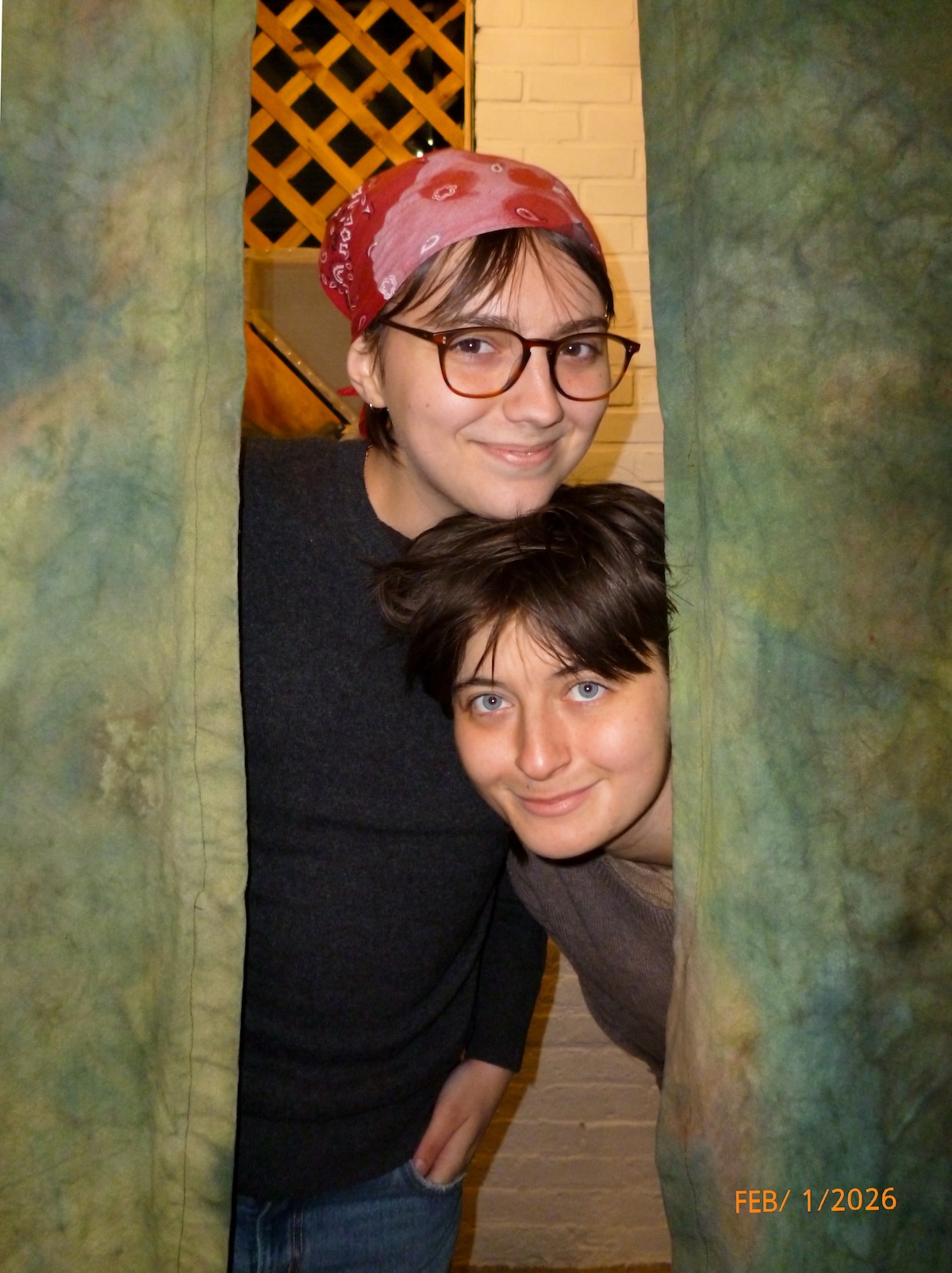 Artists Meinzer and Victoria Reshetnikov. Installation view of Hush Lobby, New York. Courtesy of the artists.

Colleen Dalusong
Colleen Dalusong is a curator and writer based in New York City. She is the co-founder of Fruitality Magazine, and has curated exhibits at Think!Chinatown. She has previously been published in Cultbytes and Mercer Street.
view all articles from this author