Whitehot Magazine
November 2026
"The Best Art In The World"
"The Best Art In The World"
November 2026
Acknowledging Humanness: Interview with Rina Banerjee for ‘Discriminating taste, hallucinations of the tongue’ at the Vadehra Art Gallery, New Delhi
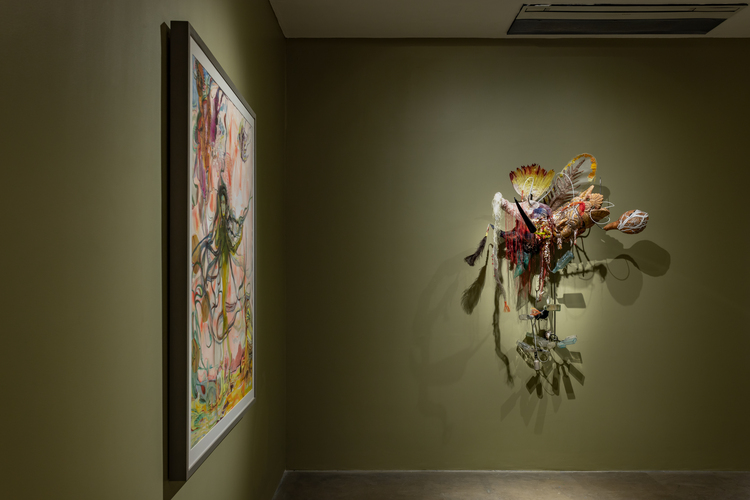 Rina Banerjee, ‘Discriminating taste, hallucinations of the tongue’, Installation View. Image courtesy of the artist and Vadehra Art Gallery
By GRACE PALMER, November 21, 2026
It has long been said that “taste is the enemy of art” [Duchamp] or “the enemy of creativeness” [Picasso]. As Mark Twain suggests, perhaps, “taste is made, not born.” For Rina Banerjee, however, these distinctions between good and bad taste remain bound by predetermined Westernised notions – ideas we have naturalised through frames of ‘authenticity’. In her latest exhibition, ‘Discriminating taste, hallucinations of the tongue’ at the Vadehra Art Gallery in New Delhi, Banerjee presents 28 works exploring the tension around consumption, desire, appropriation and appreciation. Her first major showcase in India in more than 17 years, ‘Discriminating taste’ reimagines womanhood through the uncanny, embraces hybridity as transnationality, and examines the colonial production cycles of taste. I spoke with Banerjee about the diasporic experience that shapes her work, the unexpected combinations of found objects and New Delhi’s ever-changing cultural climate.
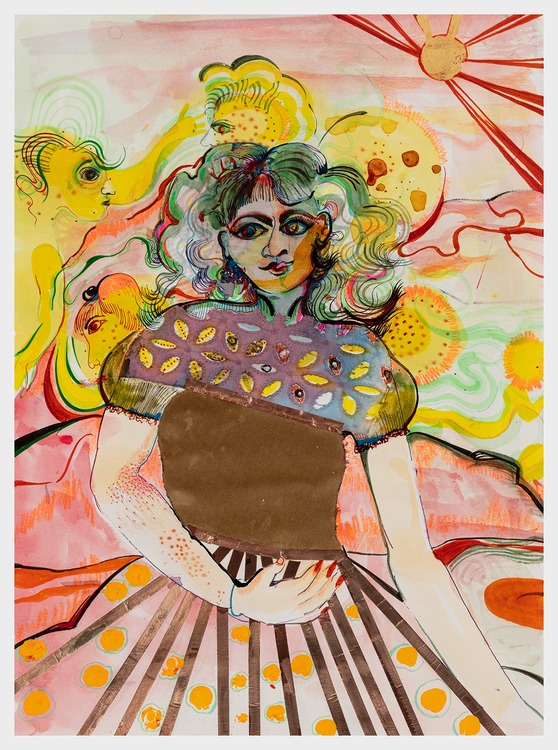 Rina Banerjee, Garish and Golden (2021), Photography © Etienne Frossard.
Palmer: ‘Discriminating taste, hallucinations of the tongue’ at the Vadehra Art Gallery sees you return to India after nearly 17 years of living in New York. What about this moment in particular inspired you to display your art in your home country after nearly 20 years? Have you found that through your diasporic experiences living in Kolkata, Manchester, London and Queens, your art has responded to changes in environment and cultural landscape?
Banerjee: My journey towards art grew out of a desire to see the world communicate its wonders across different cultures. I grew up primarily in New York City, and I have lived there for 56 years. My family arrived from London in 1970, and there wasn’t a significant South Asian community in New York at that time. The numbers were so small that if you saw someone who looked like you, you would certainly recognise the rarity of that encounter. Now, of course, many more South Asians are living abroad.
Queens, New York, is a diverse place to live; it does not reflect the rest of the country. Koreans, Caribbeans, German Jews, Italians and Irish communities are long-standing fixtures, and their presence has grown over time. Since the 1970s, the world has experienced tremendous mobility, as people travel for education and choose to build lives away from their parents and places of origin. This has created a sense of community that fosters friendships that become a family away from home.
My first experience of returning to India was when I was 20, in 1983/84. At that time, I was studying plastic engineering at Case Western Reserve University in Cleveland, Ohio. In Delhi, I remember being enchanted by the sheer volume of artistic expression, from the villages to the cities. The USA wasn’t like that then, nor were globalisation, diaspora and immigrant identity part of the conversation.
The depth of engagement with natural materials, and the ingenuity with which people used them to develop complex methods of making, building and crafting, along with the sophistication of the results, had a profound effect on me. Returning to Cleveland gave me a fresh perspective; it taught me that art and science are intertwined, just as craft and engineering are fundamentally connected. They all draw on the human impulse towards application and discovery.
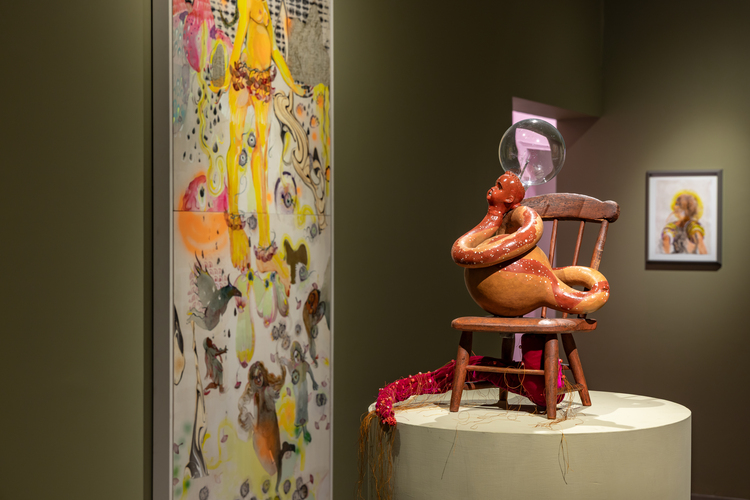 Rina Banerjee, ‘Discriminating taste, hallucinations of the tongue’, Installation View. Image courtesy of the artist and Vadehra Art Gallery
Palmer: One of your characteristic hybrid sculptures, Heredity, is included in this exhibition. You have described your process of discovering and choosing your sculptural ‘found’ objects as a “selective process” – how does this process play out? Where do you go to find these objects for your sculptures? Through these unexpected combinations, have you found that displacing and rearranging these quotidian objects allows you to explore new objecthoods, meanings and purposes?
Banerjee: My sculptures evolved towards a method of making that involves collecting what already is in the world of traded objects and materials. Through unexpected combinations of found objects, I seek to raise spiritual, historical and socioeconomic questions, drawing us towards a better understanding of ourselves. I am curious about how divisions between people are constructed, and how our language and culture create binaries and distances between races, cultures, genders, classes and geographical locations.
One such sculpture, “Heredity in Variation …”, stands tall in the exhibition: a camel dressed in brass-yellow chain-link armour, with a human face. I was interested in work that would help us understand and accept that our origins are ancient and multiple in nature. The camel’s journey, and its stamina to travel long distances without food, with water stored on its back, speaks of diaspora. I believe the awareness of our connections allows us to acknowledge our humanness.
The other animals, the giraffe, elephant and rhino, are blue-pigmented, silver-leafed, and jewelled figures whose existence is threatened by extinction. The aesthetic of my materials in both my paintings and sculptures often has a handmade element, as I have observed in the preserved traditions of India, Asia, Africa and the greater East. I am not a craftsman who strives for the machinery’s perfection. On the contrary, I explore how the handmade, with its specific character, appeals to the eye and evokes intimacy in our relationships with one another and across cultures.
Our representations and others exist through Western domination, constructing a rosy picture of the West and its achievements, past and present. These are buttressed by a colonial culture of misinformation, embellishments and erasures that particularly does a disservice to women’s experiences. The disregard of women’s making of the world is, in effect, the most cloaked magic act I have seen.
Palmer: The title of this exhibition, ‘Discriminating taste, hallucinations of the tongue’, is a provocative declaration, which challenges the ubiquity of human senses, particularly taste. Throughout your career, you have traced colonial history through taste and how our understanding and representation of this sense constantly navigate pleasure and consumption. What initially drew you to use this subject to shed light on the colonial narratives that permeate today’s representation of Indian culture? How closely linked are ideas of authenticity to the representation and perception of taste?
Banerjee: When we see, hear, taste and feel something, we believe it natural and honest, so there is no examination. We accept it as part of our making and believe it is not learned. This is a mistake. What appears natural is not always so. Racism, sexism and hatred can be so embedded in a culture that they escape our critical scrutiny.
I am also aware that communicating what good and bad taste is gatekeeps taste, class distinctions, cultural or religious distinctions, and separatist strategies that define demographics. I am interested in subjects that don’t pass taste markers and continue to exist flamboyantly.
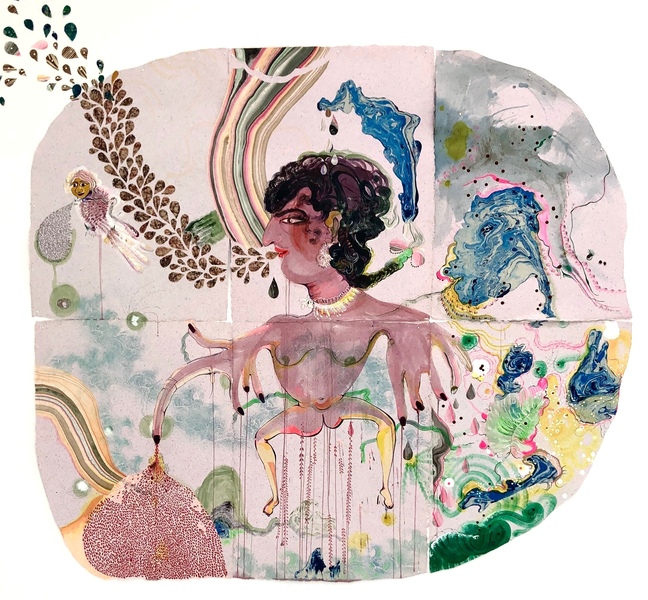
Rina Banerjee, A Myriad Voices (2019), Courtesy of the artist.
Palmer: Do themes of the uncanny influence your painterly process, especially through reimagining womanhood? In works like Garish and Golden and The Tree Flowered, the colourful, captivating worlds of these female figures feel at once secure and pastoral, while also isolating, unsteady and unfixed. Does this juxtaposition of abundance and beauty, along with the darker undercurrents that fill these scenes, speak to the tentative, often uncertain position of womanhood in contemporary society?
Banerjee: The world women live in is both dark and ominous, and lively and intimate. I am interested in this tension: creating worlds that appear beautiful, abundant and pastoral, but also unsettling and uncertain. In scenes of neglect, the figures wander out into surreal, pastoral plains. Yet this freedom is never entirely secure. Instability is the norm, and reality is a slippery, unending path, terrorised by patriarchal powers that storm the land and hold nature itself captive. This is where the uncanny enters my work: what appears inviting or familiar can also become strange, threatening and unstable.
Palmer: Showcased at one of New Delhi’s contemporary cultural landmarks, this exhibition is deeply tied to the capital's nuanced, complex and ever-changing cultural history. How important has New Delhi been as a site to explore these colonial cycles and exchanges of taste? Throughout your career, how has the city changed, in terms of its cultural production, representation and value both nationally and internationally, and has this change affected your work’s subject matter?
Banerjee: We have not left the colonial structure. It continues to rise globally, shaping what is recognised as the height of cultural achievement, both here in Delhi and in New York. Yet Delhi also has a cultural history and architectural heritage that draws people from all over the world. People come to visit Indian architecture in and around the city. These buildings exist within a living landscape, and the trees and plants are vital to the experience. For me, this relationship between architecture, history and the natural environment is vital. It reminds us that cultural value belongs not only to monuments, but also to the life that surrounds them.
Delhi has changed, as all places do, but I feel that greater travel and exchange, increased visibility of immigration and human rights, have brought questions about the city's future and its people's right to prosperity into sharper focus. I don’t see the same sense of possibility in New York, where economic insecurity reduces people to their bank accounts, leaving so many struggling simply to get by. Here in Delhi, people speak to each other in polite, loving ways, through simple gestures, like saying good morning, sharing food and exchanging ideas. These everyday acts of connection matter to me. They offer another way to understand cultural value: not simply through the institutions and achievements inherited from colonial systems, but through how people live together and care for one another.
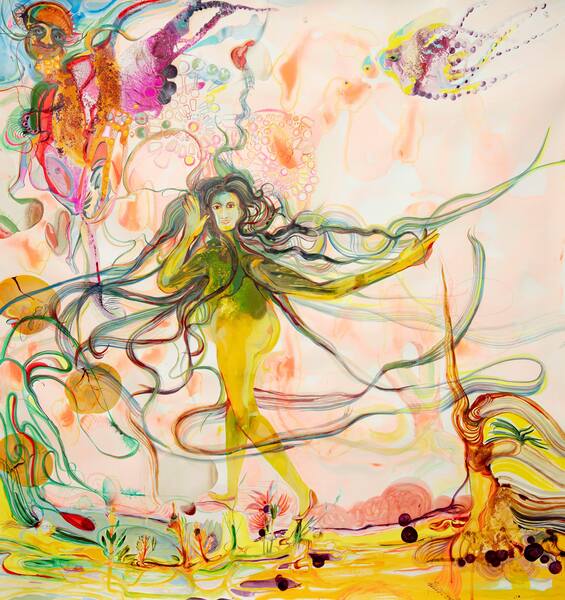 Rina Banerjee, One stands near her Ear (2026), Photography © Pat Garcia.
Palmer: Many of your works incorporate visual and cultural languages from Asia and North Africa, especially through the inclusion of Chinese silk painting and Aztec sketches. By incorporating these diverse cultural media, do you hope to challenge a Western art-historical pejorative that homogenises non-Western art into a single category?
Banerjee: I learn from and enjoy connecting with African, Asian, Australian, Mayan, Aztec and Oceanic cultural practices. They inform my mark-making and how natural materials and ingredients come together in my sculpture’s assemblage. I am particularly interested in dyeing and weaving technologies, especially the use of knots. These cultures conversed with one another long before Western occupation and expansionism disrupted those exchanges. We traded. We saw each other.
Palmer: Why showcase only 28 works from the latter part of your career (2008-2026)?
Banerjee: The works came together to explore taste. The rooms are intimate, residential in scale, allowing the works to rest in intimacy with the viewer.
Palmer: Several of the paintings on display have these very humorous and almost satirical titles, e.g., Decisions were a snap, and She Had Guts! What is the process you undergo when titling these works? Is there a reason behind the wittiness of these titles?
Banerjee: Humour comes through all the works, and it is transparent in the titles. There is a level of surprise in seeing a decisive female who may have strength … guts, as we say. There is an absurdity in the stereotypes that continue to haunt women, even as they navigate domination and the disrespect with which they are treated. I create titles that make me laugh and release the knots, allowing me to laugh at the aggressions women experience, whether small or large. These aggressions arrive as a continuous barrage of dismissive, ground-level attacks on our humanity, intended to diminish our worth and price. Humour allows me to expose the absurdity of these attacks without surrendering to them.
Palmer: After the conclusion of the exhibition, what comes next? Do you take a break after each showcase, or are you already beginning your next project? How does each project initially begin? Where do your ideas come from, and how do you let them percolate?
Banerjee: Projects overlap and build over time, speaking to one another through their content. My next project is with Grounds For Sculpture, a unique museum space in Hamilton, New Jersey. I am curious about its name. The word “grounds” led me to think about land as something claimed, owned and cultivated, and about the colonial histories embedded in those ideas. I also began thinking about the groundskeeper. The work I am commissioned to make will contemplate harvesting, hunting, gathering and commerce, including the trade in spices, animals, people, plants, medicinal plants, bitters and hair, as well as many other things that come from the earth.
My thanks go to Rina Banerjee for taking the time to discuss her work with considered, astute introspection and the Vadehra Art Gallery for hosting this latest exhibition of Banerjee’s work.
Discriminating taste, hallucinations of the tongue’ runs between October 28 – November 18, 2026, at the Vadehra Art Gallery, New Delhi.

Grace Palmer
Grace Palmer, an art historian and writer, specializes in the history of contemporary art and 1960s New York performance art. She contributes to Whitehot Magazine and is currently located in London, England.
view all articles from this author