Whitehot Magazine
October 2026
"The Best Art In The World"
"The Best Art In The World"
October 2026
Carlota Pérez de Castro Builds Her Paintings from the Ground (and Body) Up. Here’s how.
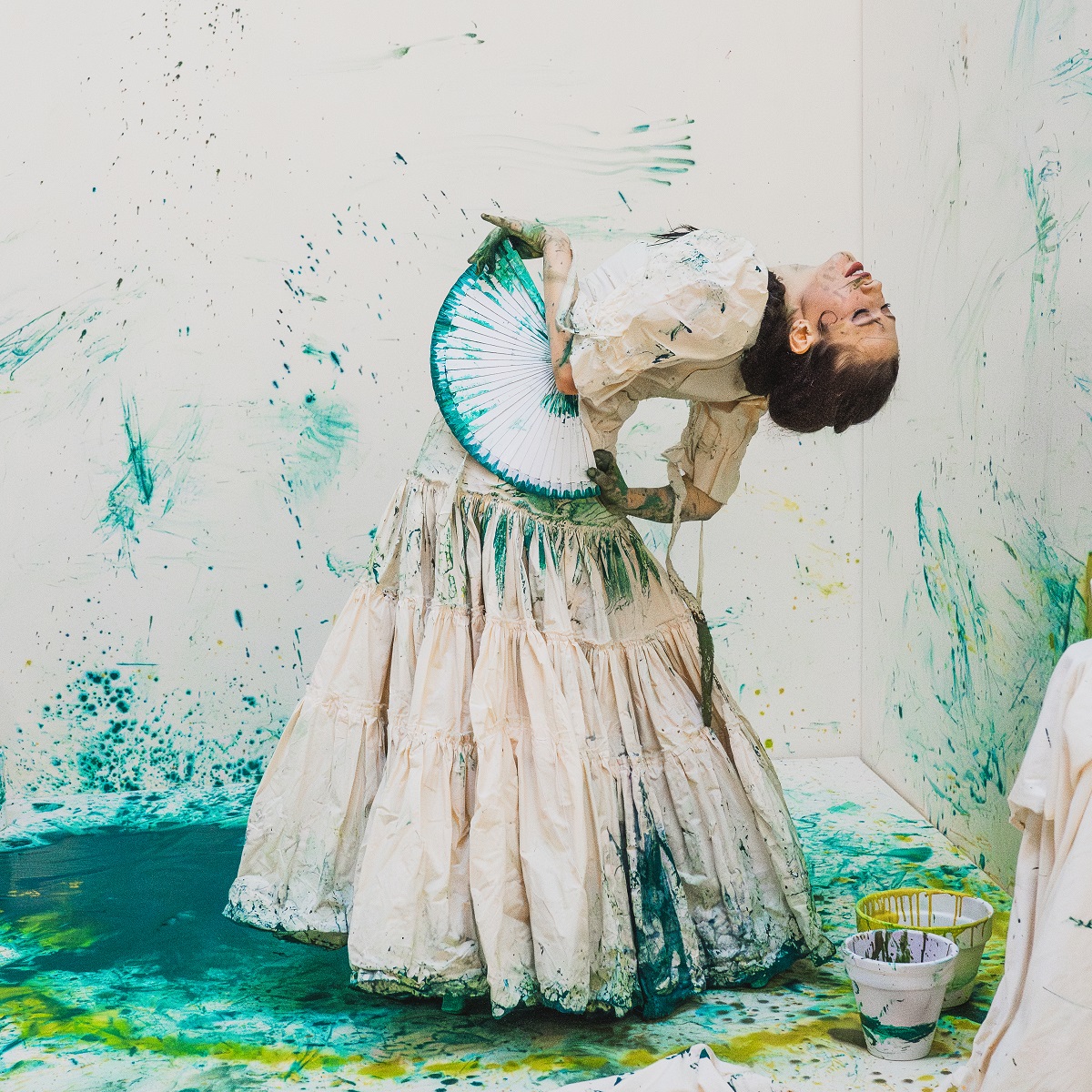 Carlota Pérez De Castro La Huella del Flamenco (“The Footprint of Flamenco”).
By LAURA DE REMEDIOS August 14th, 2025
Spain’s artistic history runs deep: centuries of brushstrokes, color, and rebellion have shaped its cultural soul. Carlota Pérez De Castro’s (Madrid, 1998) lineage is woven into that very fabric. For every era of Spanish art, someone in her family has echoed its voice: painters, designers, theorists, and visionaries.
Now, in this era, we speak with the prophet herself. Only this prophet doesn’t want to lecture us, doesn’t want to guide us anywhere, because she doesn’t think she knows better. Instead, she wants to play. She wants to paint on your skin, dance on the canvas, and let a single line carry the weight of a whole self. She wants to blur the border between artist and artwork, between pride and instinct. “I think you have to keep your ego in check,” she says, “and try to create from a place of honesty.”
We spoke over the phone, each of us melting from our corner of the Spanish summer like proper Spanish girls. Despite the similar, heated and humid climates we spoke from, and the minimal distance the Iberian Peninsula allows, it was her warm way of speaking that made her feel close.
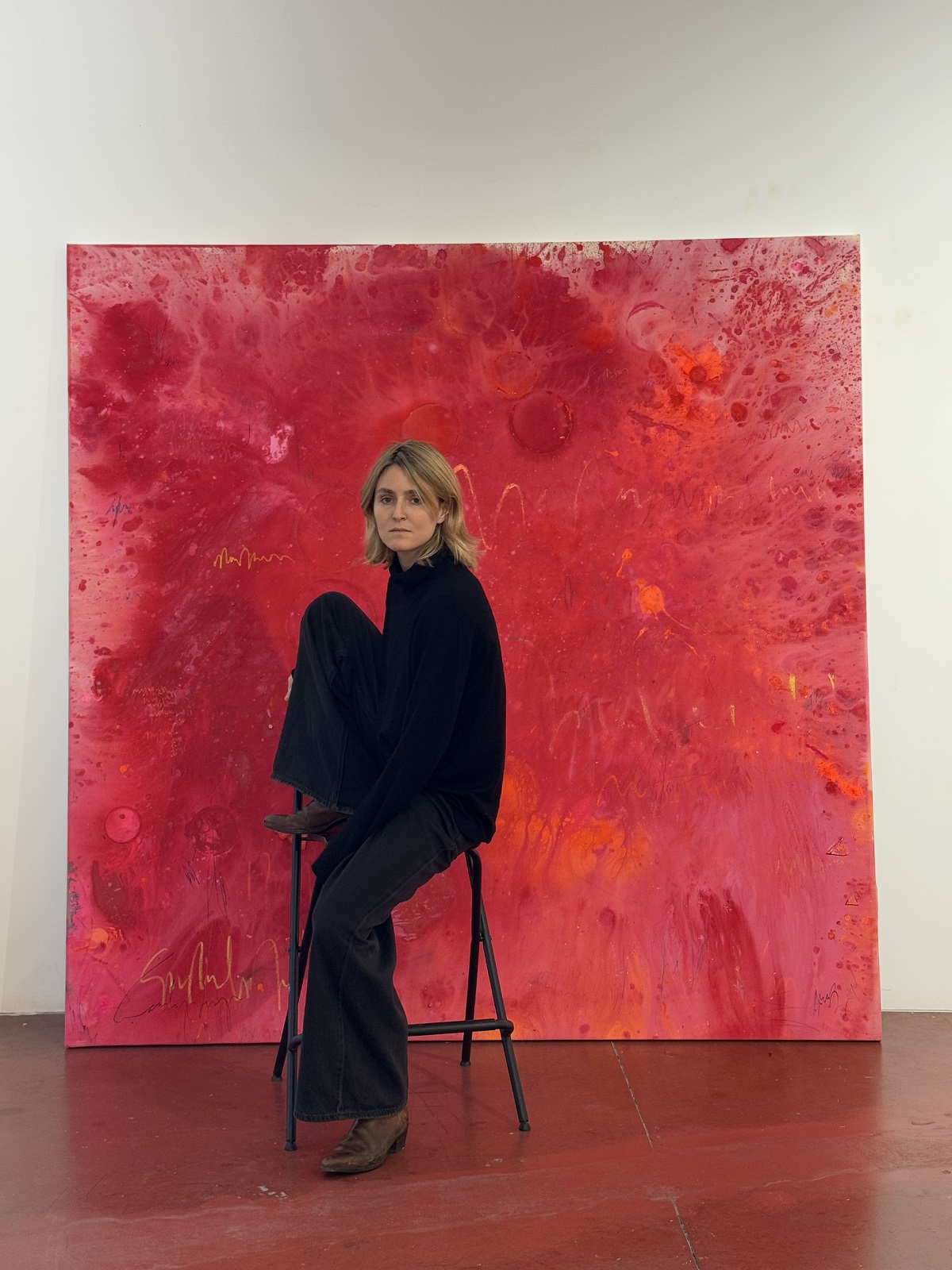 Artist Carlota Pérez De Castro
We talked about her latest series, La Huella del Flamenco (“The Footprint of Flamenco”). In it, everything the Forbes 30 under 30 honoree stands for as an artist seems to converge: the unpredictability, the vulnerability, the celebration of culture, the colors, the movement, the performance. The series is part of her wider, ongoing project Danzar la Pintura (“To Dance the Painting”), which she envisions as a global endeavor to eventually trace through paint and performance the physical memory of dances from cultures around the world.
The process, she explains, unfolds in three parts.
Stage one: The order before the chaos
It begins with the palette. For over a year, Pérez de Castro immerses herself in a meticulous study of color: which hues reflect the essence of flamenco, which capture its emotional weight, and which can coexist without collapsing into discord. The goal, she says, is simple: “to avoid that dead, muddy brown.” In practice, it’s anything but. Through dozens of test paintings, she refines a set of roughly ten pigments, a palette whose internal chemistry guarantees tension, harmony, and surprise. It’s a pivotal, patient, and iterative stage, albeit often overlooked amid the drama of what comes next.
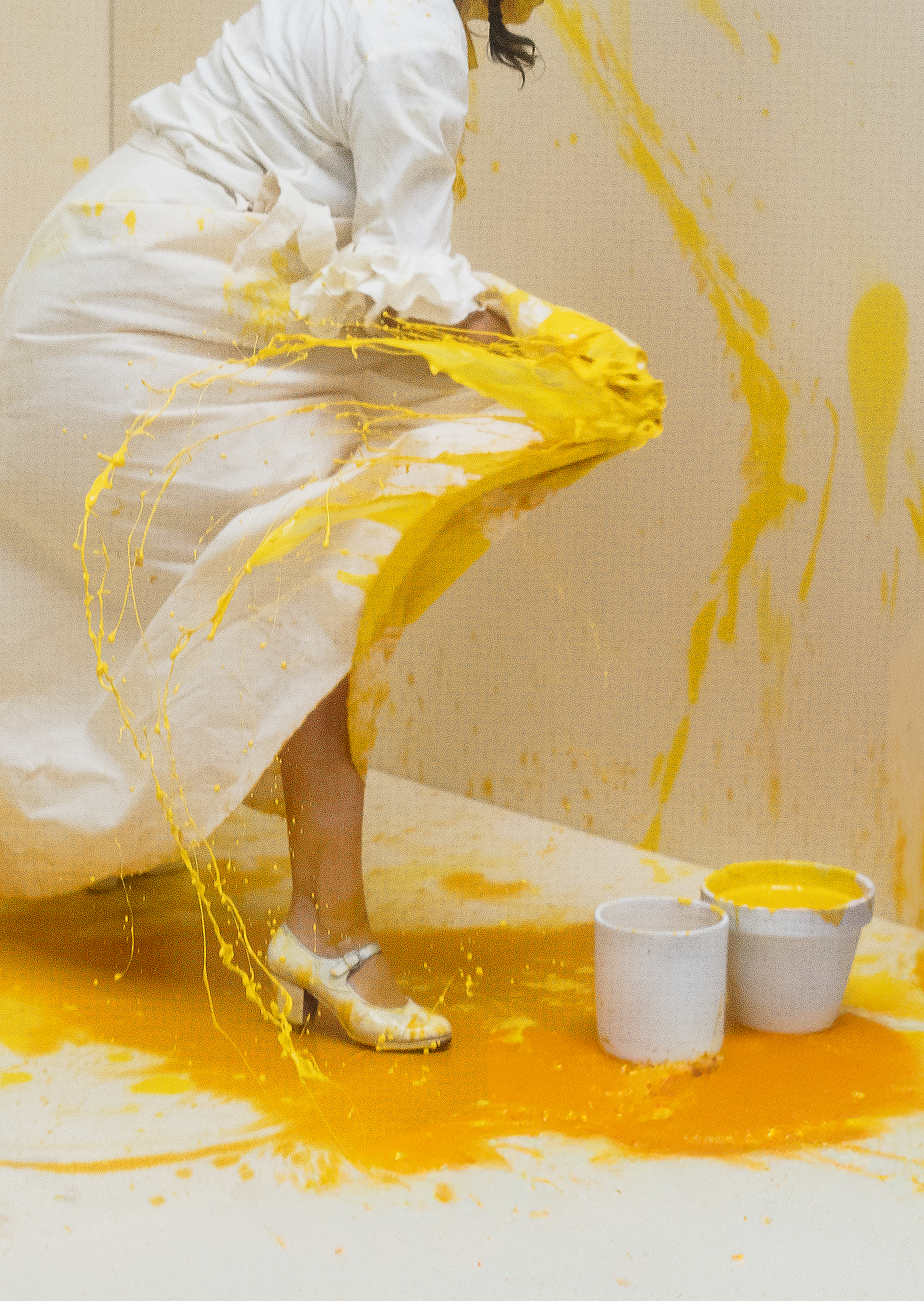 Carlota Pérez De Castro La Huella del Flamenco (“The Footprint of Flamenco”).
And yet, the palette is deeply emotional. “It comes from a very intuitive place,” she explains. “The day you feel sad, you wear black. The day you wear a thousand colors, you’re full of energy.” In La Huella del Flamenco, that energy is vibrant. But in another series, Empatía, where she reflects on the absence of empathy, the color shifts: “They’re more melancholic. A bit darker. The performance, too, feels more tragic. Not because I decided empathy is tragic, but because, naturally, the color palette reflects the theme being explored.”
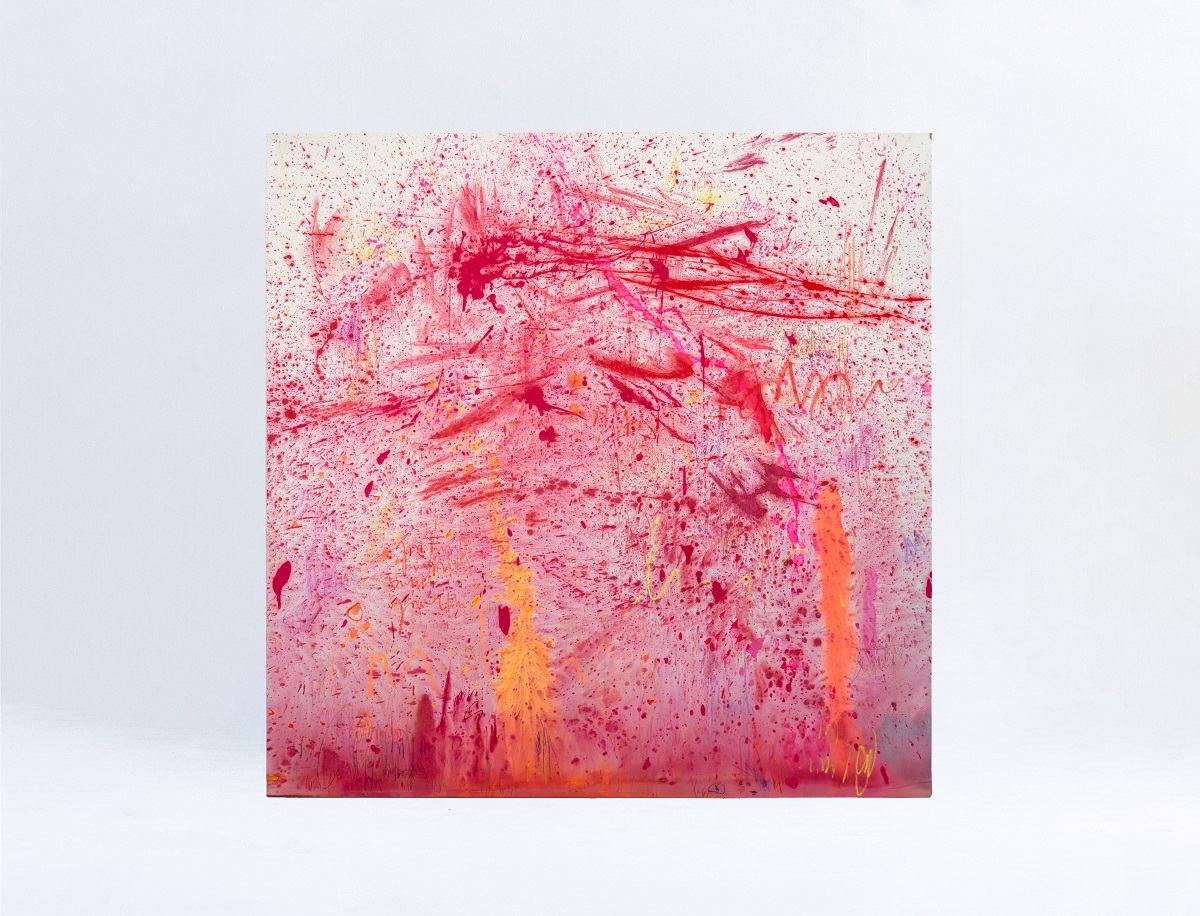 Carlota Pérez De Castro La Huella del Flamenco (“The Footprint of Flamenco”).
Stage two: The Flamenco begins
The second phase shifts in tone and tempo. With the paint prepared and the canvases laid out, the studio becomes a stage. Dancers enter. Feet dipped in paint, limbs dragged across raw canvas. The work unfolds in real time, and the painting becomes an imprint of a performance.
Here, Pérez de Castro steps back. Where others intervene, she withdraws, not as a gesture of control, but of release. “It’s an act of absolute humility,” she confesses. The palette, the space, the atmosphere; all are deliberately constructed to allow for something unpredictable to unfold.
“My technique,” she explains, “is like a cocktail of Helen Frankenthaler and Cy Twombly.”
From Frankenthaler, she borrows fluidity: “My painting is very watery, almost like watercolor. It loses control. That’s the intention: fluidity, change, freedom. In a world full of control, the moment that watery pigment hits the canvas, it becomes completely uncontrollable. And to me, that’s a beautiful metaphor for life. You can guide it, but you can’t control it. You work with what life gives you.”
From Twombly, she takes rhythm, gesture, and sound: “It’s like a dance between automatic writing, where I’m kind of talking to the painting, and automatic painting, where words disappear. I’m trying to communicate something that can’t be said. I have an emotion, an intention, but words don’t come. So I send it through a gesture.”
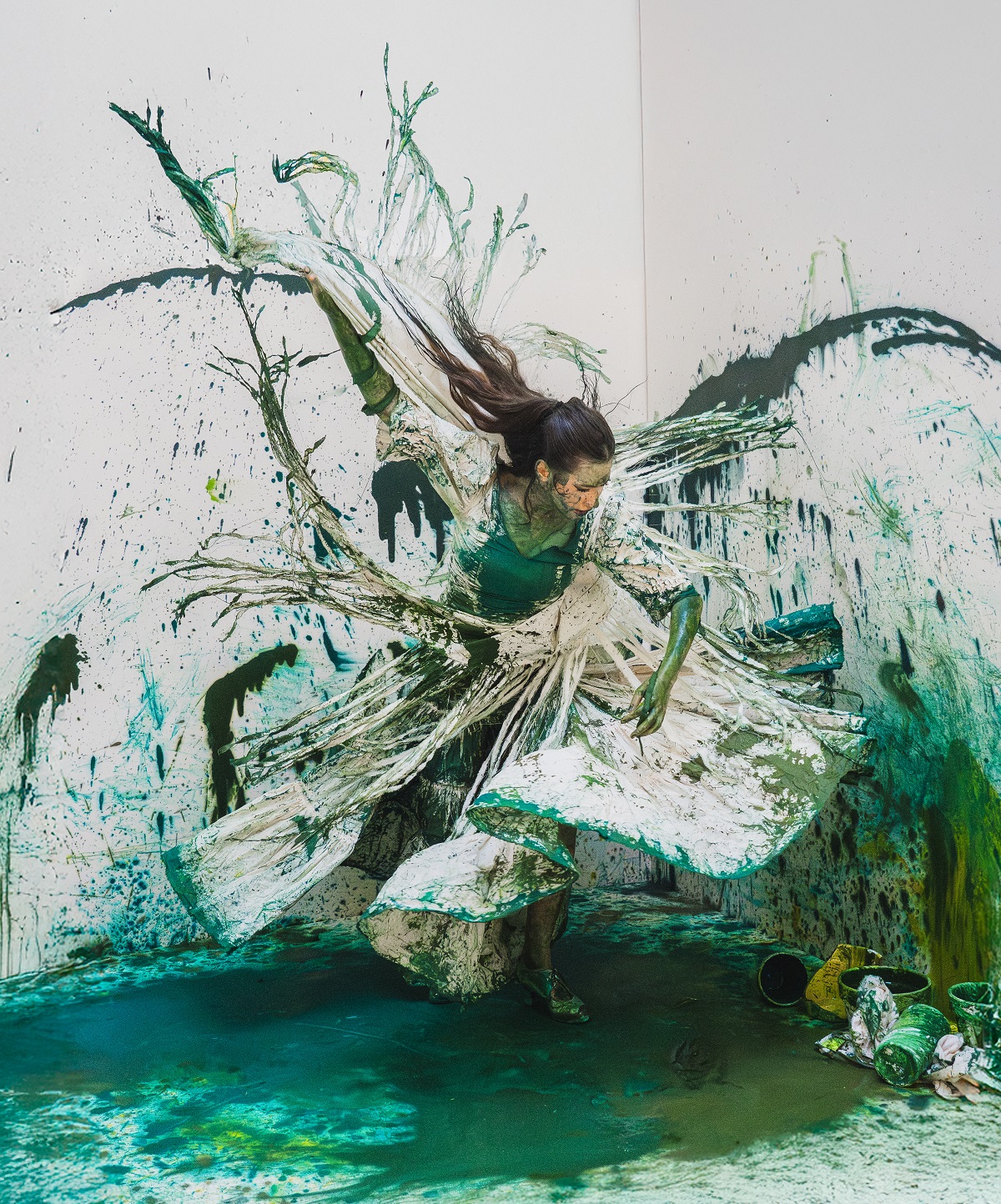 Carlota Pérez De Castro La Huella del Flamenco (“The Footprint of Flamenco”).
Stage three: Final emotions and reflections
This last Twombly-esque aspect takes form in the third and final stage, when she returns to work. The performance is over, but the energy remains. She adds her own layer, sometimes reactive, sometimes instinctive, and allows the work to take its final form. It’s not about correcting what the dancers did, but responding to it. Some are lightly reworked; others are left untouched. She doesn’t force a conclusion. Resolution, like the rest of the process, arrives on its own terms. Until then, it can take months before you’ll see it exposed in a gallery. Art, like dance, works best at its own rhythm.
The result is the immortalization of these performances: abstract compositions born out of movement, tension, and collaboration. La Huella del Flamenco doesn’t try to capture flamenco in any literal sense. Instead, it considers what it means to leave a trace: of gesture, of culture, of presence.
It is reminiscent of what the referent artist Twombly once said in a 2011 interview for The New York Times: every line he made was “the actual experience” of making the line, adding: “It does not illustrate. It is the sensation of its own realization… It’s more like I’m having an experience than making a picture.” Similarly, Pérez de Castro’s don’t depict a dance; they are the dance. Whether from a dancer’s foot or her own hand, each mark is a residue of an experience, lived and felt in real time.
Her practice, in many ways, hasn’t changed much since childhood. “I didn’t grow up with toys or dolls,” she says. “I had paint and brushes.” She and her sister would stage improvised dances, paint their bodies, and fill pages with color. For all its novelty, La Huella del Flamenco isn’t a radical invention for Pérez de Castro. It’s the grown-up version of what she was already doing as a child. Only now, the scale is larger, and the world is watching.
And among it all, a very proud Spain cheers from the front row. WM

Laura De Remedios
Lives and works in Madrid. Laura is in Politics, Philosophy, Law, and Economics at IE University with a passion for music and the art of making one’s life a hotbed of creativity.
view all articles from this author