Whitehot Magazine
July 2026
"The Best Art In The World"
"The Best Art In The World"
July 2026
Conspiracy Unmoved: Review of Obscura, The Compound, Baltimore
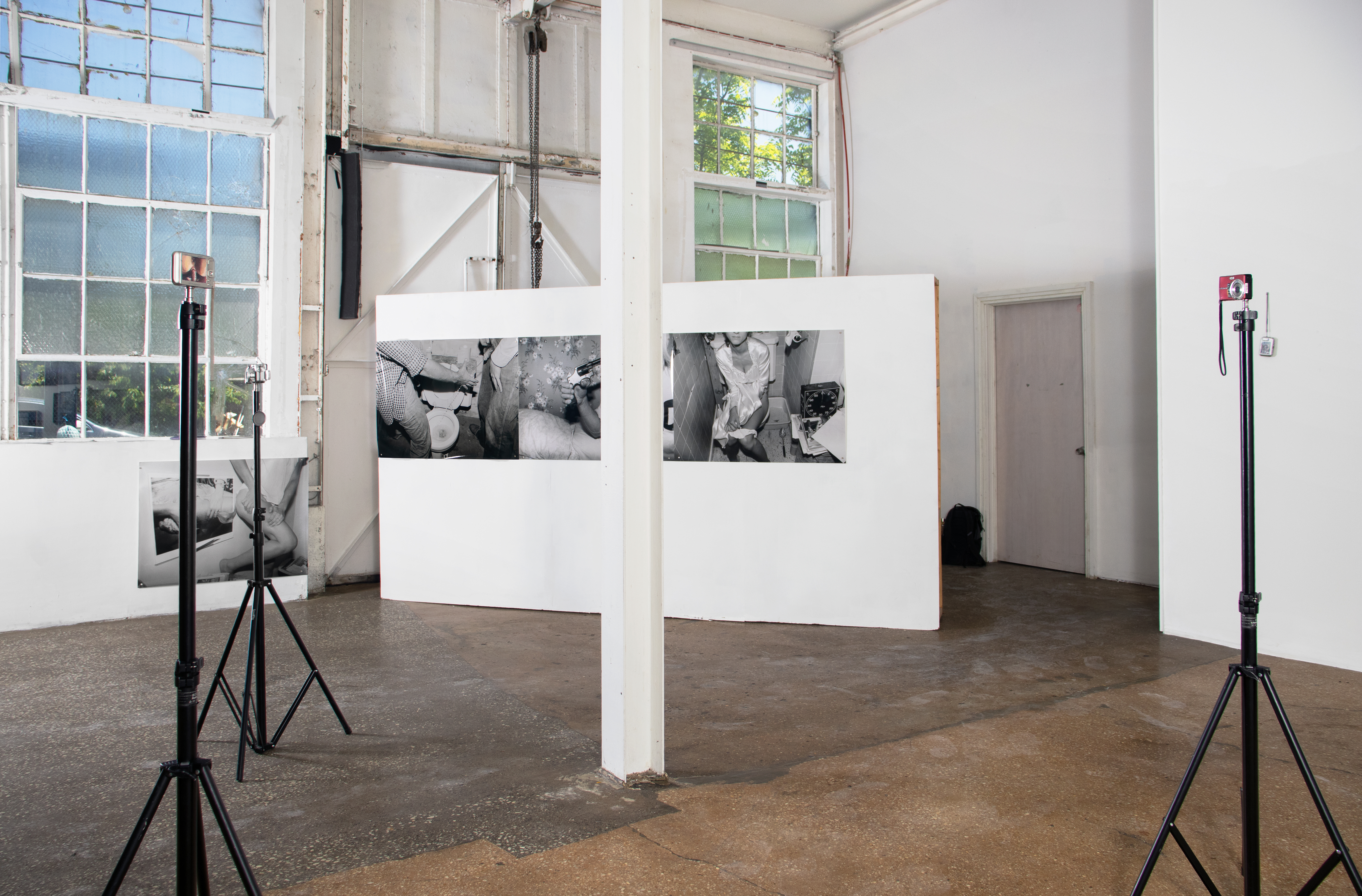 Installation shot of exhibition Obscura; courtesy of The Compound, photo by Kristofer Heng.
BY RUI JIANG May 29th, 2026
How the perpetual absurdity among intimacy, the everyday, and otherworldliness gently conspires through the grinding rotation of the lens, secreting within still life an undercurrent of flirtatious and lingering accidental affect, alongside the thrill and déjà vu brought by voyeuristic sensation. Scattered with a layer of public-domain luster, the exhibition Obscura smiles discretionarily within covert yet glaring viewing instructions, slowly appearing matte or gleaming, mischievously rehearsing the real and unreal, unwilling to stop before inducing dizziness. Before the silver shine, you hallucinate the murmur of machinery; the scraping sound of abrasion cannot be ignored, intermittently stirring something from within still life.
Obscura is on view in the gallery on the first floor of The Compound’s main space, hanging low beneath the high ceiling. Curated by Kristen Landsman, featuring Marnie Ellen Hertzler, Michael Northrup, and Landsman herself. Large black-and-white oily photographic prints are selected from Michael Northrup’s extensive archive; his lens always carries an uplifted excitement and enthusiasm, greeting ironic moments perfectly and coincidentally composed by the sky, earth, and human figures, then deeply imbued with a humorous emotional hue through long exposures. The gallery floor space is roughly divided by three of Kristen Landsman’s cameras, tripods, and paintings on screens, standing upright, lenses facing the viewers, while a walk toward the back of the cameras reveals explicit, intensely intimate paintings covering the screens of the otherwise dilapidated cameras. Marnie Ellen Hertzler’s Frog Hollow series resembles the backstage of a dismantled dream: mist-shrouded and serene. From the original moving image she extracts Frances, the purple bob-haired girl from an AI-driven robotic system, alongside sentences from the simulated spiritual world within personality archives generated through repeated linguistic commands.
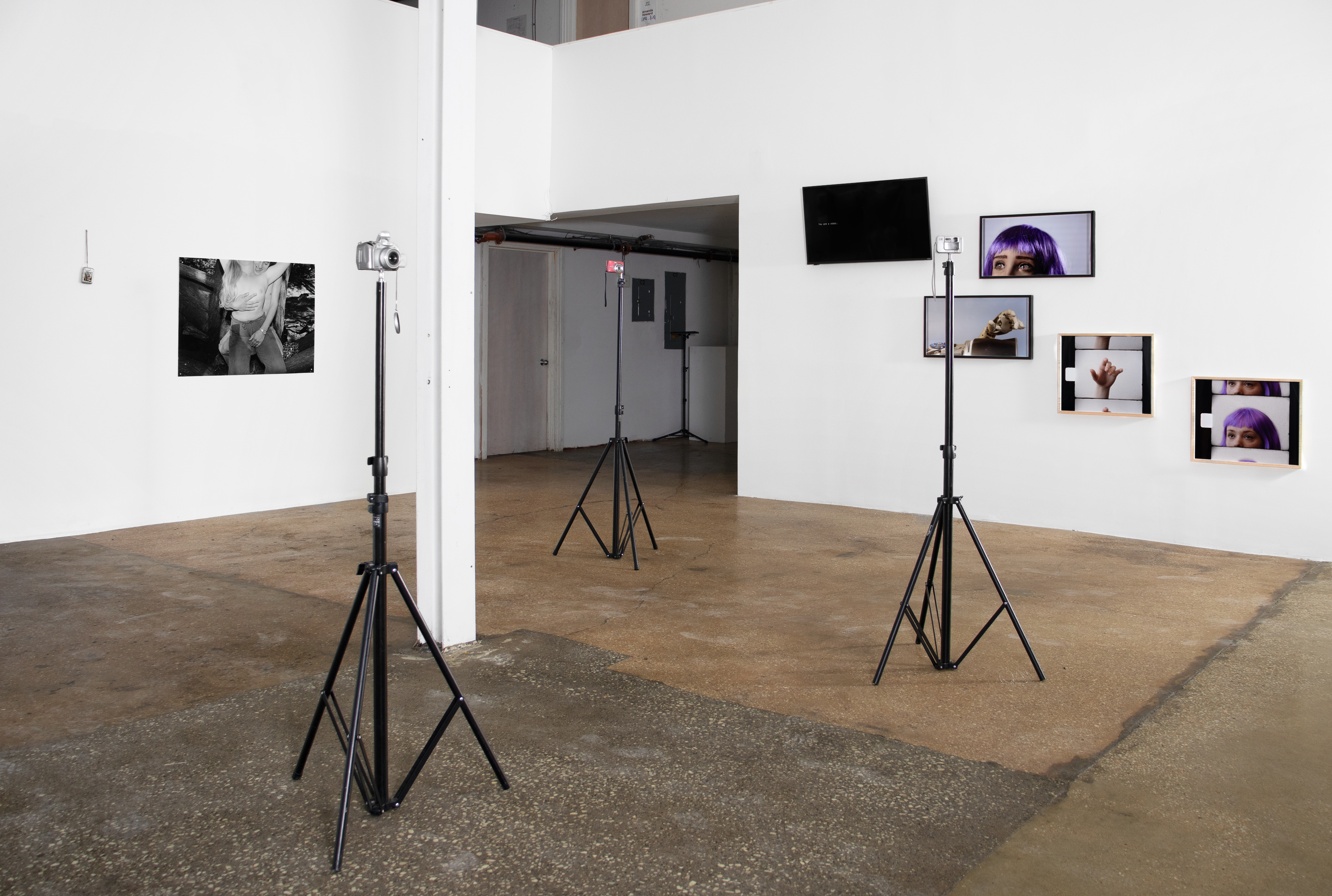 Installation shot of exhibition Obscura; courtesy of The Compound, photo by Kristofer Heng.
Because the gallery simultaneously functions as one of the passageways for artists with studios in the space, the glittering, elusive generated becoming and exquisite eroticism quietly stored there especially resemble a mistimed shot. Hurried figures pass through unguarded, as though entering from the fourth wall into the first three, nervously threading themselves among the slender camera tripods.
Image-making suddenly becomes intuitively unsettling; the entire space bodily pulls one into a viewing trap. The omnipresence of lenses authoritatively shapes an apparatus of viewing behavior in an instructional manner. Marnie Hertzler uses harmless and gentle directives to imitate the visual loop of generative processes, while each sentence extracted onto black screens conspires toward an extreme conclusion: when personality, emotion, and inner activity can be endlessly rehearsed through linguistic templates, visual structures, and technical programs, reality itself no longer exists prior to simulation, but directly exists in the form of simulation. Frances’s solitary monologue, delivered word by word, emerges in a cacophony of predefined personalities and directive emotional language, evoking a sense of melancholy toward this intricate specimen that is the self—when intimacy can be system-generated, have humans long since grown accustomed to experiencing one another through mediated scripts? Instructional learning is intimate; regardless of the learning object, the evidence is conclusive and wholeheartedly devoted.
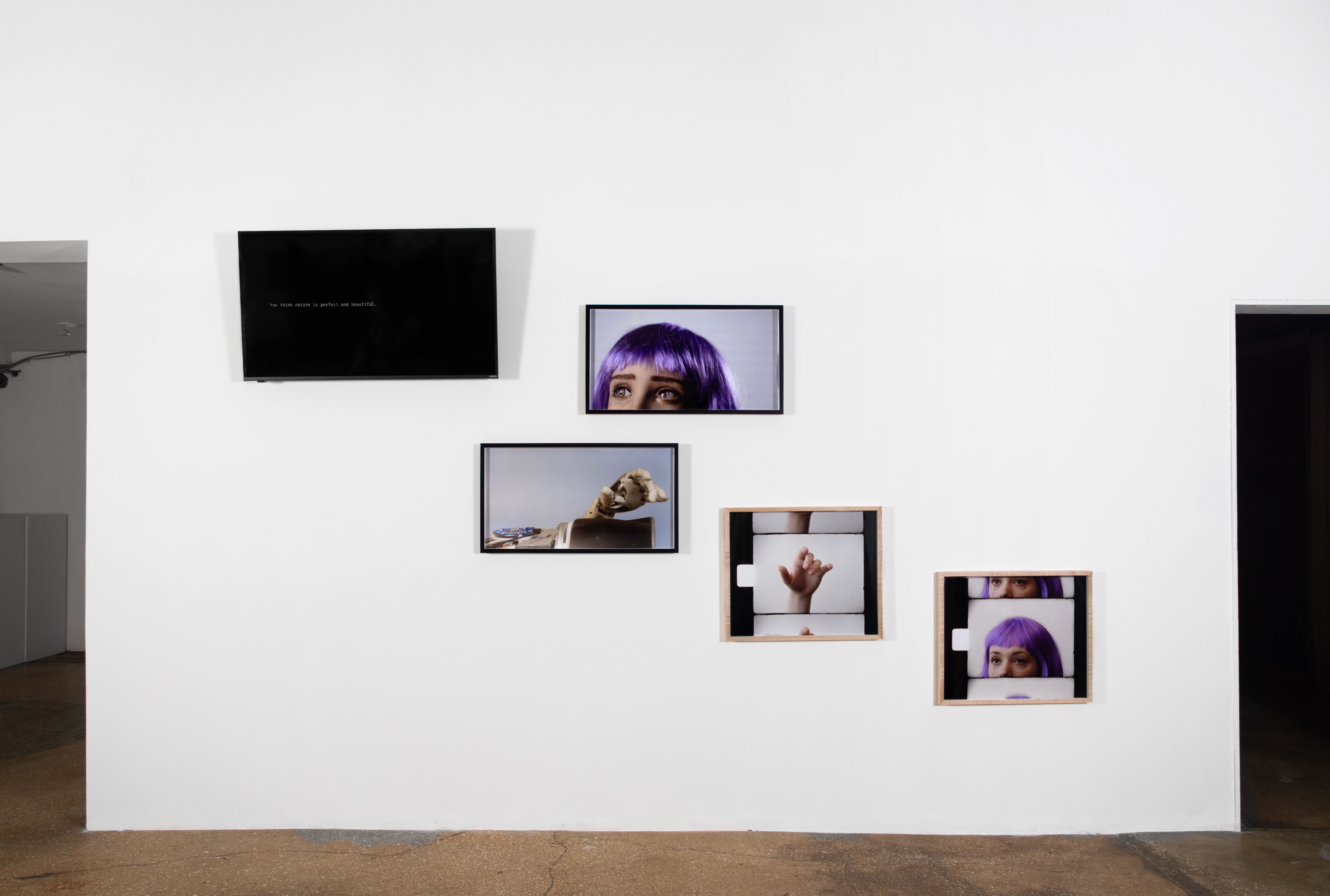
Marnie Ellen Hertzler, Primer, 2026; exhibition Obscura; courtesy of The Compound, photo by Kristofer Heng.
Landsman’s digital camera installations, having lost their original functions, therefore become especially subtle. Once they cease normal operation, they instead expose their essence as interfaces of desire. The relationship among screen, lens, storage, and viewing sinks into a malfunctioning compassion, growing burrs from overheated heads, lying in wait for the viewer’s expectations of seeing. The lens has always been, in every sense, a slowly proliferating surface. Here, paintings tightly attached onto the lens screens create a suddenly disoriented experience; through the intervention of another medium, they aptly touch upon the theoretical joke of private photography as well. Her camera-screen paintings similarly lightly scrape intimacy from the fabric of life, and through exposure-to-the-public, storage, and “playback,” tiptoe into the camera obscura too, leaving affective residue upon metal surfaces—a viewing impulse that still continues.
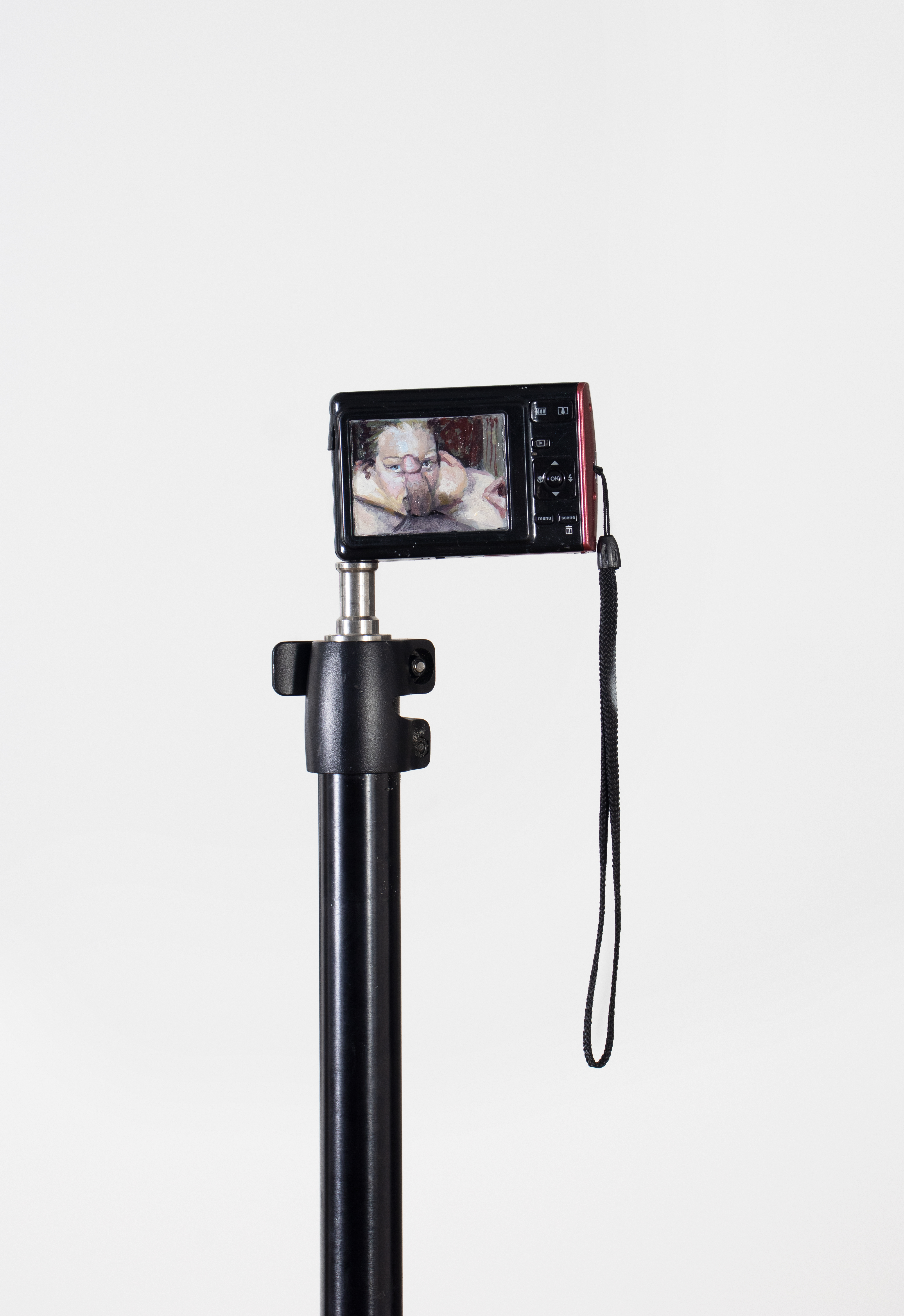 Kristen Landsman, Tea Bag, 2026; exhibition Obscura; courtesy of The Compound, photo by Kristofer Heng.
Northrup’s photography more closely resembles an ongoing flirtation and shared duration between humans and apparatuses. Thus those extraordinary moments of disorder and imbalance, instead of alienating strangeness, acquire a rare and approachable skin texture. He adeptly wanders within the accidental possibilities permitted by the camera’s program, allowing exposure, displacement, prolonged duration, and blur to become ways for reality to reorganize itself. Intimacy therefore is no longer merely an excess outside the lens, but is instead born precisely within daily relations reorganized by the apparatus itself. Vilém Flusser once pointed out that photographic apparatuses induce humans to act within the executable range of their programs. Those movements, expressions, and lights suddenly captured by the lens preserve, between fate and human intervention, a fluidity not yet stabilized, rippling into harmonious, staggering water patterns.
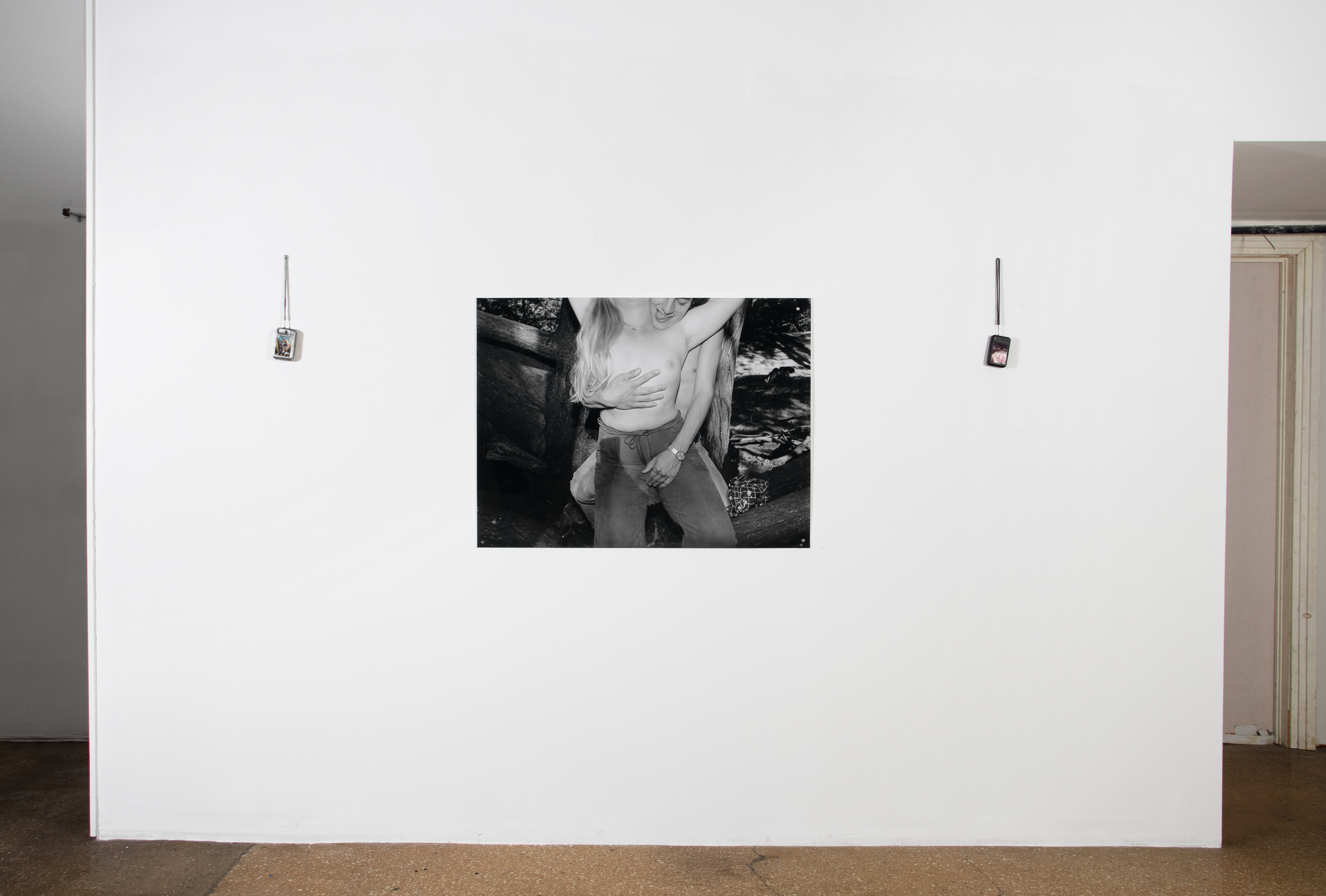 Michael Northrup, Wedding Day (middle), 1976; Kristen Landsman, BJ (left), Snatch (right); exhibition Obscura; courtesy of The Compound, photo by Kristofer Heng.
The works of each artist in Obscura do not stand at opposite ends of the exhibition in clearly separated distinctions; rather, they resemble the single milky liquid, slowly swirling beneath the surfaces of lenses and screens. The mechanism of development detours through a visual training that constantly adjusts focal distance, conspiring with mediality toward the luster of intimacy. WM
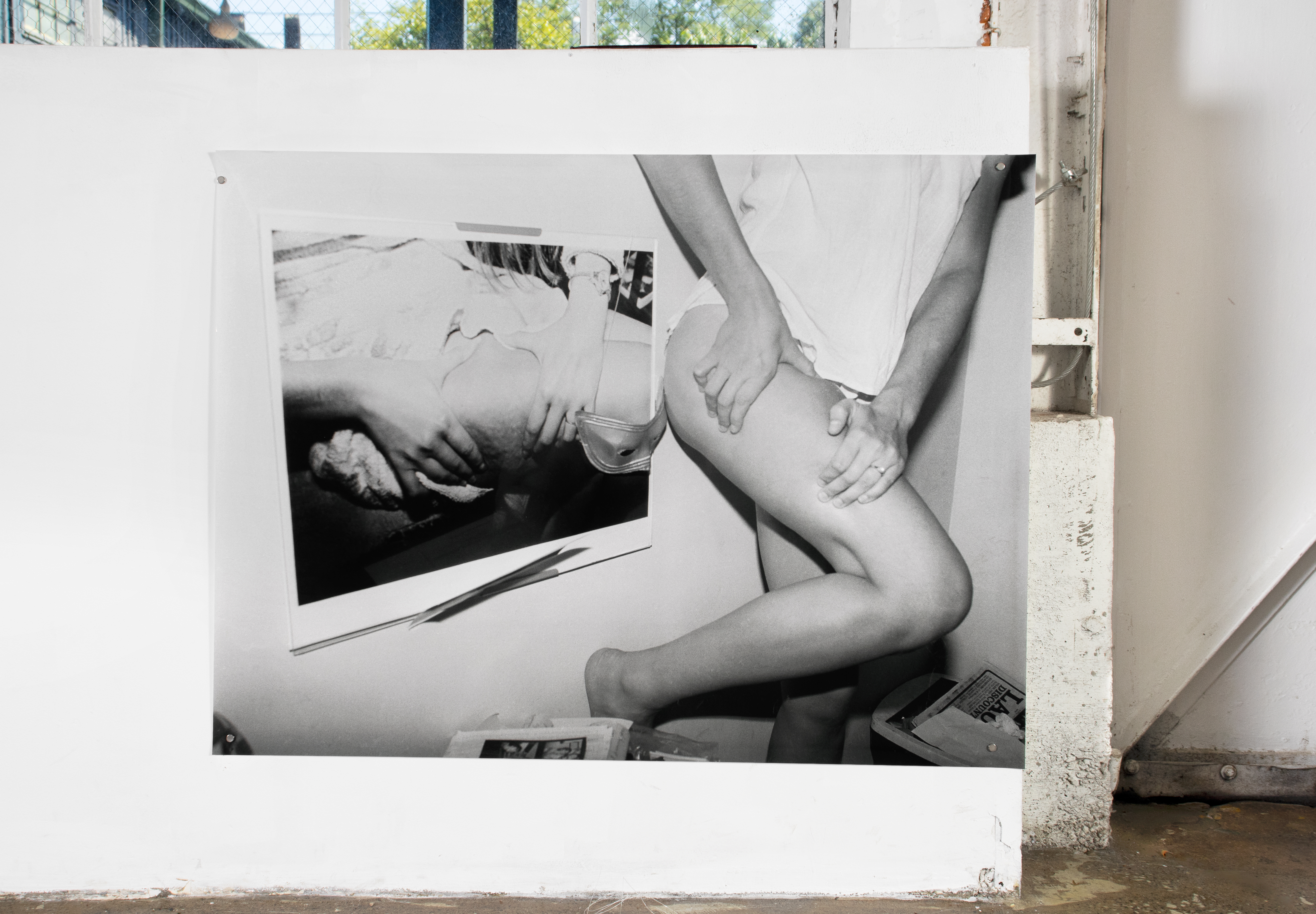 Michael Northrup, Thigh Dilemma, 1977; exhibition Obscura; courtesy of The Compound, photo by Kristofer Heng.
Obscura is on view at The Compound, 2239 Kirk Ave, Baltimore, through June 7.
Rui Jiang
Rui Jiang is a Baltimore-based independent curator and writer. She holds a Master's degree in Curatorial Practice from Maryland Institute College of Art. Her research moves between semiotics, intimate gestures, and shifting dialogues, examining how art forms deconstruct and reconstruct within a polycentric field. She investigates the tensions embedded in exhibition-making—complicity, reflexivity, and the shifting power dynamics that shape artistic discourse. Through interdisciplinary approaches, she experiments with curatorial strategies that challenge linear narratives, embrace contradictions, and reimagine the relationships between artists, audiences, and institutions.
view all articles from this author