Whitehot Magazine
September 2026
"The Best Art In The World"
"The Best Art In The World"
September 2026
Voyage into the Unknown: An Interview with Anita Glesta
By BELLA GREENBACHER September 24th, 2026 at 12:00pm EST
I spoke with Anita Glesta, a multimedia and public artist whose internationally acclaimed work explores the intersections of behavior, history, and conservation with a profound sense of empathy and curiosity. Glesta’s upcoming public art installation in collaboration with the Wildlife Conservation Society is Aqua Cosmos, an immersive project that will be projected onto the Brooklyn Bridge September 25 and 26.

Portrait of Anita Glesta
Bella Greenbacher: What were your first creative experiences and inspirations?
Anita Glesta: I’ve been an artist my whole life. I’m one of those. I’m not sure if this reflects deep existential knowledge as a child or absolute anxiety, but I remember the first time I put a magic marker to a piece of paper when I was drawing a tree and I thought: ‘this will last, and I won’t.’ There was something comforting and discomforting about that at the same time. Because I have done some public permanent art projects, one in the center of Sydney, Australia and the other for the United States Census Bureau Building, I wonder now if that would have made me feel better as an anxious child to know that there is something permanent. One thing that has been continuous for me has been balancing my interest in doing work in the public that is engaging and inspires a different way of making people think critically, and also my studio painting practice. They work together, in tandem.
 Glesta's studio with paintings "The Abstract Nakedness of Being Nothing but Human" (2025) and "Pelagic" (2026)
Bella Greenbacher: There’s a quote from you: ‘I’m interested in drawing people in and opening a space for reflection and curiosity and public engagement.’ What types of conversations do you hope your work inspires? What types of things do you want people to be curious about?
Anita Glesta: I like to say that I’m trying to make work that is aesthetically and physically beautiful and engaging, to seduce the audience into it and then to be able to be subversive. The common thread in a lot of my projects is that something will trigger me to think that it is worthy enough for me to want to dig deeper and find a form for it. This has happened time and time again in my work. I received my first public commission from the Sydney City Council in 1999, and that was in collaboration with landscape architects who were redoing a park in the center of Sydney. I was given a three-acre space and by digging a little bit into what that site was about, because work should be site-responsive, I learned that a creek began there and that the creek was named the Yurong Creek by the aboriginal group that was there. Not only did I name it the Yurong Water Garden, but I used the same sandstone that was quarried for the St. Mary’s Cathedral, which is at the site.
There was a constant dialogue between history and the existing site. I continued that trajectory of my process with the Census commission, when I was commissioned to do the seven-acre landscape of a new million-square-foot building. I immediately thought to myself: ‘I am the most non-data person ever. How am I going to wrap my head around this?’ I looked at what the history of the census was, which was basically counting people, counting animals, and identifying one’s own property. I really wanted to make a landscape that would draw attention to the diversity of the population of the United States. In addition to finding numerical symbols that represent this diversity, I thought again about the indigenous people of this country. I researched and discovered that they are one of the few groups on Earth who do not have numerical representation but instead have a counting system that is digital: the hands. I don’t remember which tribe it was that, to me, had the most poetic language form, but I wrote those sentences and pictures of them. For example, the number ‘one’ was the index finger pointed up. The number ‘nine’ was all fingers but one. I incorporated their sentences and hand painted pictures of fingers along with handpainted numerals. I incorporated the needs of the employees there, but also drew attention to the history and was a little bit subversive, because very few people acknowledge that this land belonged to the native people. That is the kind of work that I’m able to do in the public.

Animation still of UNNERVED, 2022
Bella Greenbacher: What led you to dedicate yourself and focus on the themes of cultural and environmental preservation, conservation, and diversity?
Anita Glesta: I’ve always been a political activist. These values were always a part of who I am. I felt that that is my role as an artist, without being too pedantic or didactic. I’m really interested in behavior, whether it’s fish behavior or whale behavior or human behavior. During COVID, I was really fascinated by what it means that a whole planet of people can shut down. A little something can enter into our systems and cripple everything. It came in tandem with a cardiac event that I experienced shortly after my father’s premature death and I ended up in the hospital. As I was leaving, the electrocardiologist came in and said that sometimes a rogue electrode, caused by grief or anger, can cause this. I later found that that’s been called heartbreak syndrome. Between that and Covid, it made me think that we know so little about our bodies. Because research is fundamental when I’m doing any project, I felt I needed to find a form and language for that, and I taught myself animation. I found that the University of New South Wales had an experimental media doctoral program, and I applied and was awarded a laureate fellowship to work with neuroscientists and people from various fields to learn more about this.
My mission was to see how moving image art can affect our neural system, particularly the vagus nerve. After two years of fascinating research, I created an animation called “Unnerved,” which was projected in the middle of Melbourne and Federation Square on the Australian Center for the Moving Image. It is very lyrical and very colorful, but also engages the viewer through sound. The animation deliberately causes a bit of anxiety between the sound and the visual, and then transitions the viewer into a more peaceful state. In the end, I was asked to do questionnaires with the audience.
I drew the outline of a genderless body with a brain and a heart and a gut, and on the paper people were given emoticons such as a fire, a knife, a hammer, and a feather. They were given pencils to link where in the body they experienced that feeling. I collected around 250 questionnaires, and the common response that was incredible to me was ‘I didn’t know other people felt this way.’ To me, that signaled that this work was eliciting a feeling and an understanding of the mystery of what we live with physiologically.
That is caused by emotion and the power of visual art.
That was a big, big thing for me to experience as an artist because I've always taken for granted and diminished the power of visual art, in a way. I have now given myself license to enjoy and feel that it's actually okay to paint and to draw, and to make moving images of that. That actually can be equally powerful, even more powerful sometimes, than words.
 Animation still of UNNERVED, 2022
Bella Greenbacher: How do you think public and private art installations differ from each other in terms of access and durability?
Anita Glesta: If art is in galleries, it’s about the mercantile aspect. With public installations, of course, it’s about being public and people being able to have access. I love that part of making work in the public. I have been doing this for a very long time and one of the things that I really feel is important when you're working in the public is to be site responsive, and not just plunk down an object there. I have this incredible opportunity given to me by the Wildlife Conservation Society and by ArtW, which is a women's advocacy organization, to do a work on the Brooklyn Bridge. As a New Yorker, to do a work on such an iconic place with so much symbolism for the city, is absolutely extraordinary.

Animation still of AQUA COSMOS
Bella Greenbacher: What are more examples of site responsive artworks that you've done?
Anita Glesta: My family lived across the street from the World Trade Center, and when the event happened, we eventually lost our dog. We lost a lot. I considered myself, my husband and our children to be survivors. I was invited to sit amongst the architects a few weeks later about the discussion of what would happen at the World Trade Center. As the only artist there, I kept thinking about the Guernica painting, and I thought about the actual village of Gernika. I lived in Northern Spain for a few years as a teenager, and I sent an email to a peace organization there saying ‘I’m an artist and a survivor of 9/11. I’m wondering if there’s a fragment of the bomb in the village.’ And I got back an email from the director saying, ‘We’ve been waiting for you.’ They flew me over for a few months and I met the survivors, and I spent five years going back and forth, creating a sound and video work that was at Chase Manhattan Plaza and the Chelsea White Box in 2006. Later, it was moved to Krakow, to the Museum of Contemporary Art, right next to the Schindler Museum, and then later to Beijing. It was, very appropriately, about survival.
Bella Greenbacher: You have an upcoming exhibition, Aqua Cosmos. Can you tell me about the importance of this project, and why it is important to raise awareness about?
Anita Glesta: I heard a representative of the Wildlife Conservation Society, Noah Chesnin, talk about the Hudson Canyon and I was blown away. I felt that this was magical: a phenomenon, an Atlantis, right in New York City's backyard. The Wildlife Conservation Society agreed to generously share the archives and footage of the 1925 Arcturus Expedition with me, one of the first scientific explorations of the canyon. They recognized how art can play an important role in translating science, and they had the vision to see it realized. The archives included journals by the leader of the expedition, William Beebe, who was also a native New Yorker, and the beautiful drawings by the women who were the interpreters of the marine life that was found. The 18 minute loop of Aqua Cosmos is an amalgamation of the many layers that this project is about: the pioneering women artists who were overlooked, the preservation, and a New York story. In this artwork, I am in dialogue with the women's drawings by animating some of my own interpretations and giving a new way of looking at their drawings. When it is installed on the Brooklyn Bridge, you’ll be able to walk on the fish and hear the vocalizations of whales that live in the Hudson Canyon.

Brooklyn Bridge mock up of AQUA COSMOS
Bella Greenbacher: How do you see the intersection of art and science? How do they affect each other? How can artists make a change in the environment?
Anita Glesta: Artists and scientists are similar in that we're constantly inquiring, we're constantly exploring and we're constantly discovering. We both want to know more and dig deeper. Scientists need to quantify and qualify all of their research, but we, as artists, are not limited by that. If we're good at what we do, we respect that and use it as a way to distill the essence and make an inviting experience to understand it. What I've done with Aqua Cosmos, and what I've done in my other animations as well, is give childlike qualities to the installations. I think that all adults are very happy to be treated like children. If we can engage a very childlike, wonderful, wondrous experience of this, that's what my job is as an artist.

Portrait of Anita Glesta
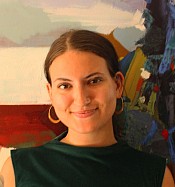
Bella Greenbacher
Bella Greenbacher is a writer, curator, and visual artist based in Brooklyn, NY. She holds a BFA in art history and visual art from Concordia University Montréal. Her work has appeared in The Michigan Daily and Concordia Undergraduate Journal of Art History, as well as curatorial work at the Bushwick Gallery. Through both writing and exhibition-curating, Bella aims to inspire in-depth dialogues surrounding underrepresented voices and topics in the art world.
view all articles from this author