Whitehot Magazine
September 2026
"The Best Art In The World"
"The Best Art In The World"
September 2026
Lynda Benglis’ Gestural Presences in KNOTTING, TYING, FOLDING at Pace Gallery
By Thalia Vrachopoulos September 27th, 2026
Spanning more than five decades of material inquiry, the oeuvre of Lynda Benglis stands as a singular force in postwar art. Benglis’ art marks a radical break from minimalist rigidity toward the establishment of an idiosyncratic sculptural identity. The artist’s development has continuously subverted and blurred the boundaries between painting and sculpture arriving at a flowing space with her unique gestural choreography. From her early glitter-infused mesh knots to the recent expressionist glazed ceramics, Benglis travelled from chromatic surface to physical mass.
As showcased in her current exhibition at Pace Gallery, KNOTTING, TYING, FOLDING, Benglis’ aesthetic serves as an essential intellectual progenitor for many celebrated postmodern trailblazers of contemporary art. Benglis’ recent work features an uninhibited embrace of surface ornamentation as seen in her sensuous pleated and folded pieces. In fact, her visceral geometries were recently translated into haute couture for Dior. Benglis demonstrates that even after an extraordinary career, her practice retains an astounding capacity to surprise, proving that her material alchemy remains vital.
Magnificent gold rays reflected from Benglis’ metallic sculptures pierce Pace Gallery’s stark white walls. As the pleated, silky-textured sculptural forms capture light, they radiate an almost sacred brilliance. Benglis transmutes heavy, unyielding gold metal into something impossibly fluid, tricking the eye into seeing a liquid metal caught mid-cascade, suspended in dynamic motion. The metallic skins ripple and gleam as if caught by an invisible breeze, converting rigid structural mesh into a shimmering drapery that breathes within the silence of space. This luminous encounter sets a transformative tone for the exhibition, which spans the period 1972 through 2024, anchored by the inclusion of rarely exhibited sand-cast glass sculptures from 1985 that further enrich her panoramic vision.
The exhibition systematically lays bare the progression of Benglis’ restless material radicalism, tracing a historical arc that continuously redefines postwar sculpture across six decades. Benglis’ journey began in the 1960s by torching pigmented beeswax onto panels before liberating color onto the floor as visceral latex pours - a body-centric process that directly confronted Jackson Pollock’s legacy.
Through the 1970s, she expanded vertically to lava-like polyurethane foam reliefs alongside wire-mesh cylinders bound into metallic, glitter-strewn knots. Beyond raw matter, Benglis harnessed early video technologies and public interventions as seen in her notorious and controversial but iconic Artforum Advertisement. During this era, she was interrogating the issue of gender and institutional patriarchy. After the 1980s, in her mature practice she sought kinetic fluidity bringing her work into the public sphere through cast-bronze public fountains and using literal water to complete her lifelong dedication to multisensory experience.
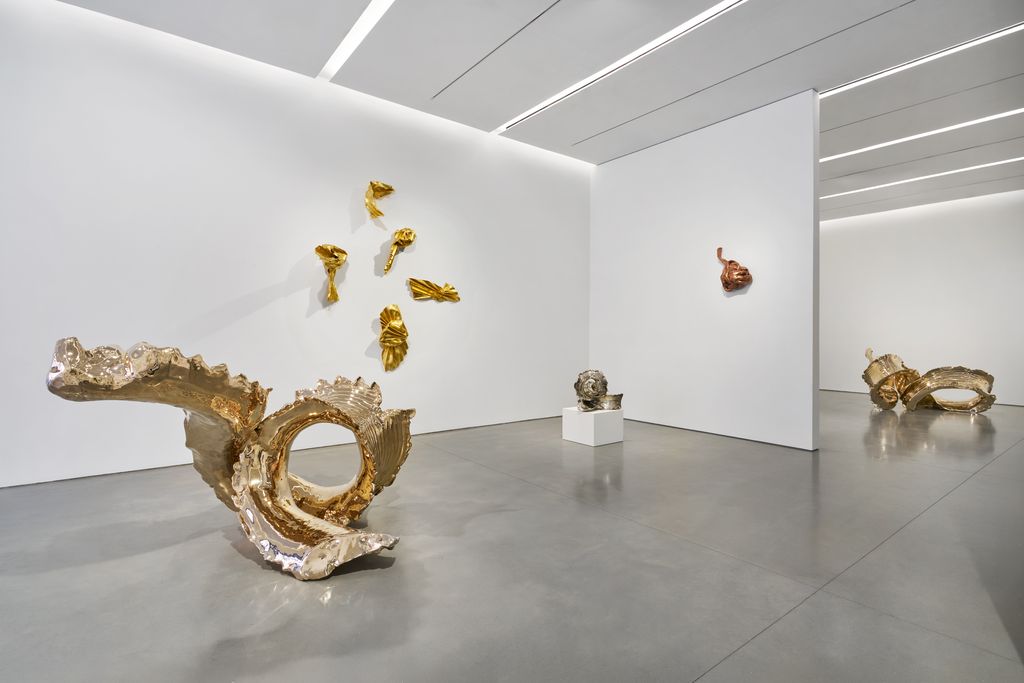 Lynda Benglis, Installation View, KNOTTING, TYING, FOLDING, Pace Gallery
In his seminal 1979 essay Pictures, Douglas Crimp compares Michael Fried’s modernist ideal of presentness (a transcendent condition of grace where a work is instantly and wholly manifest) with the kinaesthetic and transcendent condition of presence. The latter relies on a situated and durational encounter between the spectator and the object.
One cannot help but be seized by this unmistakable, almost mystical conditioning at first sight of this exhibition. The sculptures do not simply sit on view, but actively claim the surrounding air, asserting a corporeal authority before any intellectual processing begins. Weaving between Benglis’s undulating, light-refracting constructions requires physical and temporal participation. The viewer's own movement continuously activates the shifting surfaces and spatial tensions of each piece. In doing so, Benglis realizes what Crimp highlights through the words of Henry James: the presence before him was a presence, that is, a lived confrontation with an artwork that unfolds as a living phenomenon in real time.
Benglis’ monumental gold series Kutub —a title deriving from the Sanskrit word for family— channels her energy into five shimmering, torso-like forms that redefine the female archetype. Evolving directly from her wildly contorted Chicago Caryatids (1979) and her encounters with Aegean funerary steles, these pleated, wing-like works transform heavy metallic armatures into weightless draperies that breathe with rococo exuberance. The animated, tactile manipulation of metallic gold into undulating feminine contours inspired Jonathan Anderson’s fall/winter collection for Dior exemplifying what can best be understood as a numinous feminism. The female body is imagined not as passive object, but as a complex archetype simultaneously warlike, armoured force asserting spatial dominance, and goddess, as well as the Great Mother.
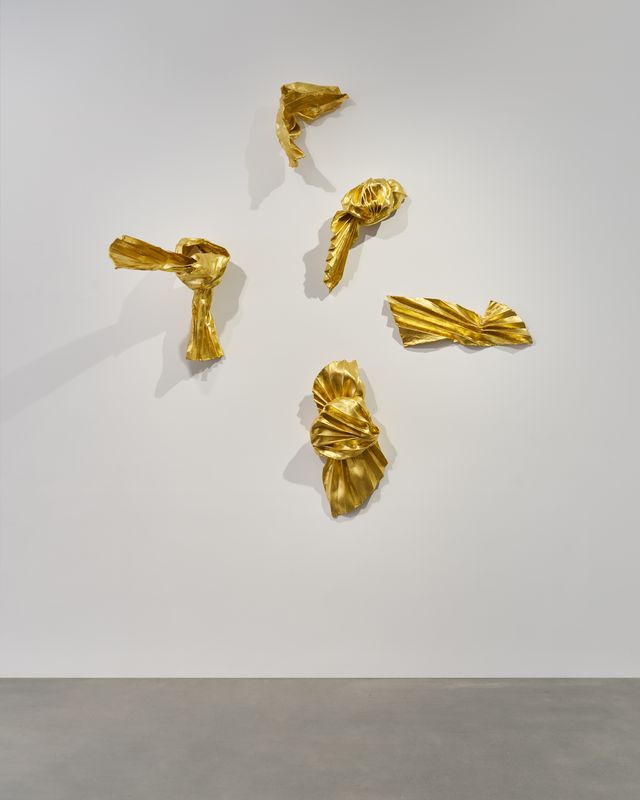 Lynda Benglis, Kutub Series, KNOTTING, TYING, FOLDING, Pace Gallery
Extending Constance Penley’s critical interventions regarding feminist resistance and popular culture, Benglis’ Kutub series reclaims the mythic and the divine from patriarchal structures. By imbuing the female form with an awe-inspiring and sacred authority, Benglis constructs a transformative aesthetic space where female power operates as both a protective, martial shield and at the same time as life-giving matrix of presence.
Ultimately, this encounter with a sacred presence remains the vital force animating Benglis’ practice across more than half a century. From her foundational break into Postminimalism and abstract biomorphism (a period that inaugurated an expansive alphabet of forms through raw latex, polyurethane, and intricate knot topologies) her art has consistently weaponized the dreamlike attributes of buoyancy and suspended motion. In previous milestone showcases, her bronze configurations translated hand-scale clay impressions into heroic, spatial markers that record the kinetic pressure of fingers against gravity.
Her sculptures consistently resist being reduced to mere digital ether or static representation. They operate as shimmering and congealed liquidities that demand our physical participation in real space. By continually entangling memory, material alchemy, and sensory experience, KNOTTING, TYING, FOLDING proves that across every decade, material innovation, and shifting medium, Benglis’s work is not merely about representation; it instantiates a numinous experience that is not just presenting art, but is, in every sense of the word, a true presence.
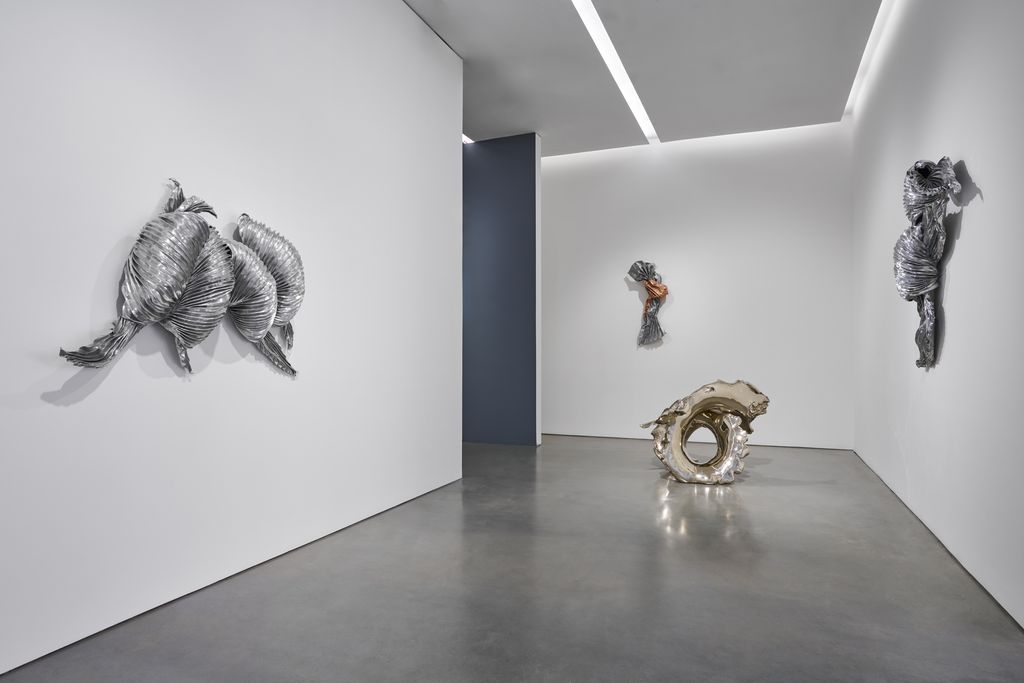 Lynda Benglis, Installation View, KNOTTING, TYING, FOLDING, Pace Gallery

Thalia Vrachopoulos
view all articles from this author