Whitehot Magazine
September 2026
"The Best Art In The World"
"The Best Art In The World"
September 2026
Identity Theft, Claudia Doring Baez Is Living in Her Subjects' Shoes
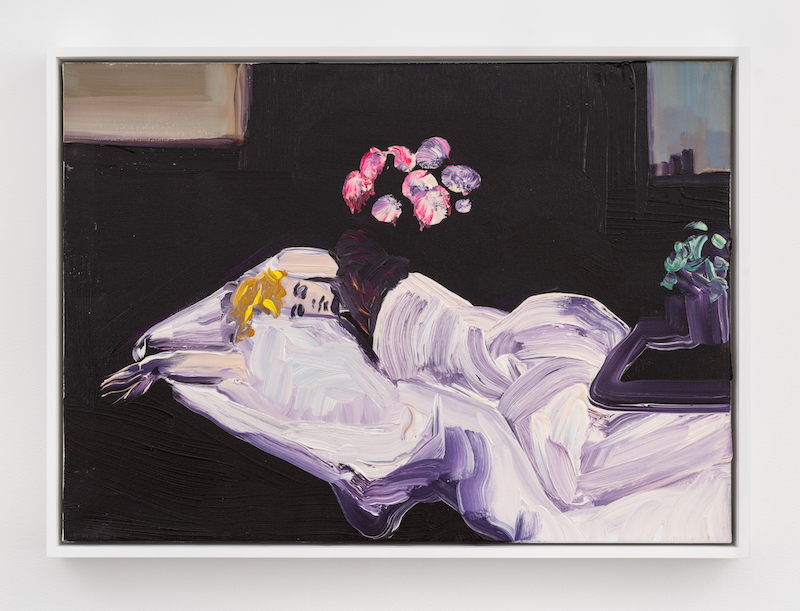 Claudia Doring Baez, Candy Darling, after Peter Hujar, 2025. Courtesy the artist and Jane Lombard Gallery.
By PAUL LASTER April 24th, 2026
A contemporary Mexican-American artist based in New York, Claudia Doring Baez creates expressionistic paintings that blur the lines between past and present, abstraction and figuration, by reinterpreting imagery from art history, cinema, literature, and photography. Celebrated for her spontaneous, gestural approach, marked by a lively application of paint, she is often seen as working in a meta mode since she usually begins with existing artworks or media.
Employing oil paint, oil stick, and charcoal on canvas, her work explores themes of authorship, memory, and identity, translating source images, such as black-and-white photographs, into vibrant, textured paintings that are rich in color and convey a strong physical presence. Working in series, she engages in conversations with the artists and authors who inspire her, reimagining Cindy Sherman’s Untitled Film Stills, films by Alain Resnais and Pedro Almodóvar, and Marcel Proust’s works.
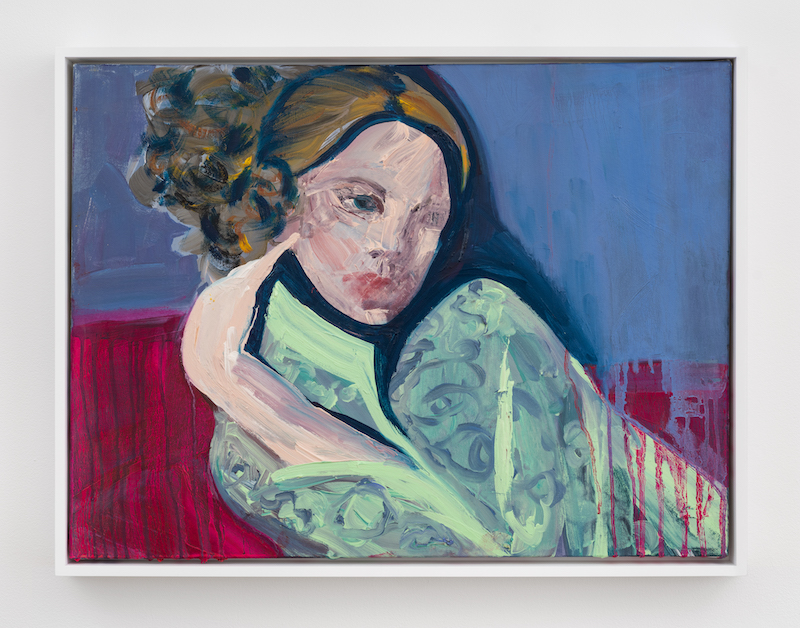 Claudia Doring Baez, Peggy Lee 2, after Peter Hujar, 2025. Courtesy the artist and Jane Lombard Gallery.
Exhibiting internationally for the past forty years, Baez is on a roll again with two solo shows in New York: “Trace” at Jane Lombard Gallery’s JLG Projects (March 13 – April 25, 2026) in Tribeca and “Paris in My Head” at Bookstein Projects (April 23 – May 29, 2026) on the Upper East Side. Inspired by the penetrating sensitivity of Peter Hujar’s striking black-and-white portraits of close friends, lovers, and fellow creative figures within his social milieu, as well as his broader range of subjects, including nudes, animals, and still lifes, “Trace” presents ten intimate canvases that transform the photographer’s grayscale images into gestural delights.
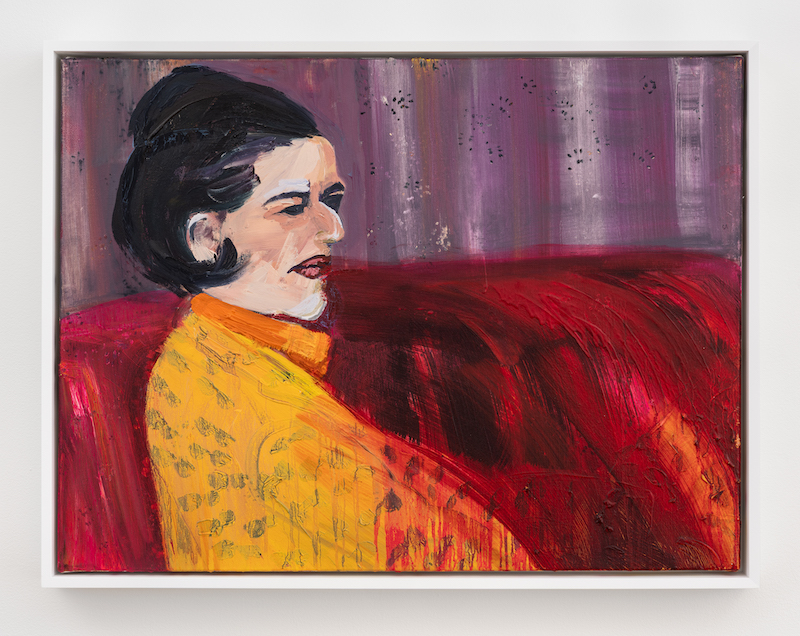 Claudia Doring Baez, Diana Vreeland 1975, after Peter Hujar, 2025. Courtesy the artist and Jane Lombard Gallery.
Baez’s painting Candy Darling, after Peter Hujar (2025), captures the Warhol Superstar in a flurry of wet-on-wet brushstrokes, beautifully transforming Hujar’s loving portrayal of the transgender actor in a hospital room on her deathbed. While the overall composition is highly expressive, Darling’s face is rendered more formally and thus more realistically, adding a touch of tenderness to the painter’s portrayal.
Her Peggy Lee, Diana Vreeland, and Nude Alexandra canvases appropriate Hujar’s photographic imagery while subtly reflecting on personal stories related to the subjects. She chose his portrait of “Fever” singer Lee through a recollection of working on the Martin Scorsese film After Hours, which features a seminal scene in which another Lee’s song, “Is That All There Is?” plays on a jukebox. The painterly runs, the quickly brushed arabesques on the singer’s blouse, and the blurring of her face, particularly one of her eyes and her lips, seem to echo the lyrics of that jukebox tune.
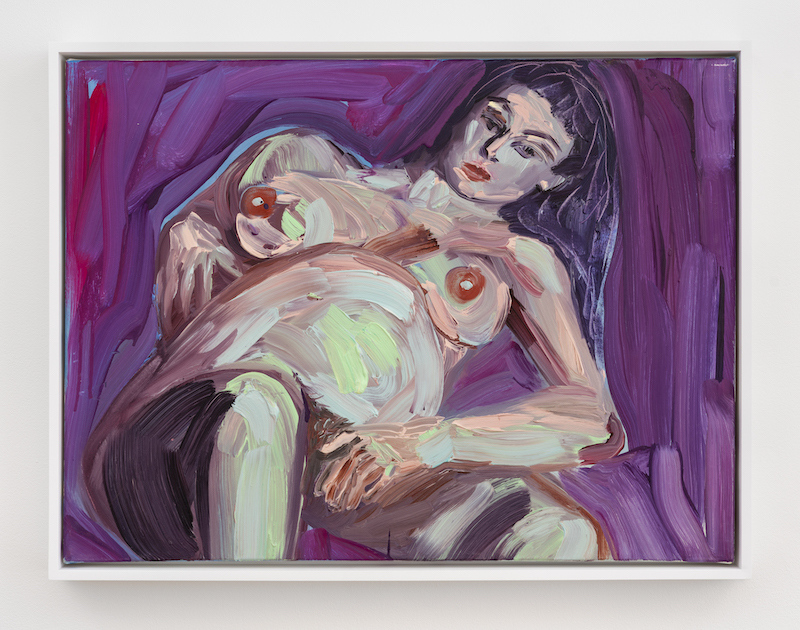
Claudia Doring Baez, Nude Alexandra, after Peter Hujar, 2025. Courtesy the artist and Jane Lombard Gallery.
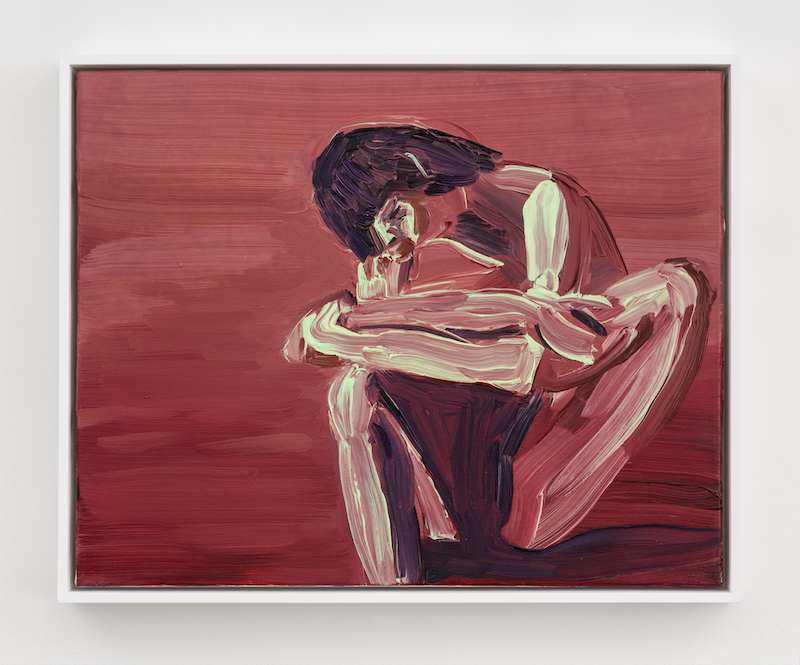 Claudia Doring Baez, Daniel 1981, after Peter Hujar, 2025. Courtesy the artist and Jane Lombard Gallery.
While turning the photographer’s image of Diana Vreeland, the legendary columnist for Harper's Bazaar, editor-in-chief of Vogue, and later a visionary consultant for The Met’s Costume Institute, into a painting, Baez recalled that her daughter’s first boyfriend had been Vreeland’s grandson. Ironically, the wet canvas picked up rat tracks while it lay on the floor of a former studio in Brooklyn's Gowanus area, which may be less an unintended reflection on the boy than on a protective mom, pondering whether any man was right for her child.
And her daughter, Alexandra, is woven into Hujar’s portrait of a pregnant nude friend, as Baez transposed her then-pregnant daughter’s face, from memory, onto the subject’s body, placing her expressively rendered figure within a broadly brushed, gestural field of purples and reds. The painting is displayed between two male nudes, a favorite subject in Hujar’s photography, with the canvas Daniel 1981, after Peter Hujar (2025), capturing the contorted subject sucking his toes. Baez portrays it with bold brushwork, revealing a fondness for Franz Kline’s calligraphic abstractions, while paintings of a dog in a grassy field and a still life featuring a high-heeled shoe round out the cleverly curated solo show.
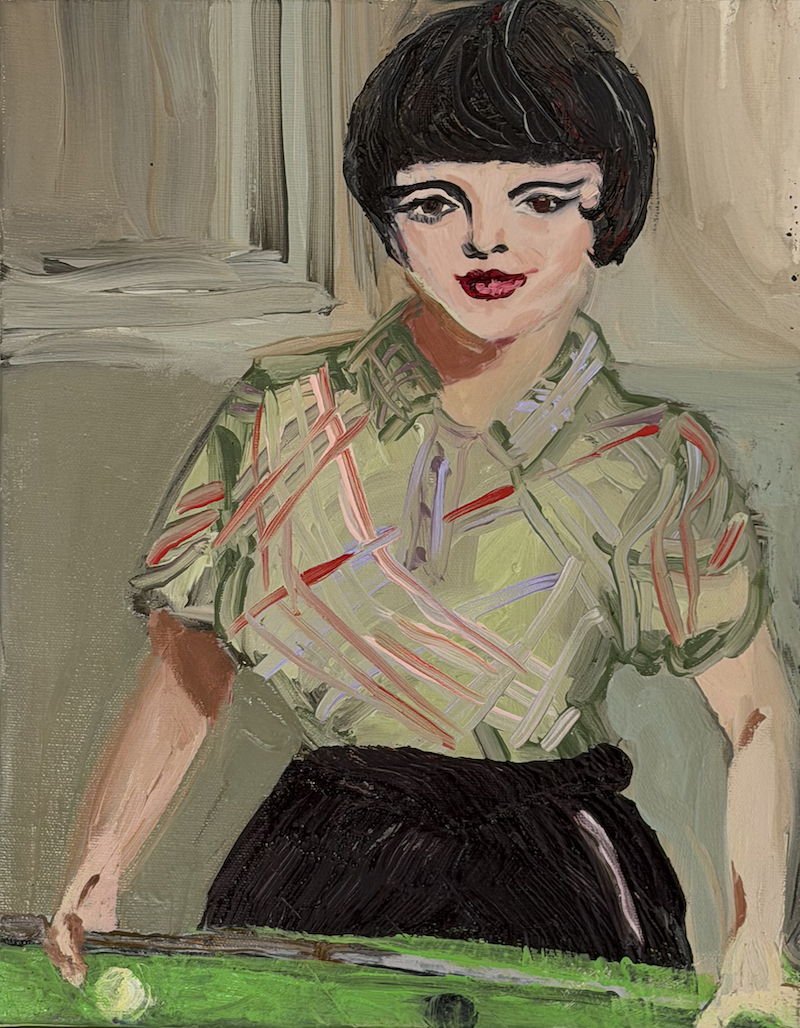 Claudia Doring Baez, Brassaï, Paris - Prostitute playing billiards, Rue de Lappe, 1932 2019. Courtesy the artist and Bookstein Projects.
Uptown, Baez’s exhibition “Paris in My Head” at Bookstein Projects features 20 paintings inspired by the Paris photographs of Hungarian-French artist and writer Brassaï (Gyula Halász) and by French art historian Yves Gagneux’s 2012 book on Honore de Balzac’s use of masterpieces by artists such as Titian, Jean Siméon Chardin, and Eugène Delacroix to enrich his novels. Created between 2019 and 2026, the small-scale paintings capture the City of Light’s bohemian lifestyle of the 1930s, portraying prostitutes, restaurateurs, newspaper vendors, showgirls, book-lovers, gamblers, and police living and working side by side, as well as paintings of celebrated women who inspired characters in Balzac’s La Comédie Humaine.
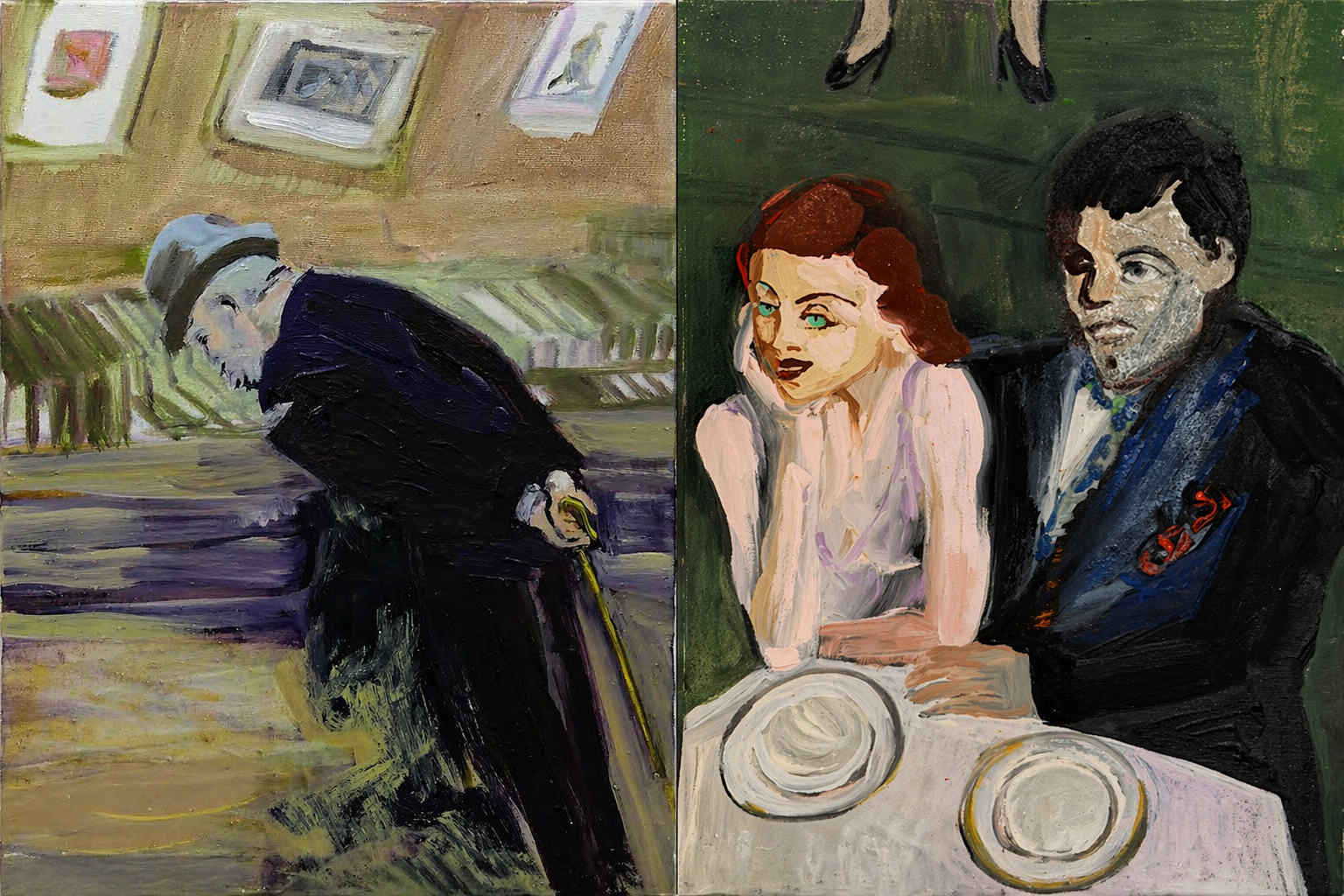 (Left) Claudia Doring Baez, Brassaï, Paris - Professeur Louis Dianier, Membre of the Institute, on Quay Voltaire, 2020. Courtesy the artist and Bookstein Projects.
(Right) Claudia Doring Baez, Brassaï, Paris - Lesbian Couple at Le Monocle, 1932, 2020. Courtesy the artist and Bookstein Projects.
Her painting Brassaï, Paris - Prostitute playing billiards, Rue de Lappe, 1932 (2019) depicts a young, stylishly dressed woman with a flapper bob, strikingly posed at the edge of a pool table in a bar, while Brassaï, Paris - Professeur Louis Dianier, Membre of the Institute, on Quay Voltaire (2020) shows an elderly gentleman looking at books at a street stand along the Seine. The prostitute’s blouse becomes a lively abstraction, with vibrant, overlapping linear brushstrokes, while the professor’s black outfit blurs into his shadow and the ground, creating an expressive mix of brushwork and hues. And in the rapidly brushed Brassaï, Paris - Lesbian Couple at Le Monocle, 1932 (2020), a lesbian couple sits at a table in a famous Montparnasse nightclub, watching the dancing crowd with joy as they await their food.
Baez’s reinterpreted paintings of Renaissance and classical masters from Gagneux’s Le musée imaginaire de Balzac: les 100 chefs-d'œuvre au cœur de La Comédie (Balzac's Imaginary Museum: The 100 Masterpieces at the Heart of La Comédie), which Balzac (1799–1850) used as source material for his stories, include works by Leonardo da Vinci, Titian, Guido Reni, Ary Scheffer, Jean Auguste Dominique Ingres, and Paulus Potter, and the series is still in progress.
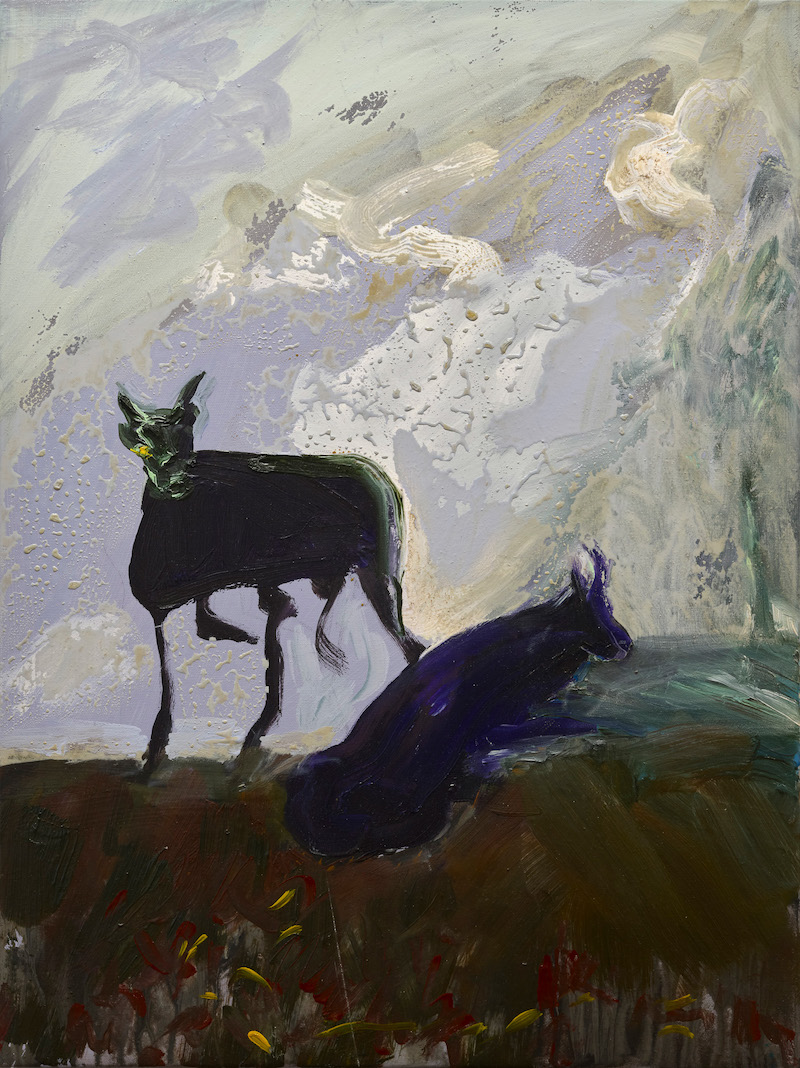 Claudia Doring Baez, Balzac: La Comédie Humaine - Ursule Mirouët - Paulus Potter, Dans un Paysage Nuageux 2026. Courtesy the artist and Bookstein Projects.
Her painting Balzac: La Comédie Humaine - Ursule Mirouët - Paulus Potter, Dans un Paysage Nuageux (2026) dramatically depicts a bull silhouetted against a threatening sky, watching over a cow resting at its feet. The turbulent sky is painted wet-on-wet, while the bull, standing defiantly, is rendered with as few brushstrokes as possible. Standout portraiture paintings from the book include Baez’s Balzac: La Comédie Humaine - Pierrette - Guido Reni; Beatrice Cenci and Balzac: La Comédie Humaine - Madame Firmiani - Jean Auguste Dominique Ingres, Madame Aymon, La belle Zélie (both 2026). The portrait of Cenci, a woman executed by Papal authorities, uses abstract brushwork to define the figure around a more realistically rendered.
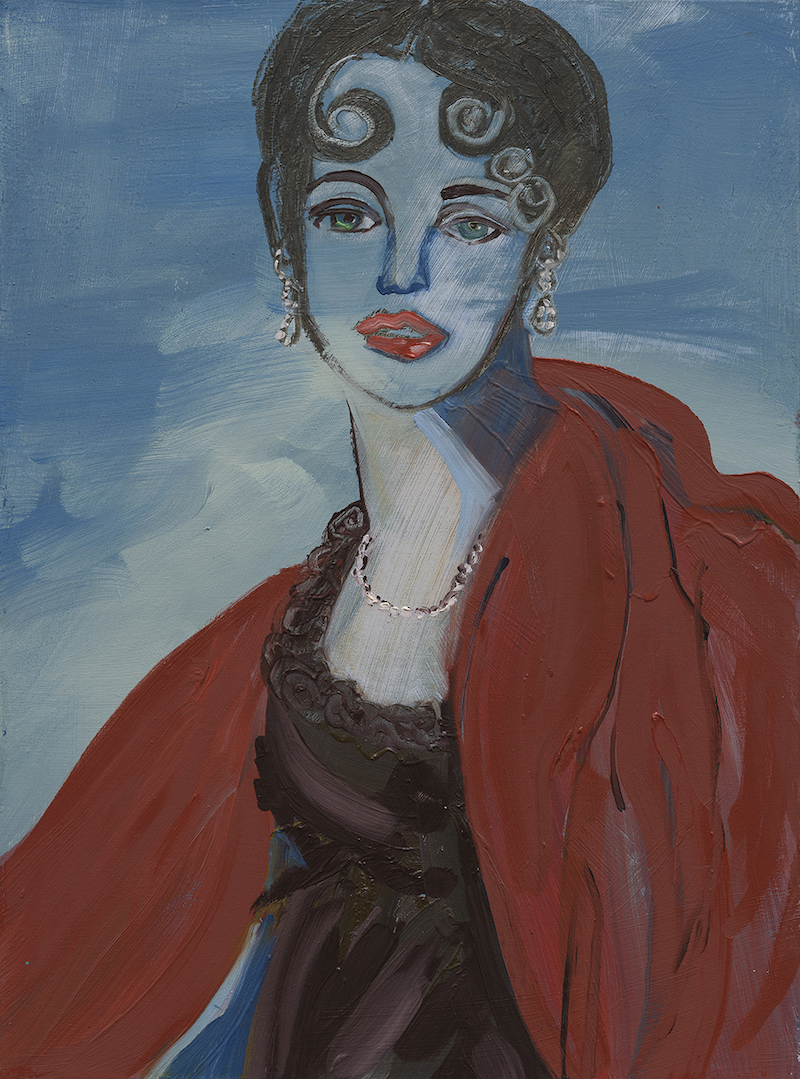 Claudia Doring Baez, Balzac: La Comédie Humaine - Madame Firmiani - Jean Auguste Dominique Ingres, Madame Aymon, La belle Zélie, 2026. Courtesy the artist and Bookstein Projects.
Taken together, these two engaging exhibitions show a seasoned artist fascinated with using photography and other existing cultural media as points of departure for painting, her primary love. Conceptually, Baez’s pictures are still lifes, since they are all paintings of bookplates pulled from celebrated tomes, studied, then painted in the same manner as Ernst Ludwig Kirchner or Henri Matisse rendered flowers and fruit. She employs playful brushwork to capture a likeness, the interpretation of an appropriated image, but never a precise re-rendering, rather a reimagination of the original artwork.
She sees it as identity theft—not pirating another artist’s work, but stealing their subjects’ identities. She wants to step into their subjects’ shoes—become one with Hujar’s legendary social elites and talented downtowners, or with Brassaï’s bohemians, rogues, and dandies, by painting them. It’s her fantasy, her way of making art. It’s art about art, a romantic notion, realized in a deeply personal way. WM

Paul Laster
Paul Laster is a writer, editor, curator, artist and lecturer. He’s a contributing editor at ArtAsiaPacific and Whitehot Magazine of Contemporary Art and writer for Time Out New York, Harper’s Bazaar Arabia, Galerie Magazine, Sculpture, Art & Object, Cultured, Architectural Digest, Garage, Surface, Ocula, Observer, ArtPulse, Conceptual Fine Arts and Glasstire. He was the founding editor of Artkrush, started The Daily Beast’s art section, and was art editor of Russell Simmons’ OneWorld Magazine, as well as a curator at P.S.1 Contemporary Art Center, now MoMA PS1.
view all articles from this author