Whitehot Magazine
October 2026
"The Best Art In The World"
"The Best Art In The World"
October 2026
Rémy Hysbergue Catching Sight of the First Cherry Trees Galerie Richard, Paris 74 rue de Turenne 3 Impasse Saint-Claude
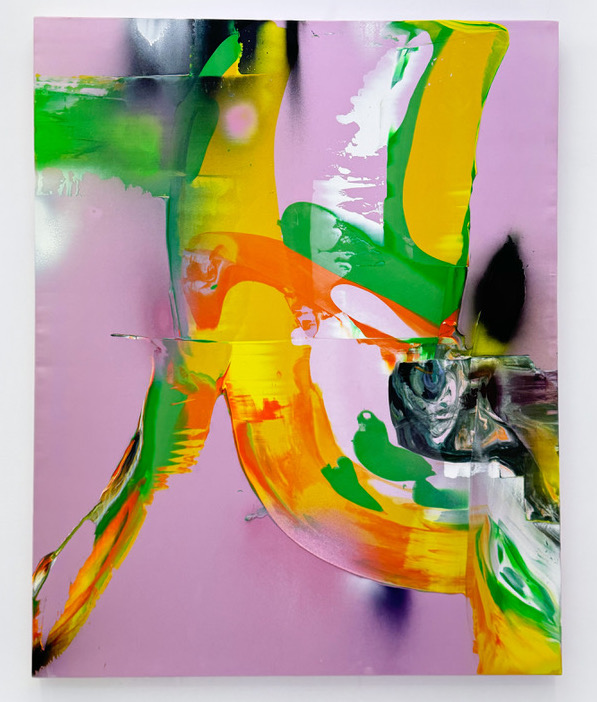 A86626, 2026, acrylic on satin, photo courtesy of Galerie Richard
By GARY BREWER June 4th, 2026
The art of painting is a protean form of creation: one can execute a preconceived image with precision and clarity, or it can be a journey of unexpected experimentation, where novel materials and techniques yield spontaneous results of emotional depth and subjective resonance.
The paintings of Rémy Hysbergue at Galerie Richard are exquisite representations of how an artist with an intuitive sensitivity to color and gesture can capture a moment of radiance. Surface and space, perceptual ambiguity, the materiality of the medium itself and the effects it creates are elements in the artist’s vocabulary.
When I first saw his paintings, I was intrigued by their chromatic richness. The paint seemed to float in a shallow space, transitioning from an ineffable depth to a loose gesture, with accents of airbrushed pigment floating in an ambiguous zone. They glowed, delicately fusing into a compelling gestalt, suggesting a space one knew but could not place.
I then realized that the ground he painted on was velvet, a material that has been used by artists such as Julian Schnabel, who played off its immediacy, as well as its association with kitsch, such as the well-known velvet paintings depicting Elvis. Hysbergue has said he uses velvet in part because it suggests Rothko’s sonorous prismatic tonalities. There is both a wink of amusement by the artist and a sincerity in using a material that deepens the chromatic resonance of his gestures and painterly passages almost like magic.
His paintings on velvet are particularly successful. The depth of space that a dark purple velvet can create in his paintings, absorbing light and amplifying the luminosity of the passages of acrylic paint, is both beautiful and mysterious.
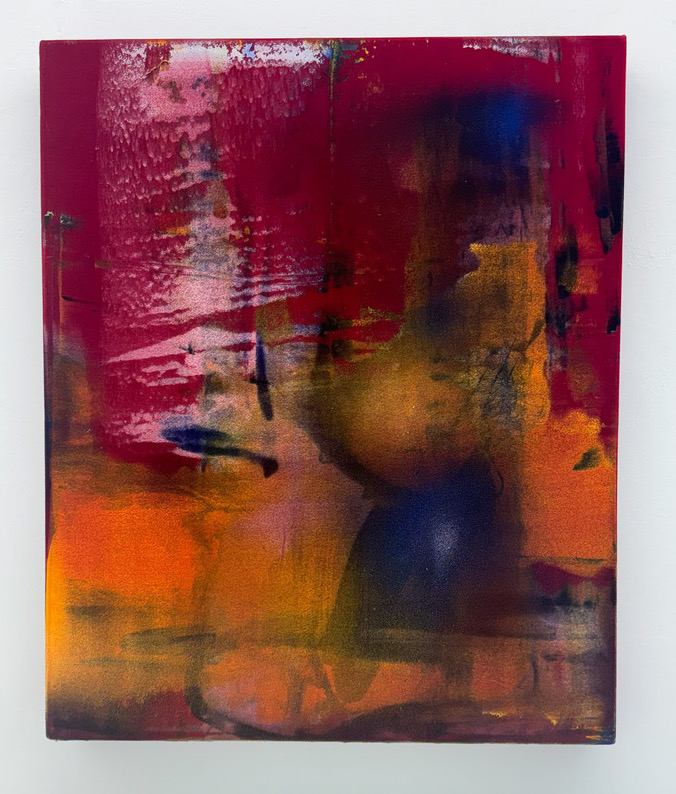 A85426, 2026, acrylic on velvet, inches, photo courtesy Galerie Richard
In a small painting such as “A85426” (2026), a deep cadmium red/magenta velvet ground sets off the burnt oranges, ultramarine blues and muted whites. The paint is applied using several techniques; it is scraped, airbrushed and pulled using various tools. The colors oscillate in an ambiguous space. They suggest fragments of a landscape where light dissolves, leaving a shadowy world where details are replaced with reverie. These compositions unfold in a rich poetic space where process, accident and intuition coalesce into deeply resolved works. There is an emotional resonance in the best of these works that touches upon both memory and the unknown. The deep stretcher bars show the velvet untouched by pigment. This gives the work a physical presence as an object and the surface as optical space.
In another painting, “A85926” (2026), Hysbergue has built a surface that suggests a topographical depiction of a lunar surface. The dark colors of the ground have been airbrushed in an off-white from a sharp angle. It creates an illusion of shadows, an amplified quality of lunar craters starkly illuminated by sunlight. In another artist’s hands this could be a simple trick, but the poetic resonance and power of this painting is impressive for its small size. The artist achieves both depth and scale—and a lovely metaphor for this time of the Artemis II flyby of the moon.
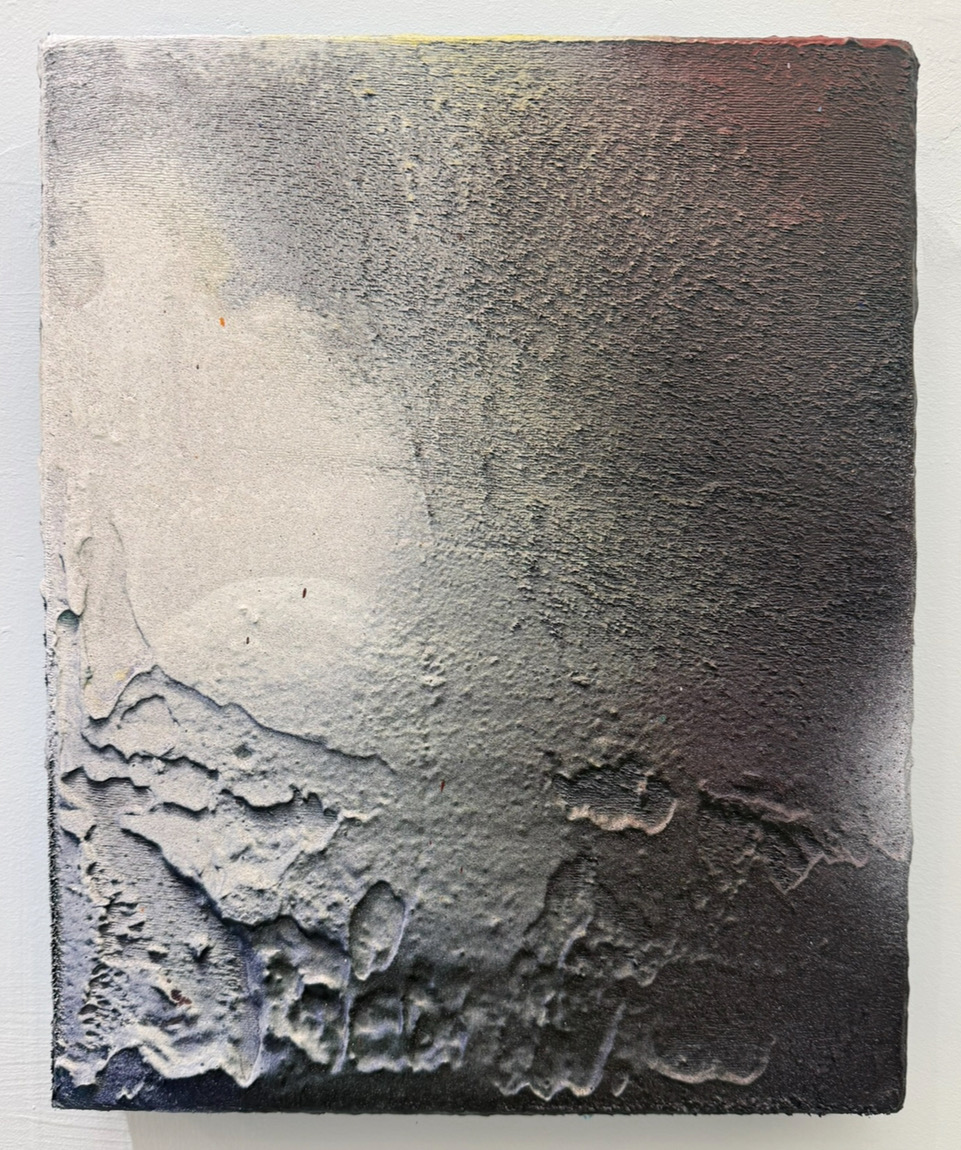 A85926, 2026, acrylic on velvet, photo courtesy of Galerie Richard
The artist also works on satin, a much smoother surface. Whereas the works on velvet have an absorbent externality, achieving something like a dry-brush technique, suspending the paint on the surface and often allowing the velvet to show through, the paintings on satin are swifter; the gestures slip and slide across the surface, losing the chromatic density for a more naked spontaneity. The exuberance in some of the satin paintings reminded me of street art/graffiti. The velvet paintings hold space and create atmospheres. The satin paintings are more on a surface in this space we share.
In the painting “A86626” (2026) strident yellows, greens, oranges and whites glide across a pink satin surface. The swift execution is nuanced with airbushed accents that highlight the composition in white and anchor it with black. It suggests a figure in movement but retains the physical quality of its spontaneous emergence, an illuminating epiphany of gesture, intention and accident.
Hysbergue allows process and material experimentation to be his guiding muse. Over the years the artist has been exploring ways that paint, color, gesture, surface and space affect perception and feeling. This exhibition is a beautiful representation of the fruits of his creative journey. One can indeed catch sight of the first cherry trees.

Gary Brewer
Gary Brewer is a painter, writer and curator working in Los Angeles. His articles have appeared in Hyperallergic, Art and Cake, and ART NOWLA.
Email: garywinstonbrewer@gmail.com
Website: http://www.garybrewerart.com
view all articles from this author