Whitehot Magazine
October 2026
"The Best Art In The World"
"The Best Art In The World"
October 2026
Interview: Painter Scott Kahn is Seeking an Emotional Truth
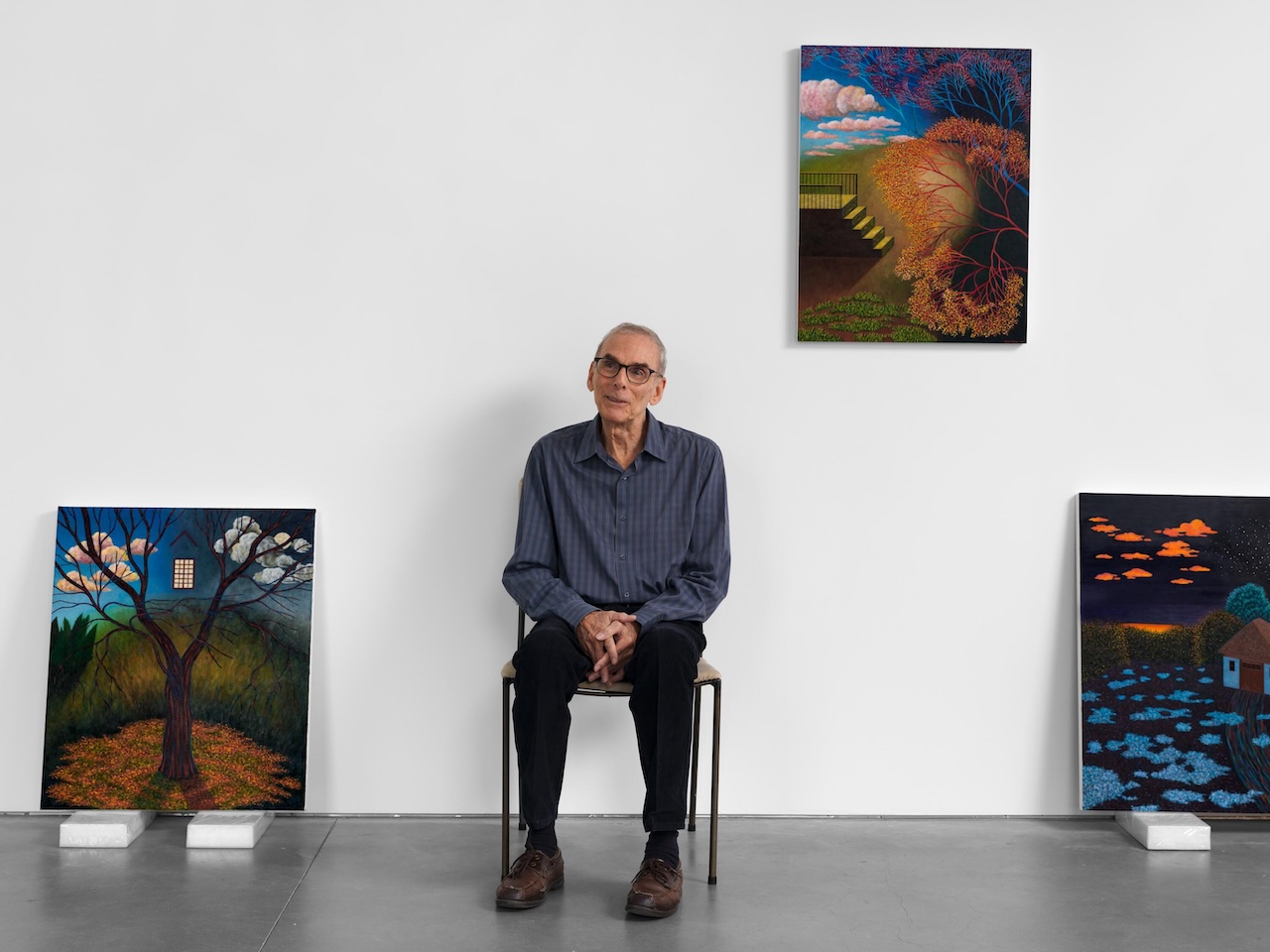 Scott Kahn, 2026, Artwork © Scott Kahn, Courtesy the artist and David Zwirner
By BELLA GREENBACHER September 10th, 2026
I had the privilege to speak with widely acclaimed oil painter Scott Kahn, an artist whose practice spans over five decades. A new solo exhibition of Kahn's work opens at David Zwirner Gallery on September 10th, 2026. Kahn’s poetic paintings translate felt experience into outward visual expression. Now 80 years old, Kahn offers a profound sense of wisdom and insight into the driving force of his practice and inspiration.
Bella Greenbacher: What first drew you to painting as a medium as opposed to other materials? What first inspired you to paint?
Scott Kahn: I’ve always been painting. I’ve always been drawn to expressing myself visually. It’s something that has always been a part of my life for as long as I can remember. Where I grew up, an art teacher would come to school maybe once a month. I couldn’t wait for her to come because I loved doing whatever project she presented. When I was in high school, on Saturday afternoons my mother used to get rid of me and my brother and drop us off at the Springfield Museum art classes for children.
I absolutely loved it. When I was in high school, I had a friend who lived down my street and we both loved painting. I guess I picked up a brush at some point and we took some private courses together. We took a course in the evenings and it was a life drawing course. We were the youngest people and there were nude models in the class - my friend and I hid behind our portfolios because we had never experienced that. The teacher allowed us to stay in that class. I also remember taking lessons at a girl’s school that had art classes. So, whatever I could find, I took part in. In college, I immediately started taking the art courses that were available. They were very basic and there weren't many – I didn’t go to an art school.
 Scott Kahn, Wolf Moon, 2023, © Scott Kahn, Courtesy the artist and David Zwirner
Bella Greenbacher: A lot of artists these days don’t seem to have a formal education with art, do you think formal training is necessary?
Scott Kahn: I would have to disagree with you from my perspective about this. In my lifetime, I’ve seen a proliferation of art schools, a proliferation of artists, a proliferation of art and galleries and you name it. The art world has exploded in the last several decades. I feel art and being an artist isn’t something you can learn, and it’s not something you can be taught - it really boils down to being a gift. You can go to an art school and learn technical things and theory and all that, but to be an artist is really a gift.
Bella Greenbacher: What about youth in the art world do you think entrances people? Do you think it’s just the novelty of their work?
Scott Kahn: I think slowly, in the last couple of decades, it’s just become trendy. Artists have become almost like rock stars or pop singers. With the proliferation and technical advances of the computer and social media, we’re all so aware of the art world, of other artists, of what’s going on all over the world art-wise, and it’s become very appealing. When I was in high school and college, there were no computers and no social media. If you were interested in art you had to find it for yourself. Initially, I was a little bit behind and my partner and I didn’t even own a computer. I eventually got connected and I started seeing the art world migrating over to Instagram. Instagram has become almost the newspaper of the art world. Everything you want to know about the art world, you can find on Instagram.
The computer has replaced a lot of print media. Social media was a way of presenting my work and finding an audience, and somehow it just took off. A lot of people started looking at my work. I owe a lot of credit to Matthew Wong, who I befriended. I met him online and he lived in Canada, and I casually said “Matthew, you’re welcome to come to my studio” and he did, with his mother. He bought a painting of mine and put it up on his Instagram feed. I think he was visionary in a way because he saw the potential of Instagram. Through Matthew, I could see that Instagram was the place to be. He put my painting up, and that set off an avalanche because people were looking at my Instagram feed and all of the paintings. Dealers, collectors, and other artists started beating down my door - and it’s been non-stop ever since. I’m indebted to Matthew. He was a generous spirit. A beautiful man.
 Scott Kahn, The Stoop, 2024/2025, © Scott Kahn, Courtesy the artist and David Zwirner
Bella Greenbacher: Your upcoming exhibition focuses on your landscape paintings. What draws you to specific places and environments, and what qualities in these places compel you to paint them? How does place function as a motif and a theme in your work?
Scott Kahn: I often describe my work as a visual diary of my life: what I experience in life, what I see in life, and the world around me. That is my inspiration. I gravitate towards nature more than I do cities or man-made objects. I feel most comfortable when I have a beautiful, natural inspiration from nature. I think landscapes offer opportunities to express a mood, and I’m very moody. Landscapes mirror life in that they change all the time. They’re not static. Life is dynamic. That resonates with me because the task of an artist is to express and interpret the experience of life. Life is the driving force in my work. Life is guiding me.
There are so many different moods in nature which allows me to express the nuances of my own mood. I’m drawn to the sky, and the various changes in the sky. It offers infinite possibilities to express how I’m feeling. Sometimes, a motif that I’ve seen over and over again creeps into my psyche because the landscape and what I have observed has moved me. I want to be moved. I want a painting to move people. I don’t want to think, I want to feel. You don’t listen to music to analyze the notes and the composition. You listen to music because you’re moved by it. A painting should have the same effect on the audience. People want some understanding of what we call “the truth.” I know that’s a very difficult word and can be vague, but I believe that there is something called “the truth.” An emotional truth. I think we’re all seeking some answers to our existence. Why are we here? What is life all about? I think that is the origin of our expression, ever since it began in the caves. How to understand the universe.
 Scott Kahn, The Basement, 2025, © Scott Kahn, Courtesy the artist and David Zwirner
Bella Greenbacher: What kind of questions do you try to answer through your practice?
Scott Kahn: I don’t think of it as questions, really. It’s the journey. It’s the seeking. Painting is a way of responding to life and the world around me. It teaches me who I am. You have to be completely and totally honest to be an artist. I often tell artists the most important painting you can paint is a self portrait. You look in the mirror and ask yourself: Who are you? What are you? What are you feeling? You have to be totally, completely honest to paint a self portrait. It’s the best psychoanalysis you can have, and it’s free!
Bella Greenbacher: Do you see your paintings as records of different parts of your life? Are they self portraits in their own way?
Scott Kahn: I often say that any work of art is a self portrait, even landscapes. I love painting portraits because for me it’s the most direct way of exploring who I am. Over time, you’re changing. Maybe you’re becoming wiser, maybe not. My driving inspiration is through Rembrandt’s self portraits, which are breathtakingly honest. Breathtakingly revealing.
I paint many self portraits throughout my life to check in on myself every now and then, seeing where I’m at. But any work of art is going to reveal something about the person who created it. A work of art reveals everything about the person who created it. It reveals their strengths, their weaknesses, their depth, and the poetry they’re able to express.
As an artist you have to call upon everything at your disposal: your intellect, your intuition, and the technical things. You need all the equipment you can gather to create a work of art. You have to be honest with yourself, and not be influenced by other artist’s derivative elements. You have to throw off any derivative element in your work.
I was very aware of that when I was younger, because what I was painting was often lumped into a movement. And I thought, ‘I don’t want to be recognized as part of a moment. I want to be recognized for me, not some group.’ I realized I had to throw off derivative elements. That creates a void, and voids get filled. It’s a way of finding your own voice when you throw off derivative elements. I’m not saying you have to reinvent the wheel, nobody is reinventing the wheel here, but you have to express yourself honestly as to who you are.
 Scott Kahn, Blue Moon, 2020, © Scott Kahn. Courtesy the artist and David Zwirner
Bella Greenbacher: Does some of your inspiration come from your dreams and subconscious?
Scott Kahn: Sometimes. There’s one painting in my upcoming exhibition, “The Basement,” which was truly inspired by a recurring dream, and that was a big departure for me in that it wasn’t some element in life. It was a dream, and the language of a dream is very different from reality. In the dream, I’m in the basement of the house where I grew up in Longmeadow Massachusetts, which was dark. I had a room in the basement and in the dream, the light came piercing into the darkness.
I found that very symbolic and positive, that there is light in this void, in this unknown. My work has always been about light. When I paint, I don’t feel like I am painting something solid, or an object. I feel like the world is revealed to us through light. That’s how we see things, light illuminates the world. That’s why the sun and the moon come into my work, but I’m not going to psychoanalyze that.
All the light we have in our world, the source of it is the sun and the moon. I’ve always felt there is a spiritual element to painting when I sense there is light in the painting. My painting, ‘The Two of Us,’ is inspired by a concept of a relationship. My partner and I were talking one night, and he told me he had read that at the inception of life, the sperm hitting the egg, there has somehow been an observation of a spark of light and energy. That really resonated with me, that the origin of life is light and energy. I just feel that’s how a close relationship is like. Melding and coming together, and a burst of energy and light.
 Scott Kahn, The Two of Us, 2026, © Scott Kahn, Courtesy the artist and David Zwirner
Bella Greenbacher: What are you most excited about in your upcoming show?
Scott Kahn: I am excited about the painting that I’ve just finished because it was a departure in that the inspiration for the painting was not something from life that I see everyday – it was from another painting, another artist. The title is, “The Studio - Homage to Hans Hofmann.” Hans Hofmann was one of the first artists when I was in university that my painting instructor suggested I look at. I immediately loved the work of Hans Hofmann, who of course was very influential.
One of my favorite phrases is: “History is ruthless.” I cannot tell you how many people in younger generations don’t know artists from my generation. Hofmann was an extremely influential abstract expressionist. When I’m inspired by a painting, it’s not the subject matter but how it affected me and moved me and inspired me to paint my painting. I have to be moved to be inspired. Some artists drug themselves with their work as an escape from their life.
 Scott Kahn, Fall into Winter, 2024, © Scott Kahn, Courtesy the artist and David Zwirner
In a way, painting is a drug in the sense that you’ve got to do it, and the more you do it the more you need it. But I don’t paint to anesthetize myself. I always describe my process as a conversation. You have the inspiration, you make some marks on the canvas. I usually cover the painting during the first session. It’s like giving birth: everything is there, all the DNA is there all at once from the very start. I like to work and refine things, and I like a sense of refinement and beauty.
But most of all, I like the dialogue and rapport and conversation with the painting. Once I get going, the painting speaks back to me: ‘You’ve done this, but you need to do this, and you need to do that.”
It happens over and over again. Sometimes you see things unexpectedly, that you hadn’t anticipated, that are a surprise. It’s very egotistical in a way, because the conversation is really with yourself. Eventually, it stops speaking to you. There’s nothing more that needs to be done with it. You never know when that’s going to happen.
It takes you by surprise. You know that when it's done, it's done. I look back at older work and sometimes think, I didn’t really finish this painting. When I was younger, I was much more productive. Youth is full of energy and youth is in a rush. You make mistakes when you're in a rush. I think it’s natural as you get older, to slow down and take your time, and at this point in my life I don’t need to produce a huge amount of paintings.
 Scott Kahn, The Studio, Homage to Hans Hofmann, 2026, © Scott Kahn, Courtesy the artist and David Zwirner
Bella Greenbacher: Is following your intuition a recurring theme throughout your practice?
Scott Kahn: It plays a big role in my process. I don’t consider myself an intellectual at all. I don’t like thinking, I like feeling. I want something to be revealed to me. People come to my studio and they respond to my work one way or another, sometimes just through body language. I’m very interested in how people respond to my work.
Not because they’re going to reveal something to me about my work or myself, but because they reveal themselves. It’s very rare that somebody can say something to you and it reveals a truth that you hadn’t realized before. It’s like the curtains part. It’s very rare. You have to learn things on your own. Life is a solo journey. I lived with my partner for 51 years, and it’s wonderful sharing the journey of life with somebody, but ultimately life is a solo journey. It's a journey of the mind.
 Scott Kahn, Silent Night, 2026, © Scott Kahn, Courtesy the artist and David Zwirner
Bella Greenbacher: How have you sustained your practice for so long? What motivates you to maintain your practice?
Scott Kahn: I learn so much from doing what I do: about myself, who I am, what I’m capable of. Maintaining a work habit gives you focus and routine, and a reason to get up in the morning and do something with your life. It gives you a reason to live. Because life is so dynamic and mysterious, I can’t imagine stopping what I’m doing.
I had virtually no recognition for a long time and I feel very lucky and fortunate that I’m still alive at 80 and this has happened to me in my life. When I had no recognition, I had no financial stability. I lived in my cousin’s attic for years which is very, very stressful. But I’ll tell you one benefit about having no recognition or success: it gives you enormous freedom. You are free to paint whatever the hell you want to paint. I now have this financial stability at this point in my life and I’m not living in the attic anymore, but there is pressure from the world. Nobody knew about me and now, there is a price to pay.
When I was younger, the mother of a very old school friend of mine once told me a very good lesson. Three words: “Don’t Assume Anything.” I often joke, you can put that on my tombstone. WM
Bella Greenbacher
Bella Greenbacher is a writer, curator, and visual artist based in Brooklyn, NY. She holds a BFA in art history and visual art from Concordia University Montréal. Her work has appeared in The Michigan Daily and Concordia Undergraduate Journal of Art History, as well as curatorial work at the Bushwick Gallery. Through both writing and exhibition-curating, Bella aims to inspire in-depth dialogues surrounding underrepresented voices and topics in the art world.
view all articles from this author