Whitehot Magazine
July 2026
"The Best Art In The World"
"The Best Art In The World"
July 2026
Cyph 001: The Archive, Memory & Truth in the Age of AI
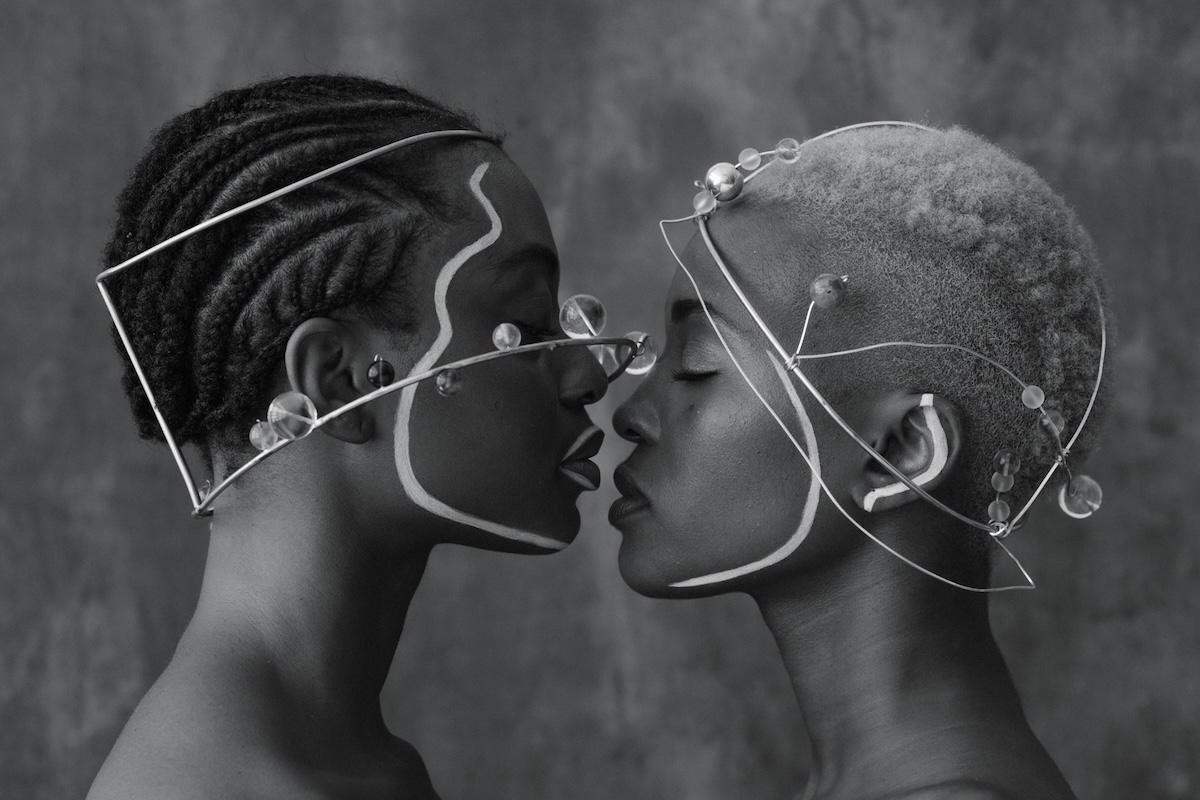 Delphine Diallo, Universallaw, 2016. Pigment inkjet on archival paper
By EMANN ODUFU June 28, 2026
Few subjects have become as sticky, divisive, or revealing as artificial intelligence. Conversations about AI rarely remain conversations about technology for long. It almost always becomes a debate about creativity, labor, authorship, and even what it means to be human in present times. AI has increasingly become a site of ideological struggle, with advocates and skeptics both speaking about the subject with near-religious conviction.
For me, the moment brings to mind sixteenth-century Spain, when figures like Saint Teresa of Ávila lived through fierce disputes over the nature of authentic Christian life. The arguments were never just about doctrine. They were contests over authority, legitimacy, and who possessed the right to define truth. Today's AI debates feel strikingly similar. Beneath discussions of algorithms and machine learning lies a deeper question: what constitutes authentic creativity in an age when machines can generate images, texts, and ideas at unprecedented speed?
However not all responses to AI have been framed as a battle for or against the technology itself. Earlier this year, Pope Leo XIV spoke of artificial intelligence not as an enemy to be defeated, but as a tool requiring ethical stewardship. His concern was not whether AI should exist, but whether its development would remain rooted in human dignity and human flourishing. The challenge, in other words, is not merely technological. It is profoundly humanistic.
It is within this tension that Cyph feels particularly timely. Cyph 001 unfolded less like a panel than a living artwork, part symposium, part listening session, part communal rehearsal for how memory might survive and is even enhanced in the age of AI. Sponsored by The Root and convened by emerging startup Cyph (the first "underground" for wisdom in the digital age) and Prompt & Purpose, an applied AI research community that brings together artists, technologists, scholars and cultural leaders to explore how technology can serve humanity. Participants were asked to consider a set of increasingly urgent questions; What is preserved? What is erased? And who gets to decide?
As Cyph co-founder Jalen Daniels noted during the evening, "Beyond the veil, we're living through an epistemic crisis, a new dark age. But every epistemic crisis, from the Greek Agora to the Harlem Renaissance, has produced a countercultural underground. Cyph is building the underground for today." Later, she reminded the audience that the word archive derives from the Greek “archaeon”, a house, residence, or place of authority, raising enduring questions about who is granted entry, who remains, and who exercises control over collective memory.
What follows are selected excerpts from the cyph that took place on May 27th, 2026. The event was organized around three prompts; Memory, Truth, and The Power of the Archive. The structure of the evening mirrored the logic of generative AI, though in profoundly human terms. Speakers introduced prompts rather than conclusions, and meaning emerged through the collective intelligence of the room as stories, memories, disagreements, and unexpected connections accumulated in real time. Rather than presenting a complete transcript, these excerpts aim to preserve the strongest threads of the evening and offer a glimpse into the questions, tensions, and possibilities that emerged in the room.
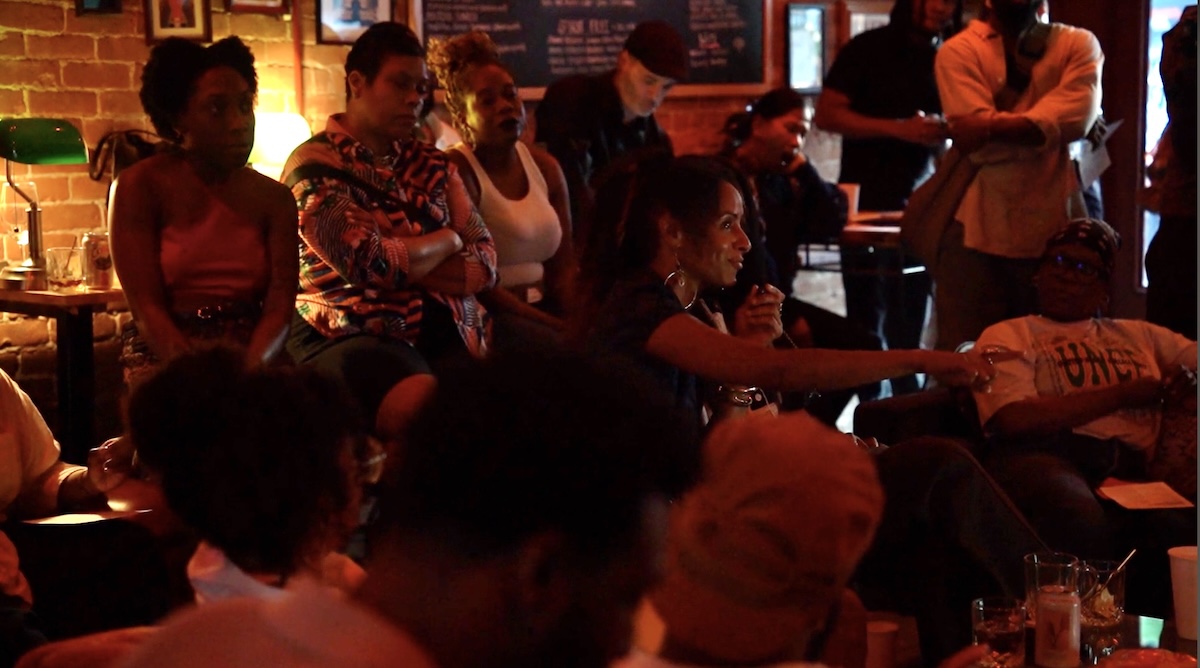 Delphine Diallo contributes to the discussion during Cyph 001. Photo Credit: Olaide Ojenkunle
On Memory
The evening's first provocation came from Ruby Thelot, a designer, cyber ethnographer, and professor of design and media theory at NYU whose work explores digital memory and the fragility of online archives.
Ruby Thelot
My work often focuses on memory, and one phrase became central to my book, A Cyber Archaeology of Checkpoints: "Forget what you lost, save what you can."
I first heard it from a Reddit user who keeps a folder called In Case the Internet Disappears. Years earlier, she lost a video that meant so much to her and a friend, that they literally mourned its disappearance. Around the same time, I became obsessed with a YouTube upload known as the Checkpoints video. For nearly a decade, people used its comment section as a diary. They returned year after year to document first loves, heartbreaks, family deaths, graduations, recoveries. More than 30,000 comments accumulated beneath a single video.
Then one day the video was removed. Thousands of memories disappeared behind a DMCA notice. That experience led me to think about what I call the shock of alteration and the shock of deletion. The shock of alteration is when a platform changes and no longer feels like the place you once knew. The shock of deletion is when something you care about simply vanishes and your first thought is: I wish I had saved it.
Technology has made memory feel permanent, but permanence is often an illusion. So, the question I want to begin with is simple: Who gets to decide what is preserved, and who gets to decide what is deleted?
Cass Pintro: There are very few photographs of my childhood. My mother was focused on survival, not documentation. Later, a house fire destroyed many of the objects and images that remained. That loss changed my relationship to memory. It made me realize that archiving isn't just something institutions do. It's something we do for ourselves.
People often imagine archives as museums or libraries. But sometimes an archive is a family story, a photograph someone carried through three moves, or a box of letters that somehow survived.
Dori Walker: I think we've started to confuse saving something with valuing it. I can save thousands of videos and never look at them again. Meanwhile, my grandmother writes her name, the date, and who gave it to her on everything she keeps.
Preservation only becomes meaningful when it is intentional. What makes something valuable isn't that it survives. It's that someone cared enough to remember why it mattered.
Josiah Johnson: As you were speaking about memories disappearing online, it made me think about decentralization.
What interests me about blockchain is the possibility of preserving information without a single institution deciding what stays and what disappears. We're also overwhelmed by information. Sometimes archiving is simply a way of staying grounded.
Hakeem Angulu: The largest archives already exist. Governments, corporations, and surveillance systems are collecting information about us at a scale we can barely imagine. The question isn't only how we preserve memory. It's also when we deserve to be forgotten.
We often talk about archiving as if more information is always better. But there are people carrying histories they'd rather not have permanently attached to them. Any conversation about preservation also has to be a conversation about consent, privacy, and the right to disappear.
Terrell Estime: What does it mean to think about oil as a medium and as a way to preserve history? And what does the idea of oil as an artist mean to you in terms of the passage of time and storing information through oil?
Demetrius Wilson: I think the importance of archive, especially for creators are important because we are typically the ones that kind of mold conversations and pretty much get things started in a way. So, there's a lot of power behind it.
I know for me especially I really hold dear to that responsibility, and I kind of make sure that I'm able to really urge other artists to really take it by the reins and really just do their part in archiving, but also just preserving and pushing motives, themes, ideas to culture.
Emann Odufu: Before my great-uncle passed away, I would play jazz records for him on Spotify. What amazed me wasn't that technology could retrieve the songs. It was that he remembered them so vividly. Songs he had not heard in over 70 years.
He could name the musicians, the arrangements, the recordings. Sometimes he'd identify a song within seconds. It reminded me that not all archives are digital. Some archives live inside people. Entire worlds of knowledge exist in memory, conversation, and lived experience. When those people pass away, entire libraries disappear with them.
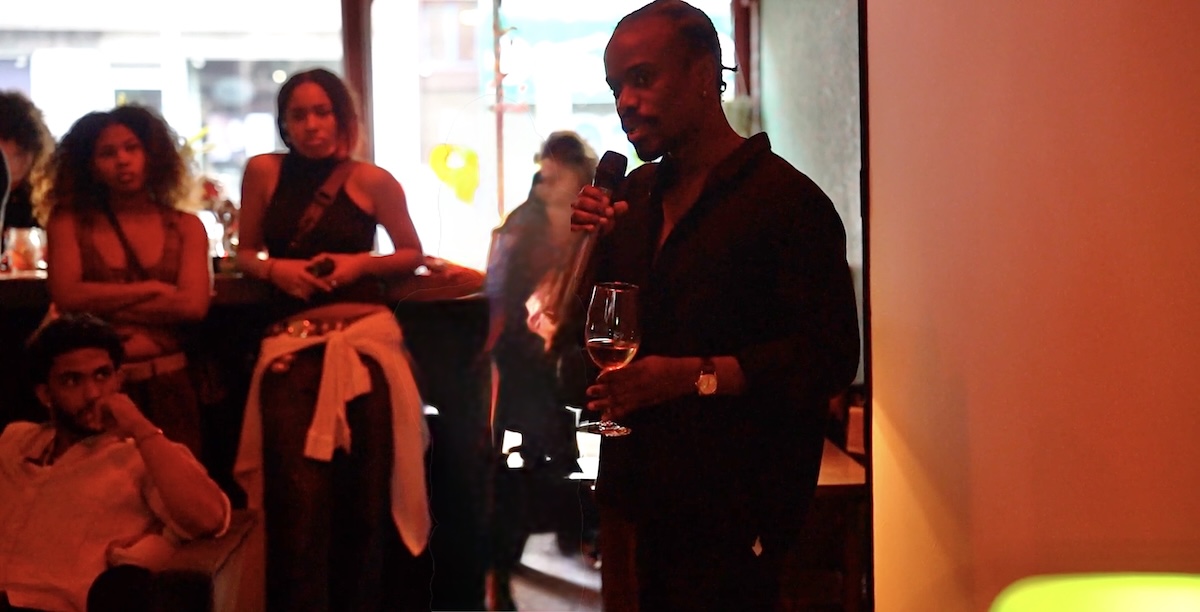 Ruby Thelot opens the discussion with a provocation at Cyph 001. Photo Credit: Olaide Ojekunle
On Truth
Beginning with a brief meditation that recentered the room's attention inward, artist, filmmaker, cultural strategist, and founder of the Institute of Black Imagination Dario Calmese guided the discussion beyond archives and toward the more elusive terrain of truth. Moving fluidly between art, philosophy, spirituality, and cultural critique, Calmese has built a practice exploring identity, consciousness, and cultural memory. Rather than approaching the evening's themes through technology alone, he challenged participants to consider the foundations upon which our ideas of truth are built.
Dario Calmese
Lately I've been thinking about truth through a series of propositions. The current state of affairs is the result of a culture increasingly incapable of suffering. To exist is to suffer. To suffer is to feel the tension between what is and what ought to be. I define suffering as the dissonance between truth and law. Law is the structure of space-time reality. Truth is something larger. To exist is a lawful endeavor, but what you are is fundamentally free.
I begin there because I think we're living through a war over memory. Not a war about us, necessarily, but a war over what future generations will remember. The question is not what happened. The question is what stories, values, and identities will survive long enough to become history.
At the same time, technology continues to strip away the things we once believed made us uniquely human. We thought intelligence meant retaining information. We thought it meant reasoning or pattern recognition. Increasingly, machines can do those things as well. What we're experiencing, in part, is grief. We are mourning a version of ourselves. Yet every technological shift has not only taken something away, it has also revealed new capacities. Perhaps the question is no longer what it means to be intelligent. Perhaps the question is what it means to be conscious.
If design is the technology that brings thought into space and time, then the world around us is evidence that ideas become reality. We are living inside thought made material. So my question is this: How do we develop the individual and collective capacity to imagine and build futures that remain faithful to truth, even when the laws, systems, and structures around us are not?
Keith Daniels: Before technology we had griots. We carried stories in people. Knowledge mattered, but so did interpretation. A griot wasn't simply storing information. They were shaping meaning, deciding what should be remembered and how it should be passed on.
That's why I don't want to outsource memory or imagination. Technology can help preserve stories, but communities still have to decide what those stories mean.
Piyali Mukherjee: I've been thinking about the distinction between truth and law through the lens of grief. A lot of the work of archiving, remembering, and preserving memory is really grief work. It requires us to stay present with absence. I often think about the COVID-19 pandemic. We lost more than a million people, yet the moment cities reopened many of us rushed back into normal life. It felt as though we never fully processed what had happened.
I wonder if part of the challenge is that we've lost our collective rituals for making meaning out of loss. Grief is personal, but it's also social. It asks us to pay attention to what is difficult to look at. In that sense, remembrance isn't only about preserving the past. It's about developing the capacity to hold painful truths without turning away from them.
Morgan Mackenzie: Art, architecture, and fashion are some of our most powerful archives. They carry histories, values, and ways of seeing across generations. Culture survives not only through documentation, but through creation. Every time someone makes something, they're preserving a worldview, whether they realize it or not. To me Creation preserves the truth.
Dario Calmese
I’d encourage us all to go a step or two upstream from your thoughts. What's beneath the belief you're holding? What's beneath the story you're telling yourself?
Whether we're talking about history, identity, memory, or even something like Blackness, many of the categories we inherit come from culture, institutions, and law. They shape how we understand ourselves and the world, but they may not be the deepest truth of who we are.
Truth isn't fixed. It expands as new information, perspectives, and experiences emerge. The challenge is to remain curious enough to keep asking what lies beyond the frame.
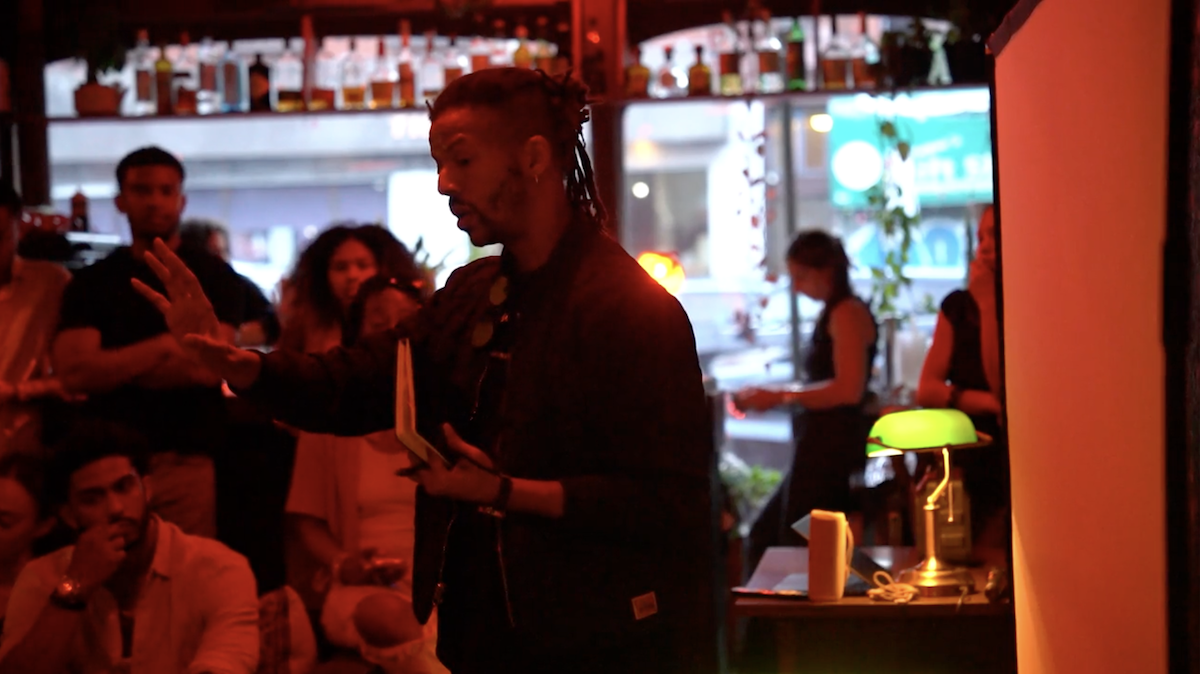 Dario Calmese addresses the audience during Cyph 001. Photo Credit: Olaide Ojekunle
On The Power of The Archive
The evening's final prompt came from William Lohier, a writer and scholar whose research explores Black speculative fiction, diaspora, and the relationship between history and imagination. Drawing from literary theory, Black studies, and the work of writers such as Saidiya Hartman and Octavia Butler, he framed archives not simply as records of the past, but as engines for imagining what has yet to come.
William Lohier
Saidiya Hartman writes about the archive as both a source of knowledge and a site of violence. Archives tell us what happened, but they also reflect the systems that decided what was worth recording in the first place. That's one reason I'm drawn to Octavia Butler. Butler understood that archives are never only about the past. They're also about the future. In her unpublished notes, drafts, and unfinished projects, you see someone constantly wrestling with history in order to imagine worlds beyond it. She used the materials of the past to speculate on entirely different futures.
Derrida makes a similar point in Archive Fever: archives are inherently tied to futurity. Every archive contains an argument about what should matter tomorrow. For Black communities especially, this raises an urgent question. If so much of our history has been excluded, distorted, or erased, how do we build archives capable not only of preserving memory but of generating new possibilities?
Calvary Rogers: One word that keeps coming to mind for me is movement. I've been reading David Bond, who argues that everything is movement. Archives, narratives, and even history are often our attempts to freeze that movement into something we can understand.
I thought about that recently when I saw a family photograph from a traumatic period of my childhood. Everyone looked happy, yet I knew there was a reality beyond the frame that the image couldn't capture. The photograph was true, but it wasn't the whole truth.
Listening to the conversation about Octavia Butler, archives, and futurity, I kept returning to Galileo's phrase, and yet it moves. Frederick Douglass later invoked that same idea when speaking about Black life and human freedom. Truth exists beyond the stories, laws, and frames we construct around it. Reality keeps moving whether we acknowledge it or not.
Delphine Diallo: I want to challenge us to stop overthinking the past for a moment.
What if imagination requires us to become a little lighter? What if the future becomes more accessible when we're not carrying all of the luggage of history?
That's why I return to Octavia Butler. She gave herself permission to imagine beyond what already existed. In my own work, I think of AI less as artificial intelligence and more as ancestral intelligence. It's a space of imagination. And imagination requires courage. You don't need permission to create a new vision. You need the audacity to pursue ideas that nobody else can see yet.
Bryant McCombs: I've been thinking about the difference between memory and memorialization. Saving our wedding photos mattered. But years later, what matters more are the memories my wife and I continue to share. Community gives memory meaning.
Morgan Ogryzek: Earlier tonight someone spoke about the pain that exists outside the frame of a photograph. I thought about a document I encountered in an archives course. It was famous for John Hancock's signature. But on the reverse side was the only known signature of an enslaved person in Massachusetts. It had been there the entire time. Someone simply had to turn the document over. What we remember is shaped not only by what is preserved, but by what is made visible.
The conversation began with a disappearing YouTube video and ended with a forgotten signature hidden on the reverse side of a historical document. Between those two moments emerged a shared understanding that archives are not merely repositories of the past but infrastructures for the future. Reflecting on the night, I keep returning to a remark made by participant Red Young: "Community is the archive. Objects matter, but people preserve meaning. If we want culture to survive, we have to keep showing up for one another."
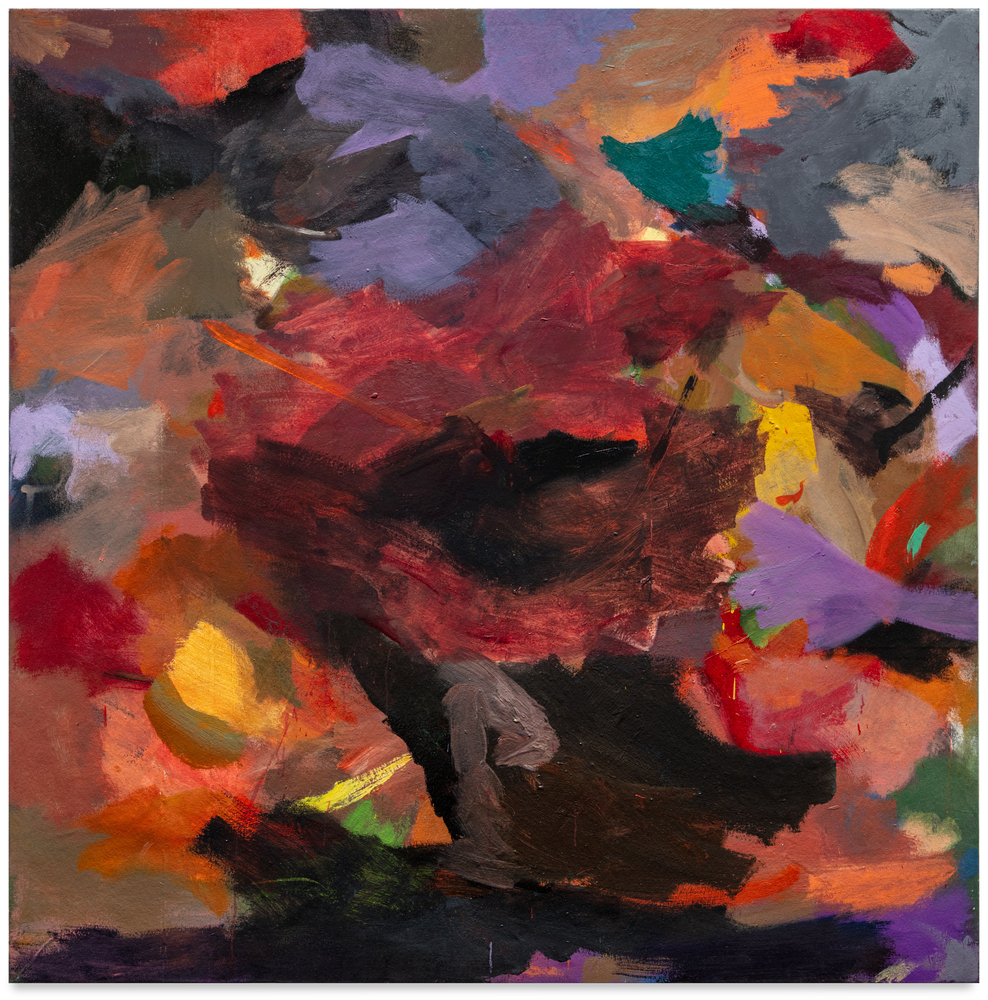 Demetrius Wilson, I Miss When the Sky Was Blue, 2021-2023. Oil on Canvas
About Cyph
Cyph is the first “underground” for the digital age, treasuring wisdom over artificial intelligence. Founded by Jalen Daniels and Bryan Cash, the emerging tech startup surfaces suppressed ideas, banned resources, and artifacts that "Big Algorithm" won't, then connects rare thinkers from around the world to excavate and engage with them through both digital platforms and intimate IRL Cyph sessions.
About Prompt & Purpose
Prompt & Purpose, a Black- and woman-founded initiative at the intersection of AI, storytelling, and culture, convenes artists, technologists, and communities to explore how AI can expand creative expression while remaining grounded in human values. Founded by Alexia Adana and with programming led by Terrell Estime, the initiative brings together perspectives from art, technology, and business through hackathons, applied learning sessions, and public conversations.

Emann Odufu
Emann Odufu is an independent art and culture critic, filmmaker, and curator from Newark, New Jersey, whose work explores contemporary art and Black visual culture through Afro-Futurism, narrative, and cultural memory. His writing and creative work has appeared and been featured in The New York Times, HuffPost, Paper Magazine, Office Magazine, and The Brooklyn Rail, and his curatorial practice includes exhibitions at the Liu Shiming Foundation, National Arts Club, MoCA Westport, Friedrichs Pontone Gallery, and Leila Heller Gallery. He has spoken at Harvard University, Yale University, the British Film Institute, and the National Academy of Design.
view all articles from this author