Whitehot Magazine
August 2026
"The Best Art In The World"
"The Best Art In The World"
August 2026
Georgia-May Travers Cook Masters the Art of Suspense
By MARGARET RAND June 13th, 2026
Tucked away in the back streets of East London’s Aldgate neighborhood, Union Pacific’s gallery space has been transformed into an eerie Victorian farmhouse. Upon arrival, viewers are met by a large wooden structure spanning the gallery’s storefront that obscures the exhibition beyond. A singular dusty window hangs half-open, inviting passersby to peer inside.
Operating in a trompe-l'œil fashion, the window frames Dusk House (2026), a painting of a three-story Victorian house whose white clapboard exterior echoes the Americana-style porch constructed within. The installation sets the tone for the exhibition inside: in each painting, the viewer is offered an uncanny glimpse into a moment of time, but never the complete story.
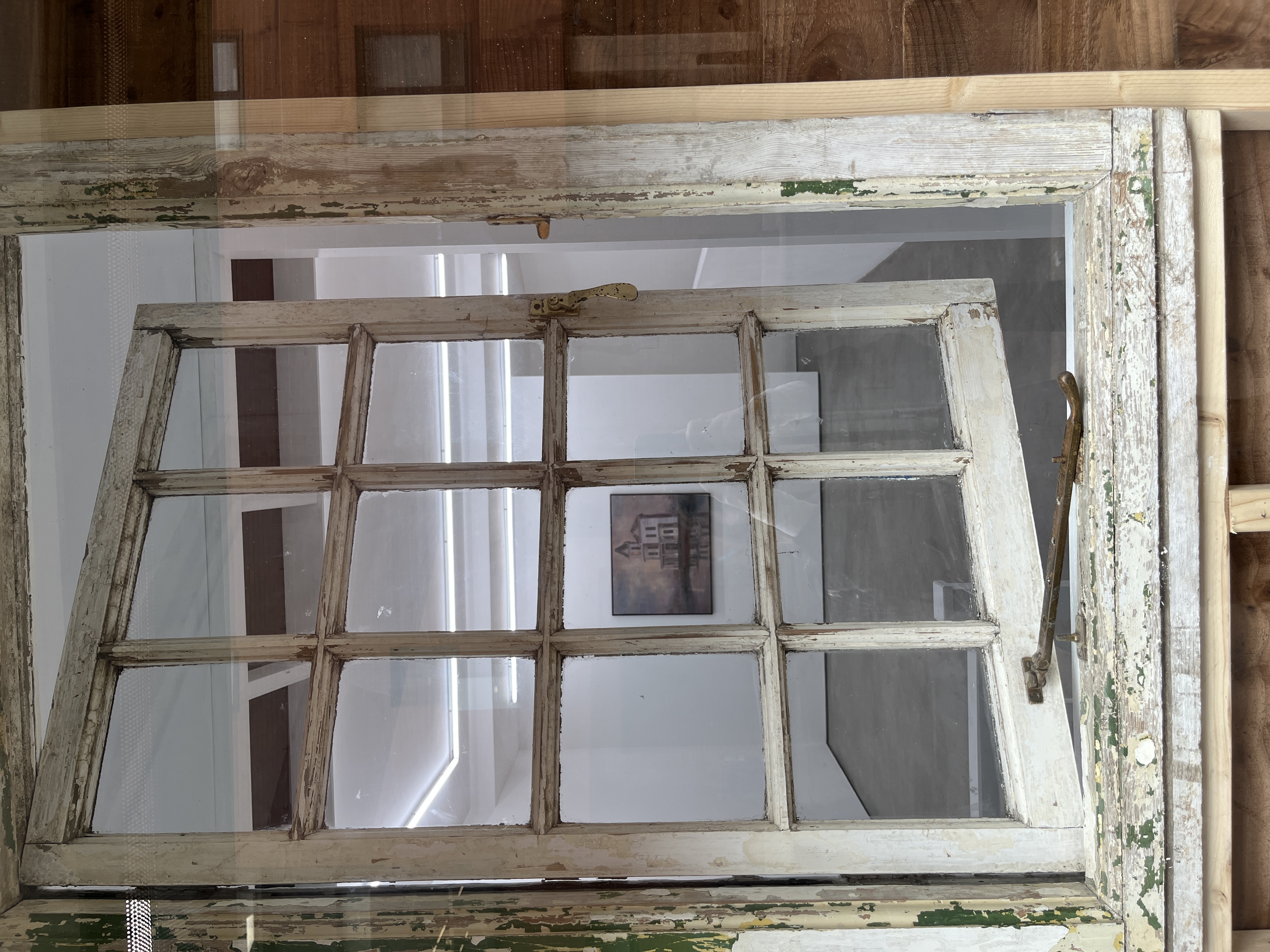 Window in Union Pacific’s storefront, framing Dusk House, 2026
In her first London solo exhibition, Georgia-May Travers Cook resists tight narratives and holds her viewers in a state of suspense. The exhibition draws inspiration from Picnic at Hanging Rock, a 1975 Australian mystery film the artist watched on repeat with her grandmother growing up. Based on a 1967 novel by Joan Lindsay, the film tells the story of three schoolgirls and their teacher who disappear without explanation during a field trip to the volcanic rock formation. The mystery remains unresolved, leaving viewers to make their own interpretations amidst the film’s dreamlike cinematography and hazy summer landscapes.
In her exhibition Picnic Lightning, Travers Cook adopts a similar strategy. While the distinctly American front porch initially grounds the show in what seems like a cohesive throughline, the paintings themselves resist belonging to any single place, period, or narrative. Instead, each work offers fragments to a larger, unseen story, drawing on sources as varied as British folklore, fiction, cinema and personal memory, while withholding the context needed to fully decipher it.
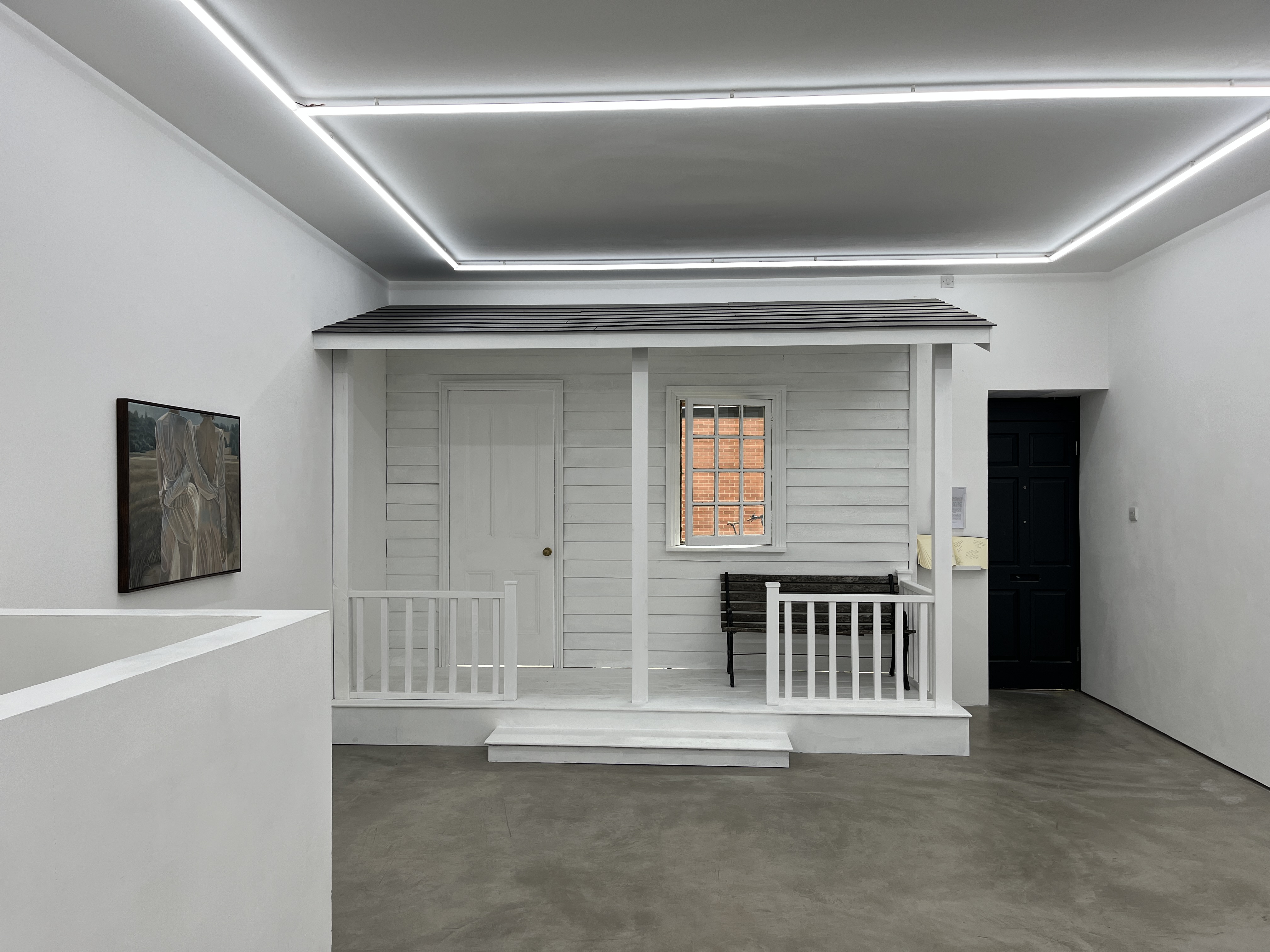 Installation view of Picnic Lightning
In The Wrong Side of the Window (2026), a whimsical tent glows from within, revealing only the silhouettes of unseen guests. Surrounded by dense foliage and enveloped in twilight, the scene possesses the unsettling enchantment of a fairy tale. Across the wall, two women in satin dresses stand side-by-side in a windswept landscape. Their semi-translucent gowns, with puffed sleeves and Victorian silhouettes, simultaneously evoke the Southern Gothic aesthetic in the film, while nodding to the history of British literary and visual culture.
When I spoke with Travers Cook in the days following the opening, she described the lateral references entangled in the scene. By capturing the two subjects from behind, she sought to imbue a voyeuristic quality, as if the viewer was “stepping into a painting.” Recalling Alfred Hitchcock films, the use of the rear-view figure resonates here. She also spoke of her longstanding affinity for Victorian literature, recalling an early obsession with Jane Eyre. This connection also feels apt. My own response to the painting was also shaped by the same heightened romanticism I had recently seen in Emerald Fennell’s adaptation of Wuthering Heights.
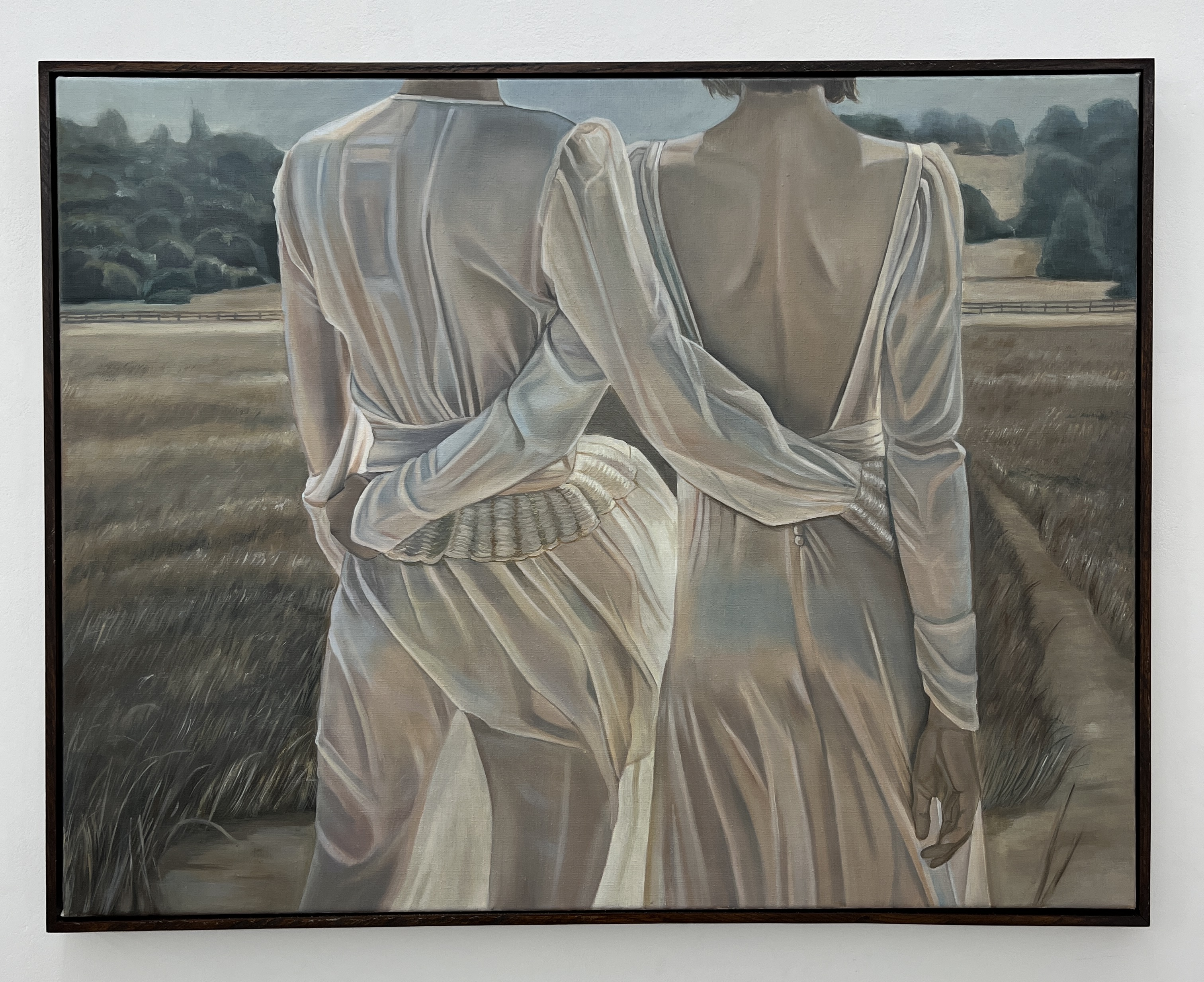 Secret Ways, 2026
Downstairs, Still Day, Reddening Sky (2026), the largest painting in the exhibition, depicts six black swans floating upon a crimson pool. The scene is at once quiet and foreboding: the blood-red water and dark birds suggest an impending event, yet no clear drama unfolds. Across, Interior with Knives (2026) illustrates a domestic kitchen scene: white pleated curtains partially cover a large window, halfway tied up with large bows to reveal endless corn fields outside. At first glance, the composition appears to be an elegant still life, but a row of kitchen knives quickly unsettles the quiet scene. By resisting a complete narrative, Travers Cook leaves space for viewers to project their own memories and interpretations onto the scenes before them.
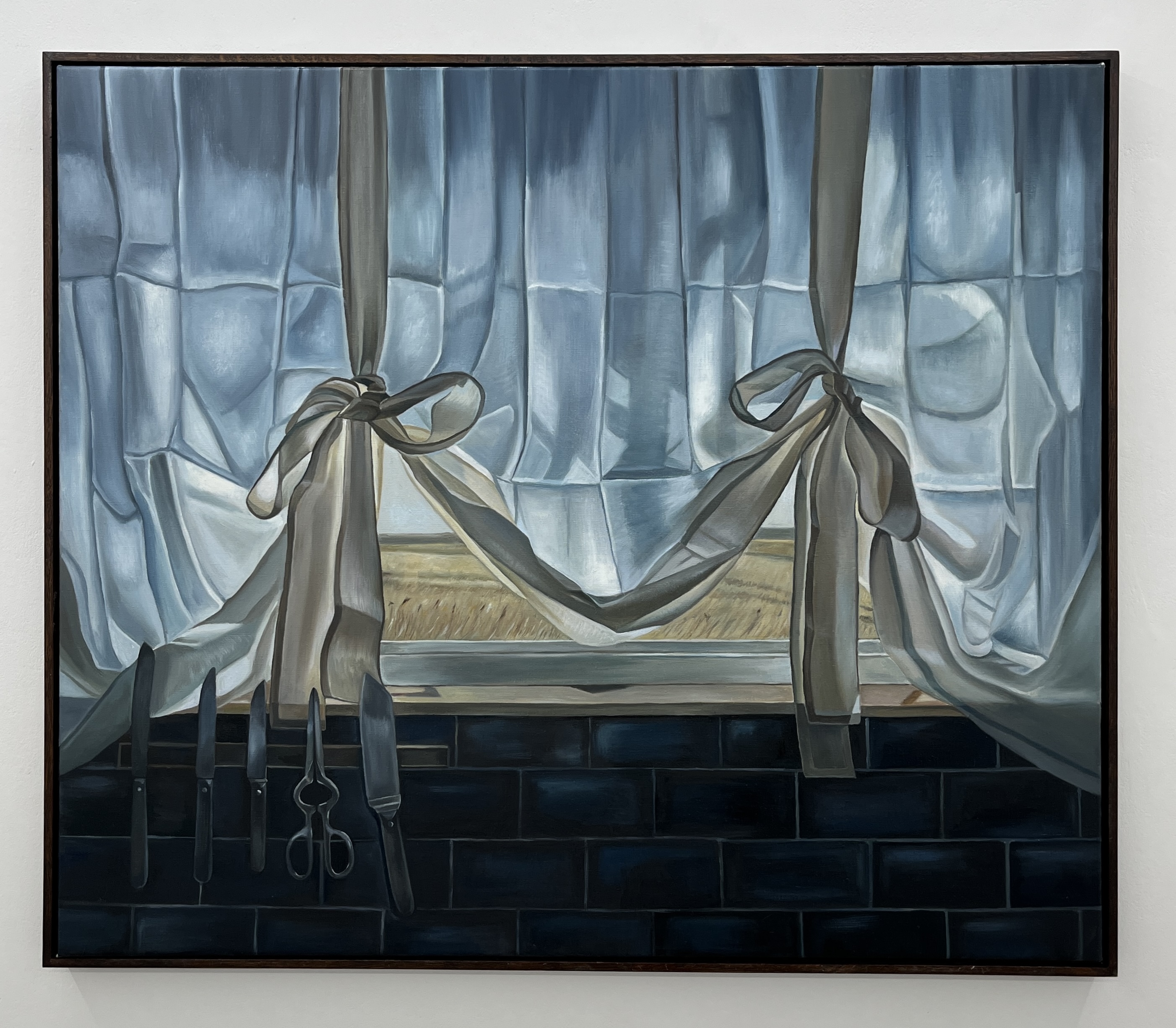 Interior with Knives, 2026
This approach places Travers Cook within a broader lineage of contemporary painters who draw upon cinema to cultivate psychologically charged compositions. UK-based contemporary artists like Joseph Yaeger and Louise Giovanelli likewise borrow cinematic framing and ambiguity to construct images that feel both familiar and elusive. Yaeger’s watercolour-on-gessoed-canvas technique lends his scenes a dreamlike, hazy quality that unmoors them from their original sources, while Giovanelli isolates and crops recognisable imagery to decontextualize and forge new meanings. Even though Travers Cook’s compositions share a similar atmospheric resonance, they are less concerned with psychological realism than with the space between narration and imagination. Her paintings feel suspended in time, like film stills. The result is an exhibition that explores what remains unresolved, rather than what is depicted, inviting her viewers’ imaginations to fill the gaps where narration gives way to memory and speculation.
Picnic Lightning runs from June 6 — July 11, 2026 at Union Pacific.
Margaret Rand
Margaret Rand is a New York–born art advisor, researcher, and writer currently based in East London. She moved to the UK in 2023 to pursue a Master’s degree at the Courtauld Institute of Art after earning a BA in Art History and Journalism from Georgetown University. Her academic research focused on the materiality of postwar and contemporary painting, with particular attention to the practices of artists such as Carla Accardi, Julie Mehretu, Cecily Brown, and Firelei Báez. Today, she continues to explore the material practices of emerging artists across the London and New York art scenes, while working as a researcher for an art advisory firm.
view all articles from this author