Whitehot Magazine
October 2026
"The Best Art In The World"
"The Best Art In The World"
October 2026
Interview: Japanese street artist Lady AIKO on her exhibition "In Transit" at Wynwood Walls, Miami
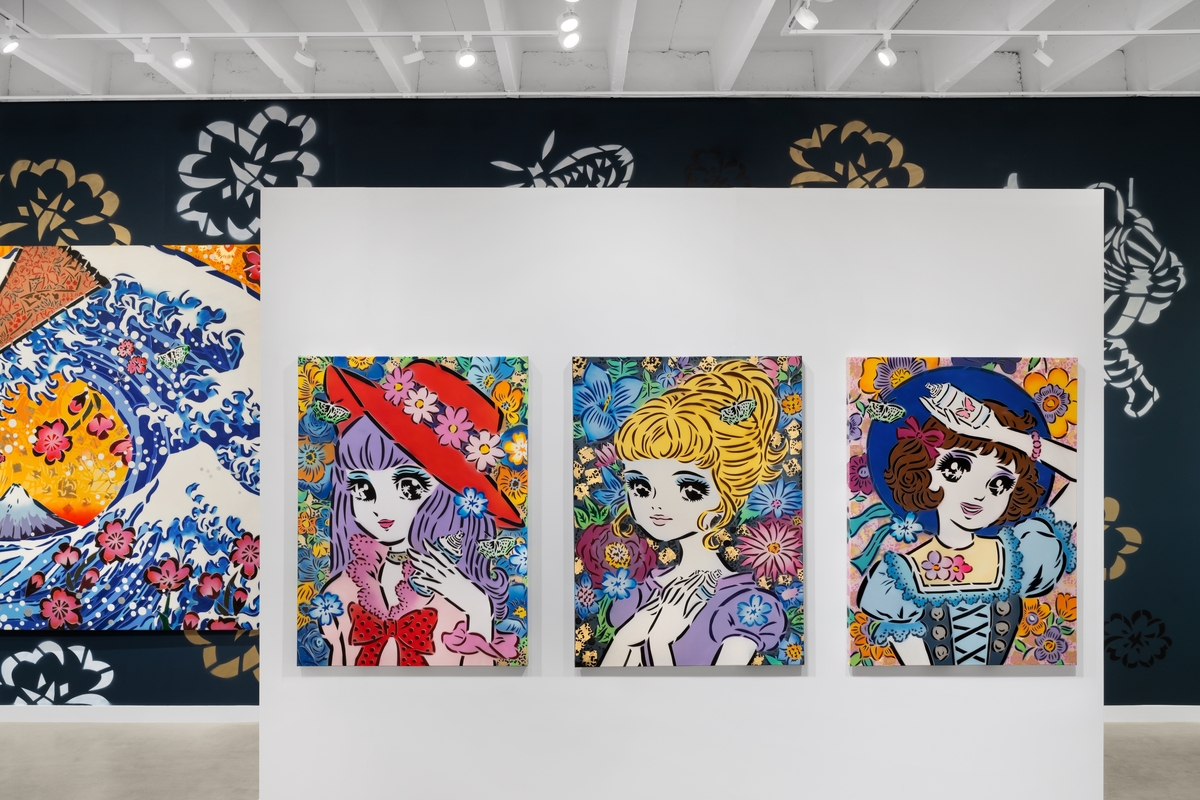 Installation view of Lady AIKO: In Transit at Wynwood Walls, Miami, Florida (on view through November 16, 2026). Photo credit: Zachary Balber. Image courtesy of Resnicow and Associates.
By LIAM OTERO, October 28, 2026
Since the 1990s, Japanese artist Lady AIKO has been leaving her mark - figuratively and literally - in the international street art scene. From working in the studio of Superflat pioneer Takashi Murakami to collaborating with Banksy, Lady AIKO has carved out a career where she has developed a signature style of street art that is uniquely her own; she combines popular culture with traditional Japanese aesthetics and contemporary flourishes of color, pattern, and mark-making. AIKO's lengthy career has taken her around the globe - from Tokyo and New York to London and Los Angeles - amounting to an impressive CV that includes commissions from former First Lady Michelle Obama, Louis Vuitton, and FENDI. Her exhibition history is just as incredible given her inclusion in shows at Jeffrey Deitch Gallery, Saatchi Gallery, the United Nations, Brooklyn Museum, Shanghai MOCA, and more.
AIKO is currently the subject of a major show in Miami, Florida at Wynwood Walls, an open-air street art museum founded in 2009. Here, she is exhibiting a new series of work that builds upon her accomplished practice through stencils, striking colors, and mixed media elements. Essentially, she is suffusing the language of street art into the painter's realm.
On the occasion of her solo exhibition In Transit (on view through November 16, 2026), I conducted an email interview with AIKO to learn more about her current artistic direction along with further details about her exhibition at Wynwood Walls.
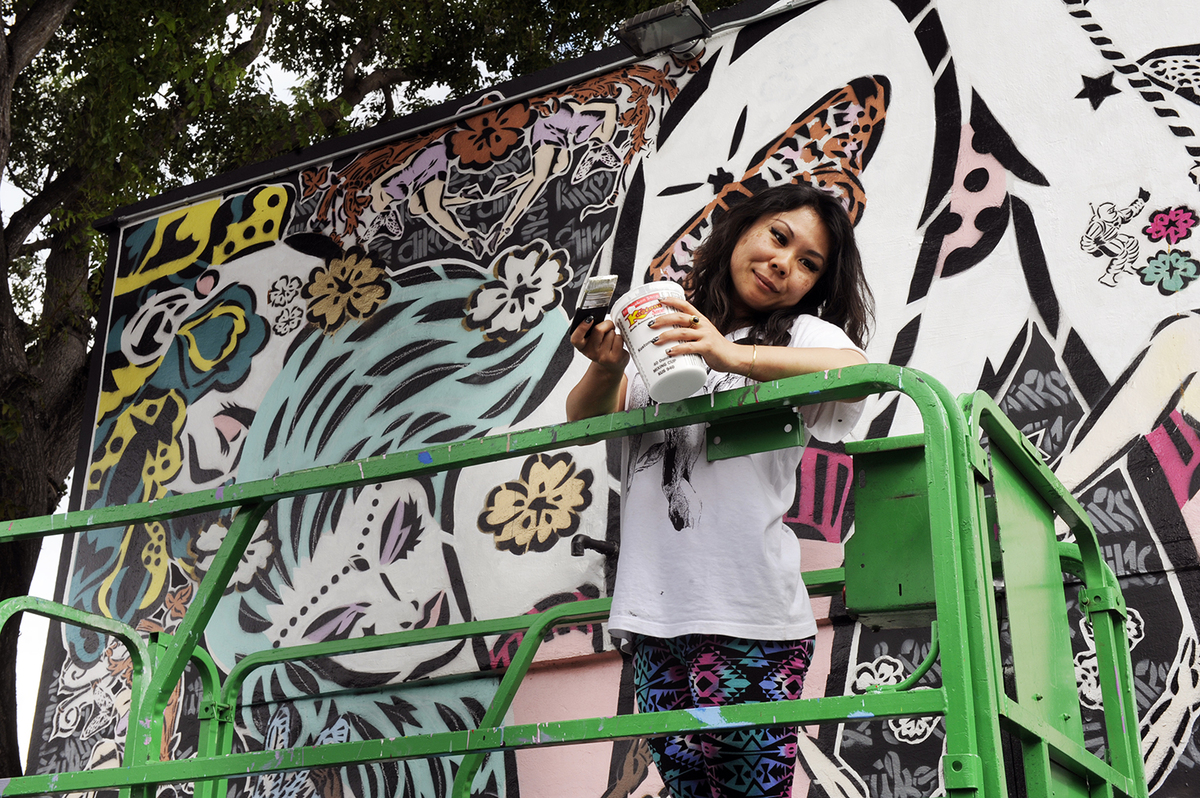 Headshot of Lady AIKO. Image courtesy of Resnicow and Associates.
Your latest project at Wynwood Walls marks a new development in your artistic practice through the adoption of multiple mediums. What sparked this desire to shift away from murals and toward these elaborate paintings?
I don’t necessarily see it as moving away from murals, but rather as expanding what my practice can be. From 2020 until this summer, I had a massive studio on top of the World Trade Center, where I spent most of my time working on large-scale canvases and developing my studio practice. During the pandemic era, the timing felt guided by the universe and destiny, moving me into the next chapter of my artistic journey.
Murals and street art belong to the city, to the people who pass by them, and to the moment in which they exist. A painting allows me to spend more time with an image and discover things I might not have noticed when working on a wall. With In Transit, I’m interested in creating something more intimate without losing the energy of the street. I bring together different materials, textures, and imagery to create layers that reveal themselves gradually. Gold leaf, collage, stencils, and painting each have their own character, allowing me to build a different kind of visual experience.
For me, this isn’t about abandoning one medium for another. It’s about giving myself permission to keep experimenting. After so many years of making art, I think it’s important to remain curious and not become too comfortable with what people already recognize as my style.
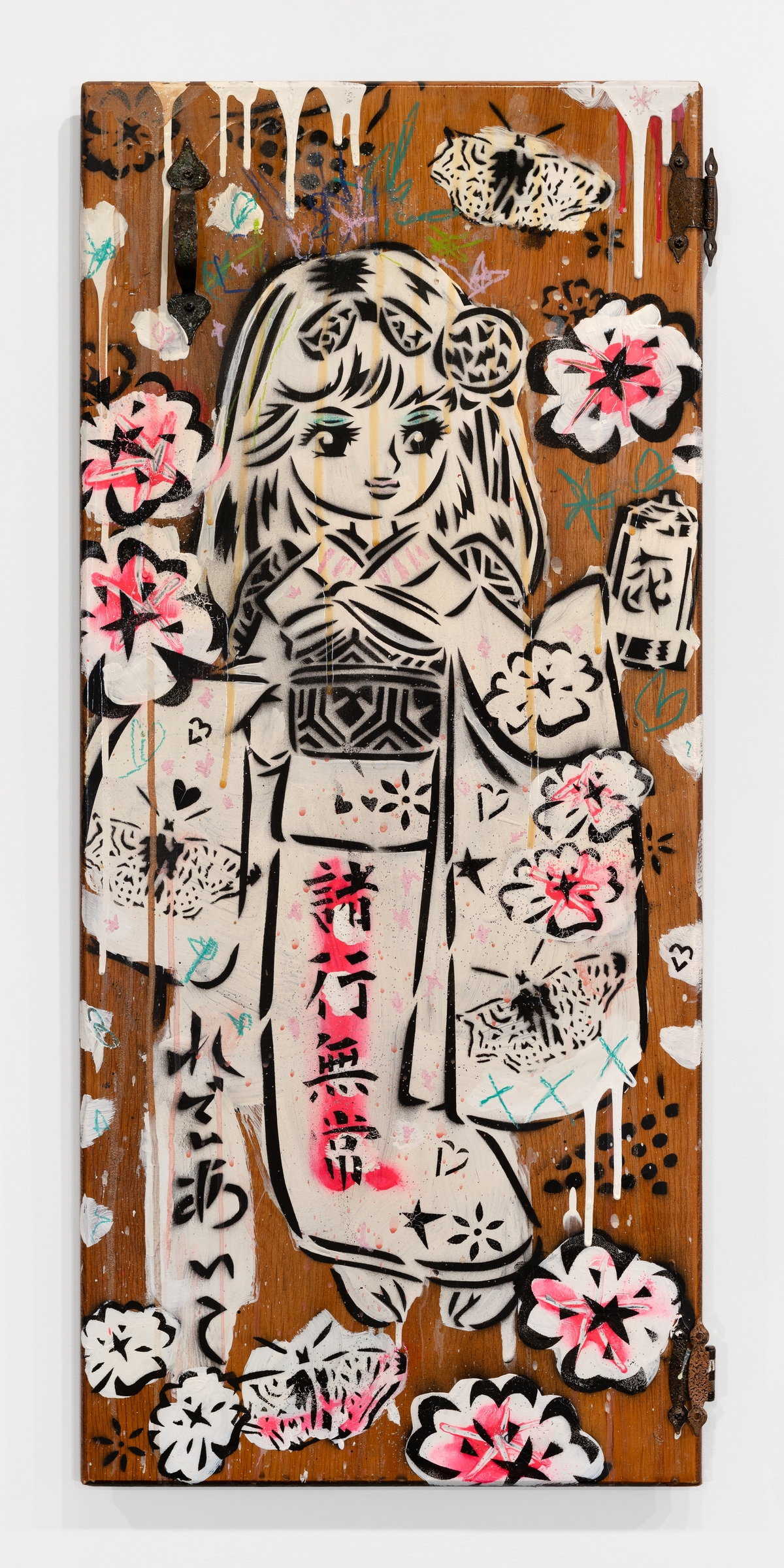 Lady AIKO, Kimono Girl on a Wooden Door, 2011, mixed media on antique cabinet door. 36 x 16 inches. Image courtesy of Resnicow and Associates.
Recurring iconography has been one of the defining features of your work, which persists in the In Transit series. How do you determine which subjects are worth repeating across multiple works, such as the rabbit or the kissing woman?
Some images stay with me because they continue to hold different meanings as my life changes. I don’t always know what an image will become when I first create it. Sometimes it begins as something playful or instinctive and, over time, becomes connected to a much larger personal experience.
The bunny, for example, became an important symbol in my development as an independent artist. It was created in 2005 at Banksy’s studio in London, and from there, it traveled with me and was sprayed around the world. It grew beyond a single character and became associated with my own identity, independence, and freedom.
The kissing woman carries a different kind of energy. For me, intimacy, desire, femininity, and human connection are subjects that can be explored in many different ways. These girls and romantic stories are part of my fantasy world. Through painting, I can be anyone and do anything. I think repeating an image is like graffiti tagging or sampling in music. You return to it because it still has something to say. I don’t want to repeat something simply because people recognize it or expect it from me. I want to see what happens when I place that image in a new environment, change its scale, surround it with different colors, or combine it with other symbols.
My stencils are cut by hand, so I’m not simply reproducing the same image over and over. Each one is different. Unlike machine-produced stencils, mine carry the physical trace of my own hand. I cut every shape with a knife and spray it myself, without assistance. That process is an essential part of my practice, and no machine can replicate the exact way I work.
Yayoi Kusama has painted millions of dots with her brush; I have cut millions of shapes with my knife and sprayed by hand. There is a kind of devotion in that repetition, but every cut and every composition is different. The image may remain recognizable, but my relationship with it continues to evolve.
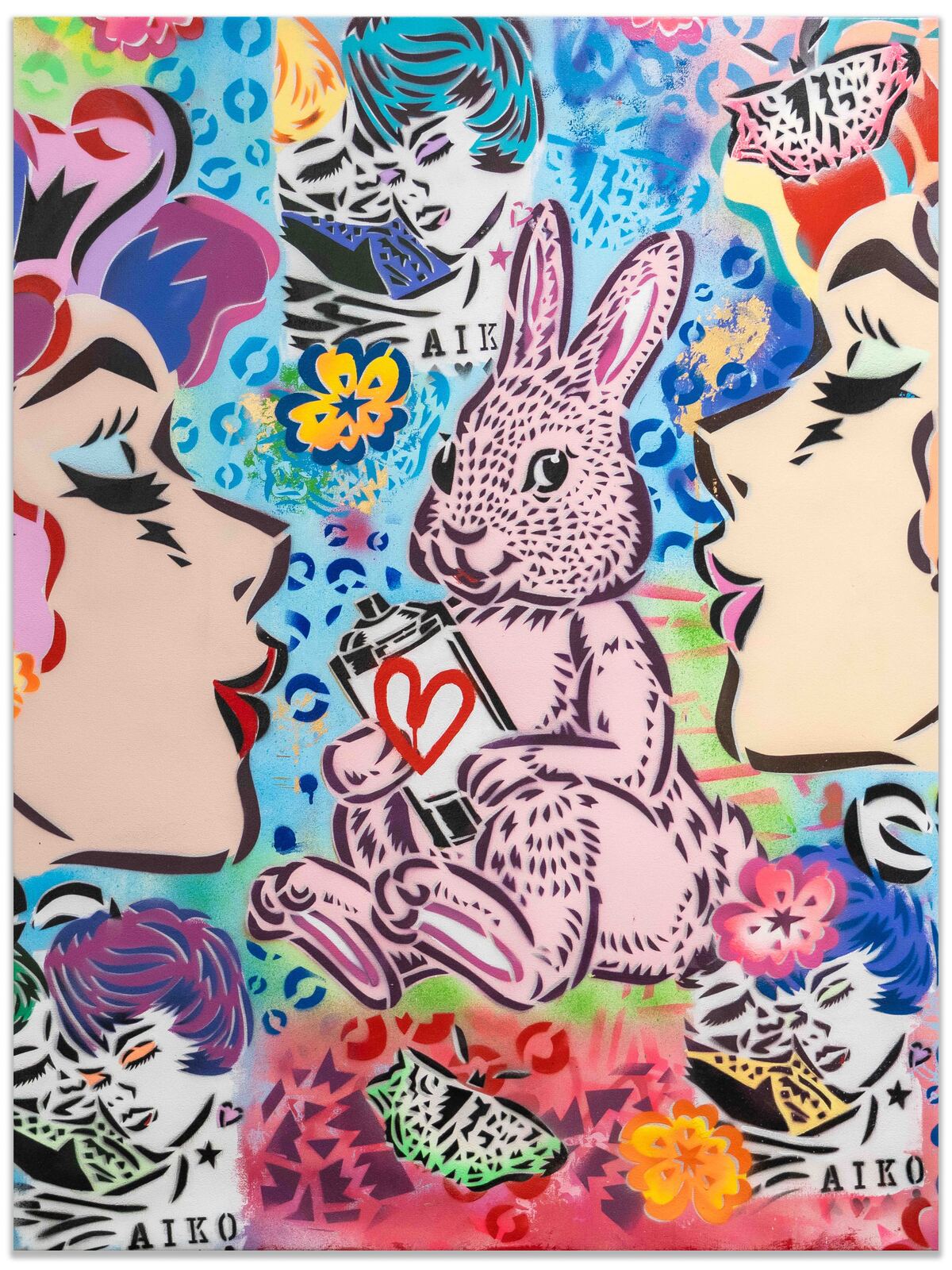 Lady AIKO, Bunny Rainbow Chant / Pink, 2026, mixed media and gold leaf on canvas. 48 x 36 inches. Image courtesy of Resnicow and Associates.
What determines the importance of a repeated image without it becoming overused or its meaning becoming diluted?
Repetition is not necessarily about using an image too many times. It’s about how much life you can continue to give it. In graffiti, repetition is part of the language. You repeat a name, a mark, or a symbol until it becomes recognizable, but the act of repeating it is also a way of claiming space and making your presence known.
I think the same thing happens in my paintings. An image can become a signature, but it should never become an empty logo. I need to keep discovering something through it. Sometimes that discovery comes from changing the composition; sometimes it comes from the material, the color, or the relationship between one image and another.
Because I cut my stencils by hand, repetition is also a physical process. It requires time, concentration, and commitment. Even when I return to the same motif, the handmade process means that the result is never completely mechanical or identical.
I also believe that meaning changes as the artist changes. The Bunny I created years ago carries my history, but it can take on a different feeling when I place it in a new painting today. I don’t want to control every interpretation. I want the image to remain open enough for people to discover their own meanings. As long as I’m still curious about an image, I don’t think it has lost its power.
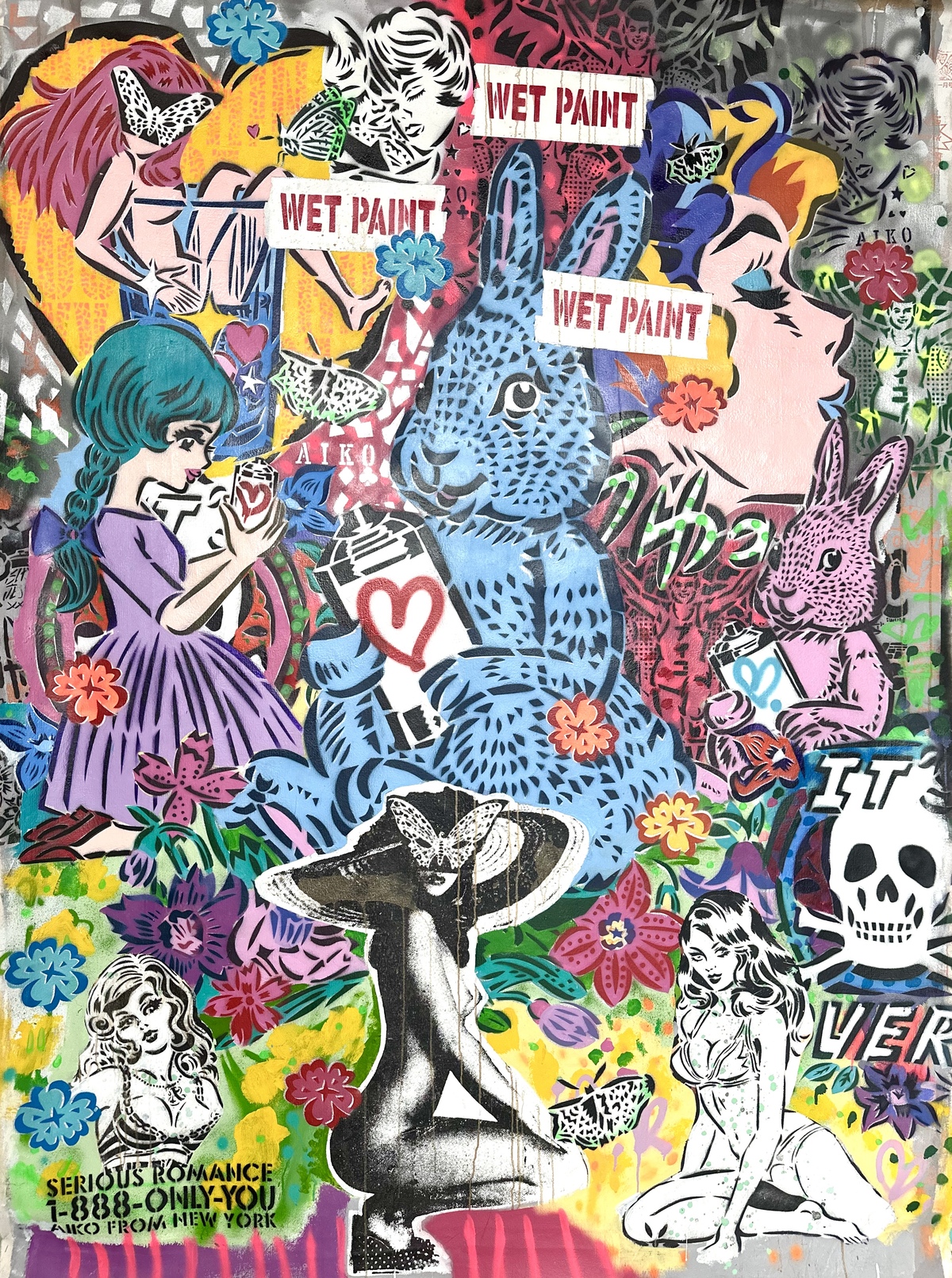 Lady AIKO, Bunny and Beautiful Girls / Blue Bunny, 2026, mixed media and silkscreen print on canvas. 93 x 69 inches. Image courtesy of Resnicow and Associates.
Are the subjects and motifs in these works sourced from other materials, imagined by you, or a bit of both?
It’s a combination of both. I’m influenced by the visual world around me, including traditional Japanese art and popular culture, fashion, magazines, photography, advertising, and the imagery that surrounds us every day. Growing up in Tokyo, living and working in New York, and traveling around the world have exposed me to many different visual languages. Those influences continue to come together in my work.
I also draw from my imagination, personal experiences, memories, and emotions. Sometimes an image begins with something I see, but it changes as I work with it. I might simplify it, exaggerate a gesture, change its proportions, or combine it with something completely unexpected. I’m interested in how images circulate through culture and how their meanings change when we take them out of their original context. A familiar image can become something new when it is placed next to another image or transformed through a different material.
For me, making art is partly about collecting these visual experiences and creating my own language from them. The finished work is not simply a reproduction of what I have seen. It is the result of how I interpret, transform, and sometimes completely reimagine those influences.
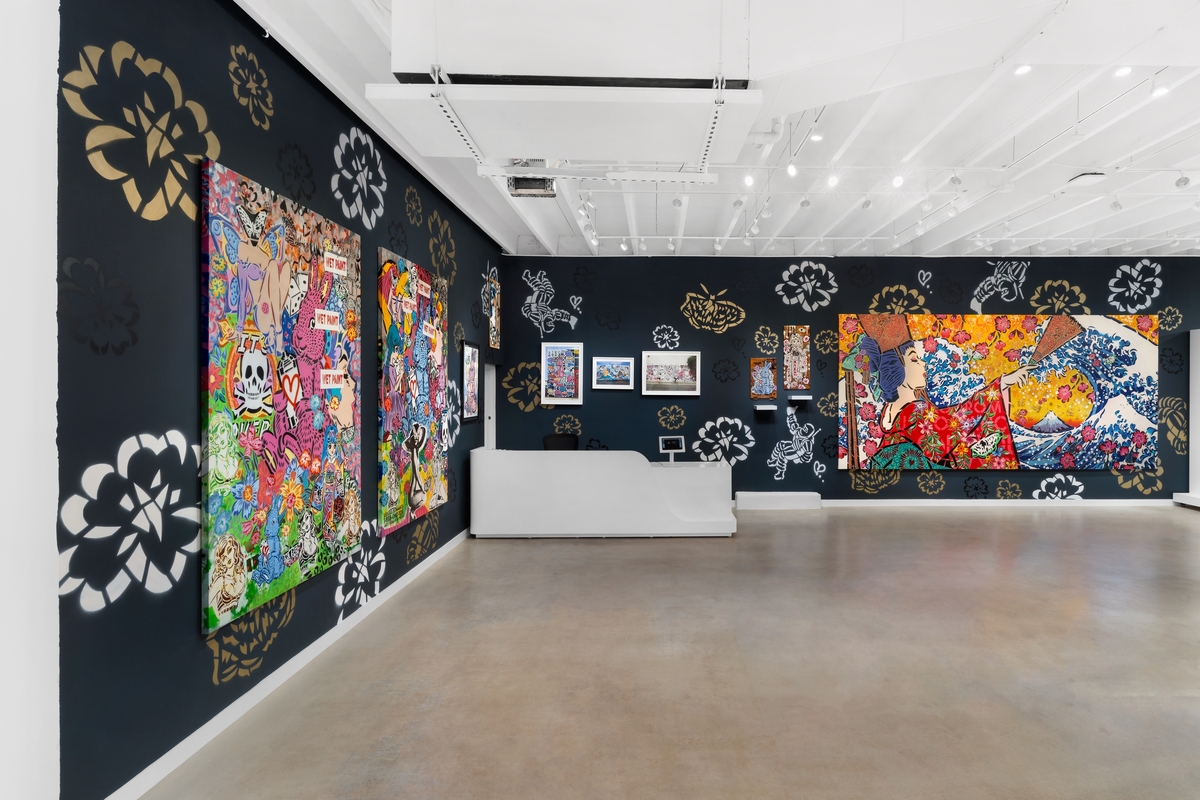 Installation view of Lady AIKO: In Transit at Wynwood Walls, Miami, Florida (on view through November 16, 2026). Photo credit: Zachary Balber. Image courtesy of Resnicow and Associates.
As someone whose career has been built around murals and street art, how has that experience informed your approach to contemporary painting?
Street art has taught me to think about the relationship between an image and its environment. When you work on a wall, you have to consider the architecture, scale, light, surrounding neighborhood, and people who will encounter the work. You’re making something that exists in a public space, often without the audience having planned to see it.
That way of thinking remains important to me when I paint on canvas or work in the studio. I don’t think of a painting as an isolated object. I think about how the different elements occupy space, how the eye moves through the composition, and how the work communicates with the viewer.
My experience with stencils and spray paint has also influenced how I build images. I enjoy working with clear silhouettes, bold graphic shapes, repetition, and strong contrasts. But painting gives me the opportunity to slow down, add layers, introduce more delicate details, and experiment with materials that behave differently from those used on a wall. Street art has given me a certain directness. It has taught me to trust an image and allow it to communicate immediately, while the studio allows me to complicate that first impression. I enjoy bringing those two approaches together.
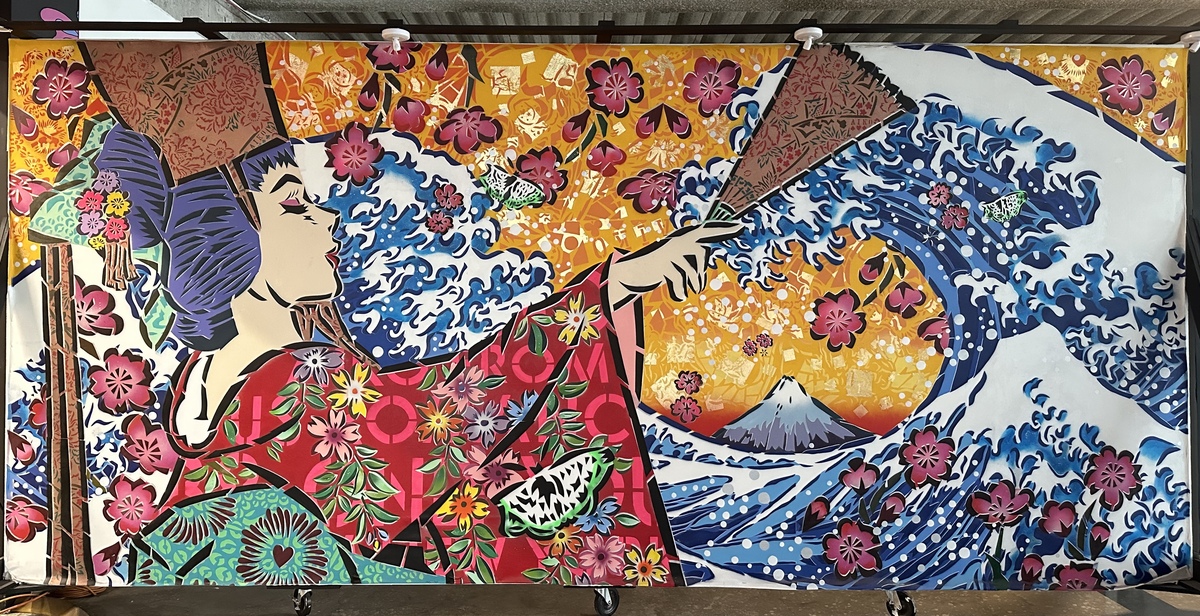 Lady AIKO, Hanako's Dance, 2026, mixed media and gold leaf on canvas. 87 x 192 inches. Image courtesy of Resnicow and Associates.
Having started your career working in the studio of Takashi Murakami, the Superflat ethos has been a major part of your style. In what ways are you adapting or reimagining it through a non-street-art approach?
Spending time with Takashi Murakami exposed me to a way of thinking about images that brings together fine art, popular culture, commercial imagery, and Japanese visual traditions. That experience was important to my development, but I have always wanted to build a visual language that reflects my own experiences and interests. I think the relationship between high art and popular culture remains relevant to my work. I’m interested in images that are immediately accessible but can also carry more complicated meanings. A playful character or a beautiful, colorful composition can invite someone into a work before they begin to consider its deeper associations.
In the studio, I can explore that relationship through materials and physical depth. Paper collage, gold leaf, painted surfaces, and stencils create differences in texture that complicate the graphic quality of the image. Rather than relying only on visual flatness, I can introduce more tactile and layered experiences.
I don’t think of this as leaving one artistic philosophy behind. I see it as taking what has influenced me and allowing it to develop through my practice. My Japanese background, experiences in New York and around the world, and history with street art all contribute to the work, but none of them alone defines it.
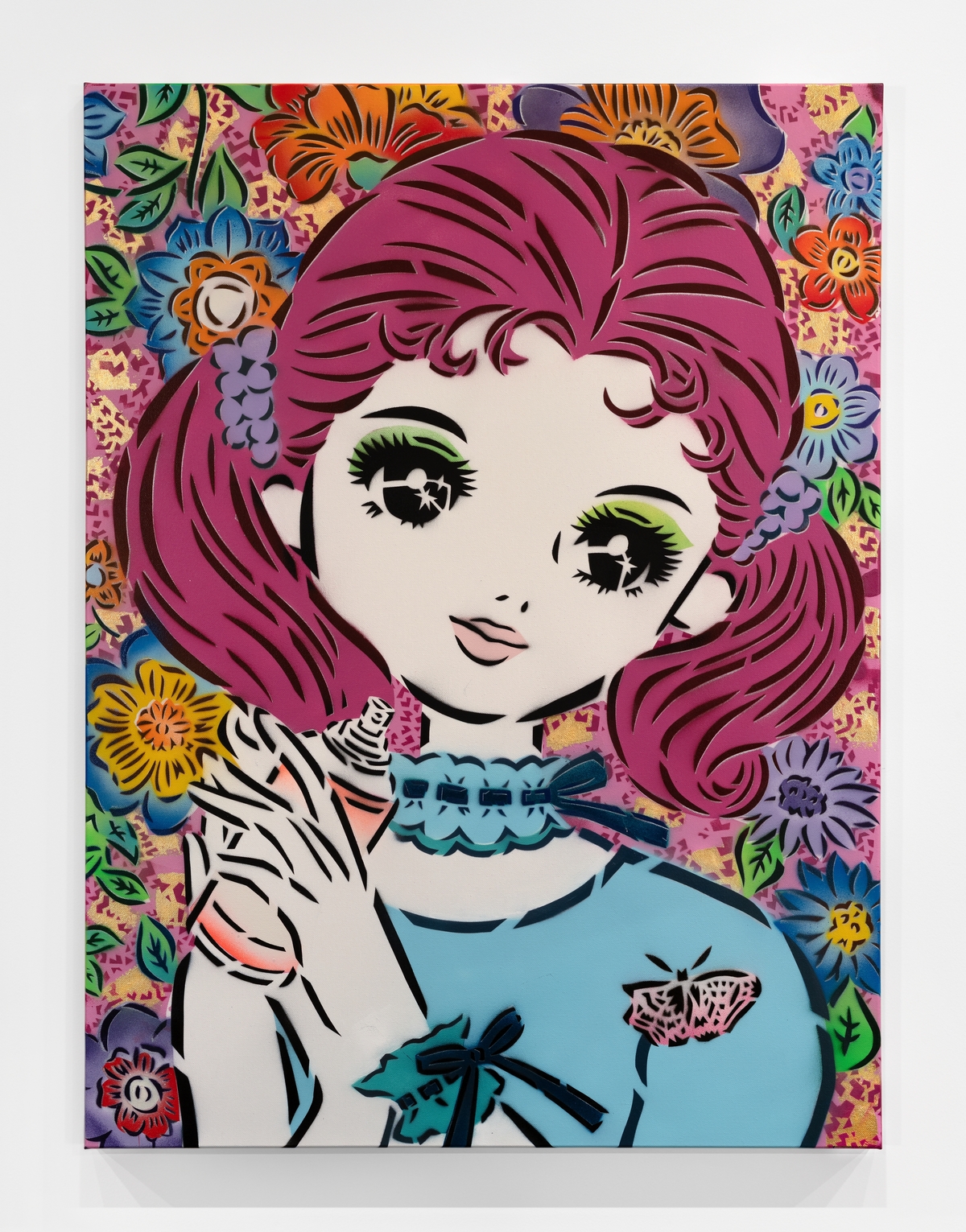 Lady AIKO, Tokimeki - San, 2026, mixed media and gold leaf on canvas. 40 x 30 inches. Image courtesy of Resnicow and Associates.
The street art scene has grown more diverse in gendered representation, with artists such as Lady Pink, SWOON, and yourself playing important roles. However, gallery and museum exhibitions in large part still seem to cling to a male-centric focus. As a female Japanese street artist, how do you perceive this in 2026?
I think visibility has improved, but visibility and equality are not the same thing. Women have been making important contributions to graffiti and street art for decades. Artists such as Lady Pink and SWOON have helped demonstrate the range, ambition, and significance of women’s practices. There are also many other women whose work deserves recognition within the broader history of the movement.
The challenge is not simply getting women into exhibitions. It’s making sure their work is taken seriously, collected, discussed, and included in the histories that institutions create. We have to ask who gets represented as influential, whose work receives sustained critical attention, and who is given opportunities to develop a career over time.
As a Japanese woman who has built a career internationally, I’ve also experienced how identity can influence the way people interpret an artist’s work. Sometimes people focus on your gender or cultural background before they discuss your ideas, techniques, or artistic decisions. Those identities are part of who I am, but they are not the entirety of my practice.
I want to see a world in which women can make ambitious, challenging, commercially successful, or unconventional work without constantly having to prove that they belong. I also want younger artists to see a broader range of possibilities for themselves. Ultimately, the goal should not be to replace one narrow definition of the art world with another. It should be to create a more complete understanding of who has contributed to contemporary art and whose voices we still need to hear.
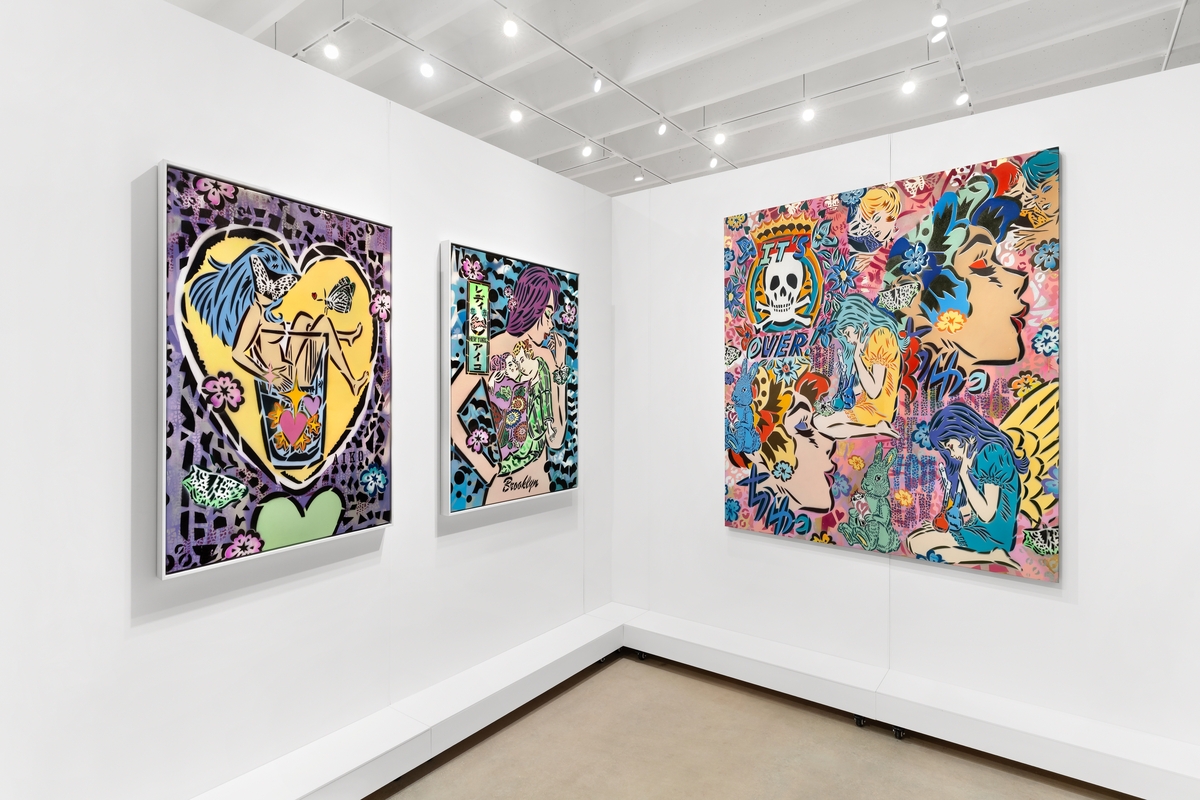 Installation view of Lady AIKO: In Transit at Wynwood Walls, Miami, Florida (on view through November 16, 2026). Photo credit: Zachary Balber. Image courtesy of Resnicow and Associates.
What attracts you to Miami, and what has led to this sustained relationship with the beachside city since your 2009 mural at Wynwood Walls? Now that you have adopted techniques like gold leaf and paper collage for your work, are there other media or approaches you wish to explore for future projects?
Miami has a very particular visual energy. It brings together different cultures, languages, architectural styles, music, fashion, and forms of self-expression. There is a sense of color and movement that feels especially compatible with my work, but what interests me most is the way those influences coexist.
Wynwood has also been an important place for the development of contemporary street art. When I first painted there in 2009, the neighborhood and the surrounding art community were part of an evolving conversation about how street art could occupy public space and connect with a wider audience. Returning to Miami allows me to think about how both the city and my own practice have changed.
I’m interested in the relationship between an artwork and the place in which it is experienced. A mural becomes part of a neighborhood, while a painting can travel to a gallery and be encountered by people who have never visited the location where it was created. Moving between those contexts gives me new ways to consider what my work can communicate.
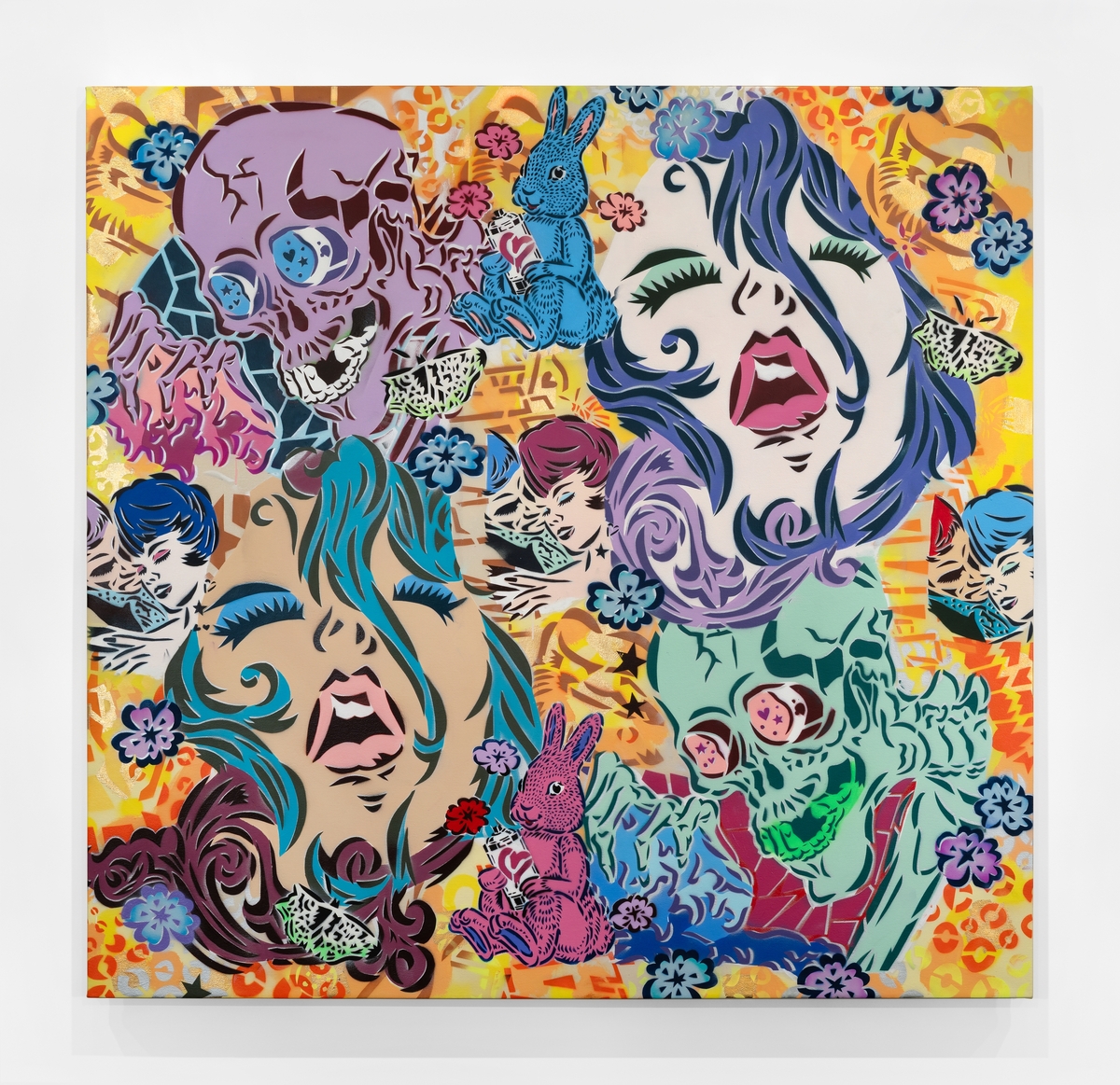 Lady AIKO, Bunny's Mantra / Yellow Background, 2026, mixed media and gold leaf on canvas. 63 x 63 inches. Image courtesy of Resnicow and Associates.
As for materials, I want to remain open. Gold leaf and paper collage offer possibilities that are different from spray paint, but I’m interested in seeing how far those relationships can go. I could imagine exploring more sculptural elements, different printing techniques, unusual surfaces, or ways of incorporating objects into my compositions.
I don’t want to choose a new medium simply because it is fashionable or commercially appealing, or because I feel that I need to reinvent myself. I want the material to have a reason to be there. Sometimes the right material emerges from the idea, and sometimes experimenting with a material leads me toward an idea I hadn’t considered before.
The most exciting part of continuing to make art is that there is still so much I haven’t tried. I want to keep the freedom to move between the street and the studio, between large public works and more intimate paintings, and between familiar imagery and new discoveries. I don’t see my practice as arriving at a final destination. I see it as remaining in transit. WM

Liam Otero
Liam Otero is a freelance art writer in NYC. He was recently named New York Editor of Whitehot Magazine.
view all articles from this author