Whitehot Magazine
September 2026
"The Best Art In The World"
"The Best Art In The World"
September 2026
Tracy Weisman: Some Birthday, America
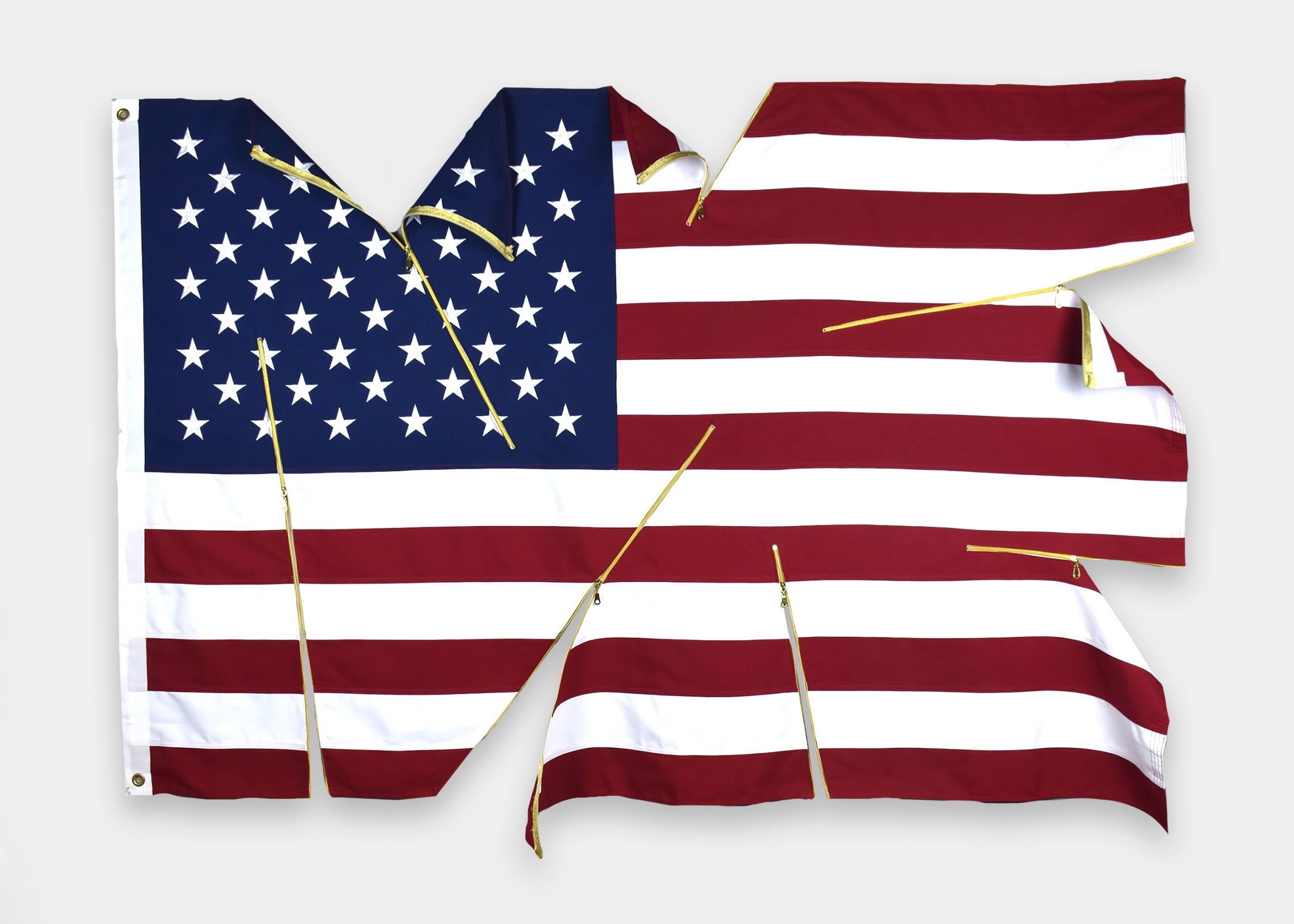 Tracy Weisman, Some Birthday, America, 2026, textile: cotton American flag, zippers, 48 × 72 in. Photo by Madison Van Wylen
By Kate Hoag, June 8th, 2026
For two decades, Tracy Weisman was a speechwriter who used metaphor, emotion and storytelling to help her clients connect with their audiences. Now she uses those same skills as an interdisciplinary artist, turning found objects, textiles, and familiar American symbols into pieces that encourage viewers to pause, reflect, and question.
"Speech writing shaped me profoundly as an artist," Weisman says. "It trained me to think deeply about audiences, emotional architecture and the weight that language carries in public life."
"As a visual artist, I still tell stories, but they're mine," she continues. "And instead of words, I use materials, symbols and physical space to communicate."
This idea is at the heart of Some Birthday, America, her upcoming solo show at CUSP Gallery in Newport, Rhode Island. The exhibition is an unflinching portrait of America on its 250th birthday that lays bare the tension between patriotism and disillusionment. The artist’s mixed media works that use altered flags, textiles, and American ephemera came together over time.
"Looking back at the work I’d been making during the past year, I realized I had a recurring visual language of red, white, blue and black, almost as though I were designing a couture collection," Weisman observes. "That consistent tension between patriotism and unease is the impetus for Some Birthday, America. To me, our country's 250th is more solemn than celebratory, and I know others feel the same.”
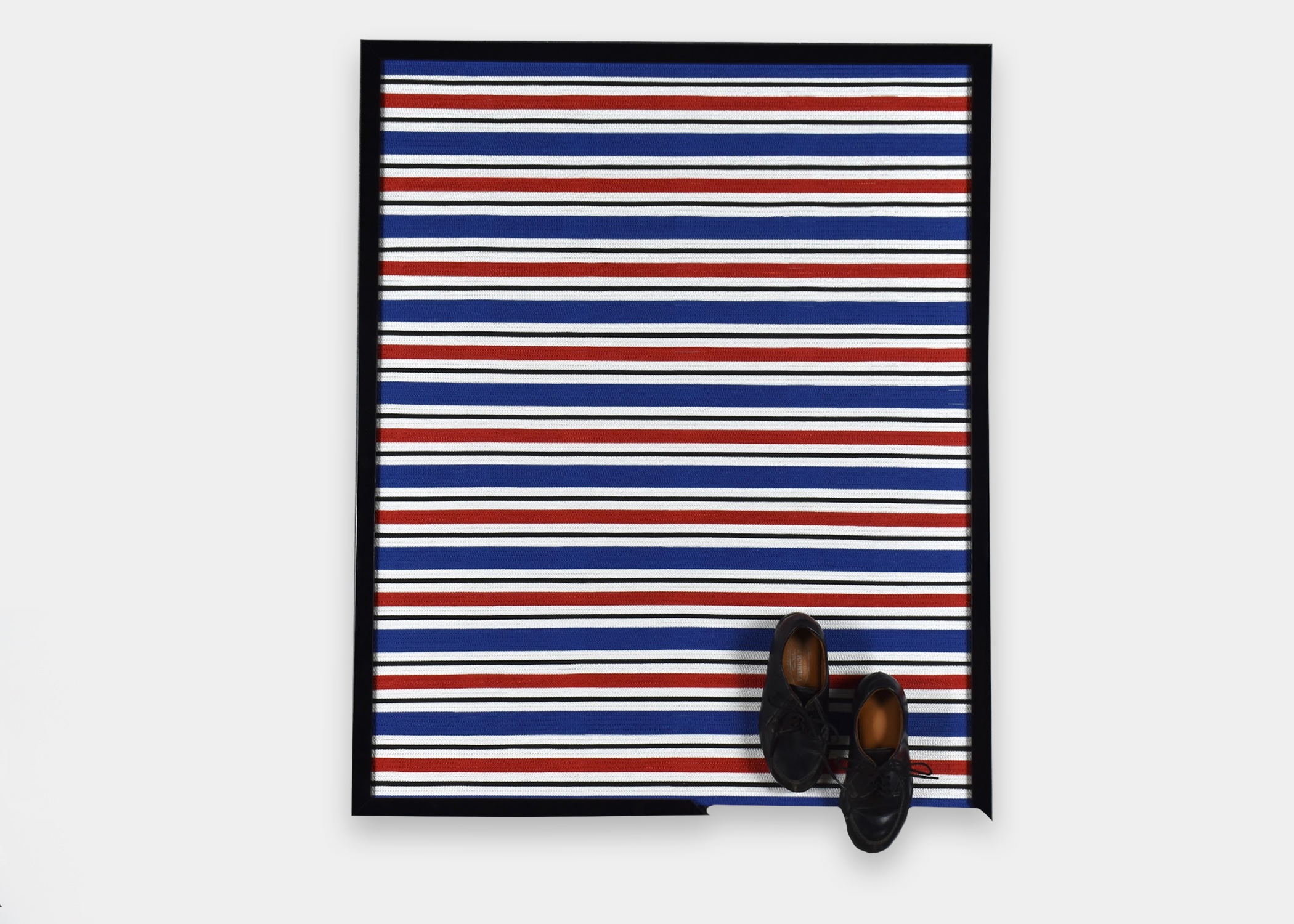 Tracy Weisman, One Foot Out The Door, 2026, mixed media: polyester cord, children's shoes, 24 × 30 in. Photo by Madison Van Wylen
Eschewing either a patriotic tribute or a simple critique,Weisman’s show articulates her contradictory feelings via materials such as an American flag slashed with golden zippers or a presidential “portrait” made up of four-letter words constructed with vintage tin French cafe letters in an overly-gilded frame. These are among the former speechwriter’s many visual metaphors in Some Birthday, America.
Weisman grew up in Rhode Island in a family of makers. Her grandfather painted and built ship models, her mother taught her to sew, and her father kept a wood shop in the basement. When she moved back to RI from Chicago, she finally had a studio large enough to accumulate and store the found and vintage objects “that whisper to me about their past lives” and give her work emotional depth.
One of those objects was a set of small, handmade Russian dolls she discovered while antiquing in Newport. The dolls were more than a century old, and Weisman immediately began imagining the journey they might have taken. "I envisioned a story of these dolls immigrating to the United States with a young girl and her family," she says. Juxtaposed against a photograph of a deserted beach and seated on a collaged piece of driftwood, the dolls take on new life as a statement on immigration, belonging, and the lengths people go to in search of a new life.
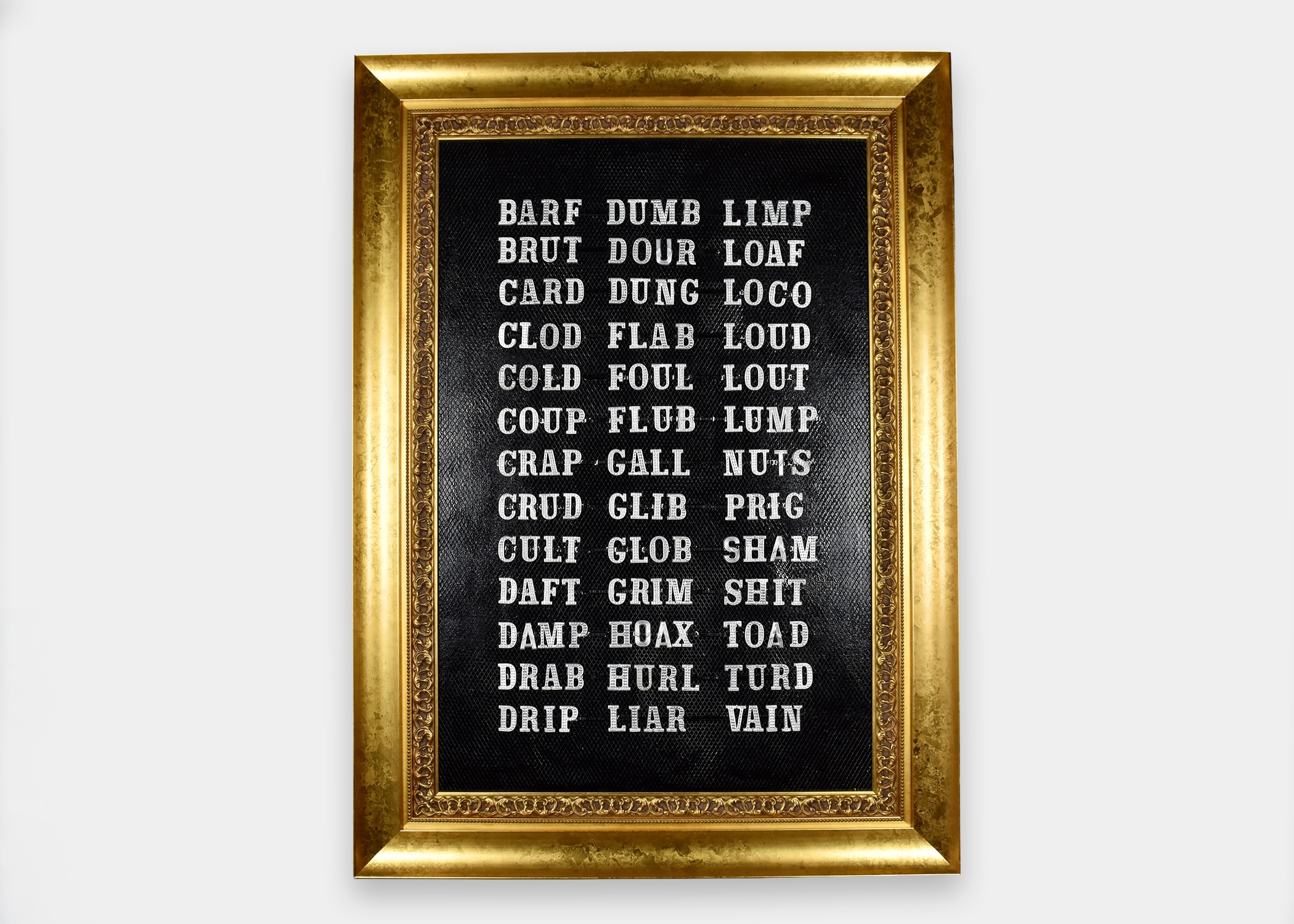 Tracy Weisman, Four-Letter Words, 2026, mixed media: acrylic on canvas, netting, vintage French tin sign letters, 33 x 45in. Photo by Madison Van Wylen
For Weisman, materials are never passive; they are narrative tools that carry histories, memories, and associations that resonate with gallery visitors. That relationship between object and meaning is also reflected in her process. Cutting, stitching, and altering materials become forms of storytelling in their own right.
"Cutting can imply disruption, deconstruction, or it can be transformative. Stitching can be very suggestive of repair, care, labor, inheritance, containment."
Weisman sees a clear link between how she once shaped language and how she now shapes materials into visual concepts. "When I slice into an American flag and insert zippers, or when I create concentric rings of plastic army figures, I'm creating little visual jolts that entice viewers like a well-told story.”
Freedom of interpretation is central to her work, and Weisman purposely leaves space for uncertainty. “I welcome ideas that don't necessarily have a tidy ending because I think they're more exciting,” she says. "A lack of closure gives viewers agency and encourages them to mentally engage with a piece."
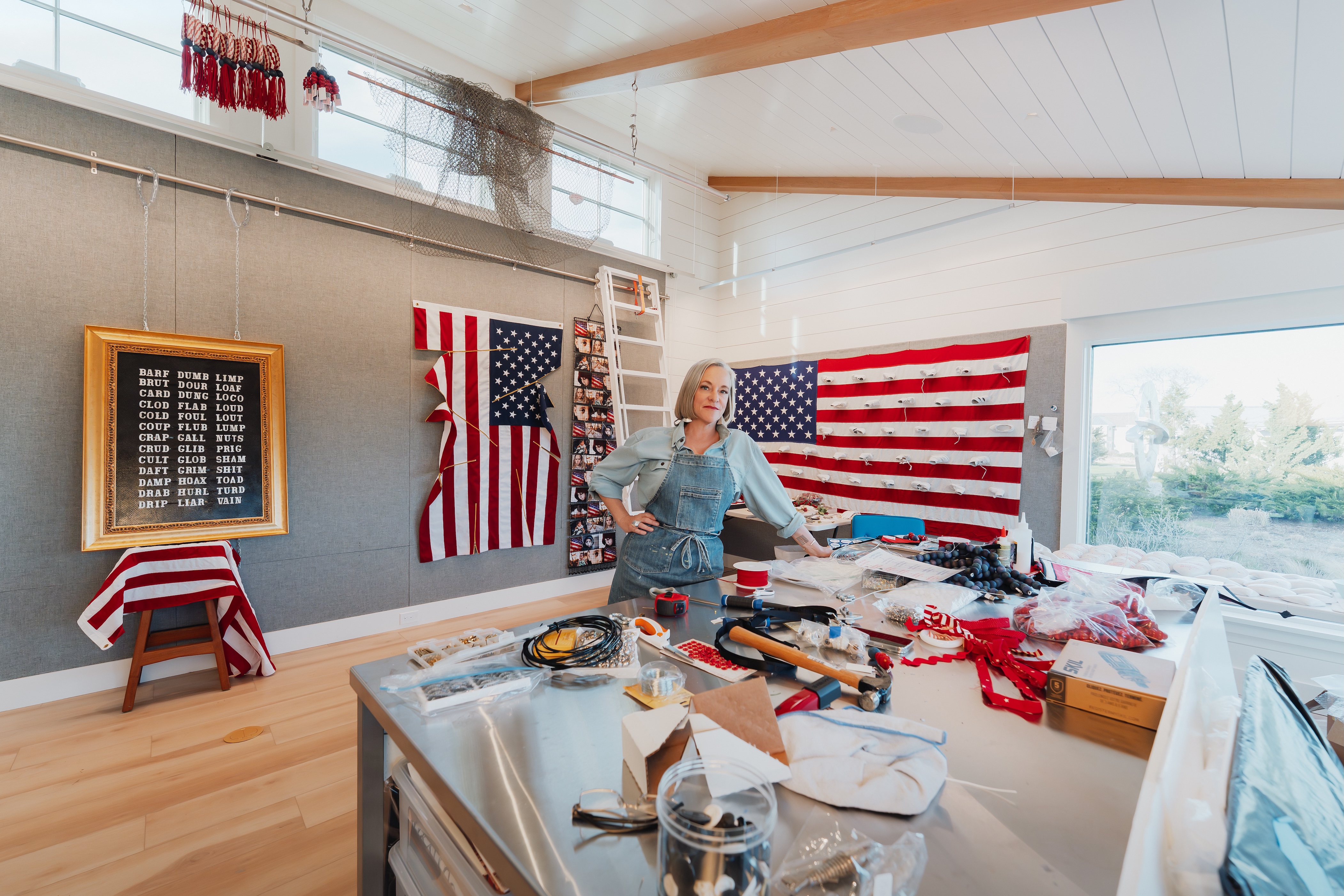 Tracy Weisman in her RI studio. Photo: Madison Van Wylen. Photo by Madison Van Wylen
That openness often leads to unexpected conversations. One collector interpreted a politically charged work about gun violence through the lens of his military service and experience with PTSD, an angle Weisman had never considered. "My intention for a piece is merely a jumping off point. Leaving tension in my work allows viewers to draw their own conclusions."
Within the exhibition, Weisman is organizing a fundraiser benefiting Newport's Dr. Martin Luther King, Jr. Community Center, a service provider for at-risk individuals, families and seniors. She embellished hundreds of quahog shells she collected from Narragansett Beach with a quote from George Washington's historic 1790 letter to the congregation of Newport’s Touro Synagogue in which he assured them that the new government would give "to bigotry no sanction, to persecution no assistance.”
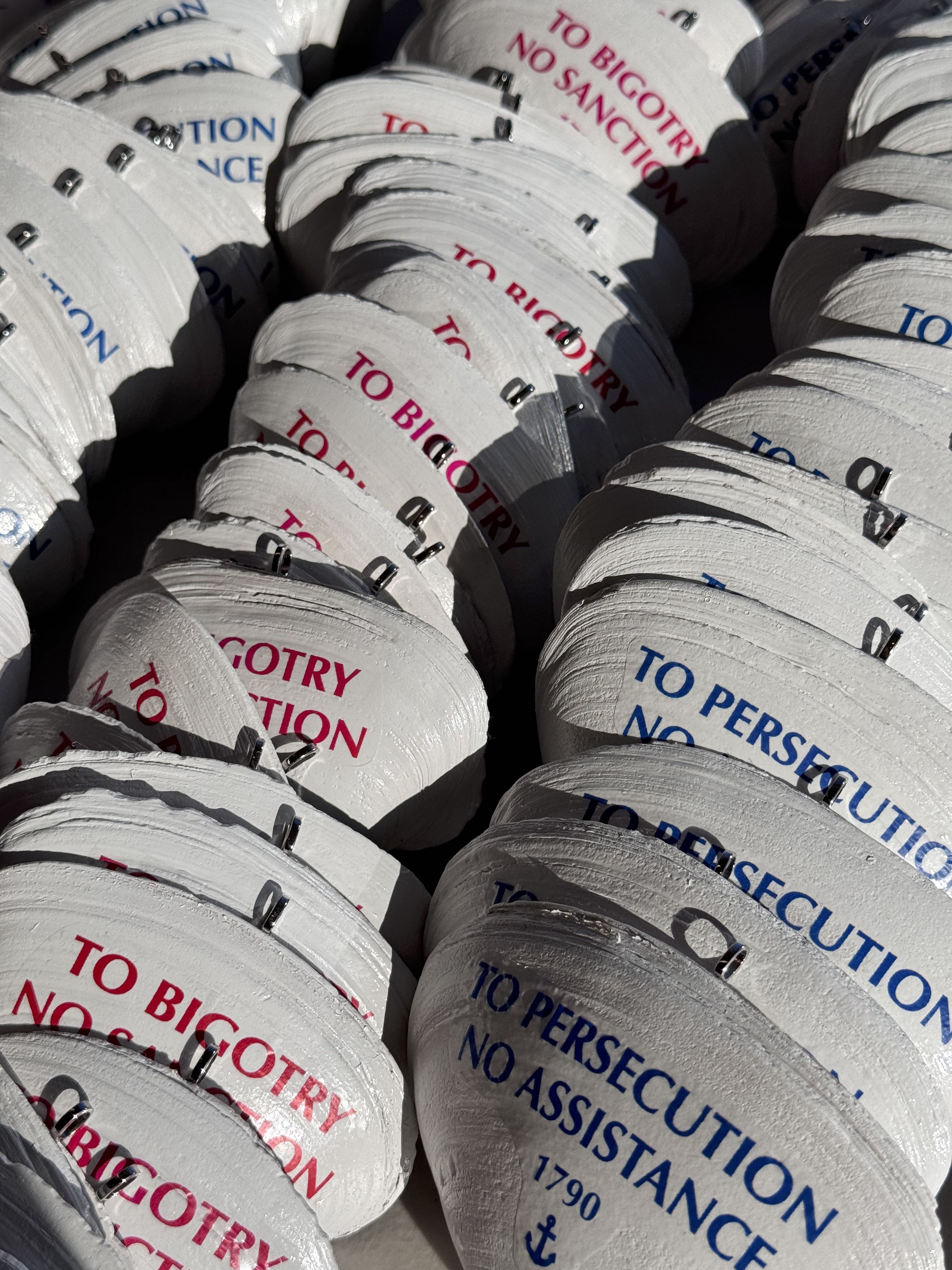 Tracy Weisman, To Bigotry No Sanction, To Persecution No Assistance; mixed media: salvaged quahog shells, type. Photo by Madison Van Wylen
"On our 250th birthday, Washington’s words seem especially prescient, and I wanted to give visitors a way to participate in doing something constructive at a time when many feel uneasy about the state of our country," she says.
While Some Birthday, America reflects on the present moment, Weisman is already looking ahead. Her next body of work explores women's rights, power, and collective action.
"At a time when women’s rights are under attack, I want to remind women how powerful we are," she says. True to her speechwriter roots, Weisman has built a practice about storytelling, symbolism, and the belief that art is a vehicle for reflection, conversation, and change.
Some Birthday, America will be on view at CUSP Gallery in Newport, Rhode Island, from June 27 through July 19, 2026, with an opening reception on June 27th from 5:00 - 8:00 PM.
To learn more, visit her website or follow her on Instagram @tracyweisman.

Kate Hoag
Kate Hoag is a Los Angeles-based freelance writer with experience in journalism, academic, creative, and content writing. She holds a B.S. in Theater with a minor in Sociology from Skidmore College, where she graduated magna cum laude with Theater Department Honors. Kate is pursuing her M.A. in Public Relations and Advertising at USC’s Annenberg School for Communication and Journalism.
view all articles from this author