Whitehot Magazine
September 2026
"The Best Art In The World"
"The Best Art In The World"
September 2026
The Ground Shifts Beneath Our Feet at The Ukrainian Museum - A Private Tour Guided by Zhanna Kadyrova
 Image Courtesy of the Ukrainian Museum
By KEN KRANTZ July 17th, 2026
“The water from the reservoir will change the structure of Kakhova,” explains Zhanna Kadyrova, whose installation captures the land’s transition from meadow to sea to forest. “It will be a dangerous forest.”
Lush and green, a forest grows impossibly fast as a camera timer ticks forward through days and nights. It is easy to get lost in The Forest (2023-2025), a video installation documenting the land impacted by Russia’s destruction of the Kakhova Dam in 2023. On view at the Ukrainian Museum, the stunning projection is the aesthetic highlight of Kadyrova’s first North American museum exhibition, The Ground Shifts Beneath Our Feet.
Across the room, a mixed-media installation mourns artists lost to the war. A fragment of a documentary about the late David Chickan, edited by Natalka Dyachenko, follows the interdisciplinary artist's fight against systemic violence before his death at the hands of neo-colonial violence. Chickan volunteered for a mortar crew to live his antifacist values. Widely considered one of the most radical voices of his generation, Chickan's work was often targeted by the far-right for its sharp critique of capitalism and nationalism. He fought for Ukranian independence on the front lines until he was mortally wounded by a drone while repelling Russian assault in the Zaporizhzhia region.
Another artist, Margarita Polovynko, a rising star of the Ukranian avant-garde, was killed in action as a volunteer paramedic at age 31. She stepped forward to evacuate animals from the submerged areas after the dam was destroyed. As reported by Vitalii Atanasov, Kyiv-based journalist, "To convey the unbearable physical pain of the new reality, she began creating art with her own blood and using inkless pens to scratch images into paper."
The loss of the dam was a catastrophic crisis, drowning forty villages and contaminating over half of the northwestern Black Sea with toxic runoff. Despite scars of violence, a massive forest has erupted from what was thought to be irreversible damage. “Violence did not start in this invasion,” Kadyrova reflects. “It started as a Soviet imperial project to erase our culture.”
The construction of the Kakhova Dam was a violent act of erasure unto itself; the dam was built during the final years of Joseph Stalin’s dictatorship. The large-scale Soviet Union’s project sought to erase the locality’s cultural history and identity, sinking two over thousand years of human history, including two centuries as the cradle of Cossack culture, beneath the water. The image most often shared of this devastation is of a flooded house, Polina Raiko's "Masterpiece House," where carefully placed frescos bleed, water damage staining the floor and ceiling.
The creation of the reservoir, according to Executive Director and Curator of IHME Helsinki Paula Toppila, was “comparable in its impact on the area’s environmental diversity and cultural identity to its destruction by bombing.” To experience Kadyrova’s post-invasion works inside a clean, climate-controlled institution in Manhattan is to witness an ontological mutation. Bringing the artifacts of open land into the walled-in galleries of a museum, visitors close the distance between Ukrainian soil and the Lower East Side.
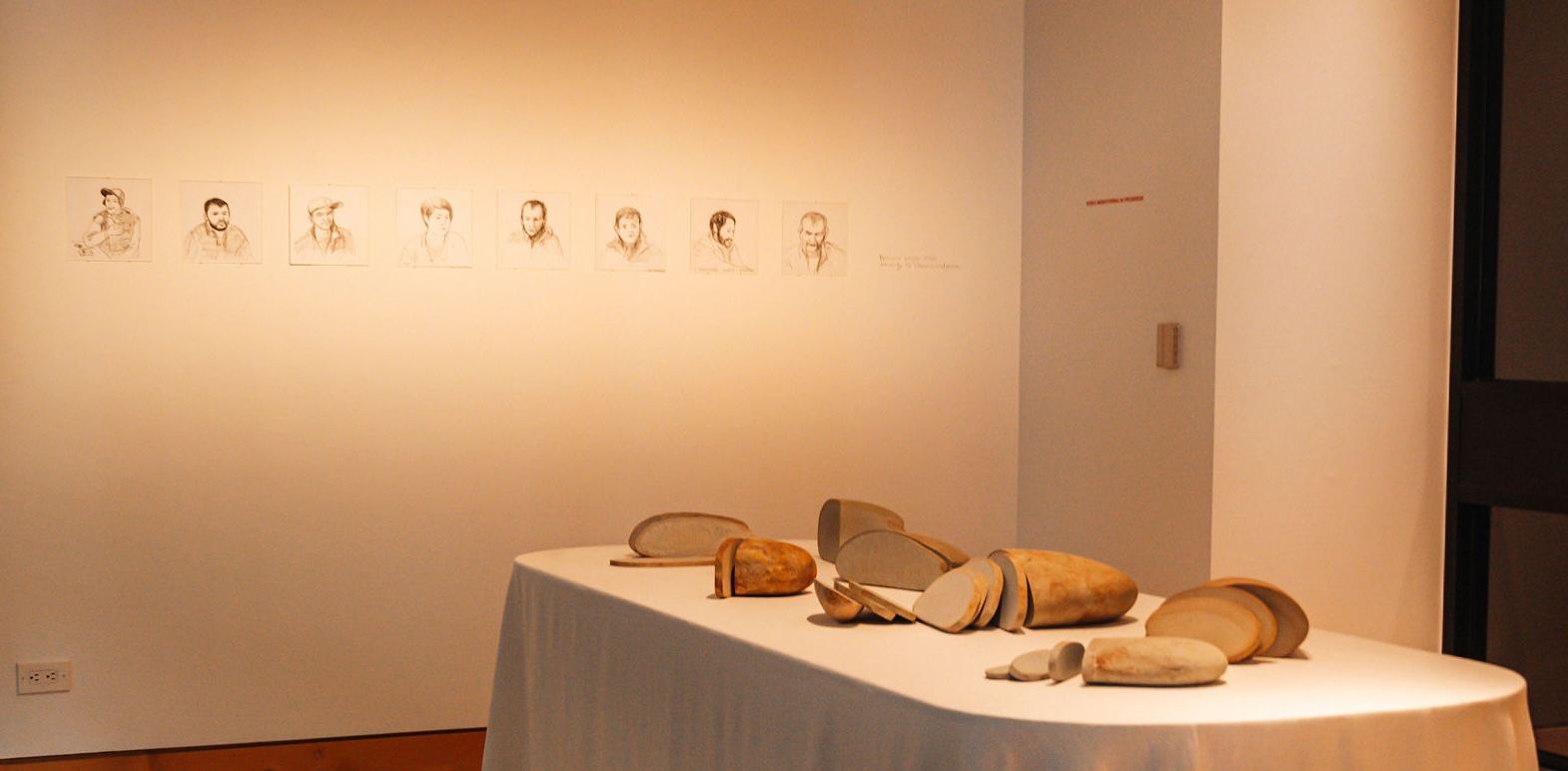 Image Courtesy of the Ukrainian Museum
When Russia’s full-scale invasion began, Kadyrova evacuated Kyiv, seeking refuge in a mountain house with no utilities in the Transcarpathian region. Her productivity did not slow, but her practice shifted. In the mountains, Kadyrova became transfixed by river stones smoothed and polished by fast-moving currents. They looked like palianytsia (large, round loaves of wheat bread). Within the context of the war, palianytsia became a shibboleth. Because its phonetic nuances are notoriously difficult for native Russian speakers to pronounce correctly, the word was used to identify Russian spies and saboteurs infiltrating Ukrainian cities.
Kadyrova collected the stones, cutting them into bread-like slices. They are displayed across a formal, banquet-style table in the eponymous Palianytsia exhibition. Before Palianytsia made waves (and raised €70,000 to support the Armed Forces of Ukraine) at the 59th Venice Biennale in 2022, Kadyrova held a grand opening in the village of Berezovo. In an accompanying video documenting the project's grand opening, a local man attempts to sharpen his knife against a slice. Kadyrova recalls the event fondly: “We created Berezovo’s first contemporary art center.”
Needlepoints of idyllic scenes captioned with повітряна тривога (air alarm) decorate a makeshift living room in the lobby of the Ukrainian Museum. “If I stayed in Kyiv, I would never have used embroidery, stone, or drawing in my work,” reflects Kadyrova.
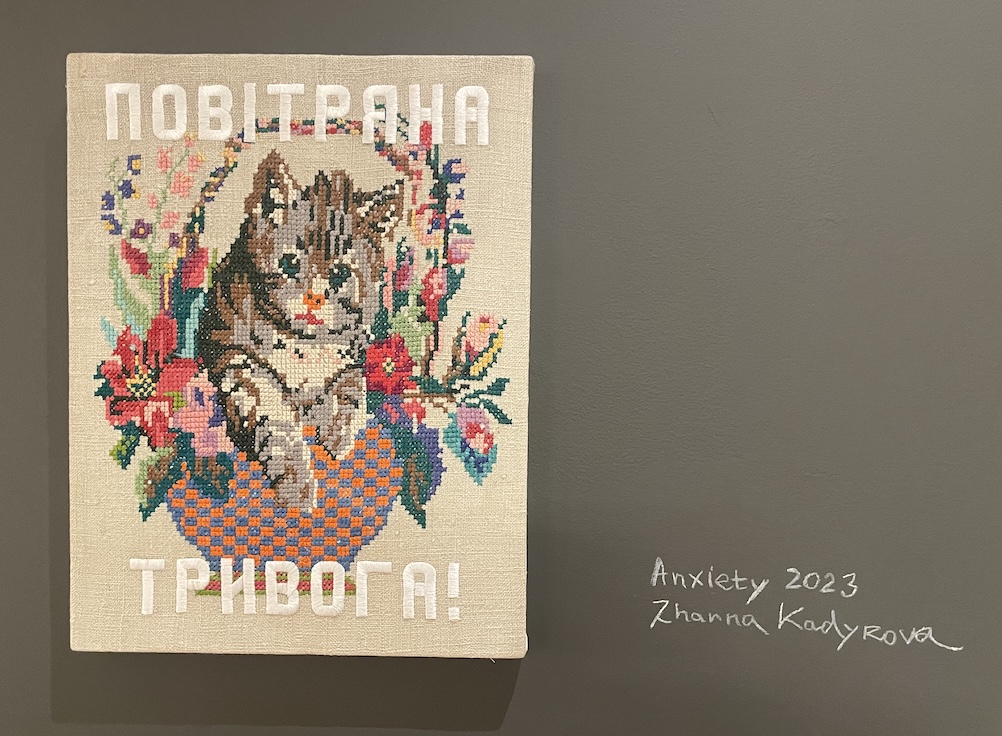 Image Courtesy of the Ukrainian Museum
The exhibition culminates in the museum's basement with her documentary film IDP (2026). The title applies the acronym for an "Internally Displaced Person" to an object: Kadyrova’s own public monument, Origami Deer. Co-created with Denis Ruban and originally installed in Pokrovsk’s Jubilee Park, the site of a former nuclear-capable Soviet aircraft, the geometric steel deer was envisioned as a permanent tribute to post-Soviet independence. When frontline violence advanced toward Pokrovsk, the sculpture was cut from its perch and evacuated with civilian evacuees. Kadyrova’s film tracks the monument's subsequent international migration, including its arrival at the UNESCO headquarters in Paris. Kadyrova reflects, “I built it to be permanent. I did not imagine it would tour 6,000 kilometers.”
Descent into the belly of the institution mimics the claustrophobic architecture of a concrete bunker, immediately echoing the subterranean spaces where millions of Ukrainians are regularly forced to seek shelter. The open-air monument is stripped of its civic context, forced to mourn the very public spaces that the kinetic violence of war threatens to erase.
A fierce refusal to allow history to be overwritten renders Kadyrova’s work crucial to survival. Faithful documentation, the application of traditional mediums by a contemporary mind, and clarity of vision all make the exhibition an exceptional monument unto itself. In The Ground Shifts Beneath Our Feet, Kadyrova offers an extraordinary, conceptually rigorous masterclass in how contemporary art is also heritage preservation.
 Image Courtesy of the Ukrainian Museum

Ken Krantz
Ken Krantz is interested in the intersection of business, culture, and bravery where great artwork emerges. He can be found on Instagram as @G00dkenergy or online at goodkenergy.com.
view all articles from this author