Whitehot Magazine
October 2026
"The Best Art In The World"
"The Best Art In The World"
October 2026
Panoramic View – Portrait of the Artist Francine Tint A film by Pola Rapaport
 Francine Tint and cinematographer Wolfgang Held in Tint’s studio, New York. Photo by Pola Rapaport.
CLARE GEMIMA March 15th, 2026
FILM REVIEW
Panoramic View – Portrait of the Artist Francine Tint
A film by Pola Rapaport
“Where have you been? I thought something terrible had happened to you. It’s been so long—what’s been going on?”
“Been busy losing my mind, Francine,” I replied, somewhat guiltily.
“Oh,” she said without missing a beat. “So you’ve fallen in love then?”
“God knows, Francine.”
How can one best describe Francine Tint? A New York firecracker? A razor-focused force? Someone who emails me at 4am (Eastern Standard Time?!) A painter who, after more than fifty years splashing and swimming in paint, is finally receiving the recognition her work has long commanded?
Before we parted one evening at her local Greenwich Village restaurant, she leaned in and offered a piece of advice in a conspiratorial whisper: “Just remember, Clare—if it’s hysterical, it’s historical.”
Tint is hysterically funny, though the word carries baggage—particularly in the male-dominated field in which she built her career, competing fiercely and struggling to survive, a field long dominated by the swagger of male Abstract Expressionists. Still, the phrase lingers. The more one looks at the paintings she makes, the clearer it becomes that her work itself is historical. It belongs squarely within the lineage of postwar abstraction, even if that lineage took decades to fully acknowledge her.
This realization anchors Pola Rapaport’s twenty-one-minute documentary Panoramic View – Portrait of the Artist Francine Tint shot by Emmy Award–winning cinematographer Wolfgang Held (The Andy Warhol Diaries). The film moves fluidly between Tint’s biography and the relentless studio practice that has sustained her for more than half a century. Tint reflects on this long arc with humor, candor, and a striking lack of sentimentality. “It was very, very sexist,” she says of the art world she entered in the 1960s. “I can toot my horn now, fifty-two years later—I was better than most of them. If I was ever in a group show, my work would shine. But I was kept down.”
 Francine Tint in her studio, New York, 1997. Photo by J. Frederick Smith.
Tint grew up in a Brooklyn tenement—her father a bookie, “not a bookmaker,” she insists, and her mother a model whose life ended tragically young after a stroke at thirty-nine. She describes herself as a delinquent teenager. Her parents believed entering the music and art world was insanity. By nineteen she was poor, working as a stylist while drifting through Manhattan’s cultural undercurrents. Rapaport recalls first seeing her, in the most classic New York circumstance, on the same subway ride. “Tint dressed entirely in white, already magnetic.”
Eventually she abandoned the glamour culture of styling for something far less refined: the painter’s uniform. In the studio today she appears outfitted in what can only be described as working armor—a bright yellow wetsuit, Crocs, a shower cap, and rain gear protecting her hair from the inevitable splash of paint. The wetsuit, she jokes, serves a practical purpose “I know when a painting is finished when I need to pee!”
Tint’s process is expansive and physical. Paint is poured, smeared, sponged, and dragged across canvases that range from intimate ten-inch surfaces to monumental works stretching nearly twenty feet. Huge rollers sweep across the ground, while sand, mesh, and gel accumulate into surfaces that oscillate between accident and control. Jazz fills the studio; Tint never paints without it.
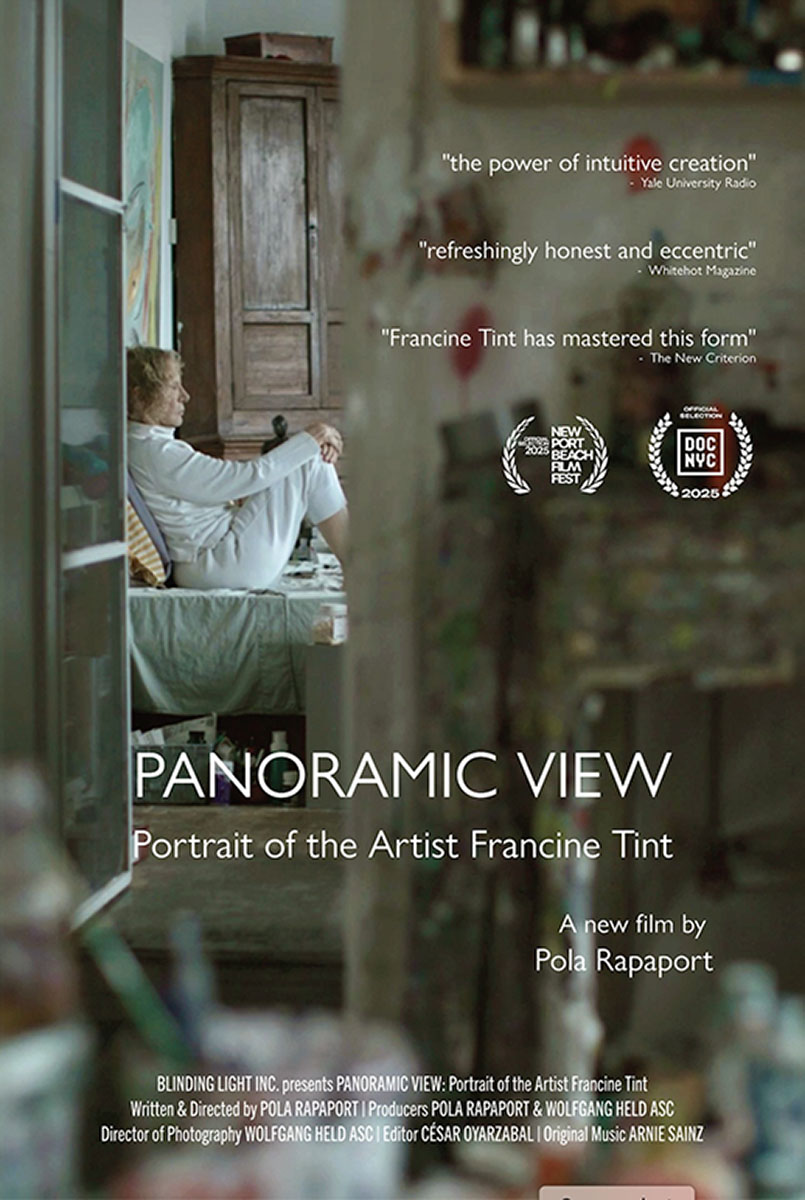 Francine Tint in her studio, New York, 2024. Photo by Wolfgang Held.
By her late twenties she had become, in her words, a “painting nun.” Nights were spent at Max’s Kansas City, where she encountered figures like Larry Poons and moved through the downtown scene that defined a generation of painters. It was unmistakably a boys’ club. Tint speaks openly about the exclusion women faced during those years, recalling how male painters were granted more space—both literally and metaphorically—within the culture of Abstract Expressionism. Yet she persisted with a quiet certainty that the work would ultimately speak for itself.
The critic Clement Greenberg eventually enters her life —not as distant authority but as a recurring visitor to her studio. Known for his formidable influence over postwar painting, Greenberg nevertheless recognized something in Tint’s canvases. “Young lady, you can paint,” he once told her.
Outside the studio she supported herself through styling and costume work connected to productions involving figures like David Bowie, Andy Warhol, and Ridley Scott, but the real labor happened late at night. Panoramic View does not present this life as a simple chronology. Instead, Rapaport—who has known Tint for more than fifty years and owns several of her paintings—constructs something closer to a visual memoir, tracing the unpredictable paths through which painting became the organizing force of Tint’s life. The film’s camera lingers carefully on the surfaces of the works themselves, capturing the saturated color and movement of the canvases with unusual clarity while allowing Tint’s voice to guide the narrative that surrounds them.
 Airlift, 2024. Acrylic on canvas, 60 × 110 in. Permanent collection of the Aïshti Foundation. Photo by Adam Reich.
Moments of reflection appear alongside the studio scenes. In one of the film’s quietest passages Tint lies on her bed in a state of calm meditation while her beloved cat Rémy sits beside her, seeming to hang on every breath she takes. Tint describes meditation and painting as nearly identical acts—forms of attention, patience, and surrender, each requiring the discipline to clear the mind, rid it of negative energy, and begin again.
Recognition, long delayed, is now gathering momentum. The documentary captures the preparation of Tint’s catalogue raisonné and an exhibition at Upsilon Gallery, while critics including Robert Mattison and David Ebony situate her paintings within a broader history of abstraction that once struggled to make room for artists like her. During one installation moment at the gallery, Tint interrupts the conversation with characteristic candor: “I’m going to be the angry fuck here.” The line lands somewhere between joke and declaration—a flash of humor from a fiercely passionate artist who knows exactly what she has fought for.
The film itself has been met with equal enthusiasm, screening to sold-out audiences at festivals including DOC NYC and the Newport Beach Film Festival, where a second screening was added in response to demand. Tint turned eighty-one during the making of the documentary—a moment she describes as the best time of her life. It is a sentiment that makes sense coming from someone who, after decades devoted almost entirely to painting, met her partner David Ritter at seventy-one and is only now watching both her work and her life expand in unexpected ways.
Near the end of the film she offers a reflection that reads less like a conclusion than a credo: “Anything worthwhile is work. And then the miracle appears.” Later she adds, with characteristic clarity: “I’m at an age when people are dying. But I feel like I’ve only just started living.”
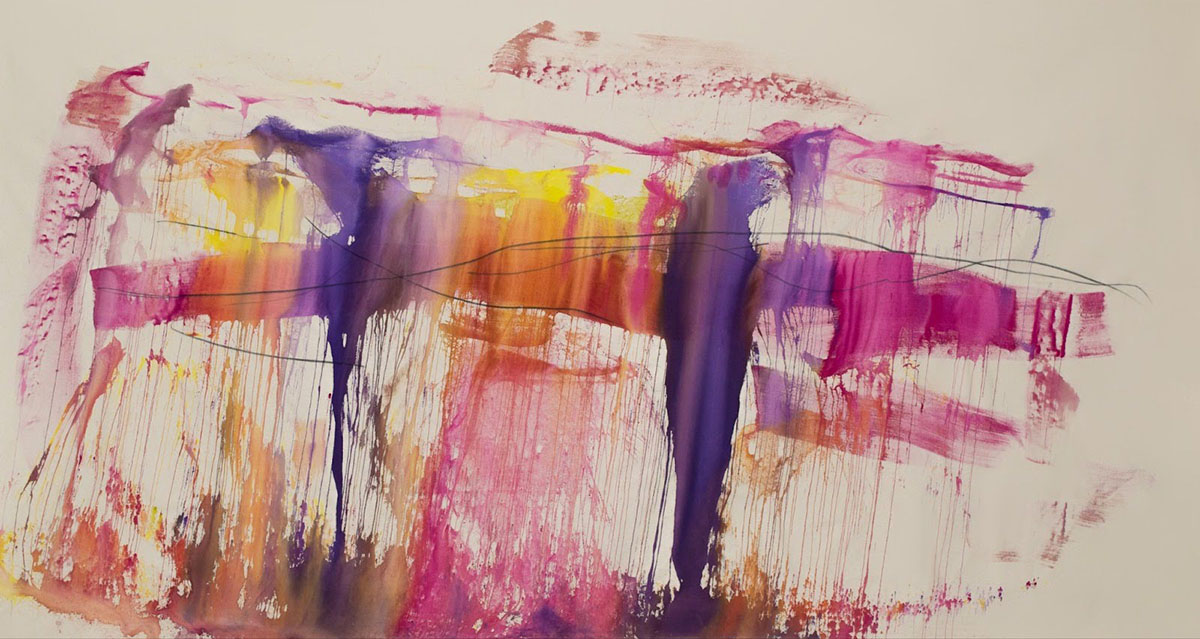 North Country Fair, 2025. Acrylic on canvas, 96 × 130 in. Photo by Amelie Trimpl.

Clare Gemima
view all articles from this author