Whitehot Magazine
October 2026
"The Best Art In The World"
"The Best Art In The World"
October 2026
Exhibition Review: coda - Hunter College BFA Degree Exhibition (on view through June 8, 2025)
 Entrance display for coda: Hunter College BFA Thesis Exhibition (on view through June 8, 2025)
By LIAM OTERO June 8, 2025
Coming on the heels of an enormously successful (and highly publicized) exhibition season for the Hunter College MFA program, the CUNY college’s equally accomplished BFA program currently has an absolutely grand exhibition for its graduating undergrads at the 68th St. Leubsdorf Gallery on the Upper East Side. The 12 artists comprising this cohort engage in a multitudinous range of artistic mediums, creative methodologies, and thematic approaches that seamlessly reflects the fruits of their labors. The term coda, with its circuitous, at-times concurrent beginning & end associations is such a fitting title emblematic of the 12 graduating BFAs and their collective experience of navigating art school, their own artistic paths, and life itself.
Deni Artemisa
Queens, New York | @multiplydeni | multiplydeni.com | multiplydeni@gmail.com
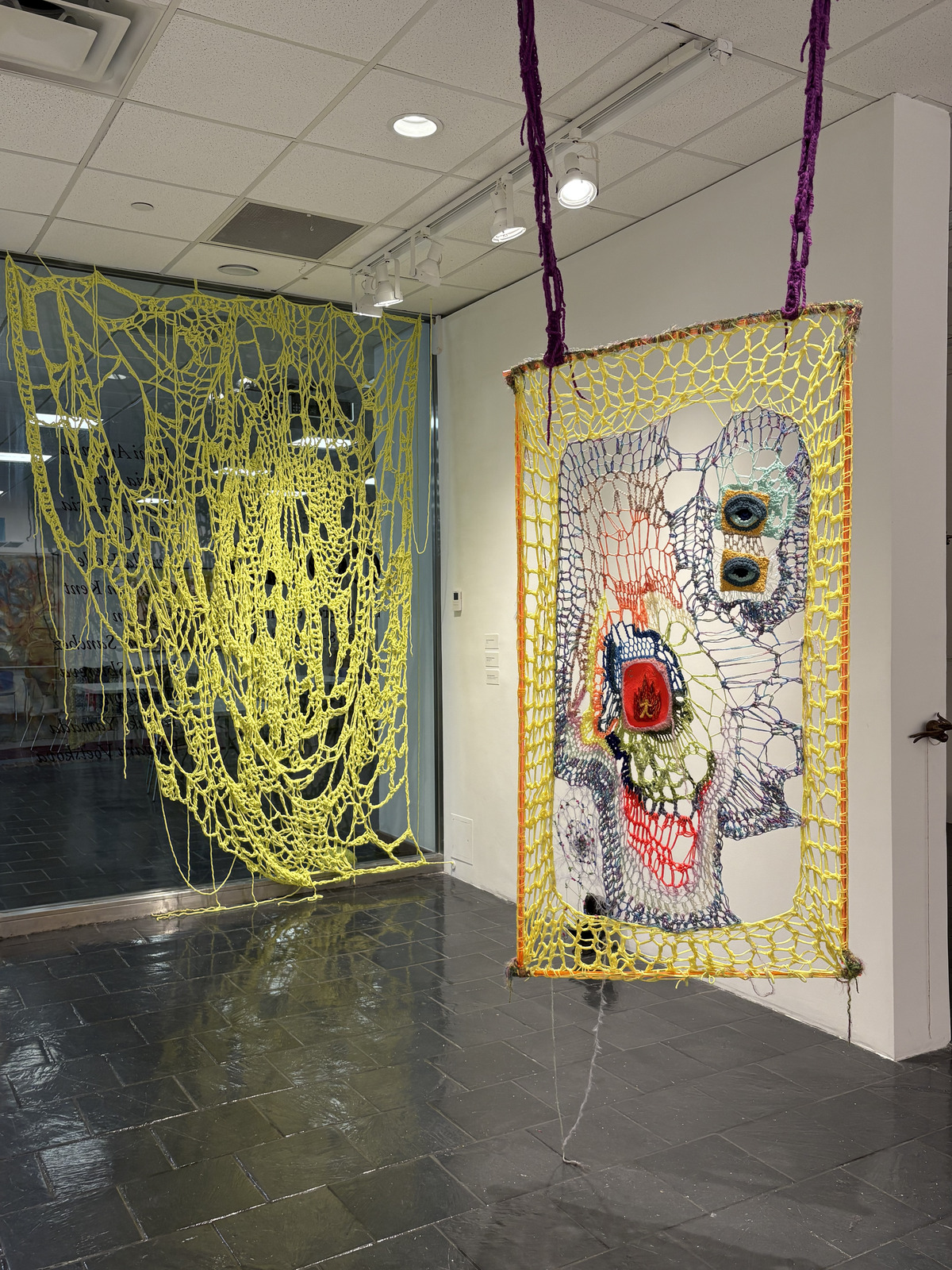
You may be familiar with the term “sculpture-in-the round”, but get ready for “textile-in-the-round”. Deni Artemisa, a multidisciplinary Chilean-American artist specializing in textile & fabric arts, conceived a monumental needlework piece, better on your hips than mine (2025), which is a multi-spectral netted embroidery of fluid forms, geometric configurations, and iconography that is suspended from the ceiling. Nearby, a miniature ceramic of an open toilet adds a humorous undertone to the space. Artemisa’s practice is a combination of self-taught discipline (specifically for their needlework) and research-based planning. For the latter, Artemisa looks to their Chilean roots to better understand ancestral craftwork as a tool to respond to contemporary political issues. The miniature toilet is an appropriate tongue-in-cheek visual summation of the state of today’s political landscape. Meanwhile, the needlework display captures the frenzy of life in 2025, especially with the red circular section containing a yellow figure engulfed in stylized flames. A pair of disembodied eyes towards upper right keep their gaze fixed on you as if to implore “And what is your take on this?”. One thing for certain with Artemisa is that much is to be gained from prolonged looking at their expertly crafted works.
Maria Brito
Newark, New Jersey / Recife, Brazil | @mclabart

Maria Brito’s work in crochet is an interesting interplay of free-form experimentation and careful schematism. Her crochets encompass a multitude of styles and forms inspired by her cultural identity: wall-to-floor tapestries of heavily stylized fauna; miniature square patches in different colors; or wearable masks attached to the walls (one of which loosely resembles a gas mask). Being of Brazilian heritage, Brito incorporates stylistic techniques inspired by the textile traditions of her ancestry, particularly the threaded patchwork terrain of long, flowy tapestries rife with multiple layers of colors, patterns, and textures. Brito’s examples in this regard ensconce the space she is allocated directly outside the gallery. Some of the works appear to crawl up the walls toward the ceiling, others seem as if they are coming straight out of the light fixtures, while the rest cozily reside along the walls and corner niches. The all-over installation of these myriad crocheted pieces goes to show that textile & fabric arts are having a critical moment!
Briana Garcia
South Bronx, New York | @brianaart_
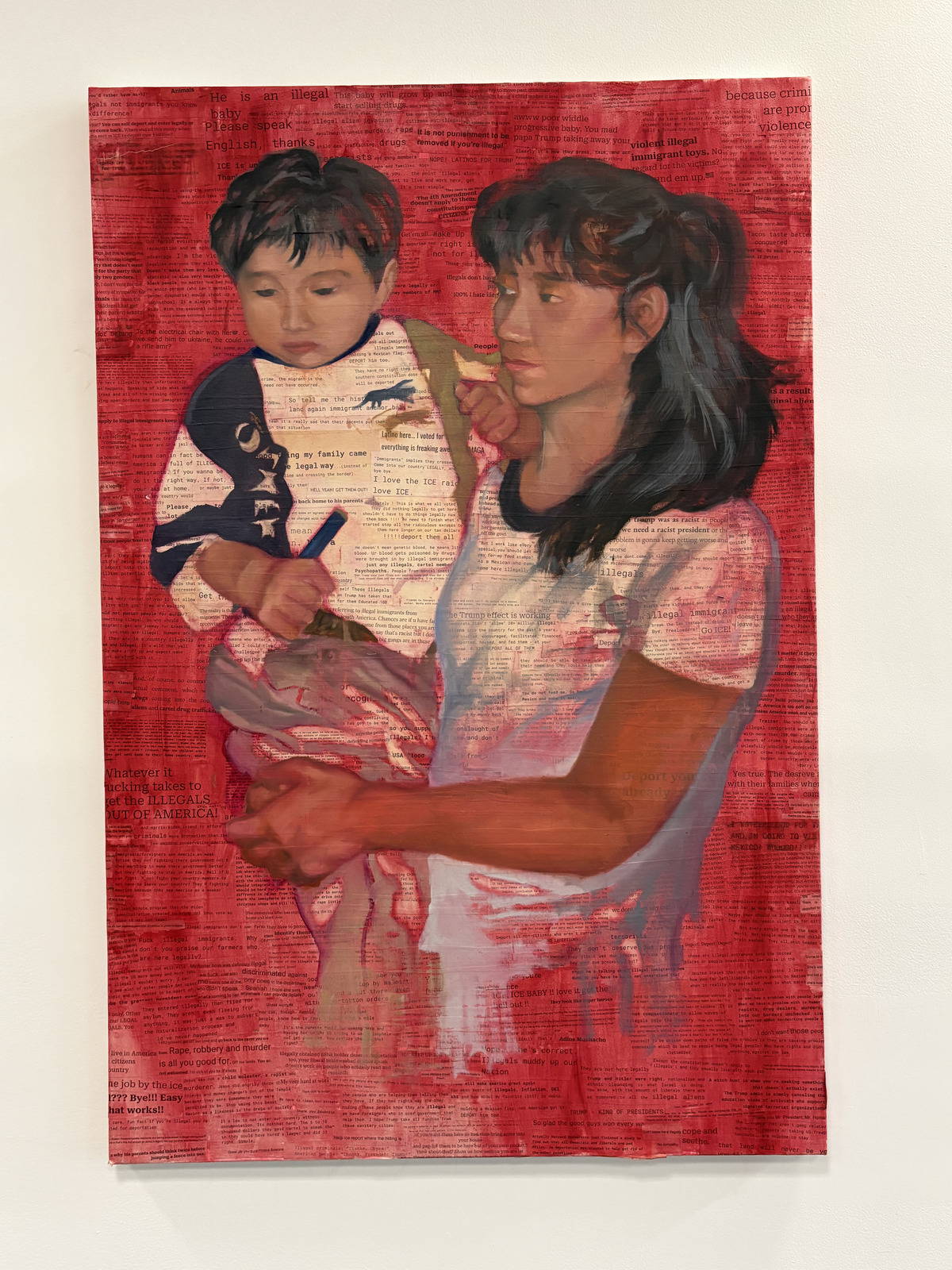
Briana Garcia, a politically-engaged artist of Mexican descent, turns to oil painting as a platform to address the intersections between immigration, identity, and childhood. Her paintings of immigrant children - either on their own or with family - are surrounded by quotes, captions, and blurbs culled from newspaper headlines, social media posts, speech transcripts, and other textual sources that express racially-charged vitriol towards immigrants (specifically those from Mexico and other parts of Latin America). “I love the ICE raids … I love ICE”, “it is not punishment to be removed if you’re illegal”, and “please speak English, thanks” are among the hundreds of offensive statements - both by political leaders and the general public - who align with the right-wing, nationalistic rhetoric that has come to predominate much of contemporary American socio-political discourse. Not only does the inclusion of such hateful text reinforce a moving message on the heinousness of these racist beliefs, but the focus on children implores the viewer the following: “Is this who you really perceive to be a threat? A child?”
Garcia’s paintings are a reminder of the inherent power embedded in painting, which evokes the universal adage of “a picture is worth a thousand words.”
Tyler Green (aka “tree”, deliberately in lower-case, like bell hooks or e.e. Cummings)
Brooklyn, New York
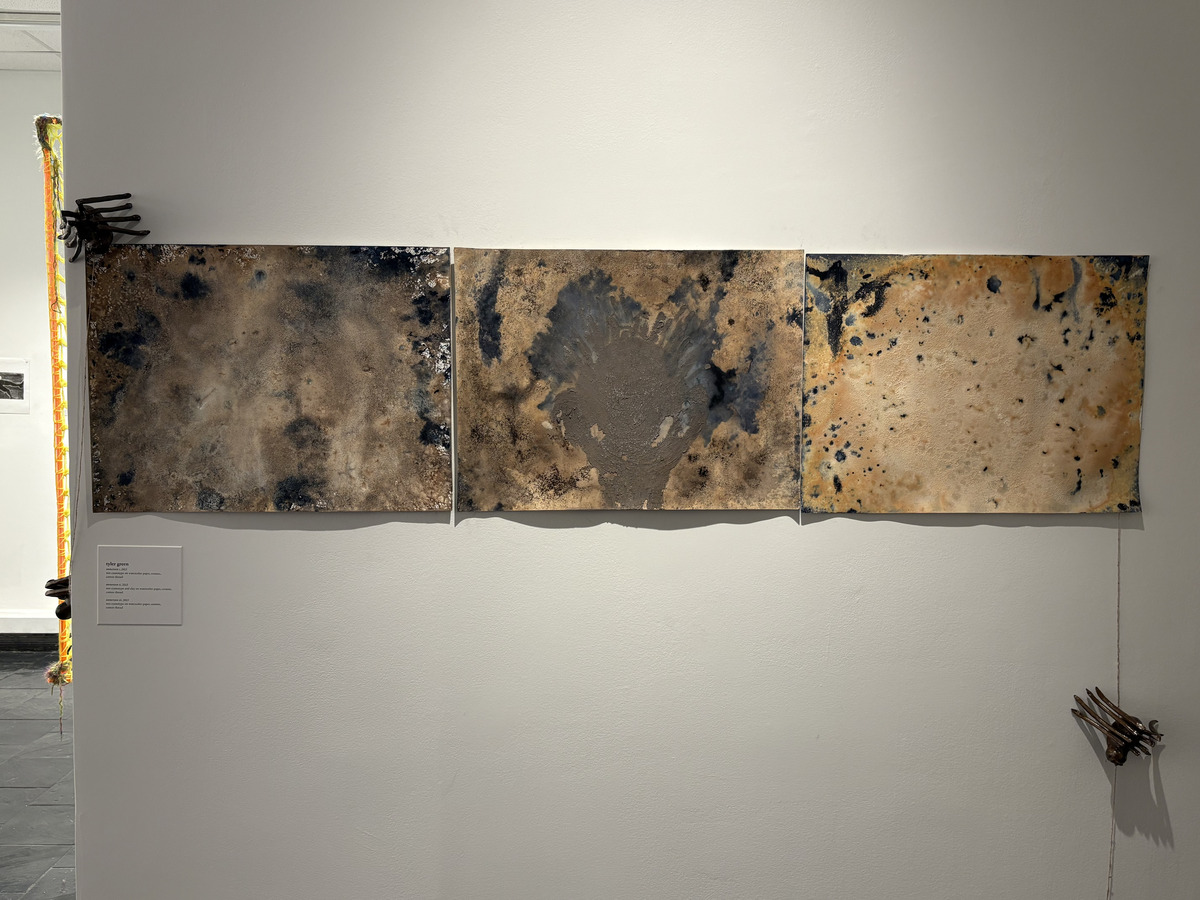
Morbidity is revered in the works of tree, specifically in the vein of the melting pot cultures of Caribbean and Black-American folklore. Through the magic of a mixed media potpourri, tree summons a series of characters derived from these folkloric strains into his art: “duppies” (benevolent spirits from Jamaican folklore), “fiends” (dual creators and destroyers, much like Vishnu in Hinduism), and “tricksters”. For this thesis show, several wet cyanotypes on watercolor paper with cotton thread are marked by an almost cosmological dusting of browns, golds, and blues - one of which contains a “fiend” who is denoted by its cranial-shaped, grayed-out presence, jagged eyes, and spiky hair. Eerily realistic ceramic spiders hold onto the cotton thread to ensure these two-dimensional works remain along the wall (or perhaps to suggest these were “spun” by such mysterious creatures). The overt mythological associations and blurring of what is an image and what is a corporeal presence make tree’s work a highly absorbent example of the fluidity and ethereality behind folkloric belief systems.
Aviella Holle
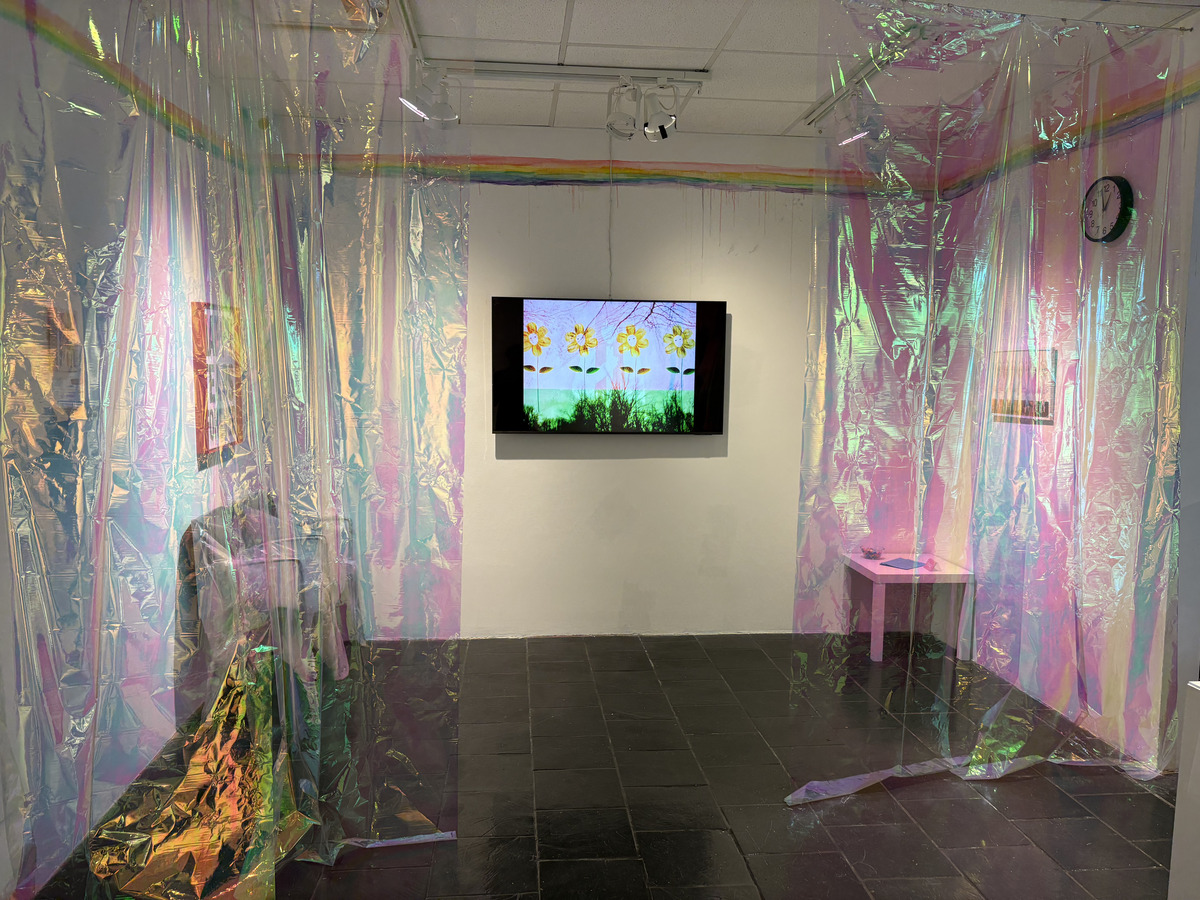
One entire end of the gallery is transformed into a site-specific audiovisual installation dedicated to Aviella Holle’s work. A transparent curtain with a rainbow-colored sheen gives way to a video of a childhood dreamscape with a costumed Halle repeating phrases like “Happiness is real” and “The world is your oyster” with twinkling music accompanying the video. “Happy tears” is a recurring motif as seen in a sign declaring this message in a metallic silver, an image of animated smiling ballerinas whose tears form letters of the alphabet, and a small vial containing teardrops (also labeled “Happy Tears”). A corner table also has a pile of blue print-outs and pink business cards going into more detail on what “Happy Tears” means.
Holle’s work is an immersive enclosure that considers humanity’s relationship with technology and how the latter produces perceptual dichotomies: reality / fiction, truthfulness / artifice, organic / mechanized, etc. It comes across as a philosophically-driven project in which I am left pondering precisely how technology has shaped my own existence, especially as someone who came of age in the 21st Century. Subsequently, viewers will find that there is a mixed feeling of appreciation for what technology enables us to accomplish, but also a sense of concern for the myriad ways in which it has yielded distortions. Perhaps these “happy tears” are more than what we would accept at face value?
Christian Kent
Brooklyn, New York | @cjhatesyou
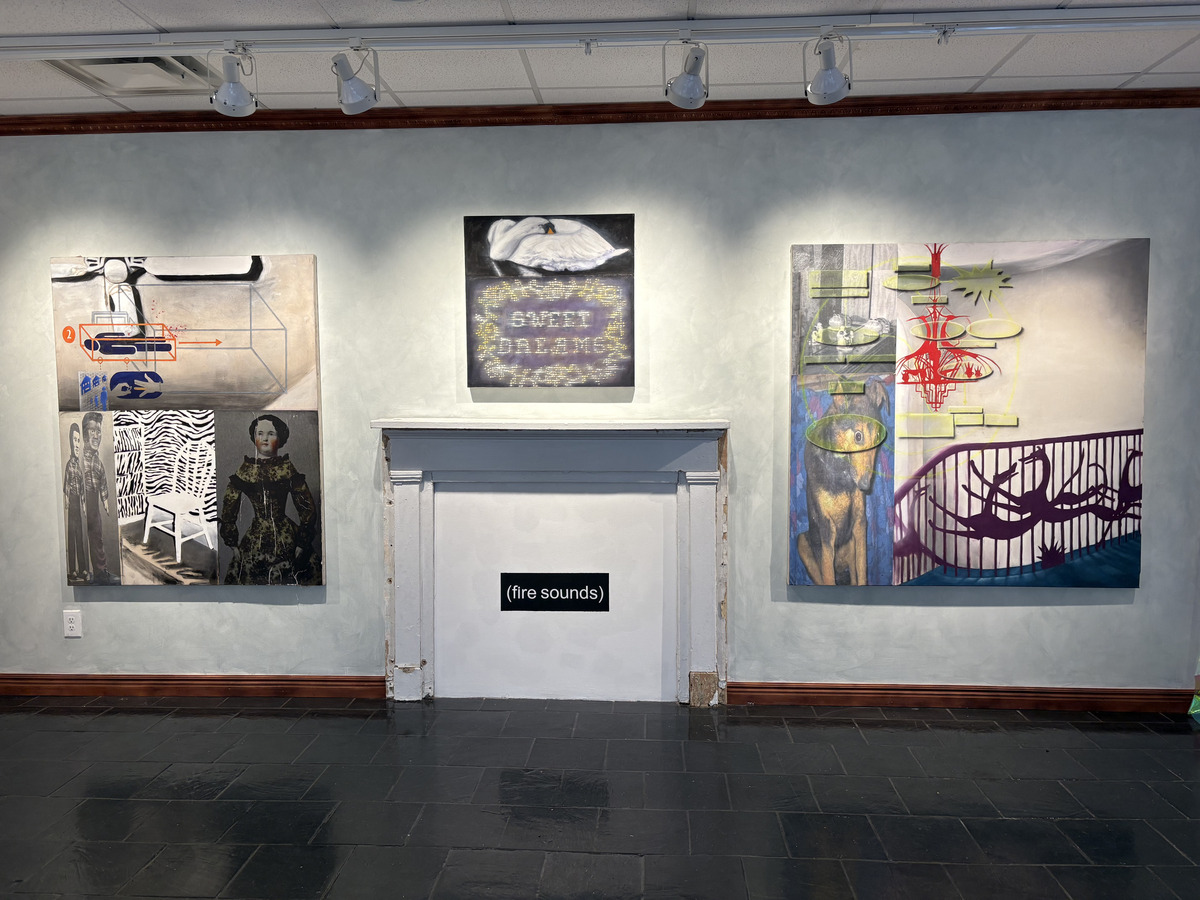
There is an expression in Art History that an artwork informs the space in which it is presented and vice versa. Christian Kent’s paintings take a page out of this concept to investigate how groups of disparate paintings affect one another - pattern recognition, visual repetition, message distortion, and so on. His exhibition space recalls a living room wall with the central fireplace and dark wood floor-ceiling trim. A black-and-white caption you would expect to see in a film - “(fire sounds)” - is situated inside the implied fireplace. Above there, a painting with the gold-gilded words “SWEET DREAMS” is beneath a swan. Flanking the fireplace are two large paintings - one on either side - containing a strange assortment of images - a ceiling fan appearing to slice off the leg of a stick figure inside of a transparent box; a corner of a room marked by a dizzying zebra-print pattern; a dog with unsettling eyes surrounded by blank speech bubbles are among the litany of uncanny subjects populated within.
The brilliance of Kent’s work is that his menagerie of images and signs perpetually produce an infinite range of associations that gradually become blurred or evolve into something entirely different from what was initially perceived.
Gigi Lin
Chinatown / Lower East Side, New York | @ggllin.canvaz | gigi-lin-studio.squarespace.com
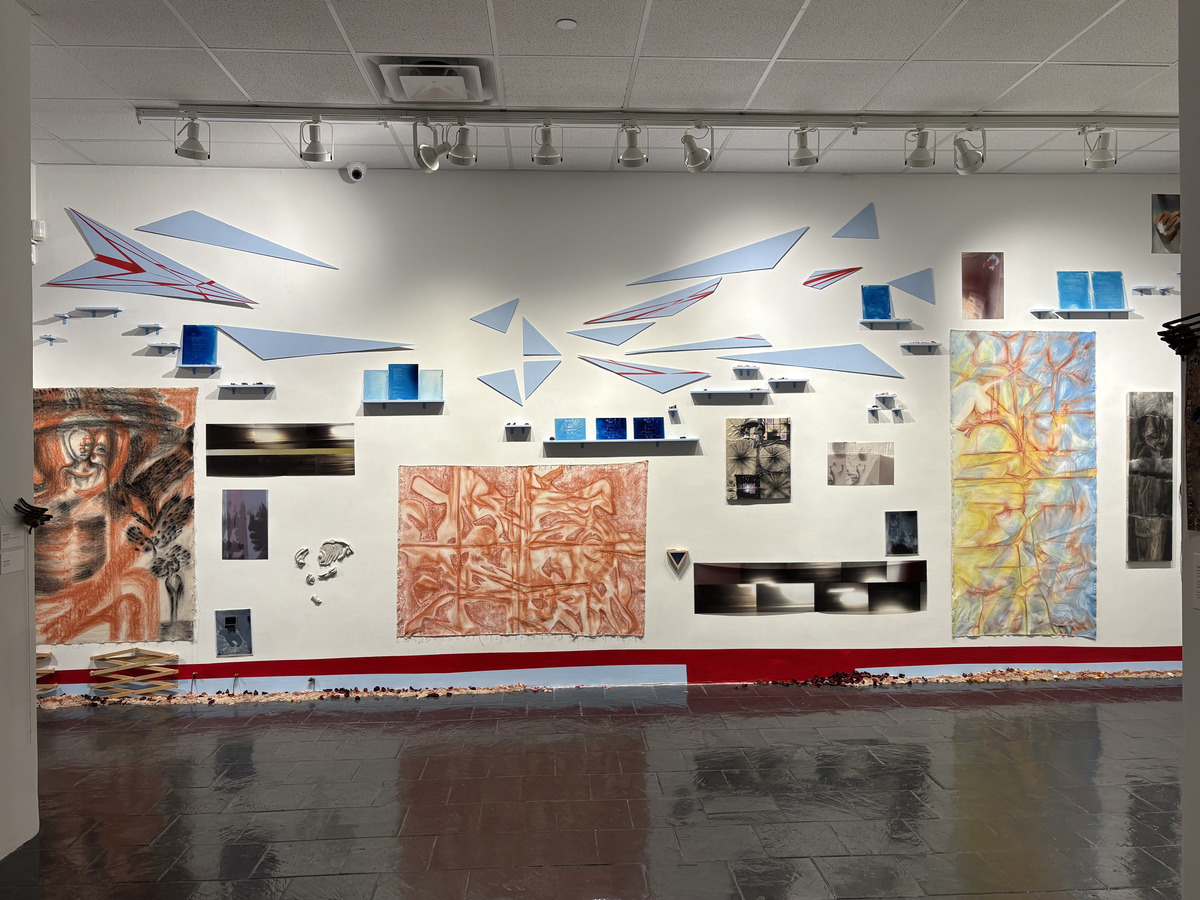
Art & literature go hand-in-hand for Gigi Lin who writes poetry and works with charcoal, video & sound, painting, and photography. A force to be reckoned with, Lin’s BFA-level magnum opus is an entire wall covered in an elaborate tableaux of prismatic shapes gliding through space, figurative and abstract charcoal drawings, projecting shelves supporting loose pages of text, and strewn petals along the base of the entire display. Her project here is dealing with the Resonant Body, a term specific to performance art referring to a work that interacts with a body in a physical and sensorial manner. Lin’s approach to this is to make tangible the physical, emotional, and memory sensations of what a body - particularly one related to the Global Diaspora - retains from a lifetime of experiences - the good, the traumatic, and everything in-between. Since Lin is also a poet-writer, it would be of further merit to pick up a copy of the coda catalogue as her section of the text contains a series of experimental poems that richly inform her visual practice.
Jasmine Sanchez
Manhattan - Upper West Side, New York | @jasmine.sanchezart | jasminesanchezart.org
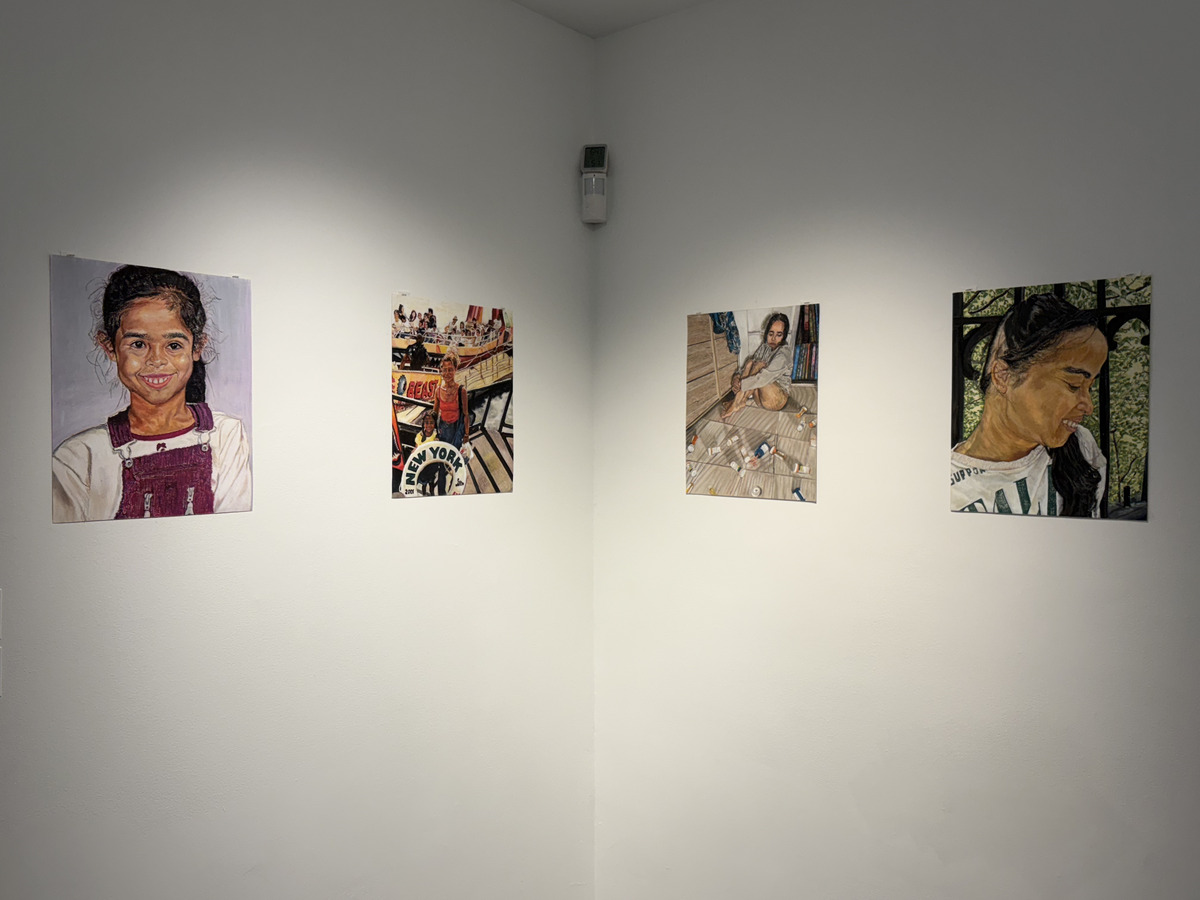
Sanchez’s self-portraits are the conceptual canvas for the artist’s intersectionality with respect to gender, race, political beliefs, physical & mental health, and artistic identity. The native New Yorker / second-generation Puerto Rican painter creates autobiographical works that investigate the many layers of who Sanchez is as a person: reflections on the innocence of childhood; struggles with mental health and dependency on prescription medications; the physical and emotional weight of chronic pain and Alopecia Areata; and the interconnectedness of female self-empowerment and creative agency. Though these are self-portraits in the literal sense, they are more so portraits of memories specific to Sanchez. In effect, her paintings are a great example of painterly journaling seeing that she is covering key moments from her life and recurring themes - how the past informs the present, and vice versa. And while these are personalized stories, I appreciate the relatability that naturally filters in Sanchez’s authentic visual expression - very much in the spirit of the writing style of the artist Anne Truitt and her published diary Daybook (1982)!
Lilian Shtereva
Brooklyn, New York / Haskovo, Bulgaria | @lilian.shtereva | lilianshtereva.com
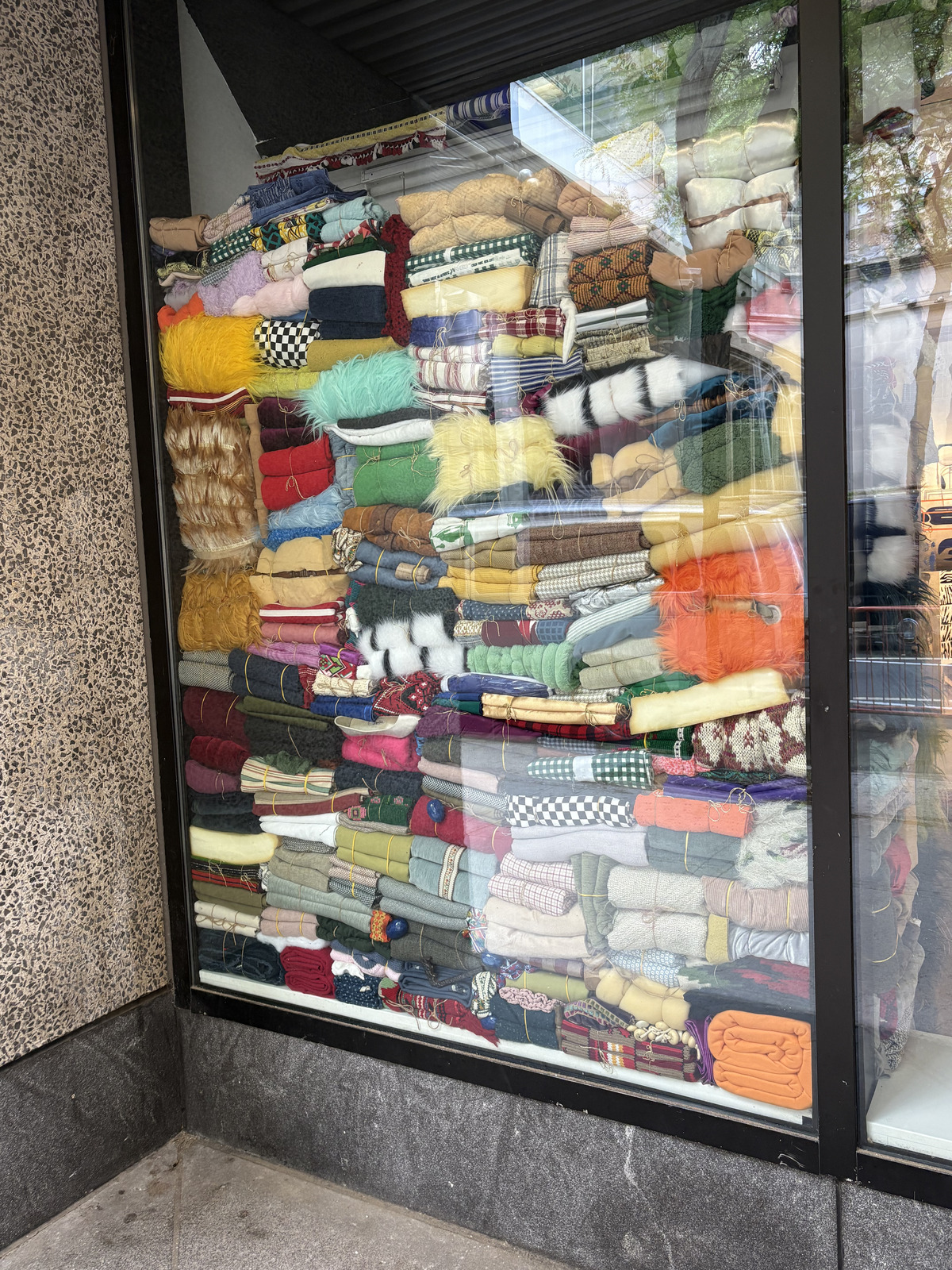
Lilian Shtereva’s folded cloth pieces are a startling accumulation of patterns and textures that overwhelm the front-entrance display window of Leubsdorf Gallery - it is literally impossible to see beyond her fabric accretions! Checkerboard patterns, loose strings, shag rugs, towel-like surfaces, and reams of other fabrics are included in Shtereva’s display. Though one can get a better view of the window display’s work after entering the gallery, you’ll need to look up as even more of these fabric pieces are latched onto the poles and over the doorway. The domestic sphere is of great interest to Shtereva as fabrics, linens, and other textiles are often synonymous with the idea of “home.” However, these materials are often discarded or forgotten about after they’ve either fallen into disuse, are misplaced, or seemingly fulfilled their intended function. Yet, Shtereva gives these works a renewed purpose, a sense of agency in how their forms, surfaces, and styles can be the locus of creative expression.
TJ Wilson
Bedford Stuyvesant, New York | @googieart | thisisgoogielife@gmail.com
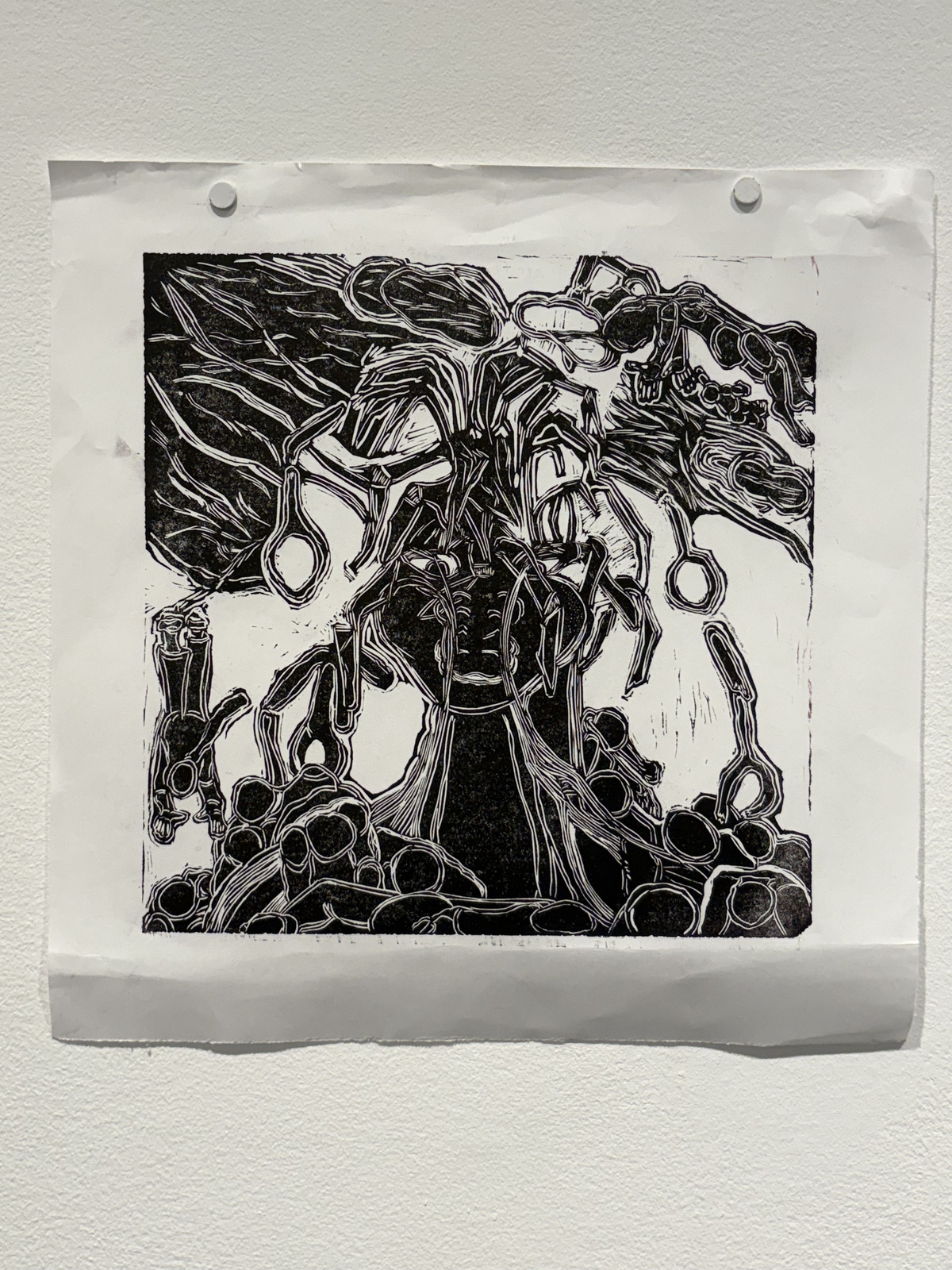
Like Gigi Lin’s catalogue entry, TJ Wilson’s opens and closes with an ekphrastic poem in which she contemplates the mysteries of nature and an affinity for painting (just that one sentence of “Ah painting” speaks volumes on Wilson’s affection for the medium). Wilson’s background as an African-American artist and interest in the Art History of black imaging (especially in an American context) has been the focus of her latest body of paintings in this thesis show. Her images are a celebration of black culture, spirituality, and family through a matriarchal lens. This gendered-reading centralizes our attention on the comfort of home - in this case, a rustic cabin. Elsewhere, scenes of agricultural labor, stylized portraits, and mystical night scenes abound, each of which vibrating with an energetic cadence of kinetic figures. Spending time with Wilson’s compositions really inspire one to delve further into the history of how the black figure as interpreted by a black voice (or hand in this case) comes to life much like when reading a seminal text by Maya Angelou, Toni Morrison, or Zora Neale Hurston.
Taisuke Yamada
Brooklyn, New York | @waniwanipanicdj
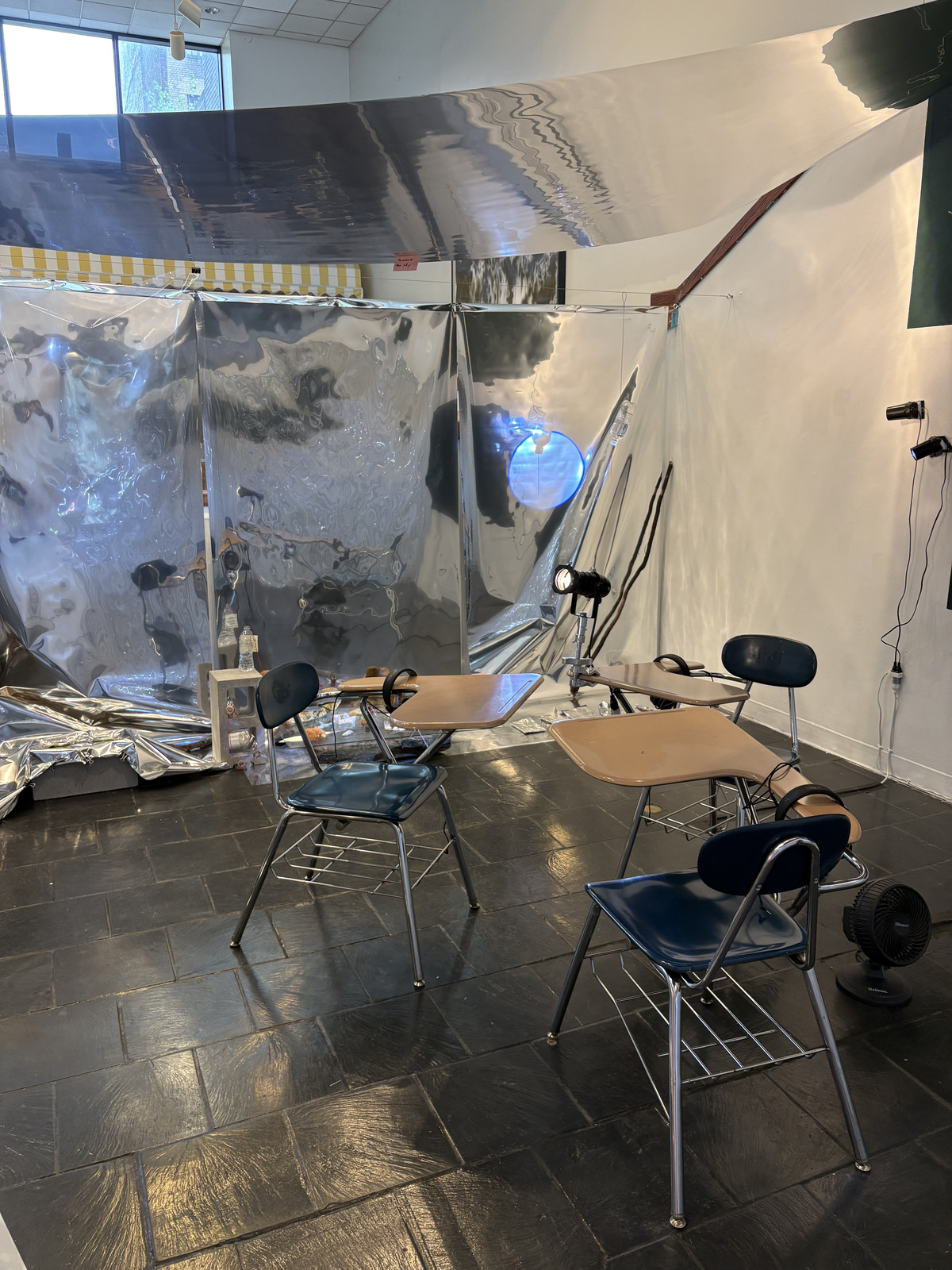
A makeshift architectural site-specific work, much as what you would find at the Venice Biennale or one of the documenta festivals, is an excellent example of gesamtkunstwerk (total work of art). Reflective foiled walls that vibrate when you pass them have the occasional post-it note with reminders of “being attentive to those spaces in between” or to look “toward the sun.” Three classroom desks are grouped in the center of the space while nearby chalk-drawn maps with certain sites marked by a colorful dot hang off to the side. At the end of the space is an altar-like floor display of a tree branch, cinderblock, plastic water bottles, feathers, and other natural and material detritus, some of which are connected by a red string. As you walk through Yamada’s work, your reflections along those foiled walls are inescapable. But then seeing yourself in relation to those sticky note mantras seems to be a call to action - adopting a more wholesome view on life and extending a greater degree of altruism towards those around you. The space is an interesting blend of classroom, church, and library - all sites of learning whose sole purpose (when done right) is to make one a better person, which in turn, is to yield a better society.
Varvara Voetskova
Moscow / New York | @varvaravoetskova | varvaravoetskova.com
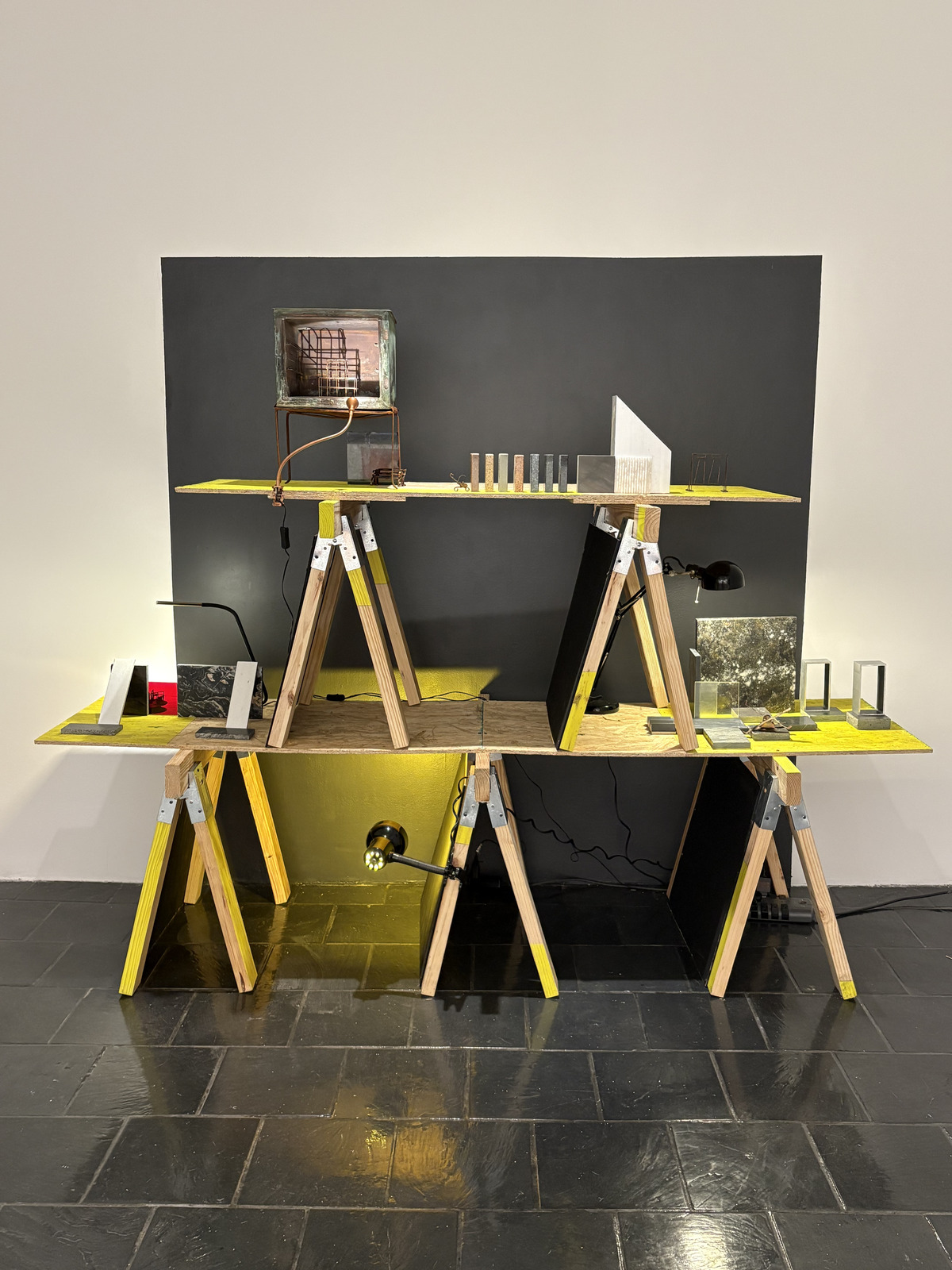
Voetskova constructed a miniature stage-set of the most cerebral and experimental sort as it features a disentangled network of levels, rooms, nooks & crannies, and terraces. A piercing yellow demarcates certain zones - either with the aid of an artificial light or painted surface. Tiny park benches, playground jungle gym, and carriage are among the “props” that populate this liminal space. Geometric blocks of different metals and stones form the gamut of the set. There is no indication of what is the beginning, middle, or end, or even if these are supposed to be a series of loosely connected vignettes (à la Armistead Maupin’s Tales of the City). Figuring out the narrative structure or cohesion is not the point, as Voetskova’s work boils down to what the imagination can conjure in terms of fictional storytelling. As Voetskova explains in her artist statement, this project is inspired by her vested interests in New Genres, Painting, Drama, Film, and World Literature - all of which have long-been conceptual complements to one another in myriad cultural movements since the 20th Century.
Conclusion
As an aside, I instinctively knew this would be an excellent show because I was already well-acquainted with most of the artists’ works for they exhibited at the Hunter MFA studio building, 205 Hudson, for a two-week exhibition in January: Do You Find Yourself Far From Home? Help Me Retrace Your Steps.
Visitors to the exhibition are also encouraged to take a copy of the coda catalogue which includes an introductory essay by Alan Ruiz (Hunter BFA faculty), statements by each of the artists, and high-resolution color images of a few of their respective works!
A closing reception for the exhibition will be held on the evening of Sunday, June 8th! WM

Liam Otero
Liam Otero is a freelance art writer in NYC. He was recently named New York Editor of Whitehot Magazine.
view all articles from this author