Whitehot Magazine
October 2026
"The Best Art In The World"
"The Best Art In The World"
October 2026
Cecily Brown's Themes and Variations at The Barnes Foundation
 Cecily Brown: Themes and Variations, 2025. The Barnes Foundation, installation view. Image © Barnes Foundation
CLARE GEMIMA May 23, 2025
Themes and Variations, Cecily Brown’s current exhibition at The Barnes Foundation, confronts the gaze as both a historical instrument of power and a site of violence and complicity. Across her paintings spanning 1998 to 2022, Brown refuses passive depiction; the female form becomes a vessel of struggle -- contorted by audience's preconditioned perceptions and equally as burdened by the weight of the artist's representation. Brown also unravels the visual language of the Old Masters, exposing how centuries of voyeuristic tendencies across painting's history have served to eroticize, dominate, and erase the essence of certain characters. In this show, looking becomes an act of bearing witness—her empowered figures endure objectification, and defiantly resist instinctual consumption.
 Cecily Brown: Themes and Variations, 2025. [L-R] Spree, 1999. Oil on linen. 75 × 75 in. Private collection. Untitled, 1996. Oil on canvas. 48 × 60 in. Promised Gift of Agnes Gund to the Metropolitan Museum of Art. Image © Barnes Foundation.
In Spree (1999), Brown flooded her canvas with frenetic layers of greens and reds in what she described in hindsight as “going a bit overboard.” Setting an excessive stage for a radical shift, her palette starkly strips to blacks, whites, and faint wisps of ochre and pink in Black Painting 2 and Black Painting 4 (2002–03). Figures are paralyzed by morbid, grueling oil strokes while suspended in nightmarish darkness, appearing neither dead nor alive. Smothered beneath bat-like marks that recall Goya's The Sleep of Reason Produces Monsters (1799), where creatures emerge from reason’s collapse, Brown’s fractured corpses conjure a similar breakdown, seemingly caught between worlds as they dissolve into the very mediums that hold them. In contrast to the outward chaos of Spree, these paintings internalize disorder, and dwell in a quieter, haunting brutality.
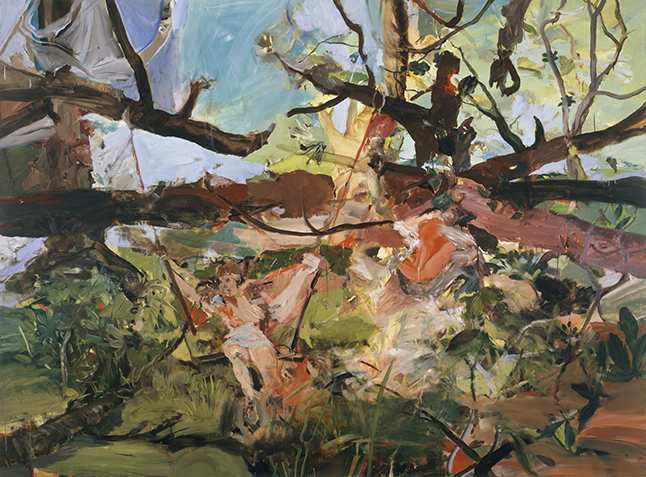 Girl on a Swing, 2004. Oil on linen. 72 × 96 in. National Gallery of Art, Washington, D.C. Gift of the Collectors Committee. Image © Barnes Foundation.
“I never wanted to paint a figure just sitting,” Brown told us as she stood in front of Girl on a Swing (2004). “I wanted them to always be doing something, especially if they were female.” The painting’s topless, suspended mid-motion protagonist sports a fearful, deer-in-headlights stare. Her expression teeters between childlike innocence and an adulterous awareness of being watched. Capturing a moment of interiority unsettled by a disconcerting intrusion, the painting fuses freedom with entrapment; the swing, a symbol of carefree motion which recalls romantic thoughts of Fragonard’s, now hangs heavy with dangerous unease. Brown, who described a “creepy presence” that lingers in this scene, victimizes her poor character, disrupts any sense of comfort, and ditches viewers in a state of complicated, pensive, and anticipatory tension.
Use of historical reference is once again evident. More defined trees, branches and leaves, especially to the left of the composition, are borrowed from Giorgione (1477-1510), Bruegel (d.1519), and Rousseau (1812-1867) landscapes, and demonstrate the artist’s rejection of absolut originality. Rather than creating in isolation, Brown recognizes the history of painting as an evolving archive, one that can be lended out, reworked and recontextualized to serve new purposes. This sampling is not mere mimicry, but an active and glorifying engagement with the past. As she put it simply, “why would I invent something when it already exists?”
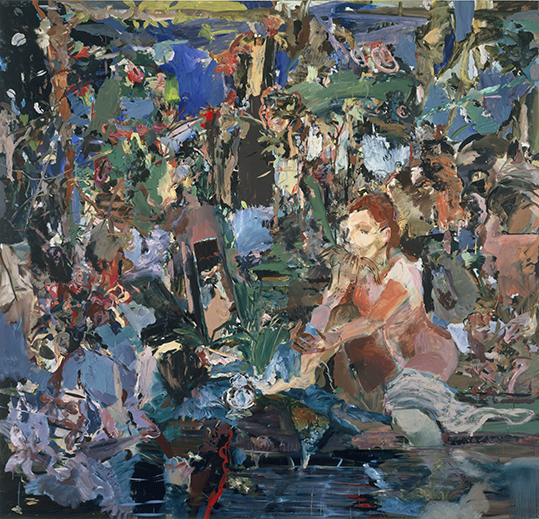 Untitled, 2005. Oil on linen, 84 × 84 in. Ovitz Family Collection, Los Angeles © Cecily Brown. Image © Barnes Foundation.
Themes and Variations at The Barnes Foundation demands slow, deliberate engagement. It compels the viewer to confront the discomfort of looking—not as a passive observer, but as an active participant in cycles of violence, voyeurism, and the concealed mechanics of the gaze. “I feel like we are constantly talking about painting, but there’s no replacement for your eyes,” Brown said, underscoring the necessity of direct, unmediated encounter. Her work forces us to reckon with the disquieting truths beneath the surface of representation—truths that are never fully resolved nor entirely visible, yet always present, and quietly lurking. WM
Cecily Brown. Themes and Variations. The Barnes Foundation. March 9 - May 25, 2025

Clare Gemima
view all articles from this author