Whitehot Magazine
October 2026
"The Best Art In The World"
"The Best Art In The World"
October 2026
Interview: The Time of flesh, The flash of myth: The archeology of the present in the art of Mimmo Paladino
By MANUELA ANNAMARIA ACCINNO, July 9th, 2026
There is a dimension in which the past is not merely remembered, but takes action. It is not an archive of dead forms, but rather an underground magnet that guides present-day action, an electric current that flows through matter. Within the contemporary art scene, Mimmo Paladino’s work is situated precisely at this fault line: the exact intersection between the transience of human experience – the time of the flesh – and the sudden, blinding irruption of the archetype, the flash of myth. In his works, Paladino does not merely offer a nostalgic reference to antiquity. His is, to all intents and purposes, an archaeology of the present.
By bringing to light visual fragments that seem to resurface from forgotten civilizations, the artist demonstrates how the contemporary is in fact layered, laden with a memory that precedes us and dwells within us. This approach finds its perfect theoretical reflection in the words of the anthropologist Claude Lévi-Strauss: “I wish to demonstrate, not how men regard myth, but how myth operates in the mind of man without his being aware of it.”
Paladino’s art operates precisely within this realm of the collective unconscious. The artist does not ‘use’ myth as an illustrative theme; rather, he is its conduit. Myth acts through his hands even before it does in his intellectual reflection. The hieratic figures, symbolic animals and timeless faces that populate his universe do not arise from a philological project, but emerge as a biological and psychological necessity, bearing witness to the fact that the structure of myth is alive, active and formative for modern man, even – and above all – in his utter unconsciousness. A profound journey between perishable matter and the permanence of the spirit, exploring how art still manages to serve as a vehicle for that flash of insight which, for millennia, has illuminated the darkness of our minds.
What image or memory from the past do you feel led you to art?
When I think back to my past, my clearest memory is of my uncle – a painter who moved between the avant-garde and visual poetry – and a trip we took together. I’d been drawing since I was very young, but the experience that changed everything was the 1964 Venice Biennale. I was fifteen and was literally blown away by Rauschenberg’s works. It was there that I realized that painting wasn’t just about copying reality, but about combining different elements, just as the avant-garde artists of those years were doing. Seeing Rauschenberg create such a pure emotion by bringing together poetry, found objects and the act of painting was my real starting point. Of course, later on at school you study Giotto and Caravaggio, but I only truly rediscovered and reinterpreted those great classics much later. From all this, I realized that works of art are ageless: what matters is only their intensity and their ability to communicate, within a journey that is slow, sometimes lightning-fast, and always surprising
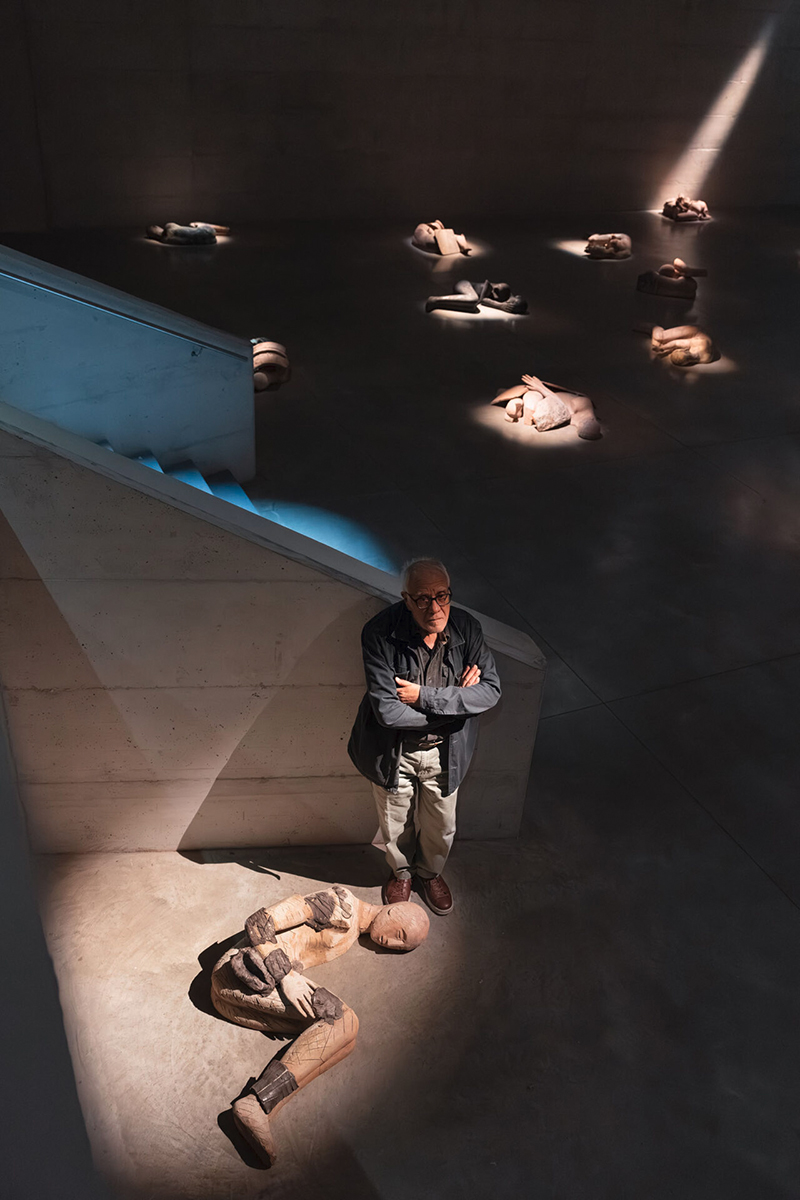
Dormienti, Palazzo, Citterio, Ph Lorenzo Palmieri
How would you describe the relationship between myth and material in your practice: is it myth that guides the hand, or is it the material that awakens the myth?
Ultimately, for every artist, only the material exists. But the material is never silent: it speaks through the visual background we carry within us. I am an artist from the South. I come from the Mediterranean, from Campania; Naples is a city of layers, with a history stretching back millennia, where the East, France and Spain have merged over the centuries. This cultural blend is not a theoretical choice; it runs in my blood. For me, there is no difference between drawing inspiration from the shores of the Mediterranean or delving into Italic antiquity. Myth never has a single or static meaning; we live by ancient mythologies that travel, transform and are reflected in cultures that seem distant. This same thirst has, in the past, drawn me towards Afro-Brazilian culture. Whilst travelling in Brazil, I was fascinated by the profound syncretism between African roots and European Catholicism. In the architecture of Salvador de Bahia or Ouro Preto, that exaggerated, opulent and sensual Baroque style is proof of how two distant worlds can merge to give rise to something entirely new.
Everything that human beings have created, built or dreamt of is living material from which I can draw to liberate form and image. Take terracotta, for instance, which I chose to give shape to the ‘Dormienti’. It is an ancient, universal material. It belongs to every people on Earth. The primordial mixture of clay and fire gives rise to the bowl used to feed oneself, just as it does to the idol used for prayer. It is in this everyday sacredness that I have found the inspiration for so many of my works. And when myth meets contemporary history, the material itself becomes a testimony.
I am thinking of “Porta d’Europa”, the monumental sculpture I commissioned for the furthest headland of Lampedusa. Five metres of refractory ceramic and galvanised iron, unveiled in 2008 on the last rock before the open sea. I chose ceramic so that it might absorb and reflect the light of the sun and the moon, transforming the work into a beacon visible from the sea. For those arriving from Africa, after hours upon hours spent adrift between water and fear on dilapidated boats, that gateway is the first visible sign of land. I did not wish to erect a celebratory or rhetorical monument, but rather to give form to a universal archetype: the act of passage, the welcoming of entry. A material stretched across the border, left there so that the wind and salt water may continue to shape it. It is not the hand that follows the myth, nor the material that reawakens it: they are one and the same, a single flesh traversing time.
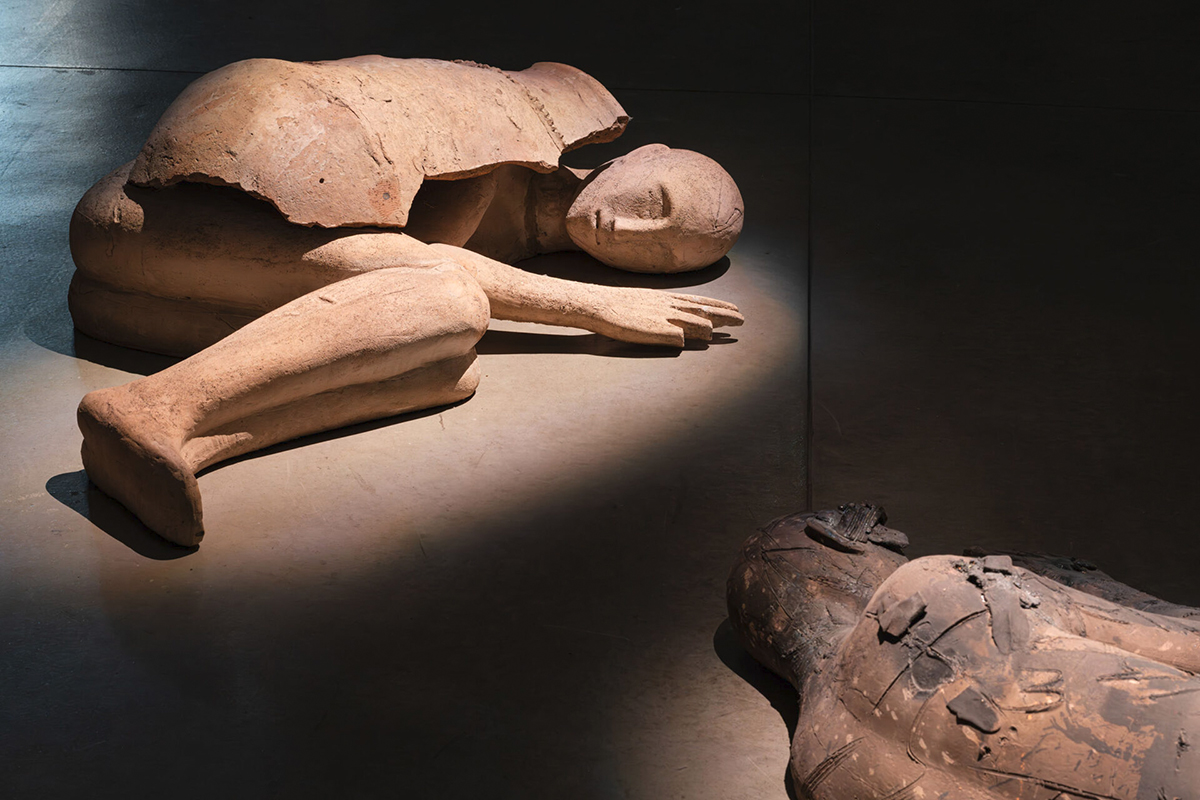
Dormienti, Palazzo, Citterio, Ph Lorenzo Palmieri
With the Transavantgarde, you and other key figures brought painting and sculpture back to the forefront, in stark contrast to Conceptual Art. At that point in history, were you seeking a revolution or a return to the roots?
The term ‘Transavantgarde’ was coined by Achille Bonito Oliva. With the keen insight of a great critic, he was able to recognize in us, a small group of four or five Italian artists who didn’t even know one another at the time, the tangible sign of an imminent change. But there is a fragment of personal history that I feel the need to reclaim: in 1977 I painted a work entitled ‘I’m going off to paint a picture’. Today it may seem a trivial gesture, but back then it was an almost subversive act. In those years, painting had become a taboo, a language that had been cast aside.
Movements such as Arte Povera, Conceptualism and Minimalism had reduced form to nothing, emptied the canvas. Ours was not meant to be an ideological revolution. We simply felt a vital need to restore the artist’s purest freedom: that of getting one’s hands dirty with paint, of reclaiming the medium and rediscovering a form of expression. The first to grasp this urgency were not the Italians, but European museums. Then, in a flash, America exploded onto the scene.
New York in the 1980s was a mythical land, a place imbued with a unique energy. Walking through those streets meant coming face to face with living legends such as Warhol, Lichtenstein and Rauschenberg. For me, a young painter at the time, that encounter felt almost sacred. Their painting had been my guiding light ever since I was a boy; I still remember the shock, the absolute revelation, when I saw a work by Rauschenberg at the age of just fifteen.
To find myself part of that scene, exhibiting in historic galleries such as Marian Goodman’s, she spotted me in 1979 during an exhibition in the Netherlands, was not merely a professional success. It was to step into the myth. And yet it had all begun in solitude, in 1978, when I arrived in New York for the first time on my own, driven solely by the desire to walk amongst the ghosts and forms of my personal mythologies. Walking along West Broadway in those years made you feel part of history itself. I owe much of what I have become to that city, and to the generous way in which it welcomed me.
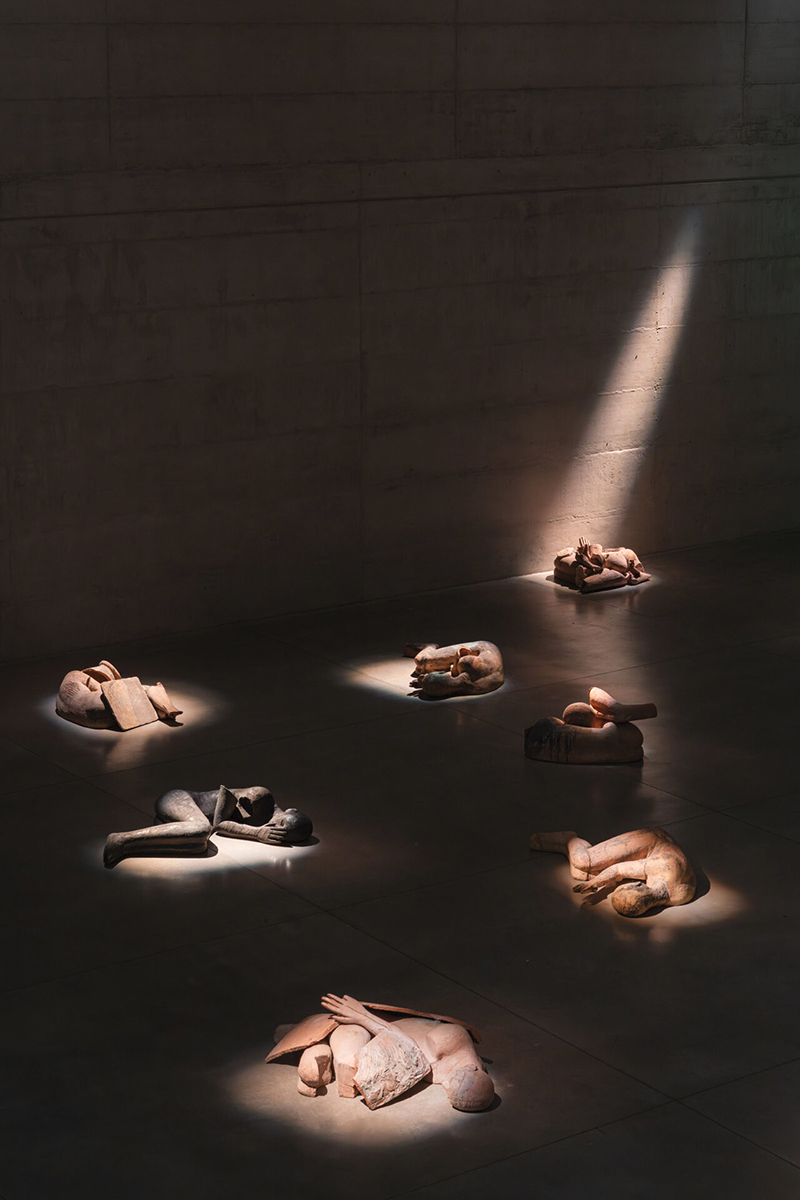
Dormienti, Palazzo, Citterio, Ph Lorenzo Palmieri
Your “Dormienti”, currently on display at Palazzo Citterio, seem suspended in another time. At this very moment in history, such a dramatic one, do you think these figures are dreaming of a better future or are they simply defending themselves against the present?
This exhibition has been, first and foremost, a revelation for me too. The ‘Dormienti’ were created in the late 1990s and presented at the Roundhouse in London in 1999. It all stemmed from a deep admiration for Brian Eno and his music. A mutual English friend introduced us, suggesting we bring our worlds together. We began to engage in dialogue, seeking a common ground, and from that exchange these figures took shape. There is a profound structural connection between us: my figures are a module that repeats and constantly changes, moving through space in exactly the same way as the sonic cells in Eno’s music.
These works have travelled and been exhibited elsewhere, but the installation in the Sala Stirling at Palazzo Citterio restores to them a power comparable only to that of their London debut. In this space, light is everything; it is not merely an accessory, but the very substance that cuts through the shadows and reveals the figures, thanks to the meticulous and sensitive work of Andrea Accetta, my director of photography. We often give in to the temptation to compare The Dormienti to the casts of Pompeii. But tragedy and ash have nothing to do with it.
The true origin of this work lies in a vivid memory of when I was in London: I saw the drawings Henry Moore made in the underground shelters during the city’s bombing raids. Moore was there, alongside his fellow citizens fleeing the bombs, and he depicted those huddled figures seeking sleep whilst the world crumbled above their heads. My ‘Sleeping Figures’ do not belong to death, nor are they defending themselves against the present. They are alive. Theirs is not a sleep of surrender or escape, but an act of underground resistance.
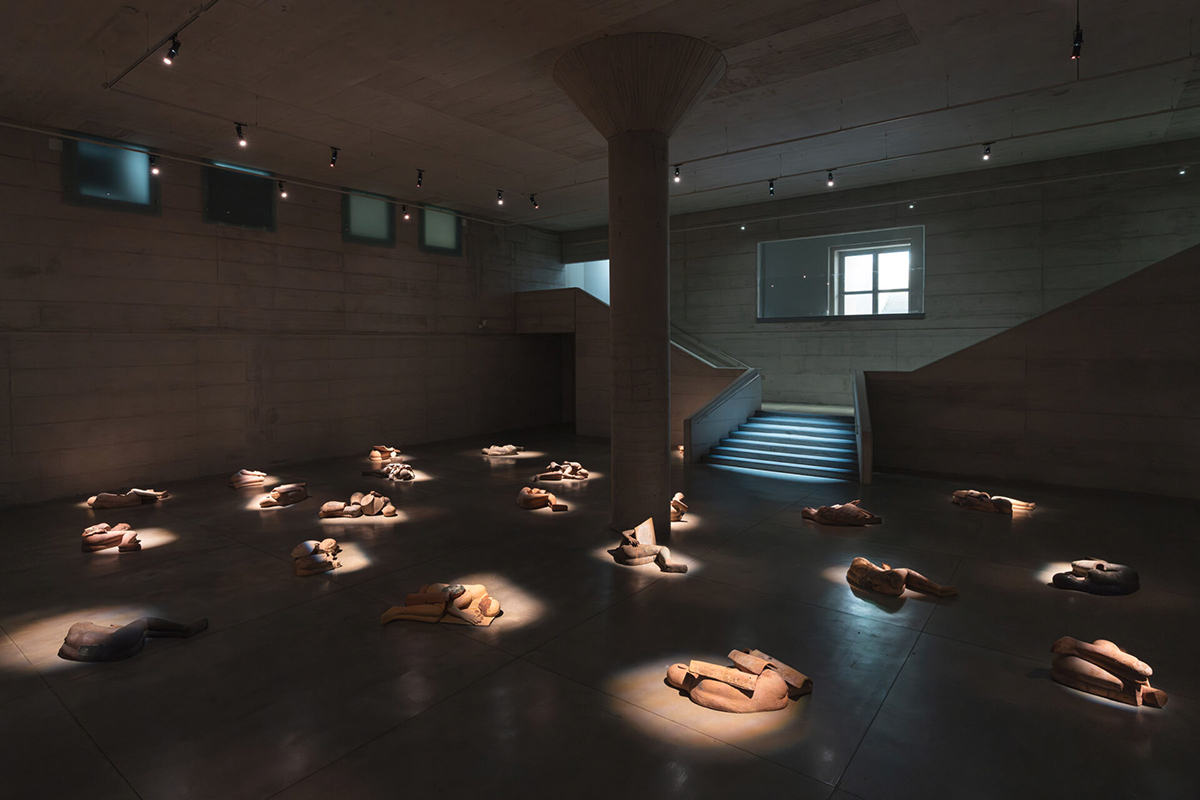
Dormienti, Palazzo, Citterio, Ph Lorenzo Palmieri
In a world that is becoming increasingly dematerialized in the digital realm and moving at breakneck speed, what role and what place will remain in the future for an art form that requires time and physical contact with materials?
Artificial Intelligence and digital technology offer extraordinary speed of execution, but they can never replace physical contact with earth, stone, wood or color. Touching the raw material is a primordial, indispensable, almost biological act: it is the original act through which human beings recognize themselves and give form to the world. Digital dematerialization forces us to constantly speed up, but form demands the exact opposite: it requires the slowness of creation and the sacredness of meditation. Only prolonged time and the labor of the hands allow an idea to settle and transform into a real presence.

Manuela Annamaria Accinno
Manuela Annamaria Accinno, born and raised in Milan, is an art historian and critic with a degree from the University of Milan. She has been actively collaborating for several years with radio stations and magazines specializing in the field of art.
view all articles from this author