Whitehot Magazine
October 2026
"The Best Art In The World"
"The Best Art In The World"
October 2026
Bascha Mon's Kin Terrains at Tappeto Volante Gallery
CLARE GEMIMA, October 16th, 2026
Bascha Mon’s Kin Terrains, on view at Tappeto Volante Gallery in Tribeca through October 24, 2026, brings together paintings, encaustics, sculptures, and works on paper spanning more than four decades. Concurrently, the gallery presented a solo booth at The Armory Show, bringing works directly from Mon’s recent Hunterdon Art Museum exhibition into conversation with her Tribeca presentation. At the fair, Homasote paintings from the 1970s encountered drawings made nearly half a century later.
Together, these presentations make a case for Mon’s past not sitting politely behind her present—it invades it, interrupts it, and returns through negotiations between what she remembers, what she invents, and what takes shape somewhere in between.
At ninety-three, Mon has little use for chronology. Time folds and unfolds across her work like a paper fortune teller, concealing and revealing the past with every stroke of the hand. Recollection is less predictable—like a blind contour drawing, the artist traces with conviction what she cannot reproduce with precision. Through paint, wax, graphite, and gouache, Mon’s past returns not as it was, but as something she is still completely free to mold.
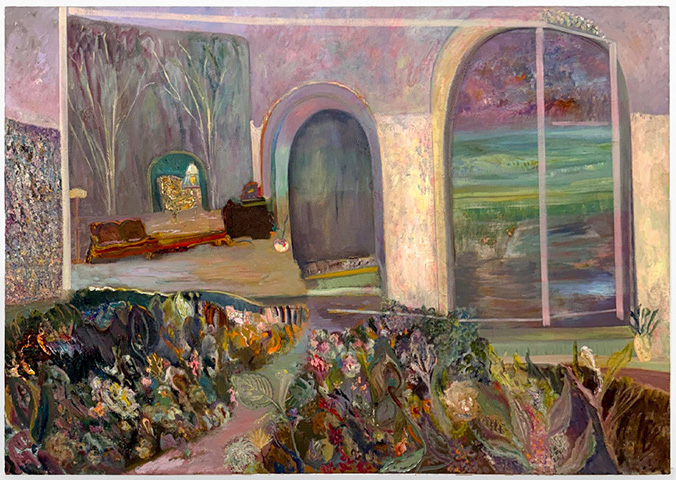
Bascha Mon. Unfinished, early 1980s. Oil on canvas. 50 × 72 in. Photo courtesy of Tappeto Volante.
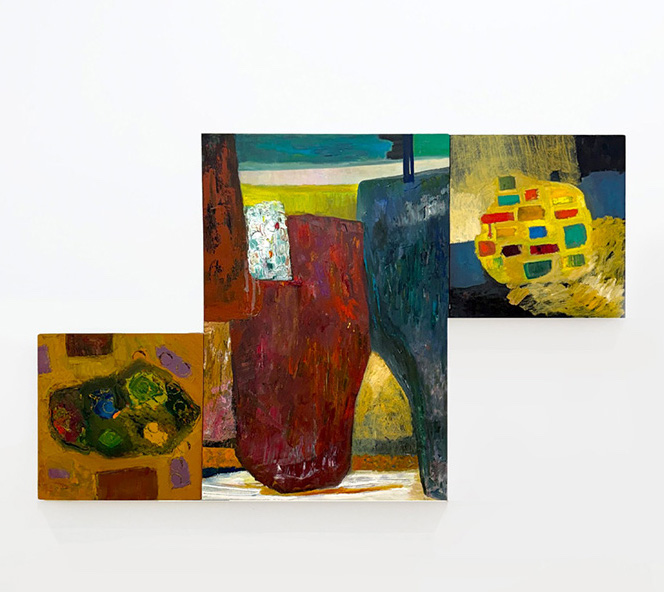 Bascha Mon. Bretagne Carnac, 1992. Oil on canvas. Panel A (top right), 22 ½ × 21 ½ in. Panel B (center), 34 × 48 in. Panel C (bottom left), 24 × 24 in. Photo courtesy of Tappeto Volante.
In Bretagne Carnac (1992), three self-contained panels crowd together pigment, competing marks, and incompatible scales, yet somehow arrive at complete agreement. Rather than smoothing over differences, Mon lets awkward partnerships flourish, one of her peculiar strengths. Their parts seem made for one another, even as they resist belonging.
Her sculptural heads make the familial proposition of Kin Terrains stranger still. Made between 1995 and 2007 from plaster, soft pastel, and encaustic, with flowers and feathers incorporated into several, Head 1, Head 2, and Head 13 look excavated rather than modeled. Bulbous and abject, they hover between fossilized organs and archaeological fragments, with the exaggerated corporeality of the prehistoric figurine Venus of Willendorf. Emphatically unprecious, they are as much relics of the body as unruly inventions of it.
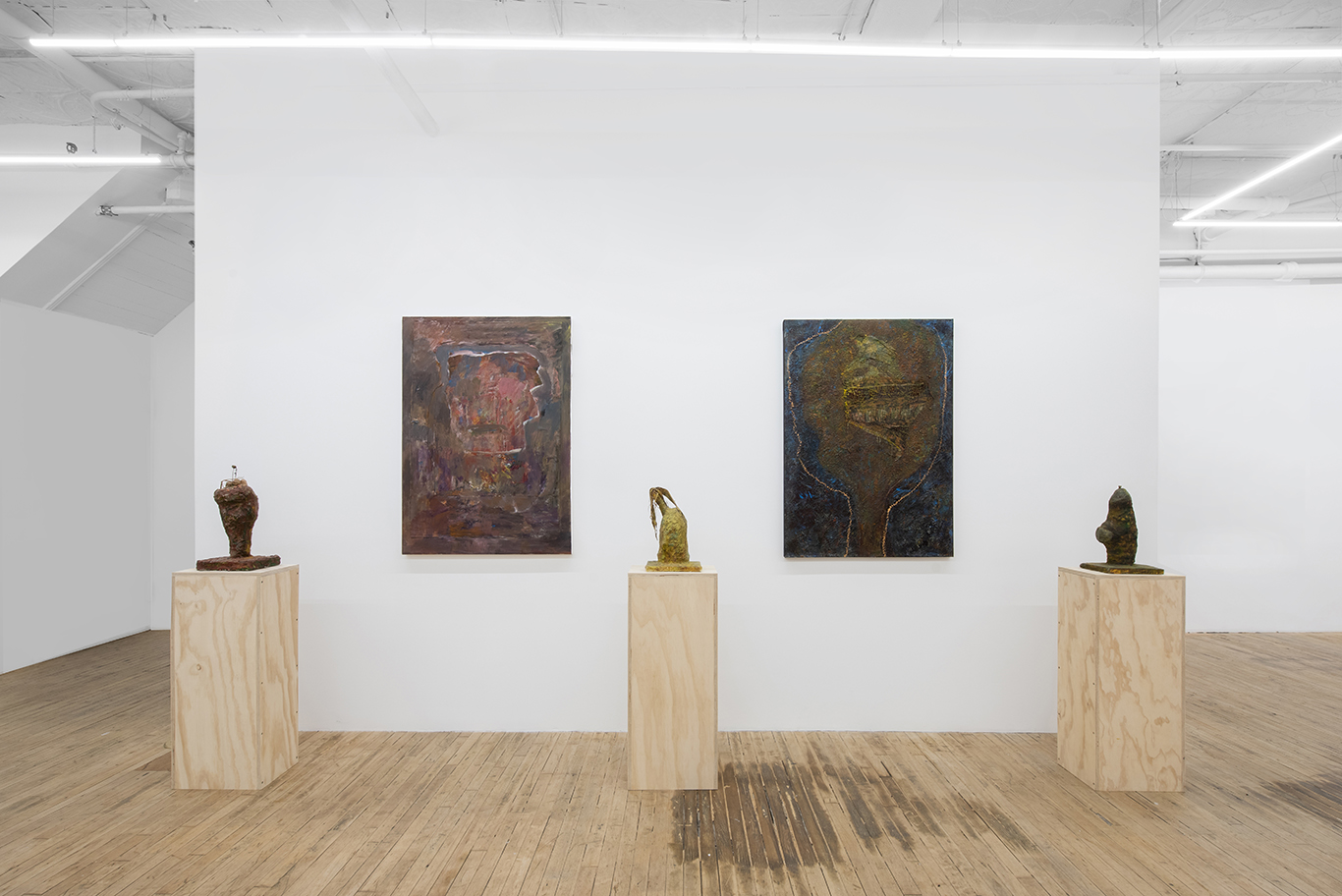
Installation View of Bascha Mon’s Kin Terrains. Photo courtesy of Tappeto Volante
Their proximity to Family Portrait: Large Head (1990s) further complicates Mon’s relationship to genealogy. Wax preserves, but it also coats and obscures. A portrait can accumulate traces of a person while gradually burying its subject. Throughout Kin Terrains, family is less a fixed lineage than something to excavate, piece together, and perhaps never fully demystify.
At The Armory Show, works carried forward from Mon’s Hunterdon Art Museum exhibition offered another way into this proposition. Her Maps + Games paintings from the 1970s are executed on Homasote, a compressed fiberboard with a rough, absorbent surface that contributes to their chalky, weathered appearance. In Maps + Games (1978), squiggles and blotches jostle with marbled passages and fleeting moments of illusionism. The painting resembles a map whose legend has long since disappeared, and its own genealogy begins to look much the same. Presented alongside drawings made decades later, it suggests a visual language never abandoned, yet relentlessly revised.
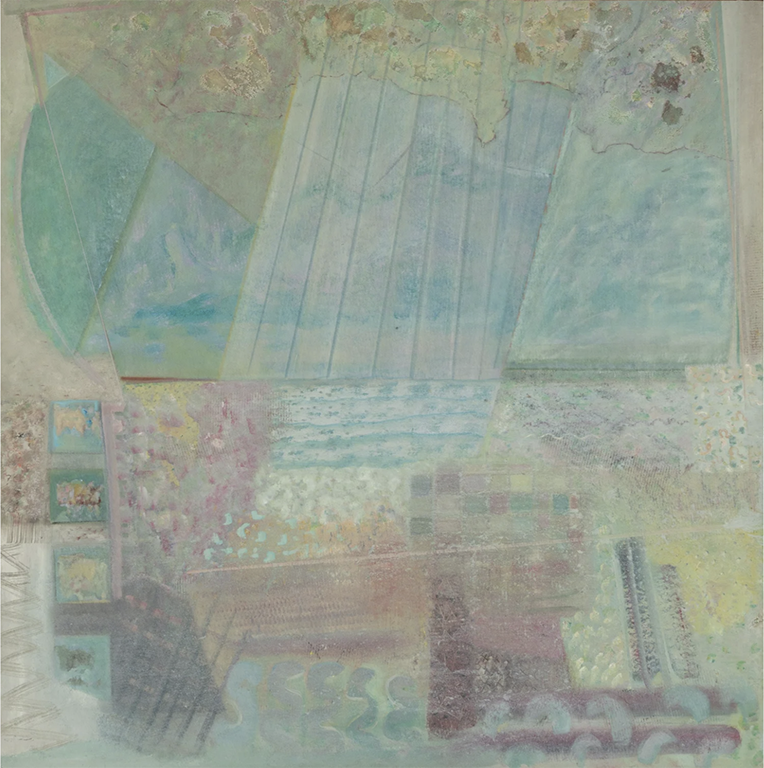
Bascha Mon. Maps + Games, 1978. Oil and perlite on Homasote. 48 × 48 in. (artist’s frame). Photo courtesy of Tappeto Volante.
Something gentler, though no less elusive, unfolds in Rain’s a Glimpse of Fall (2023). An animal briefly announces itself, perhaps a deer, a bird, or several creatures moving together, before its anatomy slips away. Bodies dissolve into vegetation, leaves become limbs, and foreground and background trade places. A vivid cobalt zigzag traces the edge of an amorphous form, momentarily holding together what the drawing seems determined to let go of.
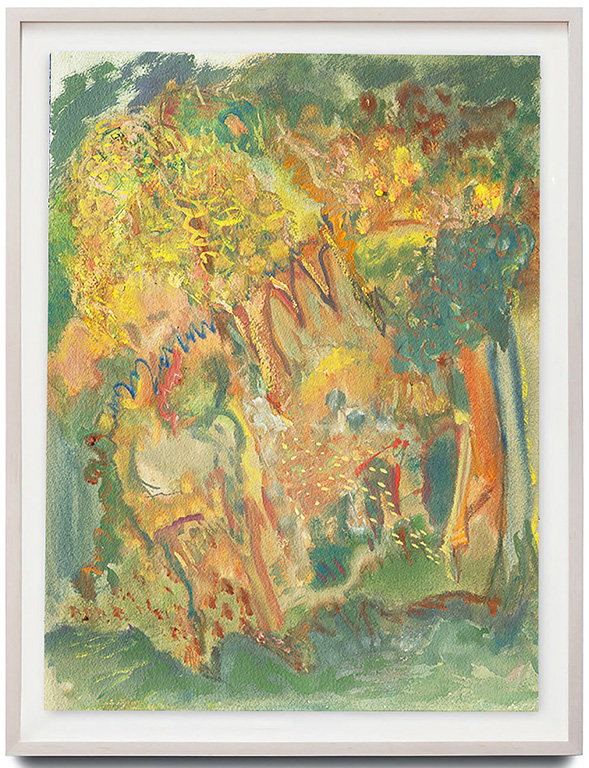
Bascha Mon. Rain’s a Glimpse of Fall, 2023. Carbon pencil, gouache on Arches paper. 19 × 15 in. Photo courtesy of Tappeto Volante
Across Kin Terrains and her recent Armory presentation, Mon refuses to let categories settle. Furniture becomes landscape, landscape assumes anatomy, and ancestry emerges through fragments that resist being made whole. Nothing stays entirely itself, nor does it disappear altogether. For Mon, memory is not a faithful archive. It is an active, unruly energy in which the past survives not by remaining intact, but by finding new ways to exist. WM

Clare Gemima
view all articles from this author