Whitehot Magazine
October 2026
"The Best Art In The World"
"The Best Art In The World"
October 2026
Exhibition Review: “Alan Davie: Paintings, 1959 - 1971” at A Hug from the Art World, Chelsea (long-term viewing, by appointment)
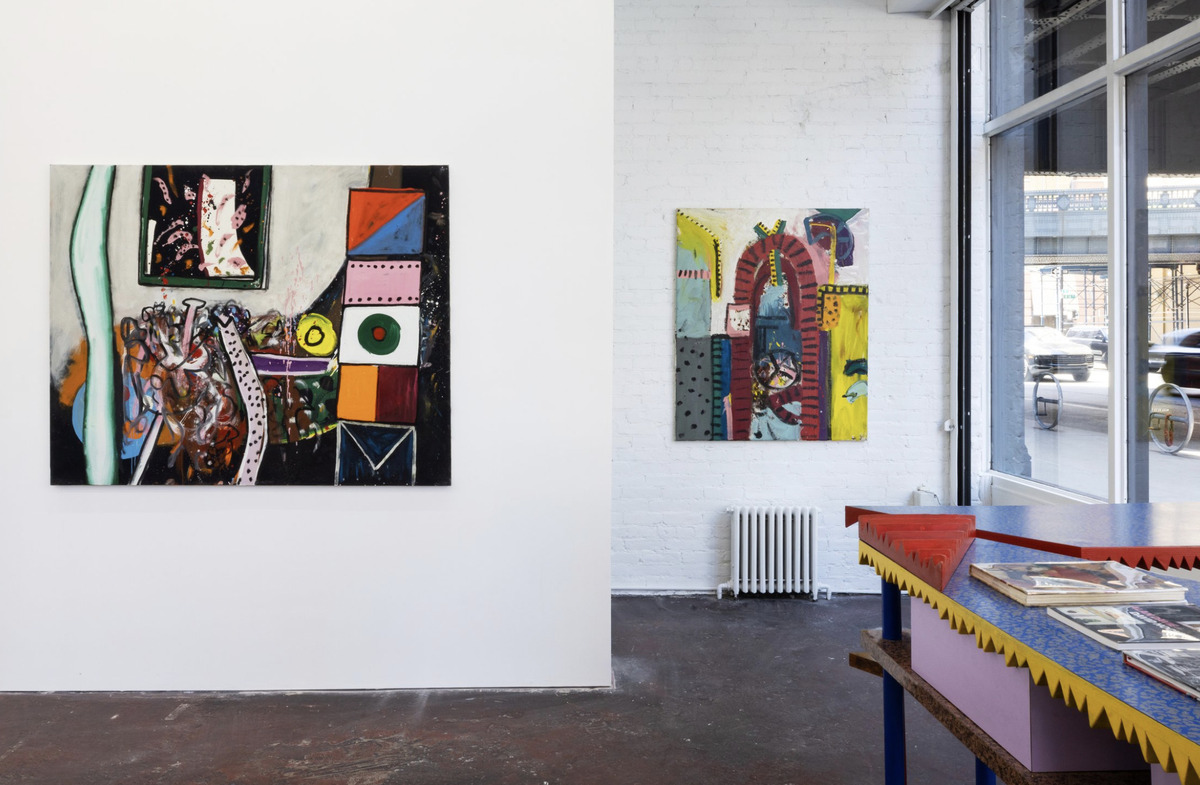 Installation view of Alan Davie: Paintings, 1959 - 1971 at A Hug from the Art World, Chelsea
By LIAM OTERO July 12, 2025
A Hug from the Art World is currently showcasing a long-term exhibition of Alan Davie (Scottish, 1920 - 2014), possibly one of the strangest characters of Abstract Expressionism. My use of the term “strangest” is intended here in the most endearing terms as Davie’s multifaceted background, inimitable abstract style, and reams of influences distinguish him in the most extraordinary ways. To give a very short bio on Davie, he was one of the most important post-war British abstract artists who attained great recognition among the New York School painters (including Jackson Pollock), was collected by Peggy Guggenheim, and many of his paintings can be found in Modern & Contemporary art collections all over the world - from the Art Institute of Chicago to the Art Gallery of New South Wales in Australia.
Adam Cohen, the founder of A Hug from the Art World, gave a me private tour of the exhibition and explained how this show materialized. In November 2024, Cohen returned to the United Kingdom, his home country, to visit family and noticed his father, the respected art collector Frank Cohen, owned a Davie painting. Having a vested interest in modern British art, Cohen felt a calling to stage an exhibition of Davie’s work at his gallery’s newest location, 112 10th Ave (the former location of high-end fashion brand Comme des Garçons’s corner POCKET store).
 Alan Davie (Scottish, 1920 - 2014), Entrance for a Red Temple No. 4, 1960, oil on canvas. 48 x 40 inches. 122 x 50 cm. Signed and dated verso.
Though he admires the work that Davie accomplished throughout his six-decade career, Cohen did not want to pursue a retrospective exhibition, for instead he honed in on the period of 1959 - 1971: “The 60s for me [Adam Cohen] are his most important breakout years for influence.” You can clearly understand why Cohen focused on this era as Davie’s style had evolved from a somewhat muted, haphazard approach in the 1950s to a far more psychedelically complex visual schema during “The Long Sixties”. Contextually, too, Davie’s decision to build upon his existing work in the AbEx vein was considered a bold move as Art World trends in the 1960s shifted away from 1950s action painting in preference for Pop Art and Minimalism. Concurrently, painting’s stature had been decentralized with the rise of new media and modes of creative expression by way of performance art, video art, Fluxus, Happenings, Land Art, etc. The cool-headed, nonchalant Davie was perfectly content with working in a league of his own.
Davie’s influences deserve a paragraph of their own as his interests were wholly encyclopedic. Coming from Scotland, Davie had an affinity for his homeland’s Ancient Celtic & Pictish roots along with early-Medieval Christian art (itself quite distinct from Continental Europe’s for its florid, semi-abstract, richly colorful style). Of course, the New York School followed suit in tandem with Jungian psychology, Zen Buddhism, and Surrealism. Even his additional passion projects played a role in shaping his artistic approach - glider piloting (also known as soaring) and jazz music (he played saxophone, piano, cello, and flute). By the 1960s, the convergence of these interests and more became a recipe for a wild, painterly fever dream.
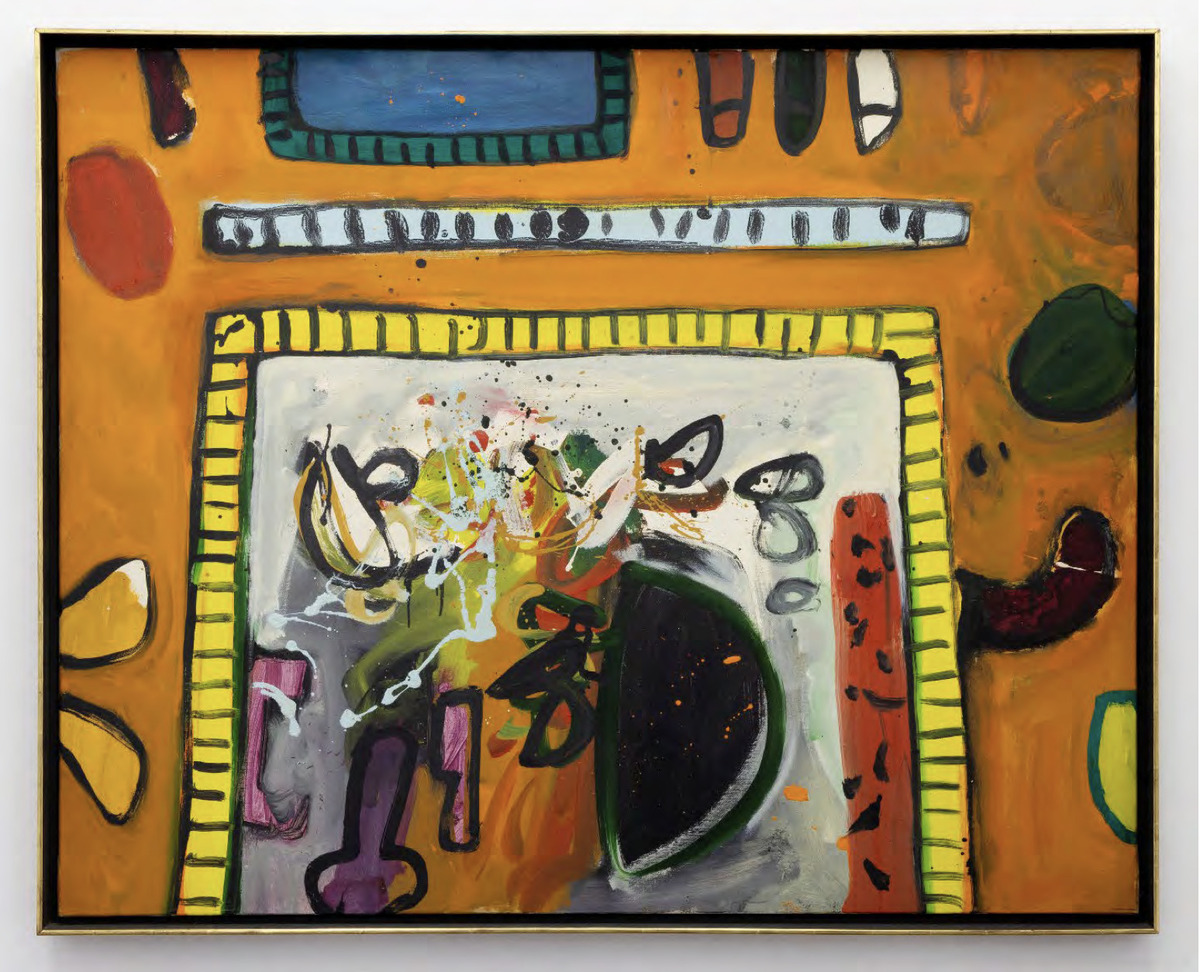 Alan Davie (Scottish, 1920 - 2014), Joe's Lucky Dip, 1961, oil on canvas. 48 x 60 inches, 122 x 152.5cm. Signed, inscribed, and dated 'Oct 1961' verso.
Joe’s Lucky Dip (1961) is a Cubist-esque downwards-facing view of a carpet featuring Davie’s signature tiger tail motifs, penises everywhere, and a splatter of frenzied brushstrokes in putrid shades of orange, yellow, red, and green. It would not be crass of me to describe the scene as an orgy of abstracted shapes and gestures. There is a remarkable tension between solid forms and that of the helter skelter drips & splashes.
The delight Davie must have taken in being a pilot likely had an effect on how the oil paint made contact with the canvas as there is a pervasive presence of gestures that glide and swerve in short and long spurts. The jazz associations, too, are amplified by the rhythmic vibrations of shapes and markings that are involved in fast-paced, highly emphatic movements.
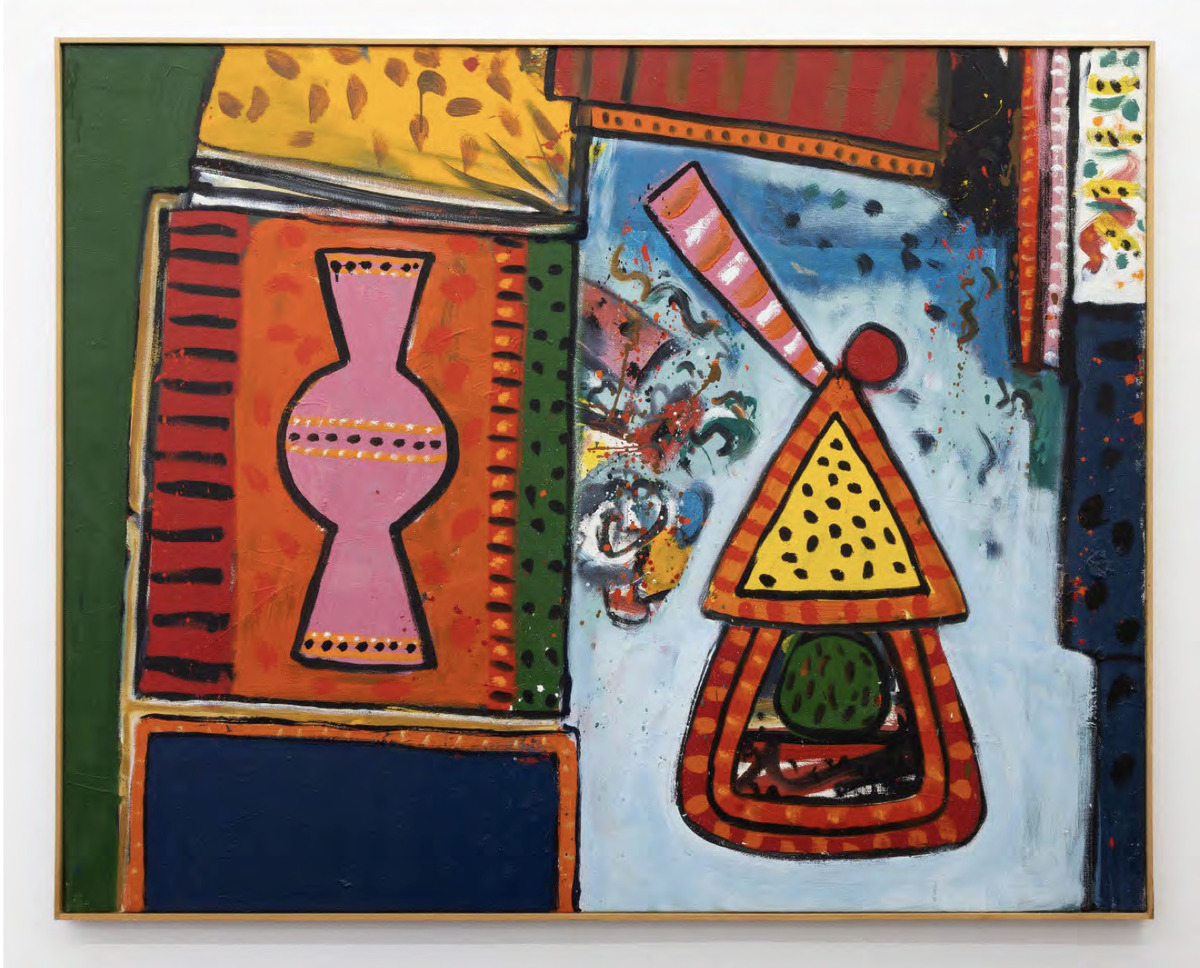 Alan Davie (Scottish, 1920 - 2014), Scent Bottle, 1966, oil on canvas. 48 x 60 inches, 122 x 152.5cm. Signed, dated, and inscribed on verso.
But Davie cannot be described in strictly abstract terms as he incorporates a mixture of discernible and illegible figures within the foggy morass of colors. There were a few instances in which I felt like I was seeing a suggestion of a tabletop or sink. It just so happens that when Davie worked on these types of paintings a popular figurative style emerged in England, Kitchen Sink Realism, which focused on the plight of working-class life (especially in the North of England). There could very well be a possibility that John Bratby’s murky and sullen handling of texture could have influenced Davie’s style, or even just simply in terms of content.
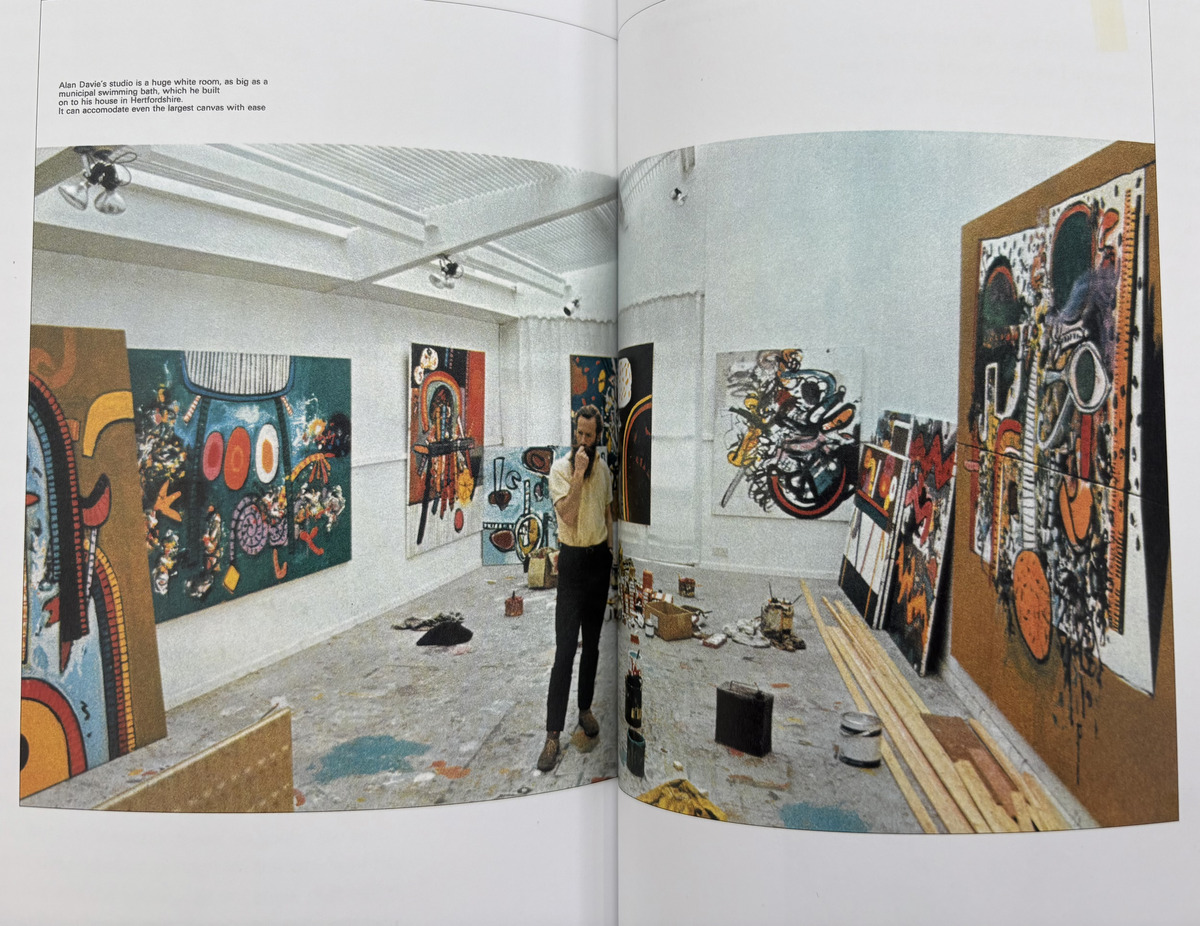 Alan Davie in his studio (1965), photographed by Lord Snowdon. Image spread from the book Alan Davie & David Hockney: Early Works by Eleanor Clayton and Helen Little (2020), published by Lund Humphries Publishers, Ltd.
With the paintings averaging in a scale of either 48x40 in. or 48x60 in., they exude a dominating presence alongside one another. Just seeing the reams upon reams of oil paint layered onto each piece gave me pause in contemplating how it must have contributed to the physical and visual weightiness of these canvases. Another important detail that must be shared on their curation is that Cohen wanted to replicate as closely as possible a famous photograph of the artist’s studio in 1965 - right smack in the middle of this crucial period - as a way to recreate how the artist likely would have intended these paintings to be grouped. A bonus mention must be made for the gallery desk - a colorfully pre-Memphsis style work of pizzazz designed by Lapo Binazzi in 1978 - that automatically gels well with Davie's work.
Alan Davie: Paintings, 1959 - 1971 is a most successful tribute to an artist who, though known among Modern aesthetes and present in many public & private collections, is a relatively underappreciated figure in Abstract Expressionism. A posthumous retrospective, Alan Davie: An Inner Compulsion, was held at Alan Wheatley Art in London in 2018. However, Cohen’s show is unique because it is the first major exhibition of Davie in New York in almost 20 years and it focuses on the peak period of his career. Davie has been gone from this world for a little over a decade, but these paintings are such a potent demonstration of how an artist’s spirit remains.
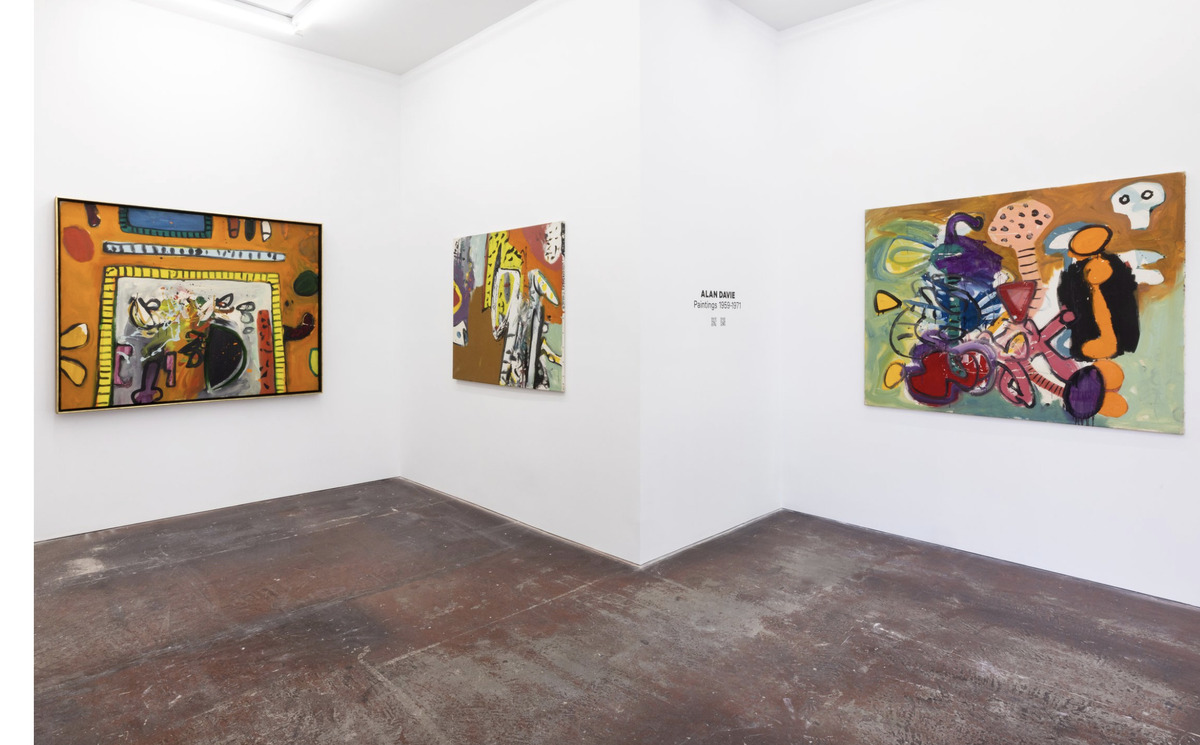 Installation view of Alan Davie: Paintings, 1959 - 1971 at A Hug from the Art World, Chelsea

Liam Otero
Liam Otero is a freelance art writer in NYC. He was recently named New York Editor of Whitehot Magazine.
view all articles from this author