Whitehot Magazine
April 2026
"The Best Art In The World"
"The Best Art In The World"
April 2026
Julie Mauskop Surveilling the Subliminal at Garner Arts Center
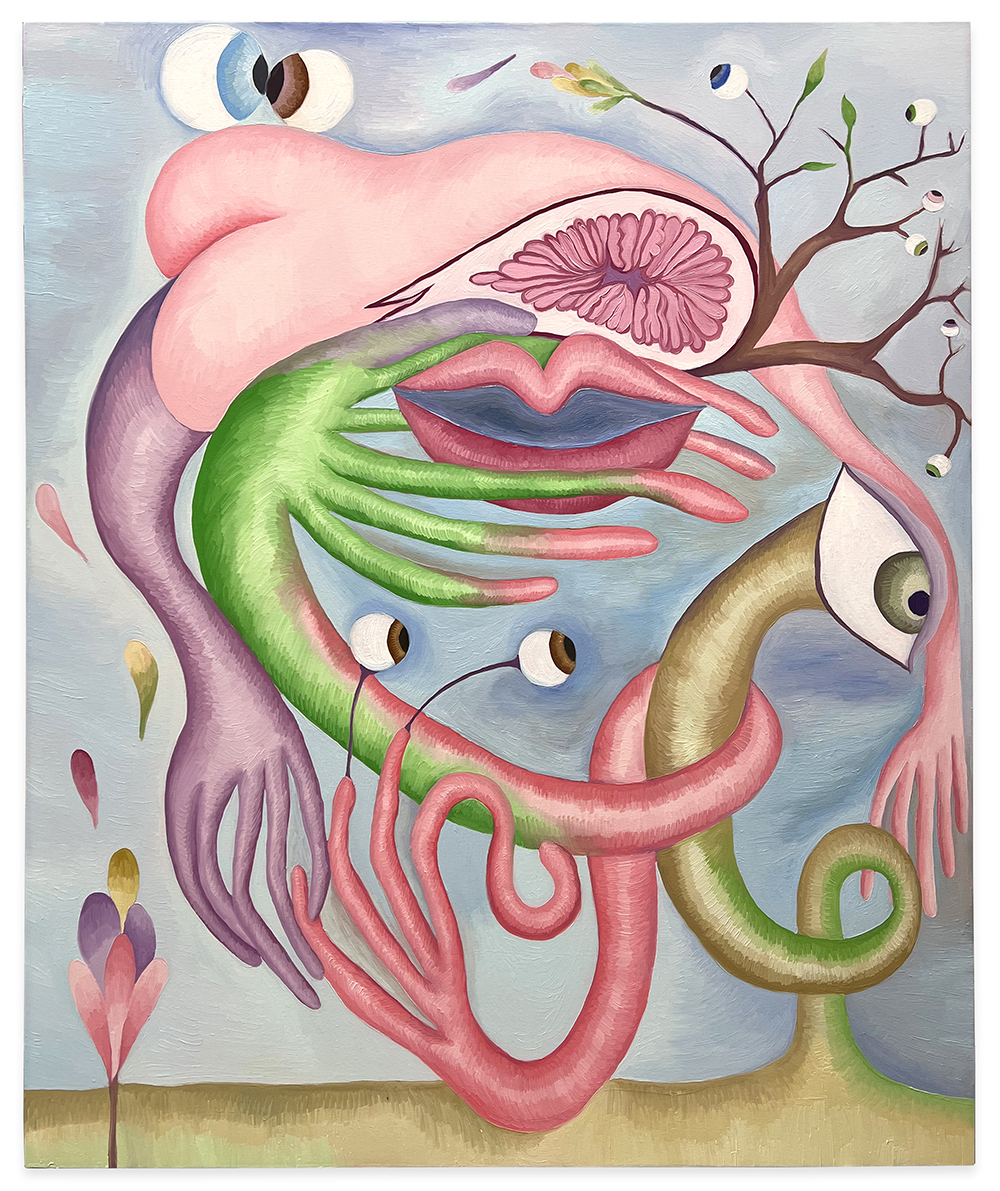 Sprouting, 2026, Oil on linen, 36 x 30 inches
By ANTHONY HADEN-GUEST February 25th, 2026
I found it unusual to be looking at the work of an artist who was new to me and exploring new territory in her work, finding it strong in a comic mock-shock vein and utterly unconnected to any Ism. So it is though with Surveilling the Subliminal, the work of Julie Mauskop, now at the Garner Arts Center (garnerartscenter.org) in Rockland County, New York, thanks to Jonathan Shorr, a curator with special skills in combining art and tech. My initial reaction to these canvases, which was somewhat conditioned by the artist’s precise use of blissy coloration, was of being sucked into a lush Toy Town aesthetic, but, as with such other at first sight playful artworks as Alfred Jarry’s Ubu Roi images and certain of Philip Guston’s comic strippy canvases, it was clear that these are fun stuff with a dark side.
Not always though. Mauskop furnishes her pieces with such elements as halves of figs, strawberries and pink mouths, producing undulant, curvaceous canvases, within which straight lines are a No-No, thereby creating a seductive world, as presented in such work as Connecting and Confronting, a pair of strong canvases hung on a brick wall. But the dominant element in Mauskop’s visual language, and the most ubiquitous working part in her pictorial vocabulary is something wholly other: the human eye.
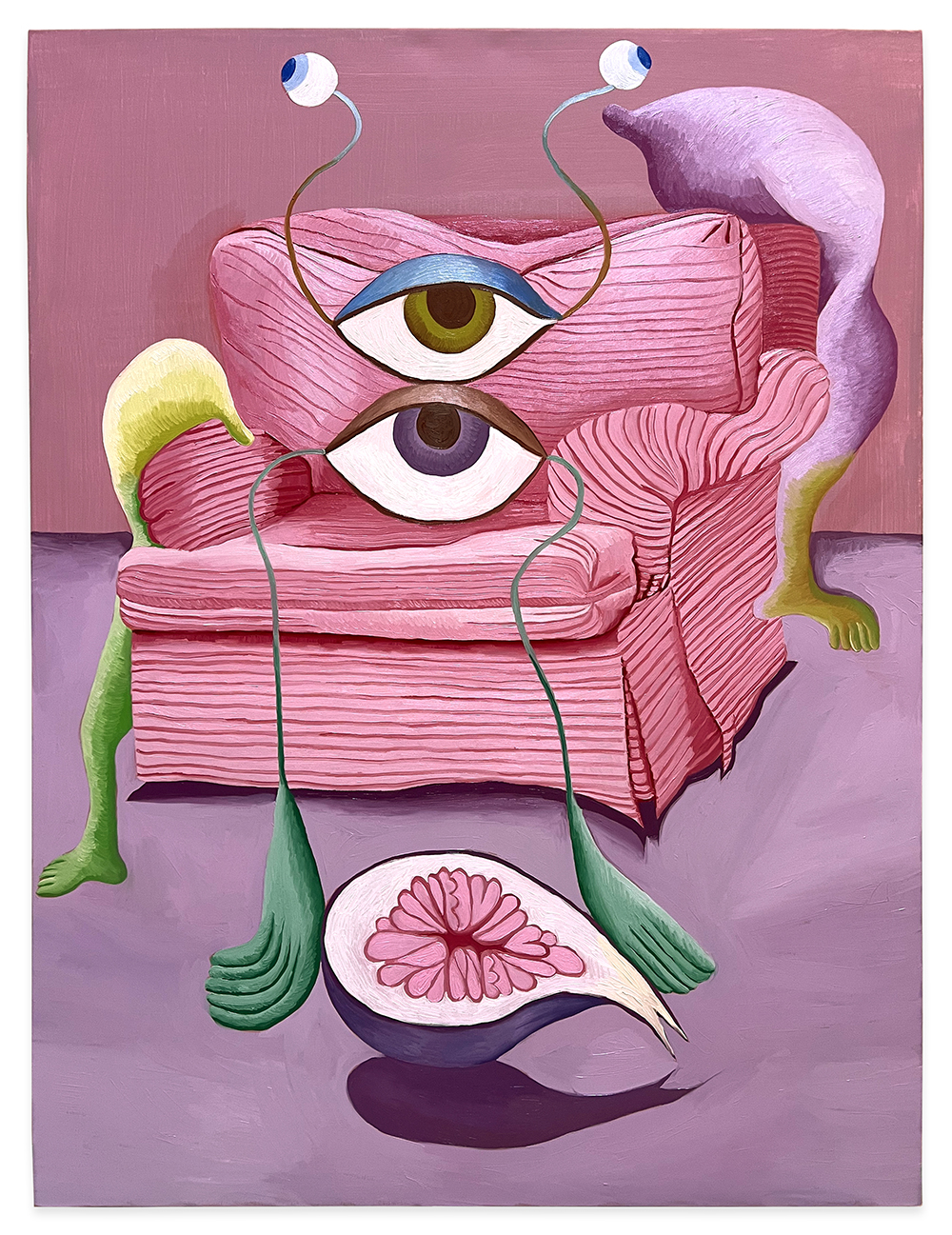 Aliens with Fig, 2024, Oil on linen, 40 x 30 inches
The eye is one of our most powerful organs, dangerously so when put to malign uses, but it is also one of our most vulnerable parts, and artists have long been making use of such contrary attributes. The blinding of Samson by the Philistines, out of terror at his revealed strength, was the subject of paintings by Rubens and Rembrandt, Duchamp and Dali took over the eye as a working body part. Un Chien Andalou, a 1929 movie co- directed by Luis Bunuel and Salvador Dali opens with the searing image with a razor slicing a woman’s eye - which, it was later revealed, had actually been that of a cat. Poor puss! Yayoi Kusama makes consistent joyous use of eyes on her prints.
Julie Mauskop puts the nimble fingers on the hands she paints to diverse uses, but her eyes are wide-open. She features one or a number of eyes in a great many of her pieces, including four eyes, two being on insectile stalks, in Contaminating, a single eye in Growing, and eleven eyes in Sprouting. In her work, Mauskop presents some of the ways in which we check out and investigate our reality, such as the hands with lean and twirly fingers that she has pictured, one holding a flower, the other a halved fig, in Growing. Or a hand transforming into the roots of a tree in Rooting or the two brown eyes giving us a frontal look above the hand clutching a mauve brain in Moonlight.
So the eyes have it. But just what precisely is it that Julie Mauskop’s eyes have, what is it that they let us know? It seems clear that they are Spying Eyes, a central presence in the World of Now. Mauskop’s father is a neurologist, her brother works in AI, she is aware of today’s brain/body connections. Her paintings depict us in our own worldscapes as constantly being watched. As we increasingly feel that we are, and not just political activists, but for the mass of us, ordinary consumerdom, there is increasing commercial evaluation of every breath we take, every move we make, these being crucial questions for our way too interesting time. But it has gotten deeper and broader than this, never has there been such mass surveillance than that being conducted on ourselves and by ourselves than in our social media drenched times.
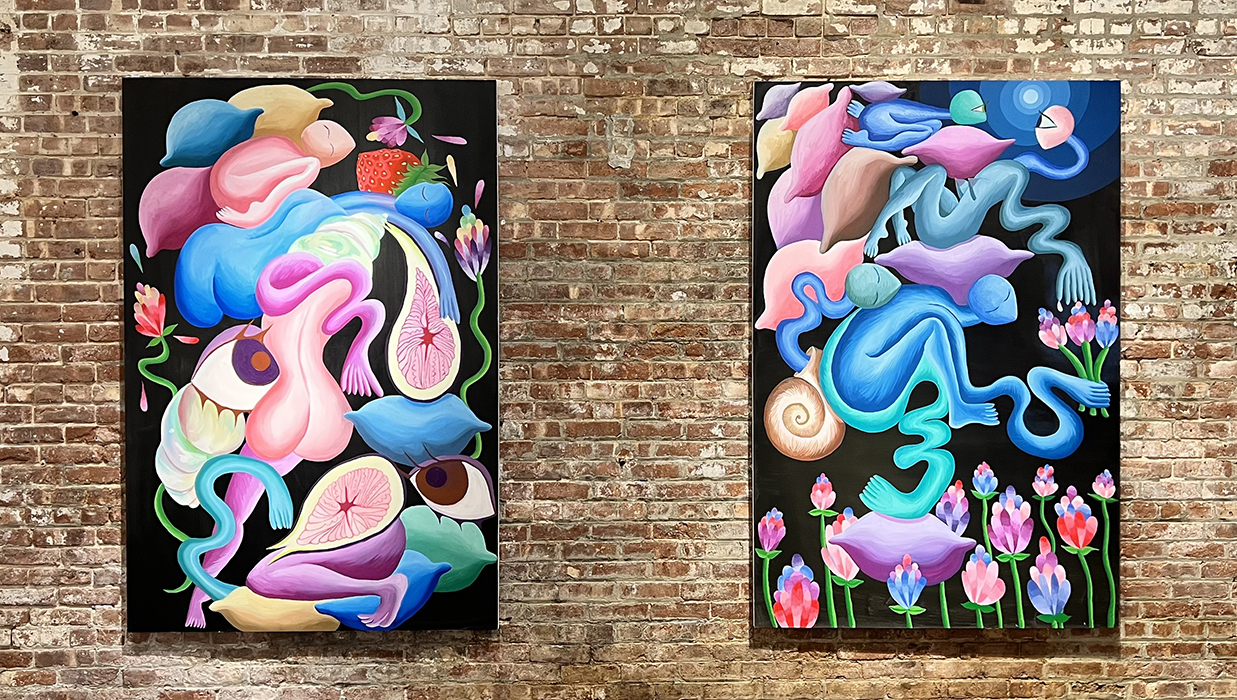 Connecting, 2023, Oil on canvas, 72 x 48 inches 2. Confronting, 2023, Oil on canvas, 72 x 48 inches
But just what do Mauskop’s eyes mean to Julie Mauskop? Do they represent life under observation in a surveillance state? “Yes. It’s definitely connected with that,” Mauskop said. “The way I place them is meant to have that surveilled feeling and explore how that is affecting our consciousness. Sometimes I repeat the eye, and just the placement is meant to have this voyeuristic and subtle sensation of surveillance.” She does not intend to limit the meanings in her painted eyes though. “Sometimes they're more alien, sometimes they’re more playful, they take on different meanings depending on their placement. I think it’s interesting when I have different parts of the body outside the body,” she told me.
I began this piece by mentioning that I’d had an unexpected reaction to Mauskop’s work. I’ll close by doubling down on precisely that. An acreage of isms occupy gallery walls but Mauskop’s painting are rambunctiously the other and what grabs me about the work is not just the watchful eyes, the curvy pod shapes, but something I don’t always get from gallery art: A throb of raw life.
Julie Mauskop Surveilling the Subliminal is on view at Garner Arts Center through March 5, 2026.

Anthony Haden-Guest
Anthony Haden-Guest (born 2 February 1937) is a British writer, reporter, cartoonist, art critic, poet, and socialite who lives in New York City and London. He is a frequent contributor to major magazines and has had several books published including TRUE COLORS: The Real Life of the Art World and The Last Party, Studio 54, Disco and the Culture of the Night.
view all articles from this author