Whitehot Magazine
August 2026
"The Best Art In The World"
"The Best Art In The World"
August 2026
Mira Goodman's 'Glimpse of a Stranger' at All St. Gallery
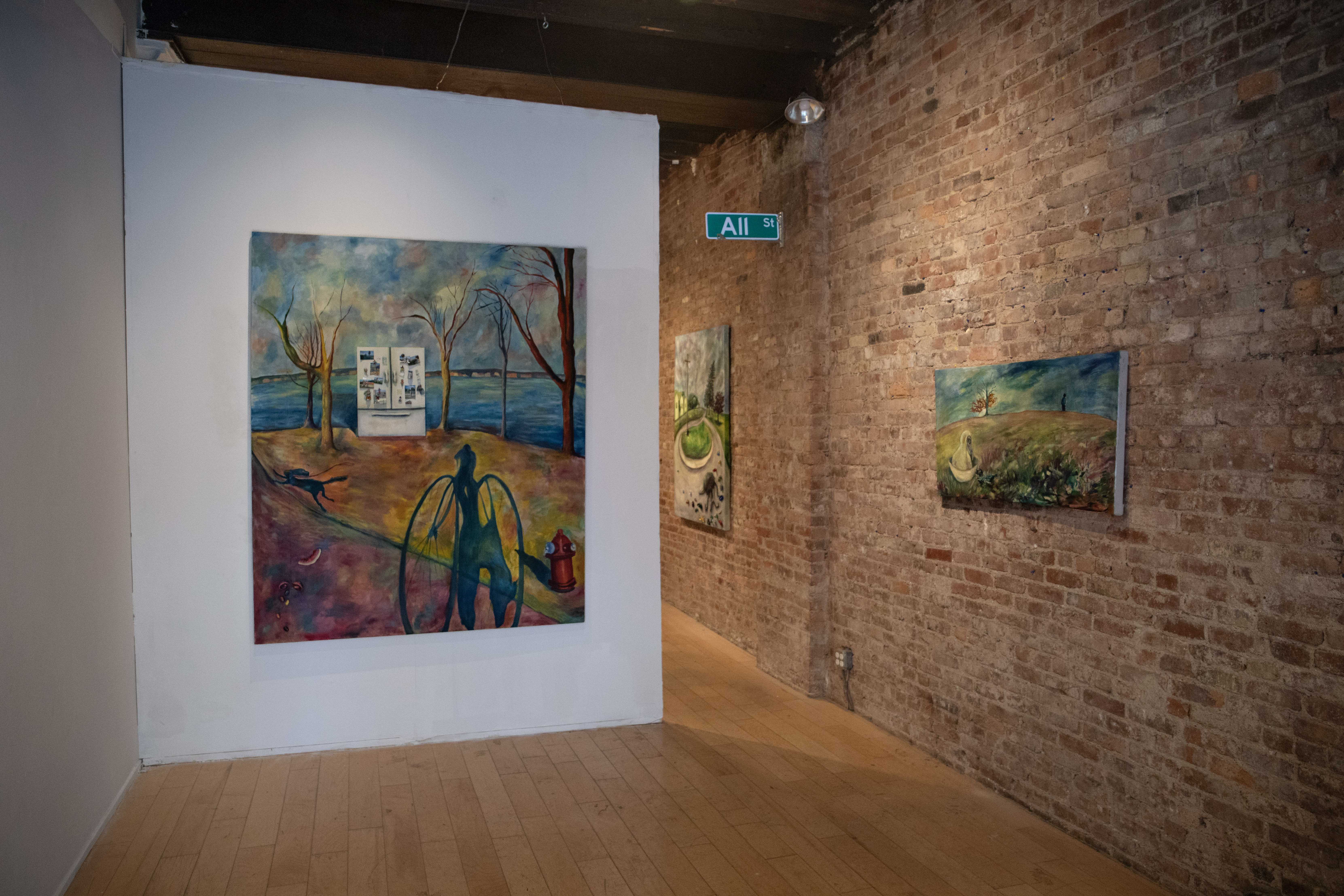 Installation view of Mira Goodman: Glimpse of a Stranger, All St. Gallery, New York, NY. Courtesy the artist and All St. Gallery.
By EMILY HOLLANDER May 23rd, 2026
Merriam-Webster defines stranger as "a person or thing that is unknown or with whom one is unacquainted." For New Yorkers, a stranger is one stitch in a tapestry—a part of the very fabric of our lives.
For Mira Goodman—whose debut New York solo show, Glimpse of a Stranger, opened last month at All St. Gallery—a stranger is a chasm. Something—or someone—bottomless.
The opening took place on a mild April evening in Chinatown; the doors were open to the busy street and visitors—friends, family, and strangers—streamed in and out of the gallery, overflowing onto the street and into neighboring bars and restaurants.
Glimpse of a Stranger opens with Homecoming, a massive painting that functions as instructions on how to view the show. The artist appears in shadow, perched atop the wheels of a bicycle stretched comically tall by lowering sun. She rushes by the scene; a shadowy dog-ish creature loose from its leash bolts ahead; the sun rushes by, too. The earth's quick, colorful brushstrokes mirror that of the sky, putting the whole natural world in motion, technicolor, spinning along the spokes of the bicycle.
Most solidly plopped along the waterfront, framed delicately by a pair of dreamy, leafless trees, is a refrigerator. This object—divorced from its natural habitat, yet more convincingly rendered than anything else in the painting—cues us into Goodman's world. It is like the closet doors that lead to Narnia. Though Goodman's paintings act, in many ways, as landscapes, the components of them are slightly off: the roadkill on the dreary cul-de-sac is an ostrich; the coniferous tree is draped with beads. The red of a three-dimensionally rendered fire hydrant is echoed in the length of a tree. These are memoryscapes, dreamscapes. We pass through a place, absorb bits and pieces of it; over time, places condense and warp. We ascribe inexplicable significance to certain objects: someone's refrigerator—the sticky notes and postcards held to it.
"Hope is a thing with feathers," says Emily Dickinson. Often, in artwork, birds sail above whatever conditions persist on the ground below, indicating some far-off chance of a better future. Not in Goodman’s case. In Despedida, a vulture hatchling sits in a half-shell gazing in a prematurely jaded, forlorn fashion at the world beyond. Upon further inspection, the edges of the “egg” are smooth—it is a bowl, a product of the man-made world. In front of it, a sculpey polymer clay scorpion emerges from the canvas, decorated with gestures of wildflowers; behind, a sparsely leaved tree signals the coming of winter. Hope appears where it is called for; where there is life, there is also death.
Fat Tuesday presents another such bird: an ostrich lifeless in the road among scattered polymer clay toys. Sprawled in an inexplicable cul-de-sac, the bird is realized in the realm of childhood nostalgia. An encounter on the brink of death results in an exchange of energies, landing the confounded feathered thing in the weird, suburban landscape of the artist's oldest memories. In Empty Beds for Holy Boys, humans—men and boys, in particular—are similarly misplaced in a landscape of rolling hills and lush brushstrokes. They mill, they sunbathe, they cradle dogs in states of partial dress. If this is a fabricated heaven for former lovers, Cowboy Christmas is a dedicated memorial. Goodman's most impressive multimedia construction features a wooden signpost and wire gate that drip with sculpted knick-knacks and keepsakes: paintings of paintings, a dollar bill, a deer jaw, and a parking ticket are among the miniature memorabilia. It is like a shoebox full of love letters, or an attic that's been neglected for a decade or two. Though the titular cowboy sits atop a horse in the far right corner, deep in the background, the painting is no less a portrait.
“In an age when” is an awful way to begin a sentence. Still, it must be said: at this juncture in time, technology is an extension of being; phones are our eyes and ears; we come to “know” one another’s digital avatars. Glimpse of a Stranger is a devotional work. Goodman asks not only what we know of "strangers," but what we know of those we consider closest to us. What if we stopped, not just to look at, but to see people, animals, places, as we pass them by? If we reckoned with the unimaginable depths of every seeming surface?
Walking through the gallery is a glimpse into the artist's perception of the world around her: a look into her looking—the characters she materializes—and their looking back.
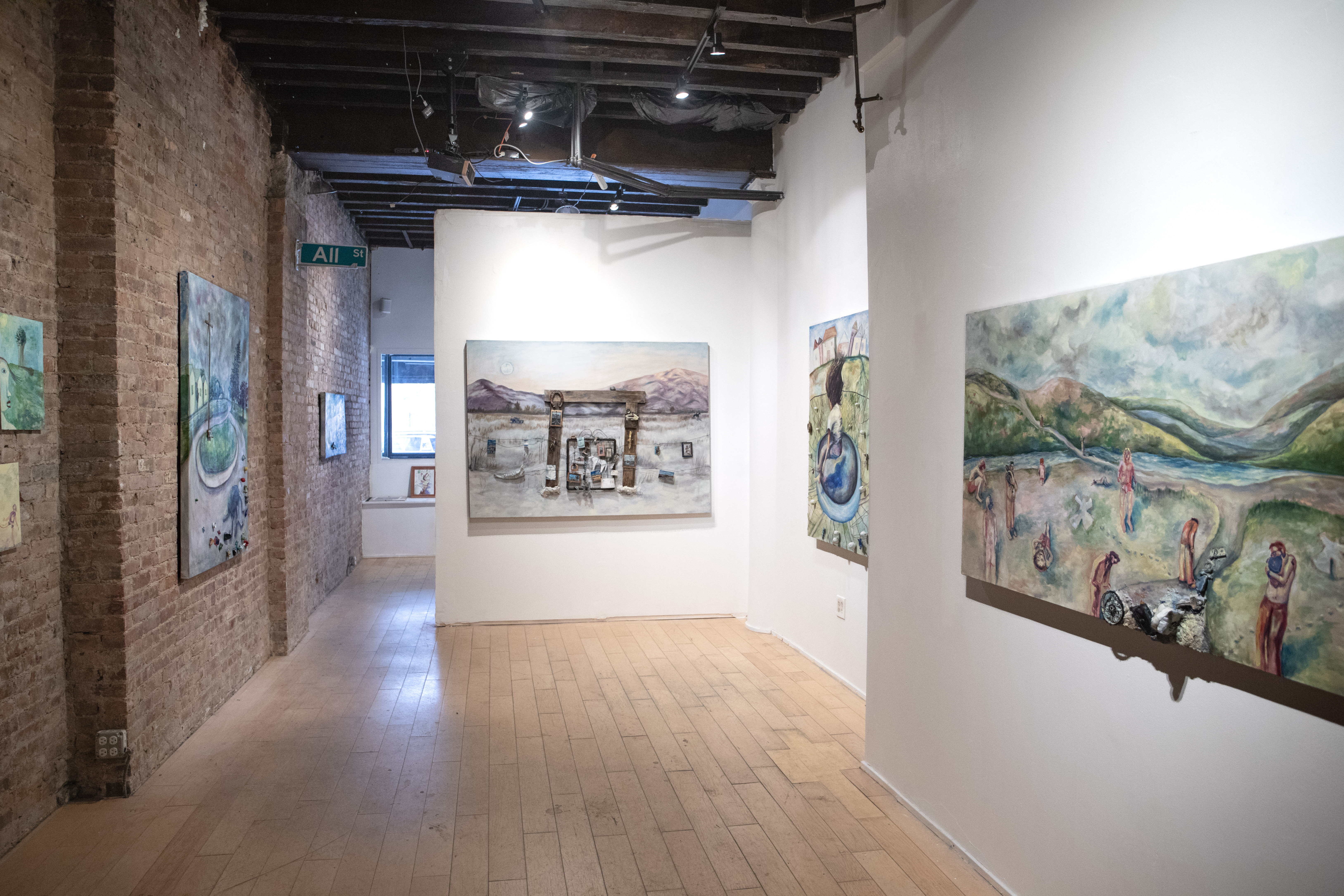 Installation view of Mira Goodman: Glimpse of a Stranger, All St. Gallery, New York, NY. Courtesy the artist and All St. Gallery.
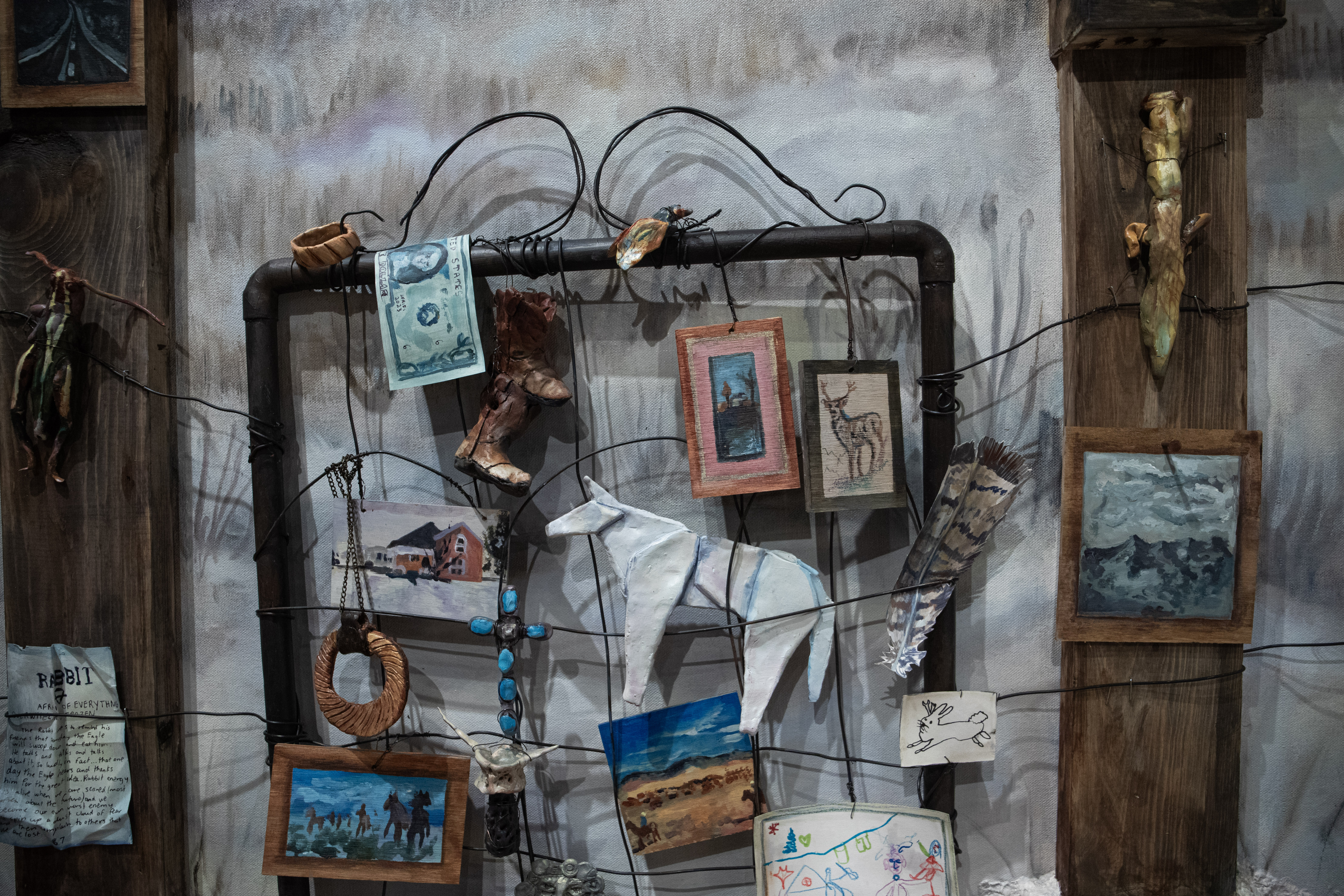 Cowboy Christmas, 2025, Oil, acrylic, wood, wire, sculpey polymer clay, sculptamold compound (clay, plaster, paper-mache), paper, nails, and necklace chain on canvas, 52" x 72" x 3". Courtesy the artist and All St. Gallery.
Emily Hollander
Emily Hollander is a poet and writer from New York. They are the author of the chapbook Successive Approximations (Bottlecap Press) and their poetry appears in Mudfish, Kestrel, and anthologies from Nightboat Books and Wesleyan University Press, among others. She holds an MFA from Columbia University where she covers news for the School of the Arts.