Whitehot Magazine
September 2026
"The Best Art In The World"
"The Best Art In The World"
September 2026
Sterling Ruby: Phosphenic Matter
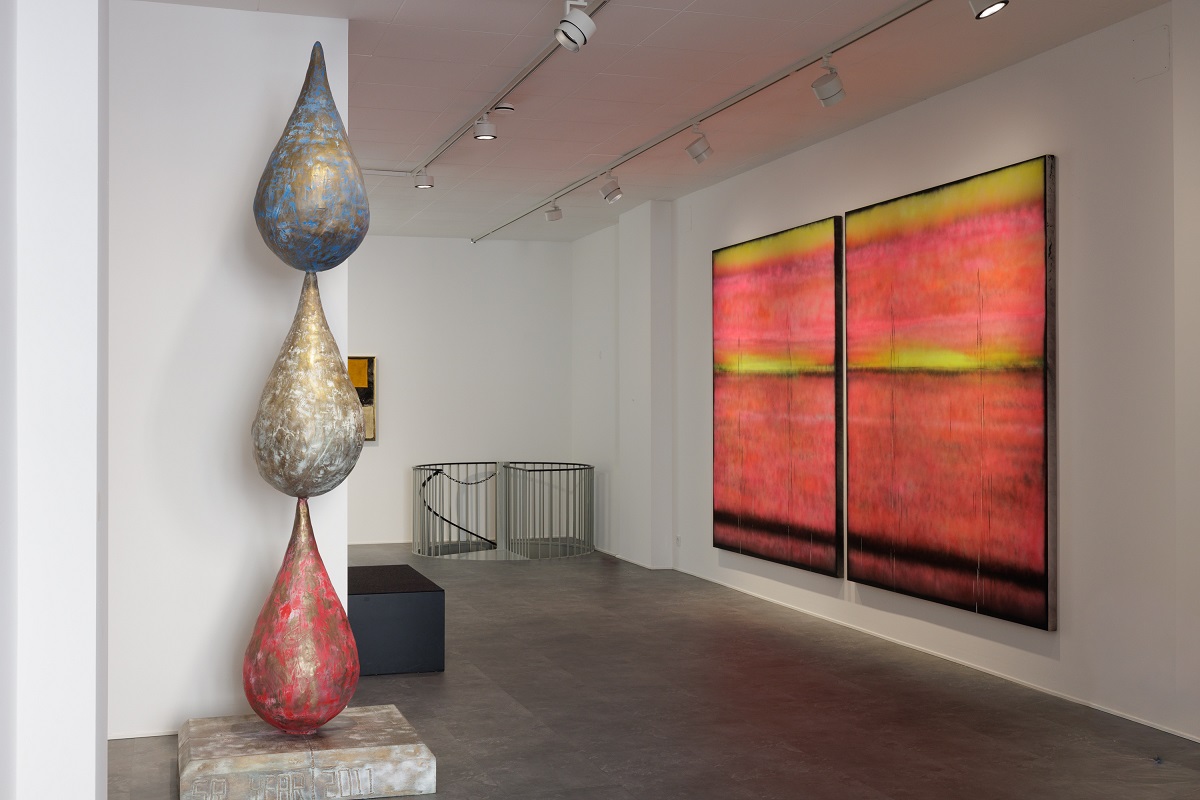 Installation view, Sterling Ruby courtesy of Sammlung Goetz, Munich
By DANIEL GIANFRANCESCHI August 8th, 2026
In a now seven year old video-interview on the Louisiana Youtube channel, Sterling Ruby, almost tangentially, mentions what Philippe Dagen termed as “new realism”; a tendency of many contemporary artists to cloak subjectivation into abstraction without the eventual work becoming estranged from itself. The current Werkschau at Sammlung Goetz’s secondo depandance in Munich (Germany) might not offer many revolutionary insights, but it certainly does an admirable job at presenting the breath of Ruby’s new realism in all its multiplicities.
Admittedly manic and paranoid in his execution, Ruby is no stranger to a cross-medial methodology. What is noteworthy here is how he is, often, able to transcend the tension between expressions that is so often found in many others’ transdisciplinary artists. One medium rarely overshadows another; rather, we are presented with a kind of scattered topography of fabrication in which questions of hierarchy are disavowed in favor of the actual act of production itself – a kind of Warholian factorization without the loss personal subjectivation.
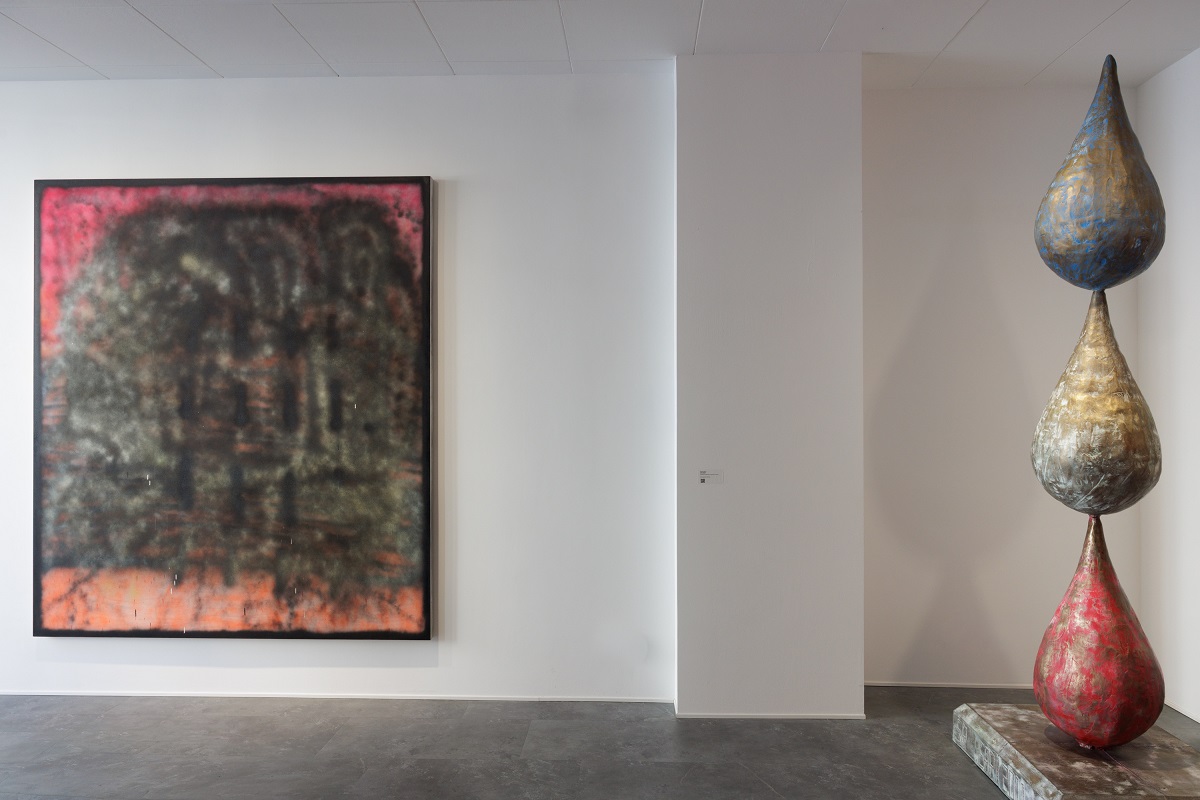 Installation view, Sterling Ruby courtesy of Sammlung Goetz, Munich
Viewing the artist’s work under this lens then becomes tantamount to playing a kind of strange guessing game with oneself in order to discover the many nuances that follow the artist between each medium, whether it be paintings, ceramics, his so-called “soft sculptures” or even (although not on display) his work in clothing design. Still, one cannot but to have favorites. While often materially sensuous, Ruby’s ceramics often feel like an afterthought, a kind of forced alchemical process of recombination indulgent in its own mythology. Where, instead, the artist has always shined are the spray-paintings; often in painfully obscene color-layers, the paintings effectively dematerialize the Pollockian legacy of painterly distance.
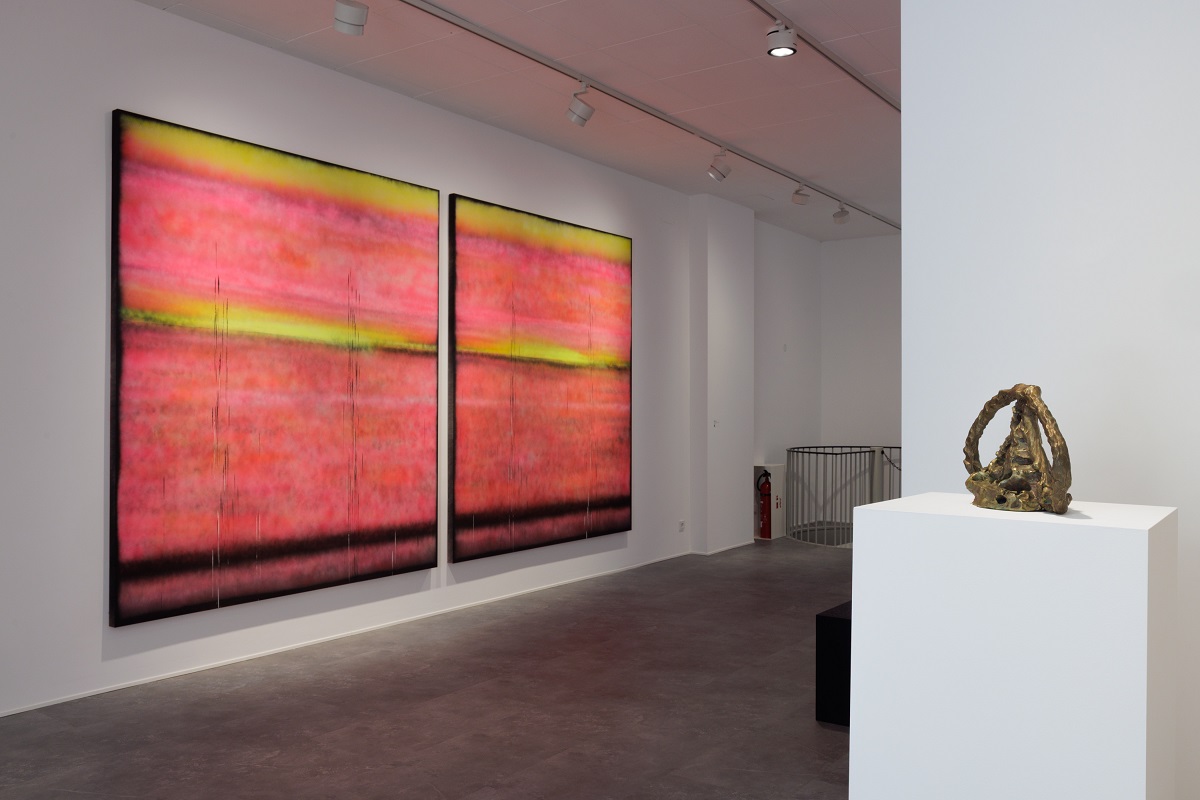 Installation view, Sterling Ruby courtesy of Sammlung Goetz, Munich
Here, it is not paint that is applied but the technological divergence from brush-painting that is usurped, and to particularly expressive results. The press-statement speaks of “street art” – whatever that may mean – as a possible reference point, but we might propose a different point of departure: that of the phosphene, the result of a compression of retinal cells that tricks the visual-output procedures in the brain into perceiving such pressure as flashes of light, swirling colors or geometric shapes even with one’s eyes closed. The paintings thus slowly transmogriphy into a kind of ocular hallucination of the act of painting – intensified by the mystery of the actual production method, impossible to guess for the onlooker if not explicitly retold – that is effortlessly able to question the legitimacy of matter in the first place.
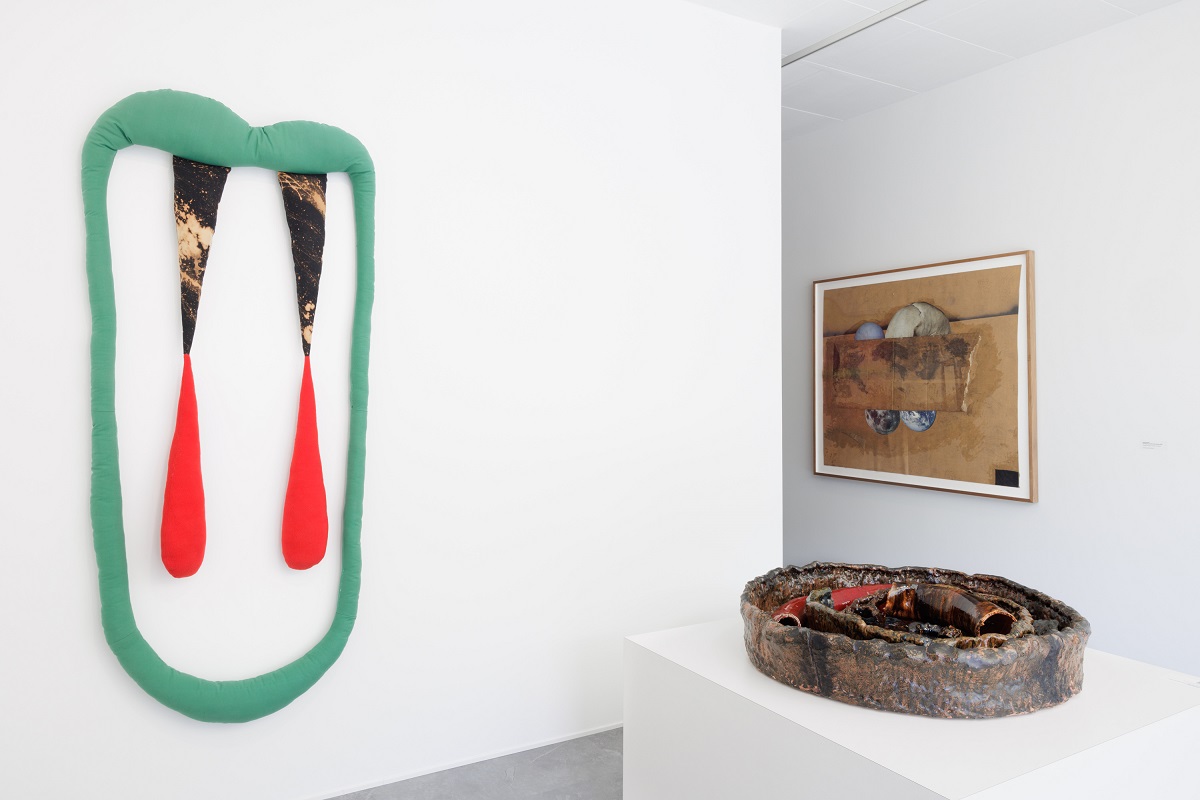 Installation view, Sterling Ruby courtesy of Sammlung Goetz, Munich
In fact, for the retinal wanderer, such phosphenes are perceived as entirely real, yet, much like Ruby’s paintings, belonging to an internalized, contracted real that, although incompatible with the lucidity of the after-dream logic, presents itself as an entirely justified site for a reconsideration of the real in the first place. If then, according to Gilles Deleuze, matter is to be understood as “the dream of mind”, who are we to even tell the difference between this manifold of spatio-temporal instigations?
Daniel Gianfranceschi
Daniel Gianfranceschi is a multidisciplinary artist and writer working within the realms of painting, text and sound. Gianfranceschi previously studied fashion management under Prof. Sabine Resch & Prof. Markus Mattes and is now continuing his studies in painting and sound at the Academy of Fine Arts under Prof. Florian Pumhösl & Prof. Florian Hecker.
view all articles from this author