Whitehot Magazine
October 2026
"The Best Art In The World"
"The Best Art In The World"
October 2026
The Guggenheim’s Spiral: Challenging the Myth of Curatorial Neutrality
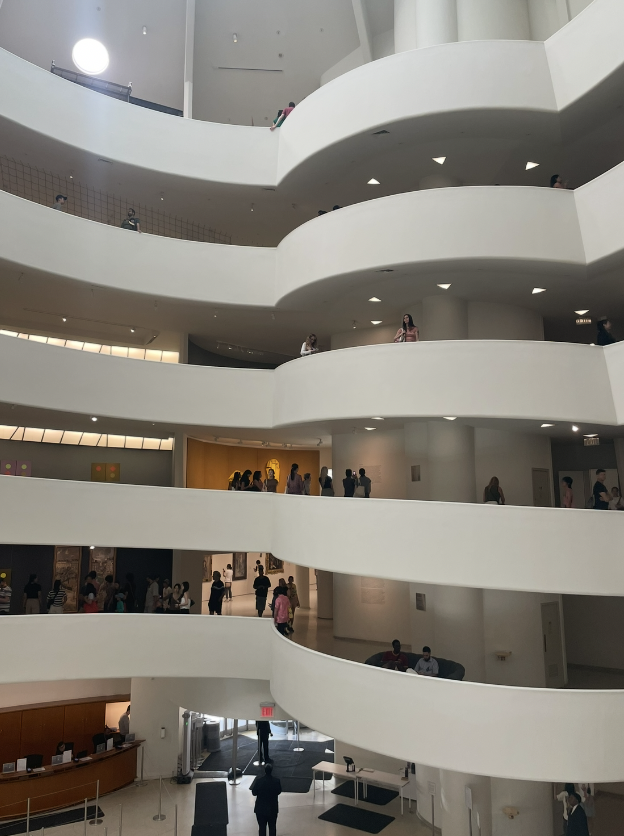
A view of The Solomon R. Guggenheim Museum's unique spiral architecture
By BELLA GREENBACHER July 2nd, 2026
As one of the most world-renowned art museums for modern and contemporary art, The Solomon R. Guggenheim Museum serves as a global standard for how artistic institutions exhibit and interpret artworks as cultural stewards. A flagship institution in the art world, the Guggenheim is especially unique in its unconventional architectural structure developed in 1959 by prolific American architect Frank Lloyd Wright, featuring a singular pathway that spirals upward and choreographs the sequence in which viewers encounter each installation via the structure itself. Rather than give viewers continuous options of their succession through multiple galleries, the progression through The Guggenheim is inevitable, providing only one sustained pathway that dictates the order of which artworks are viewed in conjunction with each other. While claiming under its mission statement to be “committed to innovation” by “exploring ideas across cultures,” implying a devotion to curation that implores diversity of thought, the museum’s unconventional architecture negates any attempt at curatorial neutrality. Unable to determine their own path through the museum, audiences are vulnerable to established curation, and without an inquisitive perspective, may lose sight of the institutional hierarchies that favor Eurocentric, male-dominated narratives sustained by histories of racism, sexism, and systemic inequalities.
The idea of curatorial neutrality, that cultural institutions are able to exhibit ideas and artifacts without political, social, or personal biases, has been endlessly dismantled by modern critical theory as mythology. Despite any benevolent intentions of creating artistic spaces free from discrimination or prejudice, the process of curation itself is inherently subjective and nullifies any attempt to neutralize established hierarchies in the art world. Every curatorial choice, whether that be the sequence of artworks, the semantics of wall labels, or the presence (or absence) of certain artistic histories, shapes the context and framework of which the audience is pre-dispositioned to view each piece. While this dilemma of controlled perception exists in all curated spaces, The Guggenheim’s unique singular-path structure further limits viewers to determine the sequence in which they view artworks.
The unique path of The Guggenheim follows the formation of a spiral with the entrance on the ground floor, and results in a dead-end on the sixth rotation of the corkscrew. In order to exit the museum, viewers must reverse course and make their way down the spiral in the opposite direction, confronting each piece for a second time in the backwards order of which they first experienced. This forced revisitation on the way down allows for a moment of reflection with each artwork, resulting in a deeper engagement with each piece. While this process of reexamination influences viewers to engage in an ongoing dialogue with the art, the physical hierarchy of the museum also creates an issue of accessibility to the exhibitions on the higher tiers of the museum. Museum-goers are guaranteed to confront the art on the first few spirals, but may not reach the higher levels due to restricted physical access, time constraints, or cognitive burn-out. Consequently, because of the museum’s spatial emphasis that privileges lower levels, the artworks on the first few floors receive a disproportionate amount of attention. Most of which, unsurprisingly, are pieces by white artists who draw on Eurocentric artistic contexts.
As of July 2026, the museum’s central pathway primarily showcases the work of Carol Bove, a contemporary Swiss sculptural artist. Bove’s largest installation Sweet Charity, as described in the wall texts accompanying her sculptures, draws upon the Pleiades of Greek mythology, seven sister-nymphs who were transformed into stars by Zeus. In addition to Greek mythology, Bove’s work draws inspiration from the works of poets and musicians including Harry Smith, Sylvia Plath, and Helen Chadwick, noting that their compositions influenced her art in terms of form, color, and spatial exploration. Referring to her exhibited piece Widdershins 1 and 3, Bove ironically describes her body of work as reflecting “past concerns from the perspective of the present” – a piece solely inspired by the legacies of Eurocentric artists whose past concerns are rooted in the silencing of non-Western artistic legacies.
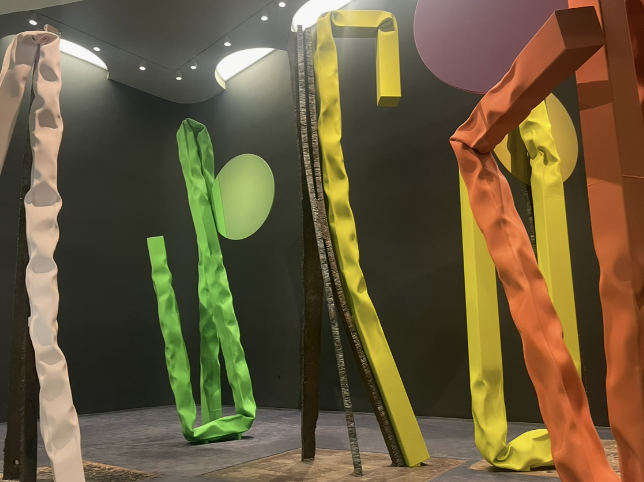
Carol Bove's contemporary sculpture installation showcased at The Guggenheim as of July 2026, titled "Sweet Charity"
In addition to the central pathway of the museum, viewers are confronted with three forks in the road. They are granted a few instances of self-direction to either continue on the main pathway, or enter into one of the smaller, more secluded galleries: The Diker Family Gallery, The Mapplethorpe Gallery, and The Samuel J and Ethel LeFrak Gallery. All three spaces are funded by wealthy donors and philanthropists of the Guggenheim, often showcasing artworks from their donated collections. The first gallery viewers encounter on their way up, The Diker Family Gallery, exhibits a collection titled “Modern European Currents,” a series of paintings by European artists throughout the 1910s including the works of Vasily Kandinsky, Franz Marc, and Egon Schiele. The wall text at the entrance of the gallery reads that the painters on view "perceived greater ‘authenticity’ and emotional charge in the more abstracted lexicon of folk art and in works by a range of African, Asian, and Oceanic cultures.” Perhaps a failed attempt at paying homage to non-Western work, the semantics of the wall text homogenises the artworks of three non-Western continental regions into one “culture,” oversimplifying internal diversities and discrediting the unique artistic cultures and histories as “folk art” in opposition to “fine art.” In addition to curatorial bias rooted in Eurocentric tendencies, only two out of the eleven pieces in the gallery are paintings by female artists: Liubov Popova and Natalia Goncharova. In the connecting Thannhauser Collection, consisting of the personal collection of Justin K. Thannhauser and his father, there are no works by female artists. In an effort to highlight “Modern European Currents,” half of the artistic population, and therefore, half of the European perspective, is absent. The Diker Family Gallery being on the second floor of the museum, viewers first and foremost encounter the works of European men, (perhaps unconsciously) setting a template of context for the succeeding installations.
There are currently only a handful of non-white artists featured at The Guggenheim, the majority of which are exhibited in The Mapplethorpe Gallery, a space on the fourth floor dedicated to showcasing photography. Liu Shiyuan, Martine Gutierrez, Cara Romero, Fara Al Qasimi, Yee I-Lann, and Wendy Red Star are among the non-white artists featured in the gallery, whose exhibited work primarily consists of photographic self portraiture. Despite drawing from multiple cultural backgrounds across many areas of the world, the work of these artists are once again homogenized through the curatorial decision of clustering them all in the same room. As the only photographical self-portraiture in the museum being produced by artists of color, the issue arises of emphasizing artist identity versus their work itself. Viewers are given access to the bodies of the artists while the personalities of European art are hidden behind the canvas, perpetuating the trend of the exoticization and foreignization of non-Western identities.
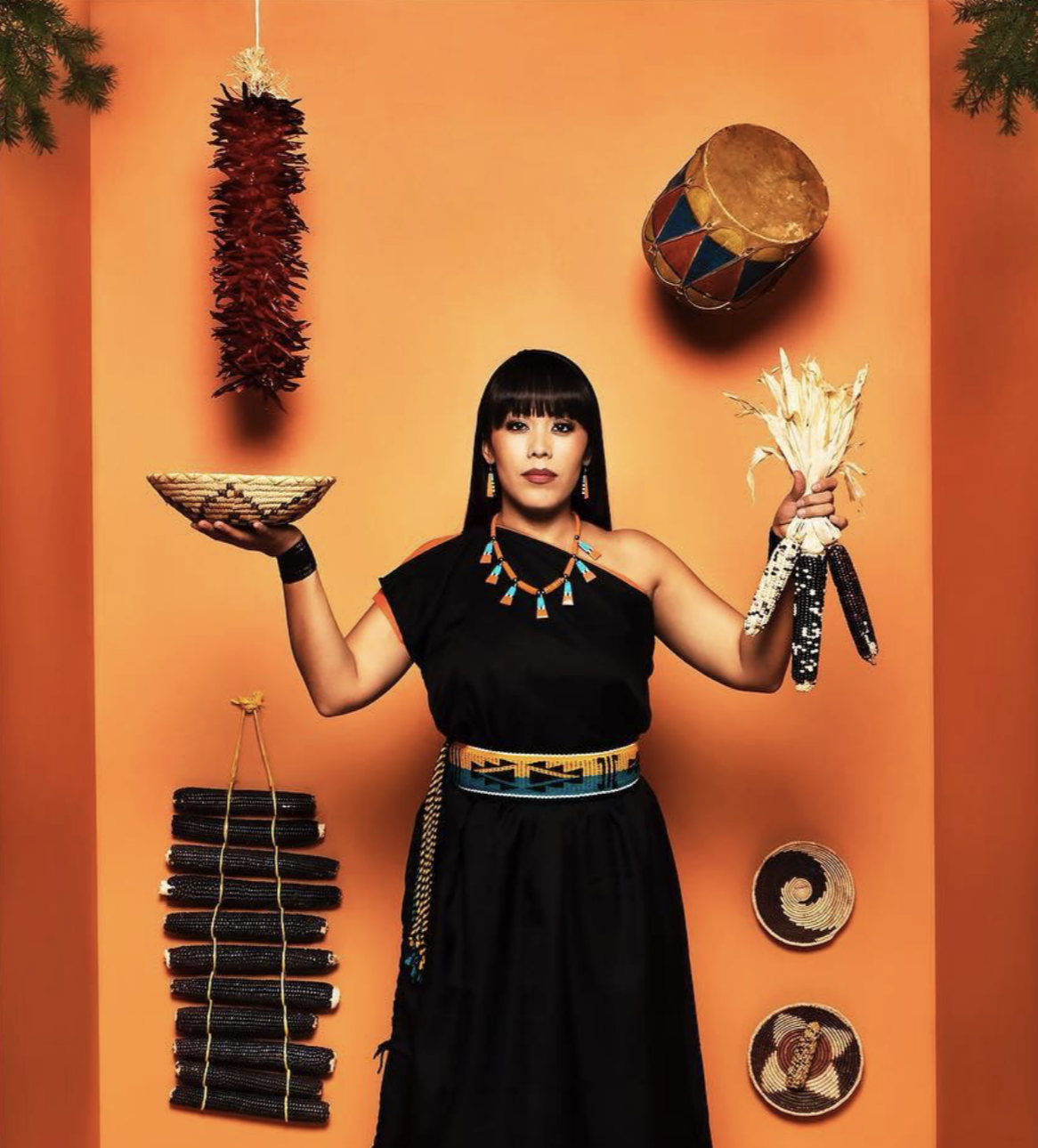 Native American artist Cara Romero's photography work featured in The Mapplethorpe Gallery, titled "Julia"
As viewers, in order to challenge the myth of curatorial neutrality in a way that acknowledges complicated artistic histories and uplifts underrepresented voices, we must approach artistic institutions through a consistently critical lens. The dismantling of perpetual narratives that snub diversity of perspective requires audiences to continue engagement outside of the institutional confines of the museum itself. This includes coming from a point of curiosity and questioning the aspects of curation that are often deemed as “neutral,” researching the systems that construct exhibitions, and searching for ways to challenge the personal experience of curated spaces. Many visitors of The Guggenheim overlook that the museum offers elevator access to the top floor, allowing visitors to rewind their viewing experience from top to bottom. At a time in American history where the cultures and voices of people outside of Eurocentric tradition are increasingly silenced, reversing our course and intentionally shifting our perception is more important than ever. By dictating our own paths, we are able to unwind the spirals of institutional narrative.

Bella Greenbacher
Bella Greenbacher is a writer, curator, and visual artist based in Brooklyn, NY. She holds a BFA in art history and visual art from Concordia University Montréal. Her work has appeared in The Michigan Daily and Concordia Undergraduate Journal of Art History, as well as curatorial work at the Bushwick Gallery. Through both writing and exhibition-curating, Bella aims to inspire in-depth dialogues surrounding underrepresented voices and topics in the art world.
view all articles from this author