
Whitehot Magazine
October 2026
"The Best Art In The World"
"The Best Art In The World"
October 2026
Exhibition Review: "Olivia Erlanger: Spinoff" at Luhring Augustine, Tribeca
 Installation view of Olivia Erlanger: Spinoff at Luhring Augustine, Tribeca (on view through April 19, 2025)
By LIAM OTERO April 18, 2025
When you step into Luhring Augustine's Tribeca location, you will feel like an omniscient giant surveying a miniature world, or better yet, a miniature galaxy. This was my impression upon visiting their current solo exhibition, Olivia Erlanger: Spinoff, which had been on my must-see list for quite some time, and it certainly exceeded my expectations. This show features the artist's new works from the last two years that encompass sculpture, sculptural installation, and graphite drawings.
 Olivia Erlanger (American, b. 1990), Blue Sky, 2024, wire, flocking, foam, plaster, acrylic, aluminum, graphite, shoe polish, LED, plexiglass, driver.
Three massive black boxes containing dioramas of miniaturized, hyper-detailed, fictitious landscapes are each supported on white plinths throughout the one-room gallery. These boxed settings open up to eerily desolate locales with LED lights that bathe the spaces in an overpowering glow: a rusty orange for a deserty, canyon & valley-ridden, Mars-like setting; pale blue for a perspectival garden replete with decorative columns, topiaries, and manicured lawns; and lastly, a sickly green tinged with a slight cyan for a cityscape of futuristic, somewhat Brutalist architecture. Though each setting is wholly distinct, a common thread among them is that they are absent of any sign of life. Not a soul in sight, an uncomfortable feeling that whoever was once there is no more. There are only mere suggestions of prior human engagement - signage, landscaping, and architecture. The press release states that these boxes are examples of Erlanger working “in the language of model-making and dioramas”, which is an apt description, but I want to take this a step further and add “stage-design” to their classification. These worlds-within-containers have a theatricality to their visual display in which the setting of the unknown drama is framed by three sides - stage left, stage right, and an implied proscenium - that faces out into the fourth wall, which is where we stand whilst looking in.
 Olivia Erlanger (American, b. 1990), Green Sky, 2024, Balsa wood, resin, snow #15, plaster, foam, acrylic, aluminum, graphite, shoe polish, LED, plexiglass, driver.
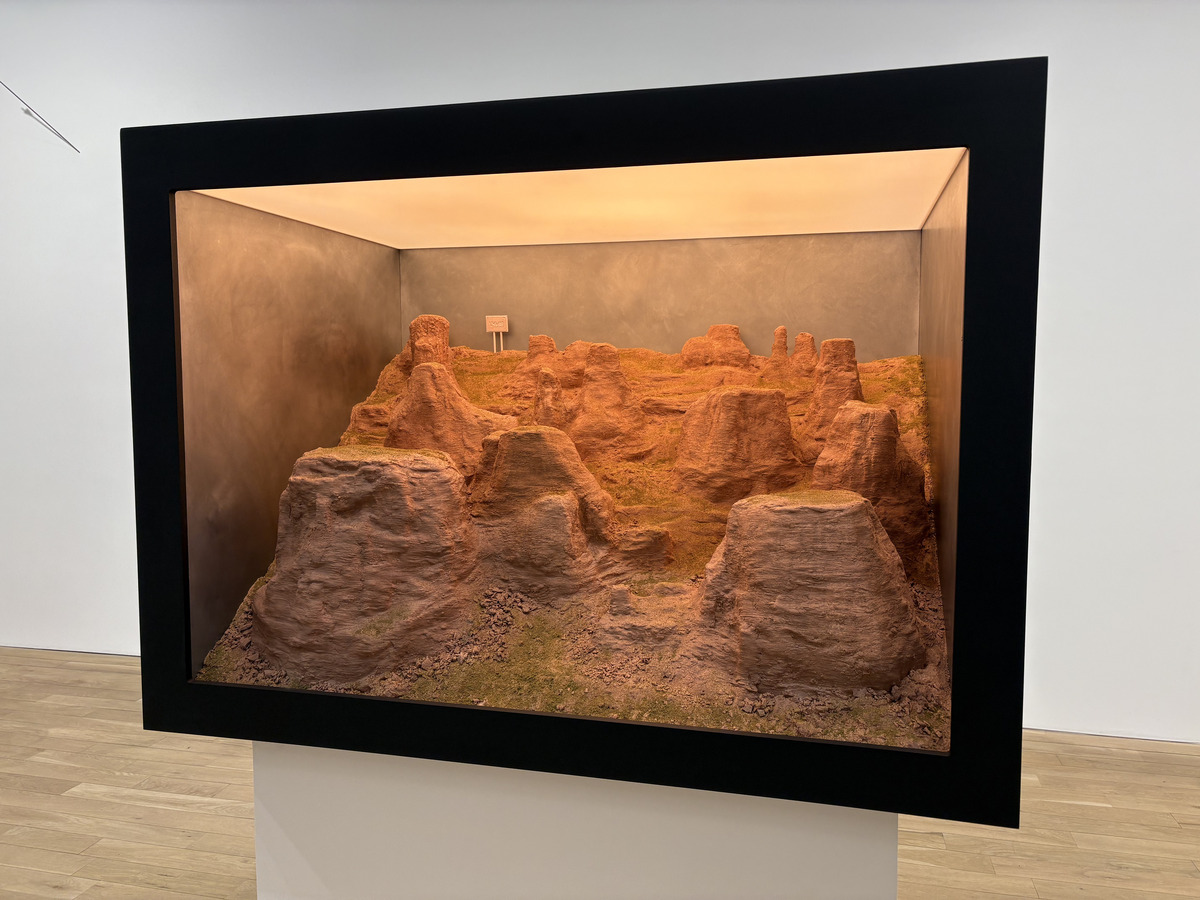 Olivia Erlanger (American, b. 1990), Orange Sky, 2024, sand, flocking, foam, plaster, acrylic, aluminum, graphite, shoe polish, LED, plexiglass, driver.
Two additional sculptures are included in this exhibition and these specific works are the exact reason why I stated it feels like one is stepping into a miniature galaxy as these are strictly planetary in form. The massively rotund Prime Meridien (2024) is an aquaresin aluminum sculpture with LED lights that protrudes from the gallery wall towards ground-level. Meanwhile, the significantly smaller silicone and aluminum 29.7604° N, 95.3698° W (2023) hangs high on a different wall closer to the ceiling. A metallic disc surrounds the two planets, a nod to the distant appearance of Saturn. These planetary sculptures are sparsely marked with tiny buildings and other structures that seem to be in a lifeless liminality akin to the boxed landscapes.
 Olivia Erlanger (American, b. 1990), Prime Meridien, 2024, aquaresin, aluminum, LEDs, drivers, cord.
 Olivia Erlanger (American, b. 1990), 29.7604° N, 95.3698° W, 2023, silicone, aluminum, LED lights, transformer, cord.
Looking at these sculptures makes one feel as though we are witness to post-human worlds that were wiped of life or abandoned altogether, like something out of a dystopian, post-apocalyptic science fiction story, but one that is undergirded by a psychological drama as opposed to the action adventure sort.
Four framed graphite drawings are spread out in the gallery and present dichotomous compositions in which the left-side shows an interior space while the right is a view of a rural wilderness scene. For Lux’s Room (8902, 6701, 463) (2025), the interior appears to be an unfurnished dwelling suggested by the familiar, homey doors and surrounding floor molding. The work’s exterior counterpart is a vertical landscape view of a desert plain leading off to a background of canyons, much like what one would expect to find in the middle of Arizona. Are the two scenes within the same area? Is it the outside looking in, inside looking out? Are these the same places at different times? Just who are the people that purportedly inhabit these spaces (much like Lux’s Room, the others are also ascribed an owner based on the titles)?
 Olivia Erlanger (American, b. 1990), Lux's Room (8902, 6701, 463), 2025, graphite on paper.
And if the sense of foreboding wasn’t strong enough, sixteen polished aluminum arrows puncture sixteen different areas of the gallery walls, and one of which pierces right through 29.7604° N, 95.3698° W. The post-human, post-activity, post-event associations seem to get stronger the more time you spend taking in every facet of this exhibition.
Where is everyone? What happened to these places? No answers are given, which is a huge reason why this exhibition is successful - both on the part of Erlanger and Luhring Augustine. Alternatively, had this exhibition vied for a supporting narrative - be it in the form of wall text, voiceover narration, or moving image component - this show would not have worked as well because it would feel over-explanatory, as if it were some extended cinematic or literary piece. Erlanger really leaves it up to the viewers to interpret the works for themselves, which I believe is critical to appreciating the sense of unease that results from these works. Luhring Augustine also excels in this regard as they do not attempt to “figure out” the narrative behind Spinoff, which would have risked an unnecessarily nuanced reading of the works. Instead, the introductory statement from the press release gives some insight into the show in enticing broad strokes that segue into a three paragraph statement by the poet Lucy Ives who further veils Erlanger’s work in a conceptual mist. Mystique abounds, but yet, a disquieting force emanates forth that seizes the imagination of all who look upon them.
Olivia Erlanger: Spinoff is on view through April 19, 2025. On the last day of the exhibition, there will be a performance of “furniture music” at 6pm by COTC NYC, vocalist Lucia della Paolera, and musicians Gobby, Justine Lugli, Timothy Rusterholz, Esther Sibiude, and Tommy Martinez as an audiovisual complement to the individual works.WM
Link to Luhring Augustine, Tribeca
Link to Olivia Erlanger's website
 Olivia Erlanger (American, b. 1990), Eros (when night was last dark) (detail), 2024, polished aluminum arrows.

Liam Otero
Liam Otero is a freelance art writer in NYC. He was recently named New York Editor of Whitehot Magazine.
view all articles from this author



