Whitehot Magazine
September 2026
"The Best Art In The World"
"The Best Art In The World"
September 2026
Nari Ward’s Until That Day, presented at the DESTE Foundation Project Space in the Slaughterhouse on Hydra
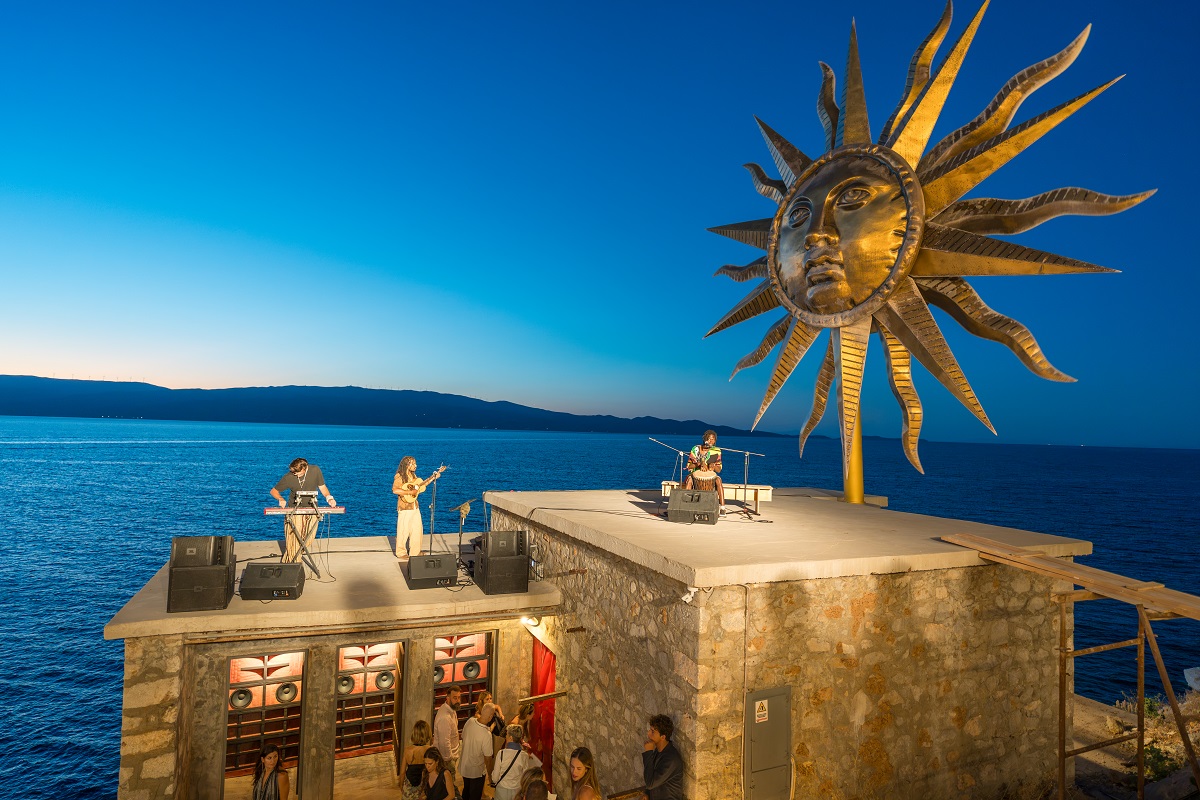 Opening night performance, Nari Ward "Until That Day", DESTE Slaughterhouse, Hydra, Greece 2026
By NOAH BECKER July 20th, 2026
Nari Ward’s Until That Day, presented at Dakis Joannou's DESTE Foundation Project Space in the Slaughterhouse on Hydra, Greece is one of those exhibitions that gets more iconic and textured as you go deeper inside it. As you enter, it appears materially spare: fire hoses, emergency blankets, keys, rock, scorched wood, luggage, copper, PVC board. Yet these objects, made in an Arte Povera tradition accumulate contextual gravity until they begin to feel monumental. The exhibition transforms found materials into a meditation on migration, memory, labor, and human dignity.
Ward has long been one of the great poets of found objects. Rather than treating everyday materials as relics of consumer culture in the Pop tradition, he sees them as carriers of lived experience. Every worn hose, every emergency blanket, every key carries traces of anonymous lives. His installations refuse spectacle in favor of resonance.
The exhibition title comes from Emperor Haile Selassie’s 1963 address to the United Nations, later immortalized in reggae through Bob Marley’s War. The phrase “until that day” refers to a future in which racial inequality and injustice are finally overcome. Ward includes an excerpt from Selassie’s speech in the exhibition leaflet, immediately framing the work within an ongoing struggle for equality rather than a historical reflection.
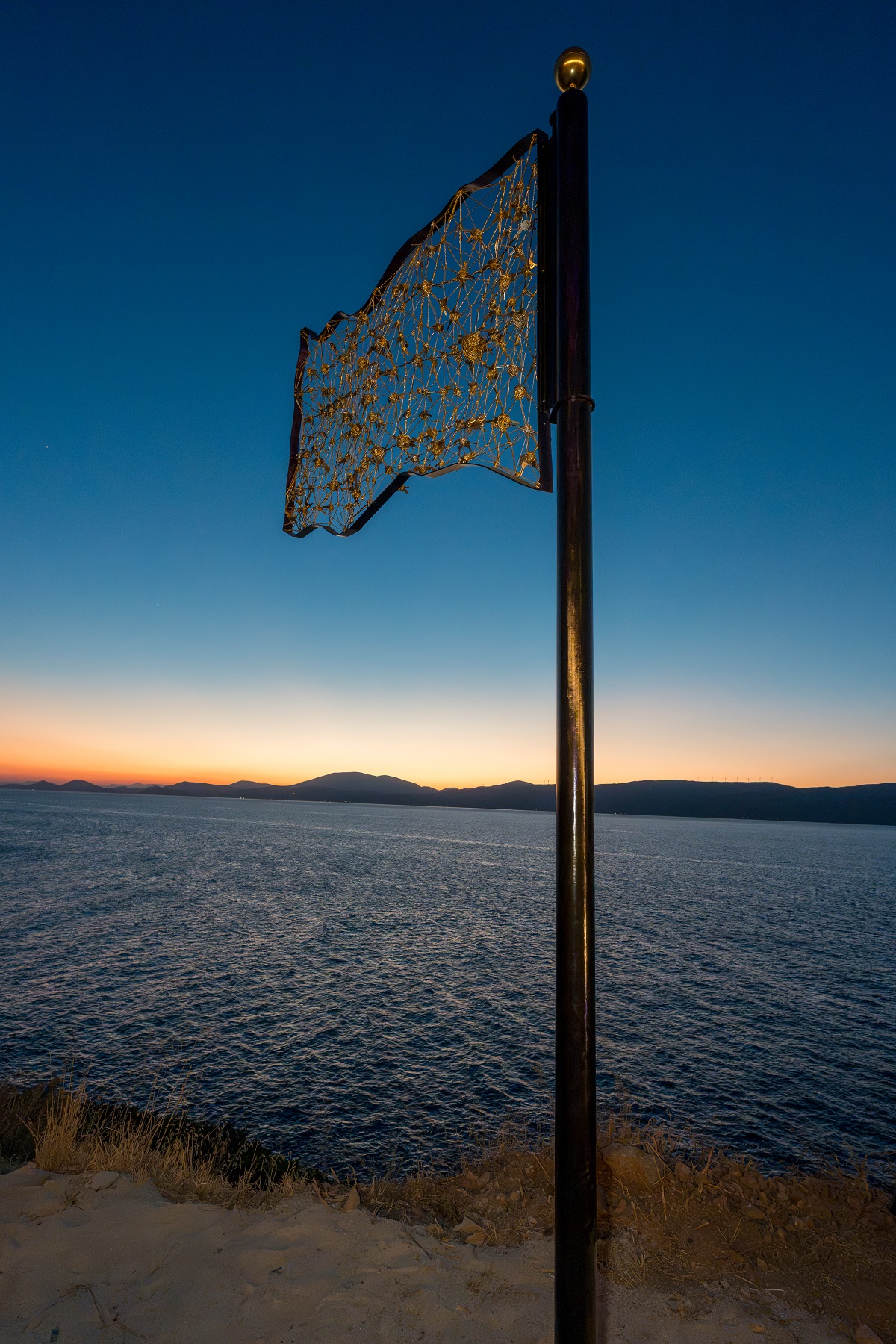 Installation view 2026, Nari Ward, DESTE Slaughterhouse, Hydra, Greece, photos by George Skordaras
What distinguishes Ward from many politically engaged artists is his refusal to illustrate ideology. There are no slogans embedded in the sculptures, no polarized sloganeering. Instead, politics emerge through the resonance of materials. Emergency blankets become shimmering abstractions that still retain the memory of displacement. Fire hoses evoke protection, danger, infrastructure, and historical violence simultaneously. Objects remain objects, yet they accumulate symbolic weight through careful placement. Ward is also using color and texture to maximize the impact of objects.
The setting amplifies these concerns. The DESTE Foundation’s Slaughterhouse on Hydra has always possessed a time-worn patina. The smaller size of the space augments the confrontational physicality of Wards objects and Ward allows the architecture to participate rather than dominate. The building becomes less a gallery than a vessel containing fragments of history.
Several works employ fire hose materials as a recurring motif. According to the exhibition map, Warning Trails, Fire Hose Man, Warnings, Power Anchor (for Jack Whitten), and Coupling all incorporate sections of hose. This repetition creates a visual rhythm throughout the exhibition that is enhanced by the faded firehouse red staining of the hoses. Fire hoses are simultaneously practical objects and loaded historical symbols, recalling both emergency response and the violent suppression of civil rights demonstrations. Ward never insists upon either interpretation. Instead, he allows both histories to coexist. Ward's materials function as faded archetypes, like remixed music played through layers of meaning.
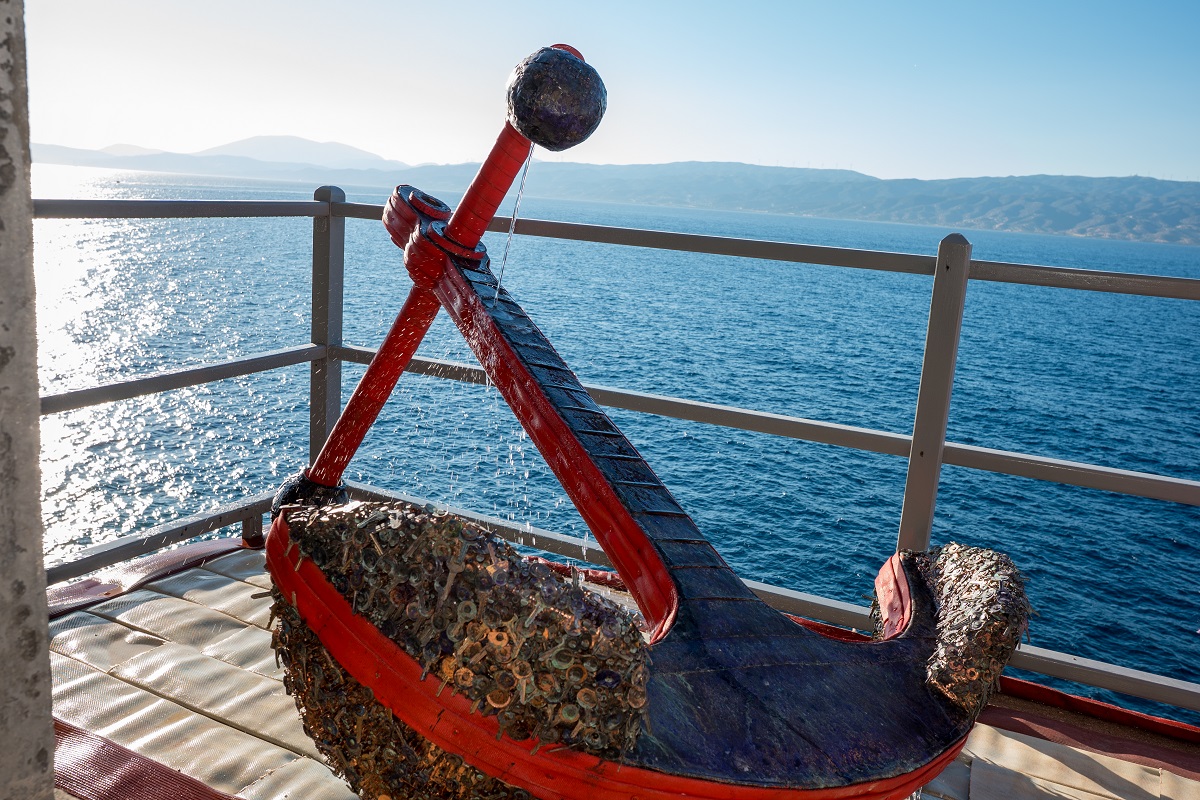 Installation view 2026, Nari Ward, Power Anchor (for Jack Whitten), DESTE Slaughterhouse, Hydra, Greece, photos by George Skordaras
One particularly moving gesture is Power Anchor (for Jack Whitten). The dedication acknowledges another artist deeply invested in material transformation and memory. Rather than functioning as homage alone, it positions Whitten within a broader lineage of artists whose work emerges from histories of migration and resilience.
The exhibition is accompanied by a commissioned musical collaboration led by Aggelos Aggelou, bringing together Greek folk traditions alongside Afro-Greek musicians. The press materials states: "Music becomes another form of migration, another cultural language carried across borders. Ward’s inclusion of performance extends the exhibition beyond sculpture into a living cultural exchange."
Perhaps the exhibition’s greatest strength is its generosity. Contemporary art addressing migration often falls into predictable emotional formulas: guilt, accusation, documentary realism. Ward sidesteps these traps. His work recognizes hardship while insisting upon creativity, adaptation, and cultural renewal. As he writes in the accompanying text, immigrants carry memory, labor, language, music, and tradition with them, continually reshaping the societies they enter.
That observation feels particularly significant today. Across Europe and North America, migration has become one of the defining political questions of our time. Yet Ward refuses to reduce migration to statistics or policy debates. Instead, he reminds us that migration has always been one of humanity’s oldest conditions. Civilization itself is built upon movement.
Visually, the installations maintain an impressive formal discipline. Ward understands scale instinctively. Objects occupy space with enough breathing room to preserve their individuality while contributing to larger sculptural conversations. Negative space becomes almost as important as the objects themselves. The exhibition rewards slow looking.
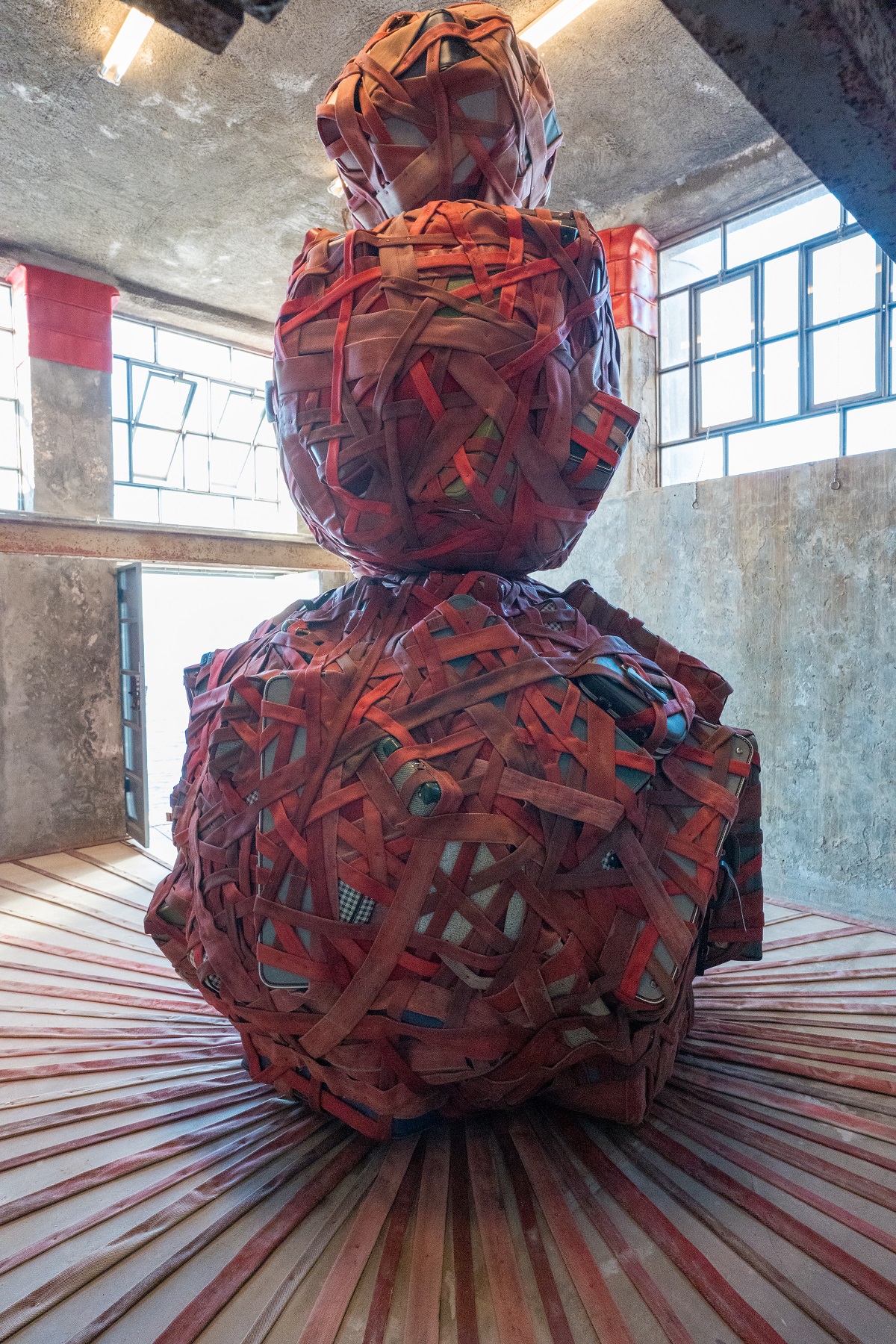 Installation view 2026, Nari Ward, Fire Hose Man, DESTE Slaughterhouse, Hydra, Greece, photos by George Skordaras
There is also an underlying optimism here. Although Until That Day acknowledges inequality, exclusion, and displacement, it ultimately argues for connection rather than despair. The repeated appearance of keys suggests access rather than confinement. Couplings imply joining rather than separation. Even emergency blankets shimmer with unexpected beauty under changing light.
Ward continues to demonstrate why he remains one of the most significant sculptors working today. His ability to merge conceptual rigor with emotional accessibility is increasingly rare. Too often contemporary installation art mistakes complexity for obscurity. Ward achieves something more difficult: work that is intellectually rich without becoming inaccessible.
Until That Day ultimately succeeds because it never forgets the human beings embedded within its materials. Every object points toward someone absent but deeply felt. The exhibition becomes less about things than about lives carried through them.
In an era when political discourse is increasingly polarized and visual culture increasingly disposable, Ward offers something slower, quieter, and more enduring. He reminds us that sculpture can still function as a moral space - not by preaching, but by asking us to see ordinary materials, and ordinary people, with renewed attention.
That may be the exhibition’s greatest achievement. It leaves Hydra speaking not simply about migration, but about shared humanity. Until that day arrives, Ward suggests, art remains one of our most powerful ways of imagining it. WM

Noah Becker
Noah Becker is an artist and the publisher and founding editor of Whitehot Magazine. He shows his paintings internationally at museums and galleries. Becker also plays jazz saxophone. Becker's writing has appeared in The Guardian, VICE, Garage, Art in America, Interview Magazine, Canadian Art and the Huffington Post. He has written texts for major artist monographs published by Rizzoli and Hatje Cantz. Becker directed the New York art documentary New York is Now (2010). Becker's new album of original music "Mode For Noah" was released in 2023.
Becker's 386 page hardcover book "20 Years of Noah Becker's Whitehot Magazine of Contemporary Art" drops Aug 8, 2025 globally on Anthem Press.
Noah Becker on Instagram / Noah Becker Paintings / Noah Becker Music / Email: noah@whitehotmagazine.com
view all articles from this author