Whitehot Magazine
October 2026
"The Best Art In The World"
"The Best Art In The World"
October 2026
The Shortest Fireworks: Diego Dai's first solo exhibition, Illumined Night.
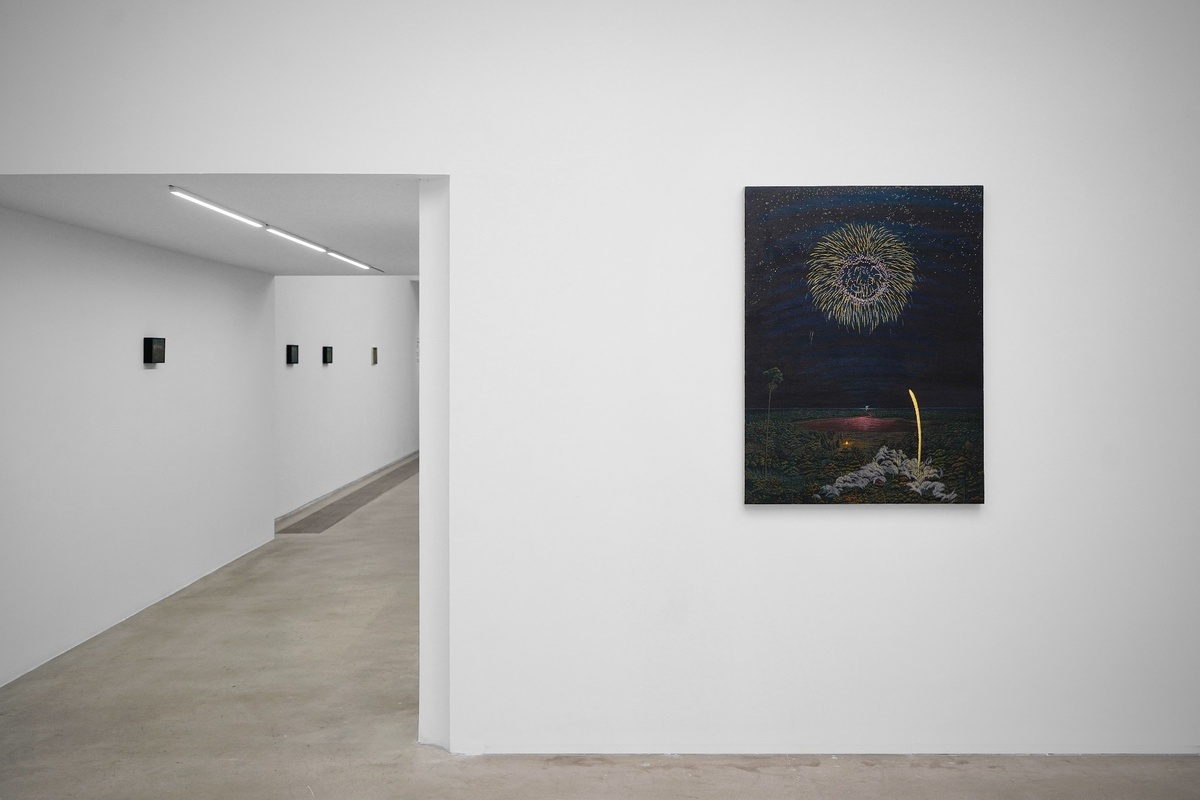 Installation view of Illumined Night. Courtesy of BONIAN SPACE and the artist.
By SHUHAN ZHANG October 12th, 2026
I once attended a fireworks festival where I was presented with an interesting choice: a fireworks display lasting two, four, six, or eight minutes. I could choose only one. In the end, I chose the shortest, just two minutes. For me, the beauty of fireworks has never depended on how long they last, but rather on the fact that they are destined to disappear. Brilliant bursts of light suddenly illuminate the night sky before quickly fading back into darkness. Before we have time to fully take them in, they have already become memories. Perhaps this is why the most fleeting moments of beauty often stay with us the longest. Two minutes of fireworks were enough to leave a lasting impression, and enough to be remembered long after they had disappeared. Yet when fireworks fade, what exactly do we miss: the moment itself, or the meaning that memory has given it?
This reflection on transience and remembrance finds another response in Diego Dai's first solo exhibition, Illumined Night. Curated by Wang Yaoli at BONIAN SPACE in Beijing, the exhibition brings together a series of paintings exploring night, light, memory, and time. Fireworks, bonfires, fireflies, and the moon repeatedly appear within dark natural landscapes, creating nocturnal scenes that exist somewhere between reality and imagination. Through delicate, repetitive brushstrokes, Dai preserves these fleeting sources of light on canvas, as though time itself could momentarily stand still. Yet what makes his paintings particularly compelling is perhaps not their ability to preserve a moment, but the way they allow what has disappeared to continue existing in another form.
In Ladder of Knives (2026), a golden firework hangs in the deep blue night sky, its radiating trails of light spreading outward, while the forest, river, and vegetation below remain largely immersed in shadow. Although the firework dominates the composition, it does not fully illuminate the surrounding landscape. Its form resembles a blooming flower or perhaps a tree growing towards the sky. This fleeting, artificial light takes on the appearance of a living organism, bringing together blooming and growth, transience and continuity, within a single image. Rather than simply documenting a firework, Dai seems to reconstruct the way it is remembered. While fireworks in reality disappear with the passing of time, the painted firework remains suspended at the very moment of its unfolding.
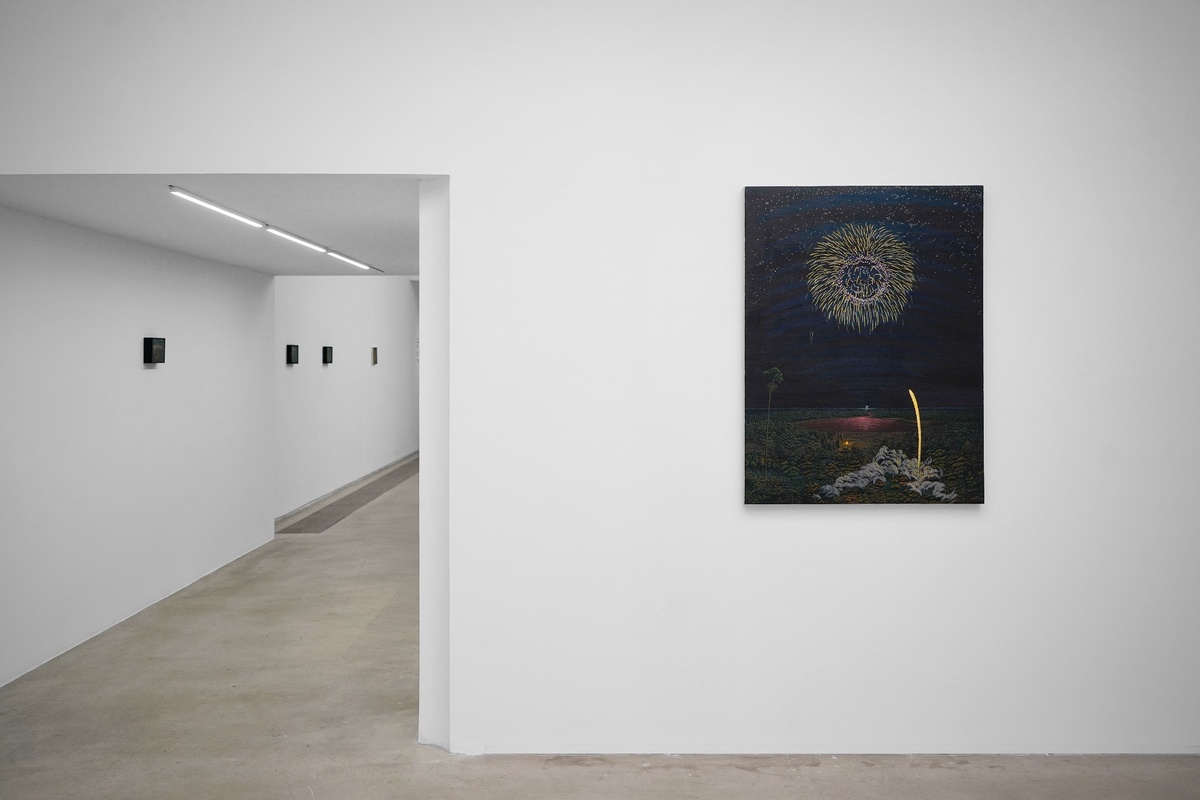 Installation view of Illumined Night. Courtesy of BONIAN SPACE and the artist.
This reconfiguration of time recalls the French philosopher Henri Bergson's concept of duration. Bergson distinguishes between the homogeneous time measured by clocks and the continuous, qualitative experience of time within consciousness. In the latter, the past does not simply disappear when a moment ends; instead, it continues to enter and shape the present through memory. A two-minute fireworks display may be shorter than an eight-minute one, but the weight it carries in memory cannot be measured by its duration alone. Similarly, the fireworks in Dai's paintings are no longer confined to their brief existence in reality. Through memory and the continuing act of viewing, they acquire another dimension of time.
This sense of temporality exists not only in the subjects Dai depicts, but also in his painting process. According to the exhibition text, Dai often begins with a deep black ground, gradually constructing the landscape through dense, repetitive brushstrokes before applying successive layers of translucent colour to allow light to emerge. A firework that lasts only a few seconds in reality requires a prolonged process of artistic labour to recreate. The suddenness of its appearance stands in contrast to the slowness of its making. These accumulated layers of paint also resemble the workings of memory: new experiences do not entirely erase what came before, but continue to develop upon the traces of the past.
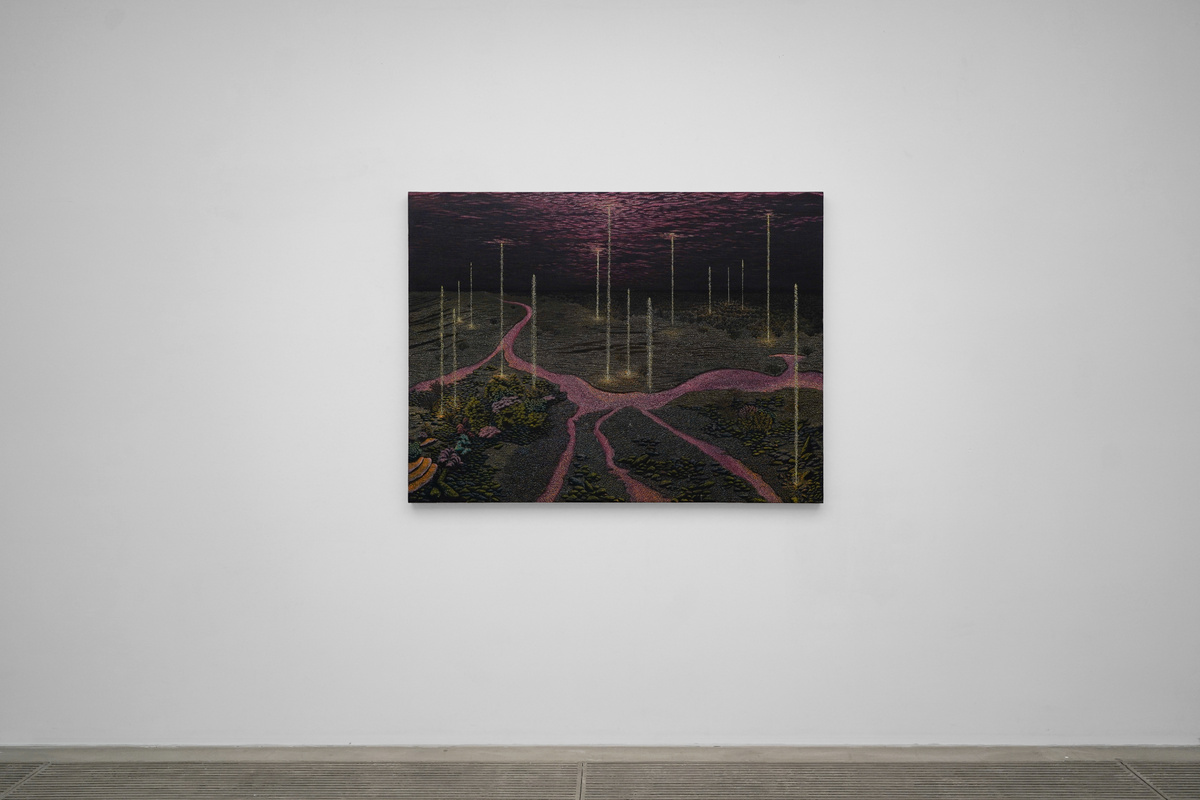 Installation view of Illumined Night. Courtesy of BONIAN SPACE and the artist.
This relationship takes on a quieter form in The Profound (2025). Dark trees overlap in the foreground, while a small fire burns in the distance. Scattered reflections of light fall across the ground and water, yet never fully penetrate the surrounding forest. Compared with the spectacular firework in Ladder of Knives, the light here feels faint and remote. It does not attempt to illuminate everything, leaving the landscape concealed in shadow open to uncertainty. Memory works in much the same way. Rather than offering a complete reproduction of the past, it often preserves only fragments, colours, and feelings, while everything else gradually becomes blurred by time.
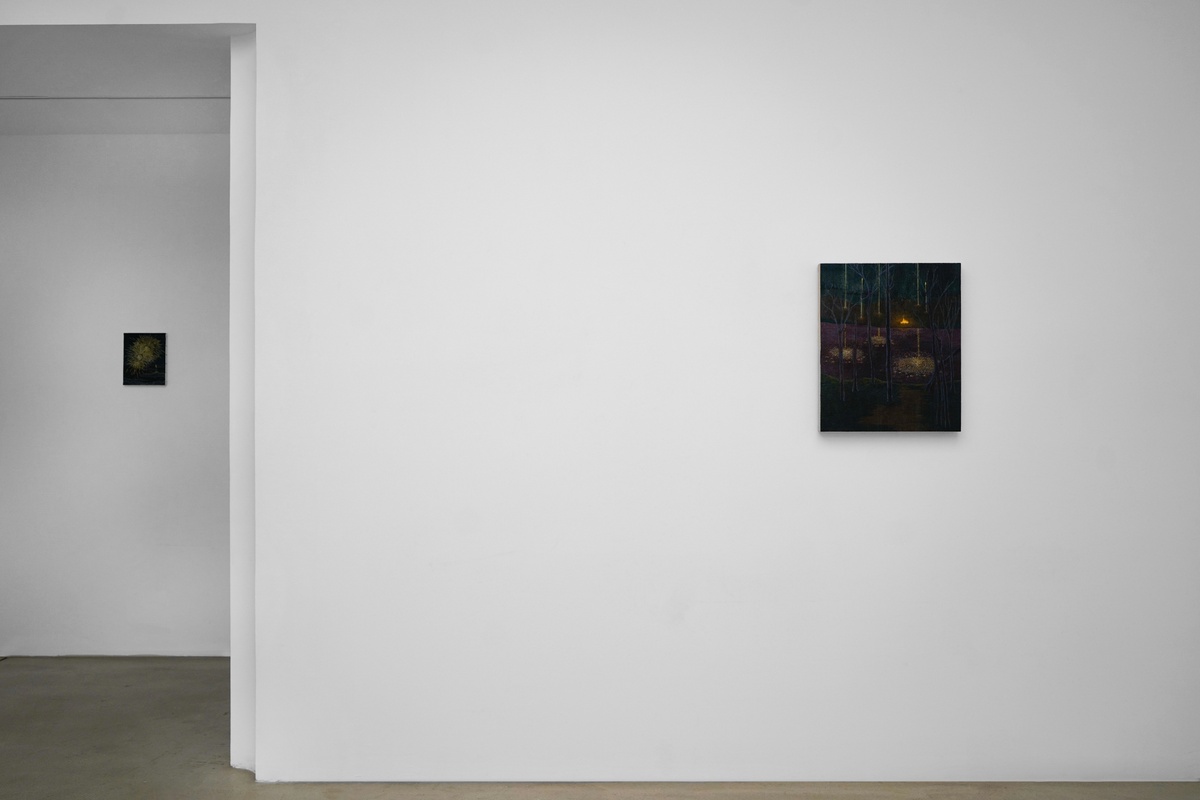 Installation view of Illumined Night. Courtesy of BONIAN SPACE and the artist.
Light is often associated with hope, warmth, and strength, yet its meaning is far more complex than these comforting associations suggest. The beauty of fireworks lies precisely in their fleeting existence, while fire can offer warmth as easily as it can signal danger. The presence of light does not necessarily mean the disappearance of darkness, just as the persistence of memory cannot prevent forgetting. Dai's paintings preserve these seemingly contradictory relationships, allowing light and shadow, transience and continuity, to coexist within the same image. Luminous moments become all the more precious against the surrounding darkness, while the areas left unilluminated create space for memory to continue unfolding. Perhaps what stays with us is never simply the moment when light bursts into the sky, but also the possibilities it leaves to our imagination long after it has faded.
Looking back on that two-minute fireworks display, I gradually realise that what I wanted to hold on to was never the fireworks themselves, but the feelings that continued long after they had disappeared. Illumined Night does not truly stop time either. Dai preserves fleeting light on canvas, but neither can nor needs to prevent its disappearance from reality. What painting allows to endure is the ever-changing relationship between a moment and its memory. When the final firework fades, the night remains long, yet the light that once illuminated the sky may already have become part of how we understand the darkness.

Shuhan Zhang
Shuhan Zhang is a curator and writer based in New York. Her work focuses on contemporary art, digital culture, and the politics of exhibition-making.
view all articles from this author