Whitehot Magazine
October 2026
"The Best Art In The World"
"The Best Art In The World"
October 2026
Lived Duration in Fool's Hour (Durée Vécue dans L’Heure Des Fous) Xinyu Liu’s Solo Exhibition at Art Cake
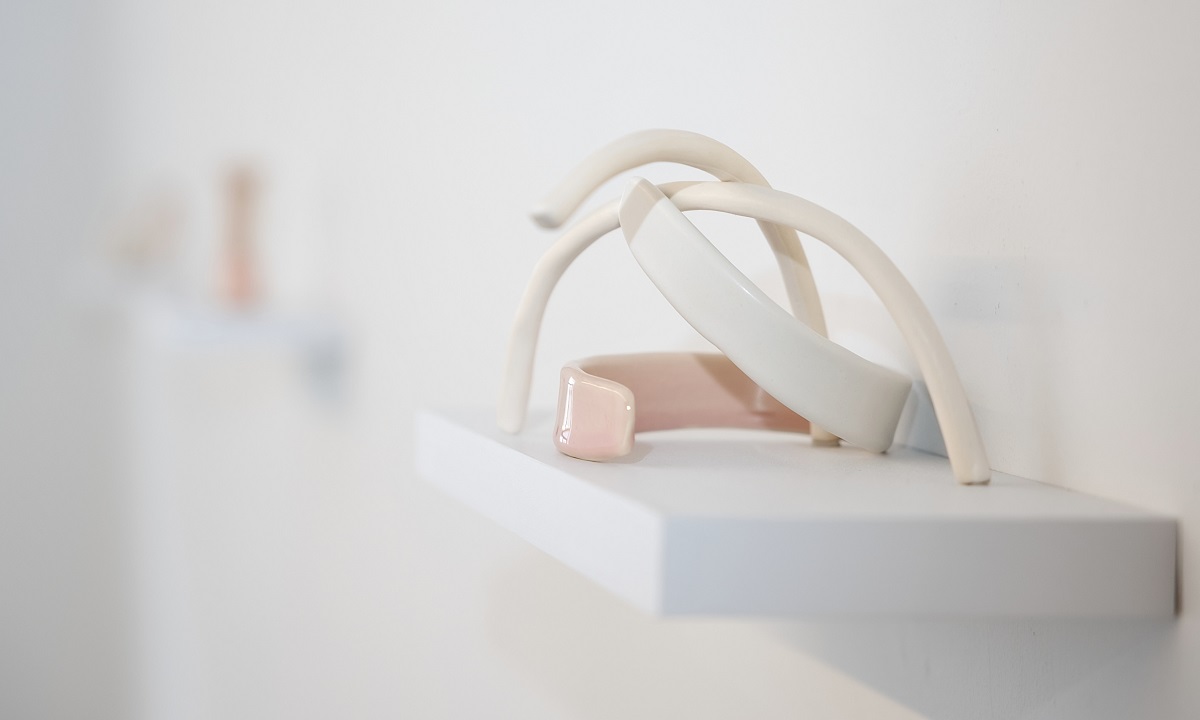 Installation view of Xinyu Liu’s solo show. Curated by John Yau. Untitled, 2026. Art Cake, New York.
By FANFAN YUXUAN FAN May 26th, 2026
The Ferris wheel is turning and turning, without hands, numbers, or terminus. We are inhaling, exhaling, feeling the presence of time and of ourselves. Time exists in the turning. Clock-time recedes, its coordinates dissolving. Centrifugal force lingers in spheres and arcs: no blueprint, no scale, no graduated marks. Then, how do we feel time at all?
Fool's Hour, Xinyu Liu's solo exhibition curated by John Yau at Art Cake, invites us to feel time through intuition, sensation, and the body’s most immediate knowledge of its own duration. In Xinyu’s practice, time becomes a direct experience of being, what Foucault described as “a time that exists for itself.” ( un temps qui est sa propre fin).
Liu creates a fairground temporality, a “heterotopia” in which time is experienced in its most futile, transitory, precarious form.1 The exhibition opens with its titular work, Fool's Hour (2025), a translucent pink acrylic installation resembling a Ferris wheel and clock: it rotates in place, arriving nowhere. Within its circular form, a slide, roller coaster tracks, a seat, and the numerals 0 and 9 suggest time has loosened from its own axis: clock-time interrupted, duration set free. The work radiates outward like ripples, ring after ring, evoking a suspended flow, a parallel world held in motion. Here, the pendulum forgets to measure; within the haze of light and shadow and the hum of mechanical rotation, meaning begins to dissolve.
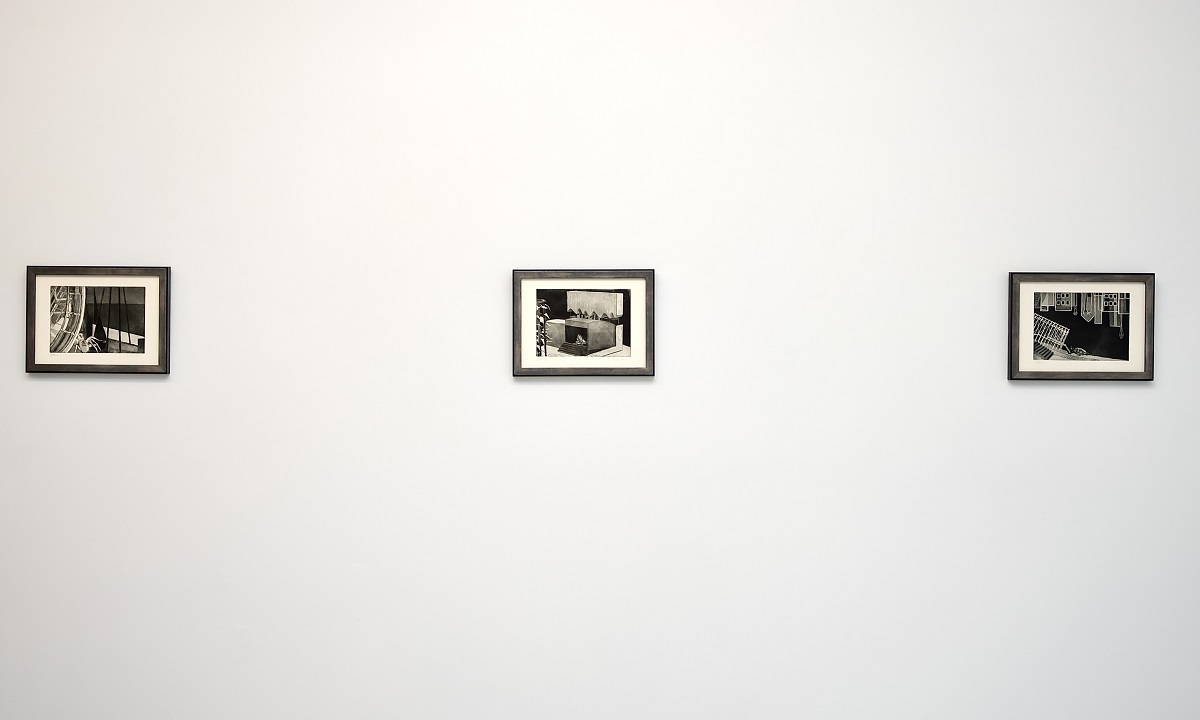 Installation view of Xinyu Liu’s solo show. Curated by John Yau. Small, Still, 2025. Art Cake, New York
Lumibaatata's Park and Lumibaatata's Garden (2025) continue into smaller works. These paintings frame scenes of a playground where time appears frozen, or emptied of duration. With light gestures, mixed materials, and the shimmering plastic surfaces that carry the tactile lightness, the works captured fragmentary, carnival-like moments, yet slipping away. Time is briefly solidified and stacked, sliced and collected, forming what Foucault called “hétérochronies”, moments of pure symmetry. Detached from linear progression, Xinyu’s works foreground a more immediate, lived, qualitative experience of time, an insistence on authentic duration.
Heidegger’s fallenness describes a temporality in which, under the logic of modern life, time is absorbed by everyday tasks, social expectations, and productive obligations, instrumentalized as a means “to get things done.” Xinyu responds to this intimately. Time is not lost, it is freed (2025) emerges from her own anxiety of non-productivity and regret over “wasted time”: a open dark brown wooden box, open, its interior hand-carved with the work's own title. Non-productive time is redefined as the threshold of freedom; the box a vessel for time, fleeting and breathing.
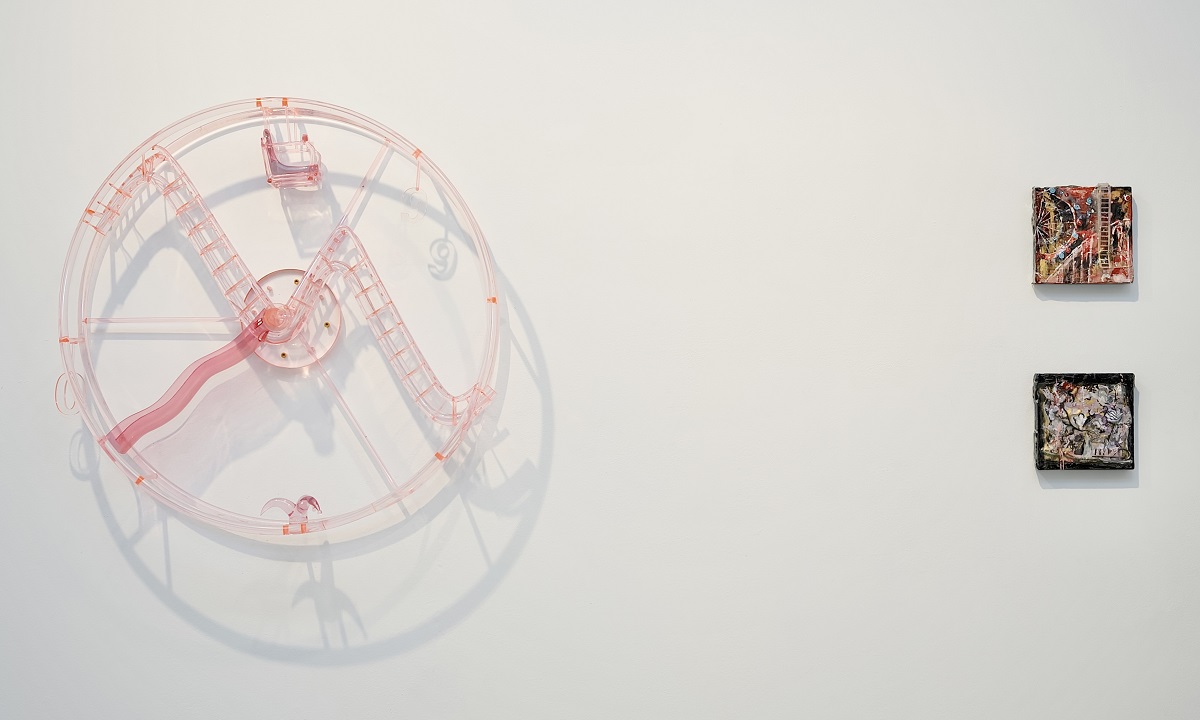 Installation view of Xinyu Liu’s solo show. Curated by John Yau. Fool’s Hour, 2025 (Left) Lumibaatata's Park and Lumibaatata's Garden, 2025 (Right). Art Cake, New York.
Her ceramic series Untitled (2026) distills the fairground— roller coasters, slides, and hourglasses— into pale cream and white forms. Line and figuration interlace, abstracted toward pure sensation. Time, stripped of measurement, becomes tactile and playful. Small, Still (2025) pulls us out of the pink dream and into a black-and-white world. The artist figures herself as a turtle moving through the city's industrialized temporality, echoing her experience of migration. As curator John Yau notes, her work carries "a sense of displacement and adventure," alongside a tender, comic awareness of the absurdities of daily life. The turtle neither rushes nor arrives, but simply continues with time, with the lived duration.
-
Michel Foucault, "Of Other Spaces: Utopias and Heterotopias," trans. Jay Miskowiec, Diacritics 16, no. 1 (Spring 1986): 26.
Henri Bergson argues that clock-time is a violent simplification of lived time, cutting qualitative duration into homogeneous units, as if each minute were equal to the next. In Xinyu’s Drawing series (2026), this logic falters. Five colored-pencil works, each produced over different durations: 40 minutes, 8 minutes, 15 minutes, 20 minutes, and 1.5 hours. Some were made in urgency, some in sustained concentration. By presenting these five drawings at identical prices, Xinyu refuses to translate labor into quantifiable difference, foregrounding the incommensurability of time itself. Time here is evidence of labor and the deconstruction of its logic, faithfully recorded, and gently withdrawn from any calculus of value. Time can be measured, but measurement cannot exhaust it. Like the fool, Xinyu leaves no footnote upon the scale of measurement, questioning its very fiction.
Fool's Hour continues turning, returning, and breathing. It returns to where it began, departs again, then returns, endlessly. This seems like lived duration itself: continuous, circular, complete in its turning — time inhabited, felt, and perceived in the most immediate experience of being.
-
Michel Foucault, "Of Other Spaces: Utopias and Heterotopias," trans. Jay Miskowiec, Diacritics 16, no. 1 (Spring 1986): 26.
Fanfan Yuxuan Fan
Fanfan Yuxuan Fan is a curator and writer based in New York City. She has worked for Asia NOW Paris Art Fair in Paris, Eli Klein Gallery, and Marc Straus Gallery in New York. She had curated exhibitions that include: To Elongate, To Entwine (China American Arts Council | Gallery 456, New York), Soft Instructions (Art Cake, Brooklyn), Threshold in Relations (Nguyen Wahed, New York).
view all articles from this author