Whitehot Magazine
September 2026
"The Best Art In The World"
"The Best Art In The World"
September 2026
Sound and Its Social Silence in The Post Office
By RAPHY SARKISSIAN | June 7, 2026
Laura Kaminsky bypasses the roaring scale of the grand orchestra, forging the dramatic force of her chamber operas entirely from the irreducible friction of voices compelled to share a single space. Kaminsky defined this practice with As One, a chamber opera that premiered at BAM in 2014. Defying the fate of most new operas, it has since generated over sixty independent productions across the United States and internationally. Through it, she anchored a style built on intimacy, economy, and the charged relationship between the competing dimensions of an individual self navigating an unyielding civic space. The Post Office, closing its New York premiere run at BAM Fisher’s Fishman Space, transposes that same practice from the private interior of a single life into the volatile overlap of intimate ties and institutional order. It is, after all, the messy reality of American life and the complexity of its human relations that the opera stakes its claim on.
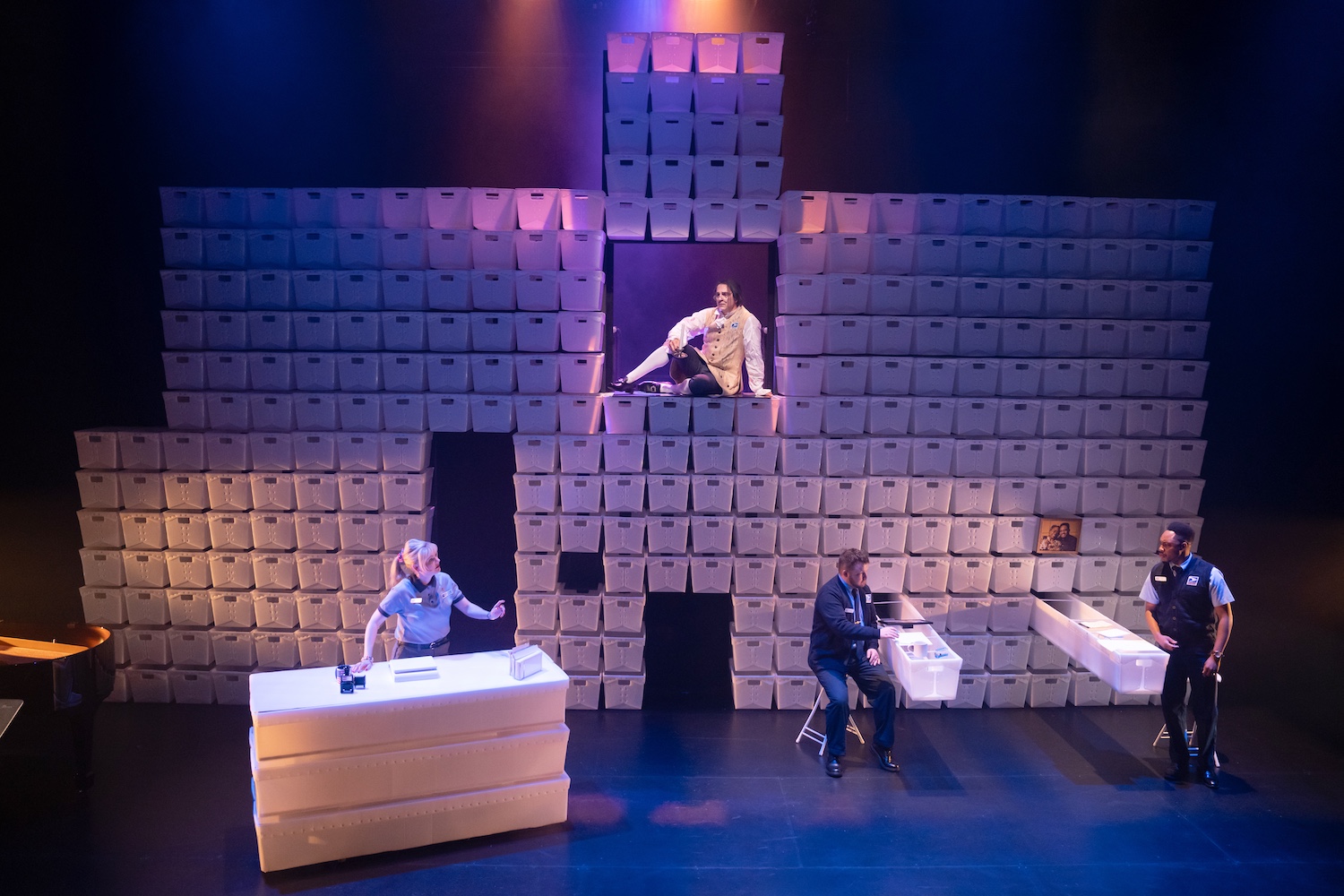
From left: Anna (Sarah Moulton Faux), Benjamin Franklin (David Adam Moore, above), Frank (Brian Jeffers), and Ben (Markel Reed) in The Post Office. BAM Fisher, Fishman Space, May 2026. Photo: Julieta Cervantes.
The dramaturgy Kaminsky and her librettist Elaine Sexton have devised occupies a site at once literal and allegorical: a one-room American post office, that most quotidian of civic institutions, cunningly designed by Charles Renfro of Diller Scofidio + Renfro. As an architect whose practice has long been concerned with the performing body in contested spaces, Renfro's design manifests a premise that the most familiar architecture carries social narratives that are at once mundane and fraught. This opera in poems was hypnotically directed by Kevin Newbury and unfailingly conducted by David Bloom. Together their task was nothing less than mediating between the rigor of Kaminsky’s piano score and the intentionally fractured and tautologically conditioned vocal terrain it was asked to sustain.
Renfro’s set, constructed from postal boxes that unfold to reveal furniture and hidden props, does not merely represent a post office: it enacts its systemic logic, turning the architecture itself into a mechanism of concealed contents and sudden disclosures. Into this space Sexton introduces the ghost of Benjamin Franklin, the first US Postmaster General, as an unwilling witness to a civic unravelling. As Virgil Thomson and Gertrude Stein understood when they conjured Susan B. Anthony's ghost in The Mother of Us All, the founding figure returned to the present is not a comfort but a confrontation. This founding figure, Franklin, stands as a historical marker designed to measure the irreconcilable distance between the republic's founding language and its current condition.
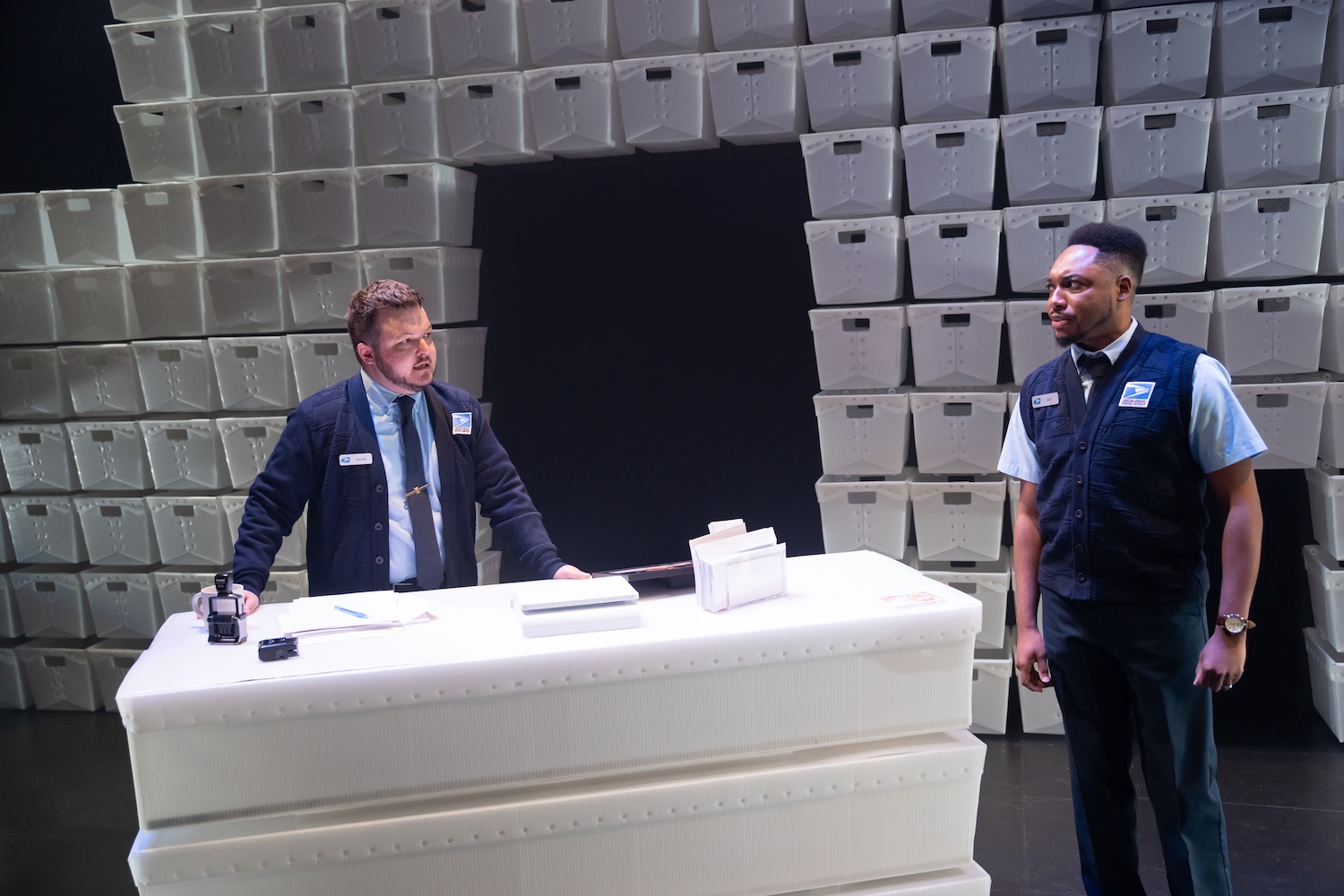
From left: Frank (Brian Jeffers) and Ben (Markel Reed) in The Post Office. BAM Fisher, Fishman Space, May 2026. Photo: Julieta Cervantes.
In the physical architecture of the Fishman Space, dominated by Renfro's monolithic grid of postal boxes, the set functions as an allegory of institutional compartmentalization. Kaminsky's compositional language operates as a direct counter-grid to this spatial confinement, establishing a dialectic of space and sound. Where Renfro enforces a rigid grid with sharp right angles, Kaminsky's score deploys fluid, percussive piano lines to shatter the boundaries of the cells, releasing sound from its institutional containment.
What passes for narrative here unfolds as a series of institutional confrontations, each character staking a position within a system that was never designed to accommodate them all. The plot hinges on the administrative bureaucracy of human attachment. That attachment is the very struggle over who is permitted to file their devotion under the approved government letterhead. Characters do not develop in the traditional operatic sense. Instead, they are treated as structural cogs moving through a physical network of hidden compartments and abrupt revelations. The tension arises from the friction of forcing dynamic human relationships into a clinical, state-stamped taxonomy. Here the tensions of class, gender, and ethnicity reveal themselves as the crux of The Post Office. The social cartography of this operatic drama is inherently heterochronic: Franklin's Enlightenment civics and the post office's contemporary conflicts inhabit the same space. Where Greek tragedy aimed for catharsis, The Post Office calls for resolution.
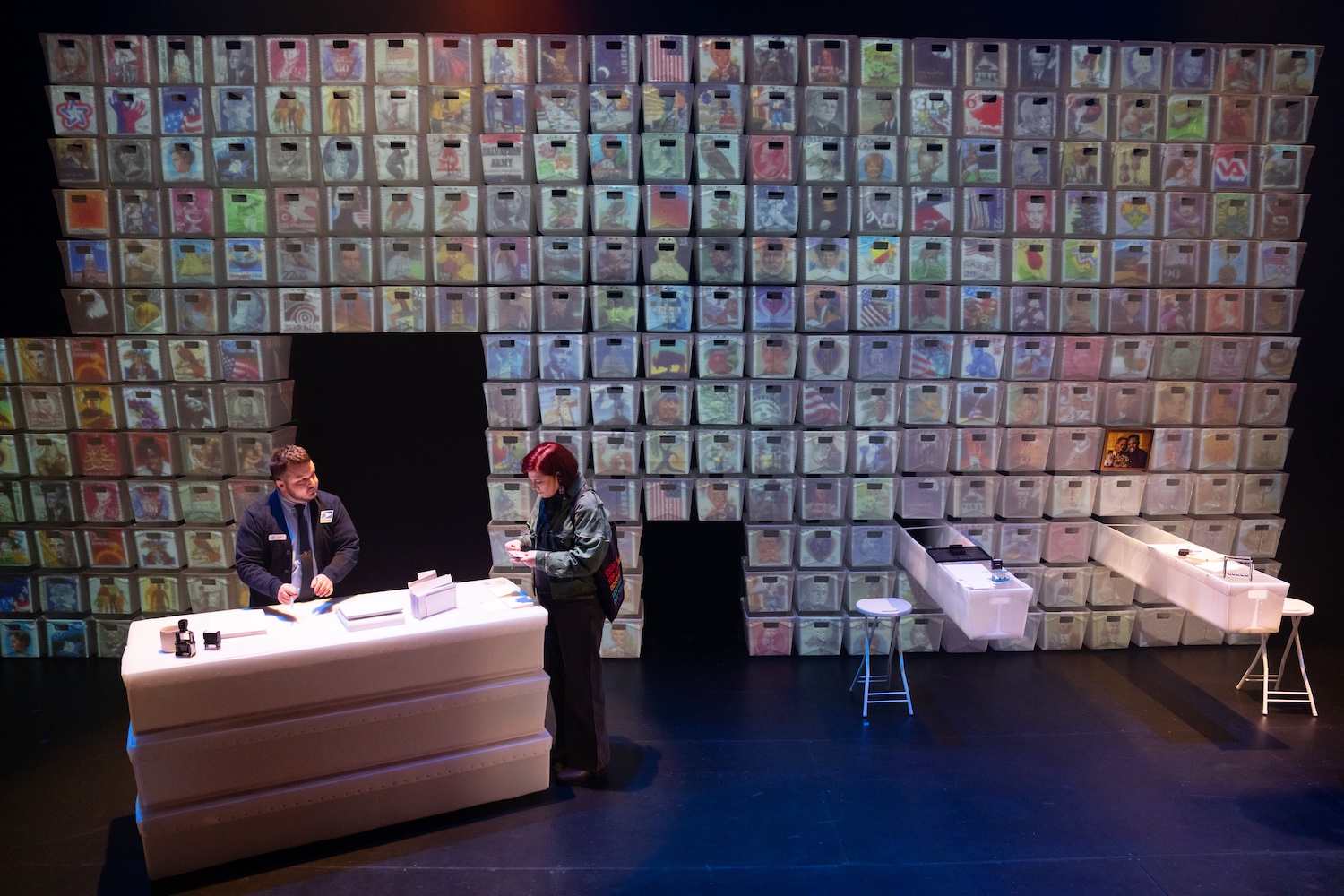
From left: Frank (Brian Jeffers) and Emily (Blythe Gaissert) in The Post Office. BAM Fisher, Fishman Space, May 2026. Photo: Julieta Cervantes.
By introducing the ghost of Benjamin Franklin into this rigorously administered space, Sexton and Kaminsky give stage to the ideological differences that define contemporary American life. Franklin represents the Enlightenment ideal: the transition from the “sacred” to the “self-evident” truth of a systemic, orderly republic. Yet as his spectral presence watches the contemporary postal workers unravel, the opera exposes the historical futility of that very order. Kaminsky’s music turns repeatedly turbulent as the pristine, rational founding language of the republic is audibly crushed under the accumulated weight of its own administrative machinery. This is a system that has become the very tyranny it was designed to prevent.
Renfro's modular scenery consists of 312 mail containers that articulate surface and space interactively throughout the performance, giving literal form to Sexton's opening invocation of Walt Whitman's words: "I contain multitudes." At times the partial absence of a set of containers serves as an architectural opening, such as a door or window. At others their presence on the stage functions as furniture and fixture. At times they assume the role of screens representing zip codes. The projected numbers span the nation: from Pegram, Tennessee's 37143 to downtown Los Angeles's 90014; from Chicago's 60645 to Brooklyn's own 11201. Each audience member's own zip code is potentially among them. As if a social aporia, this architectonically regulated stage set enacts Foucault's Discipline and Punish, where the mechanisms of power are distributed through the architecture itself: schools, factories, hospitals, prisons, and military barracks. This social construct thus produces docile bodies sorted by address, identity, and civic compliance. The result is panoptic: normalized behavior, invisibly surveilled. Toward the close of the performance, a face is projected on each container side.
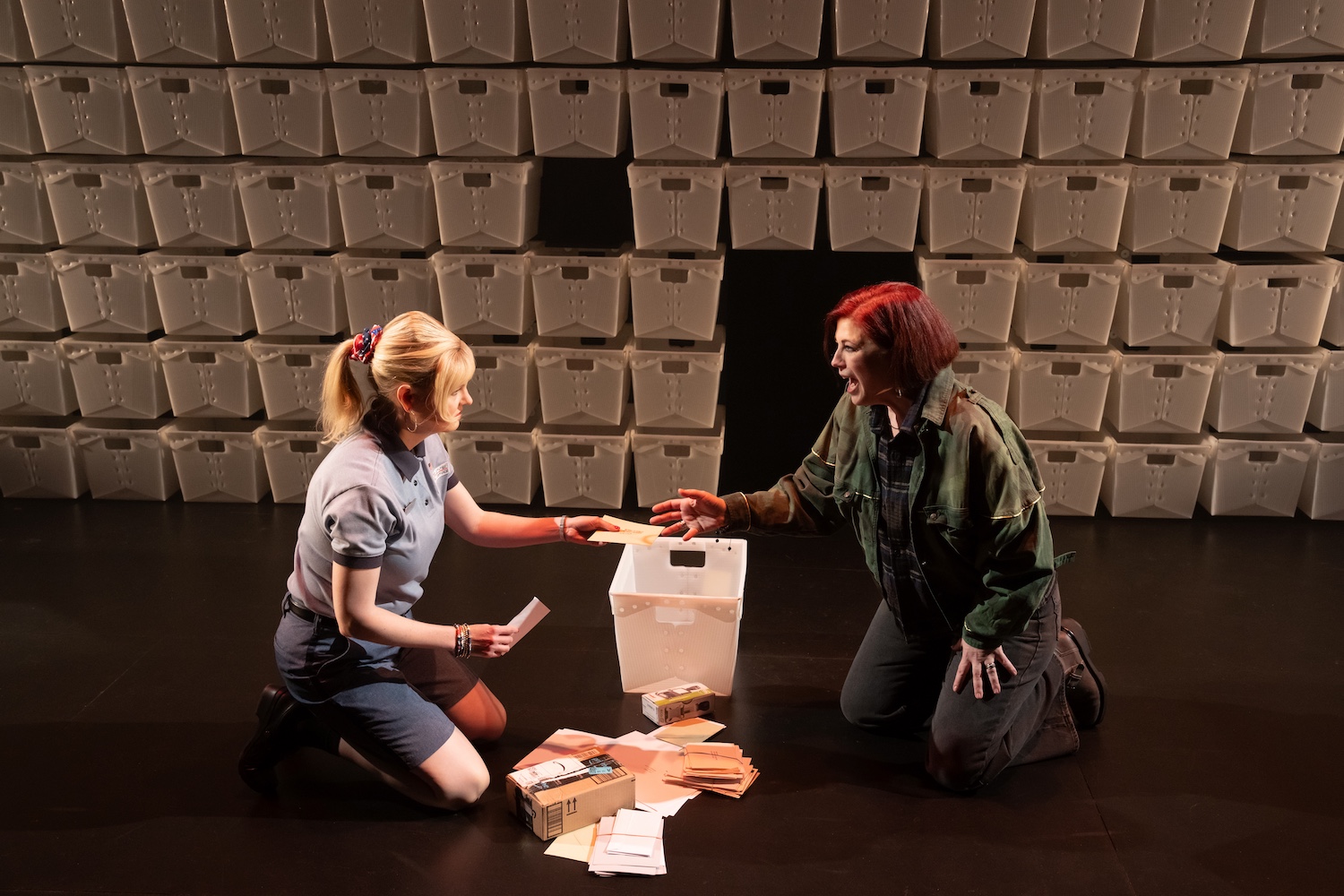
From left: Anna (Sarah Moulton Faux) and Emily (Blythe Gaissert) in The Post Office. BAM Fisher, Fishman Space, May 2026. Photo: Julieta Cervantes.
Daniel Gortler's piano anchors the production with a classical authority that reveals Kaminsky's writing as its foremost structural spine. Sarah Moulton Faux (Anna), Blythe Gaissert (Emily), Brian Jeffers (Frank), Markel Reed (Ben), and David Adam Moore as the ghostly Franklin inhabit Renfro's grid as the production's body politic. Their voices collectively reach toward a resolution that the institutional space itself refuses to provide. Whenever the vocal ensemble willfully retreats into an undifferentiated collective sound, Gortler's pianism maintains the classical rigor that Kaminsky's score demands. His is the one instrument in the Fishman Space that never loses its composure: precise, masterful, and quietly indispensable. Without him, the production risks becoming what the postal boxes suggest but cannot sustain: a purely conceptual proposition, elegant in design, hollow in resonance.
What lingers is the crossing of music and text, imagery and language, sound and discourse, each becoming the other. Kaminsky's piano writing—classical in its rigor, masterful in its formal control—holds its composure above a vocal landscape that has retreated into something primal and somewhat elusive. The singers do their utmost to paint in sound precisely what is absent: a collective agreement that holds a society together, a founding document that still means what it promised, Franklin's apparition that is capable of emancipating what the republic has become. This is where The Post Office exceeds the taxonomy of opera as an established form: in the gap between the piano's Enlightenment order and the voice's primordial unravelling. The audience, whether prepared or not, is summoned into that gap, only to find none of these things. What remains is the sound of voices that refuse to be sorted.
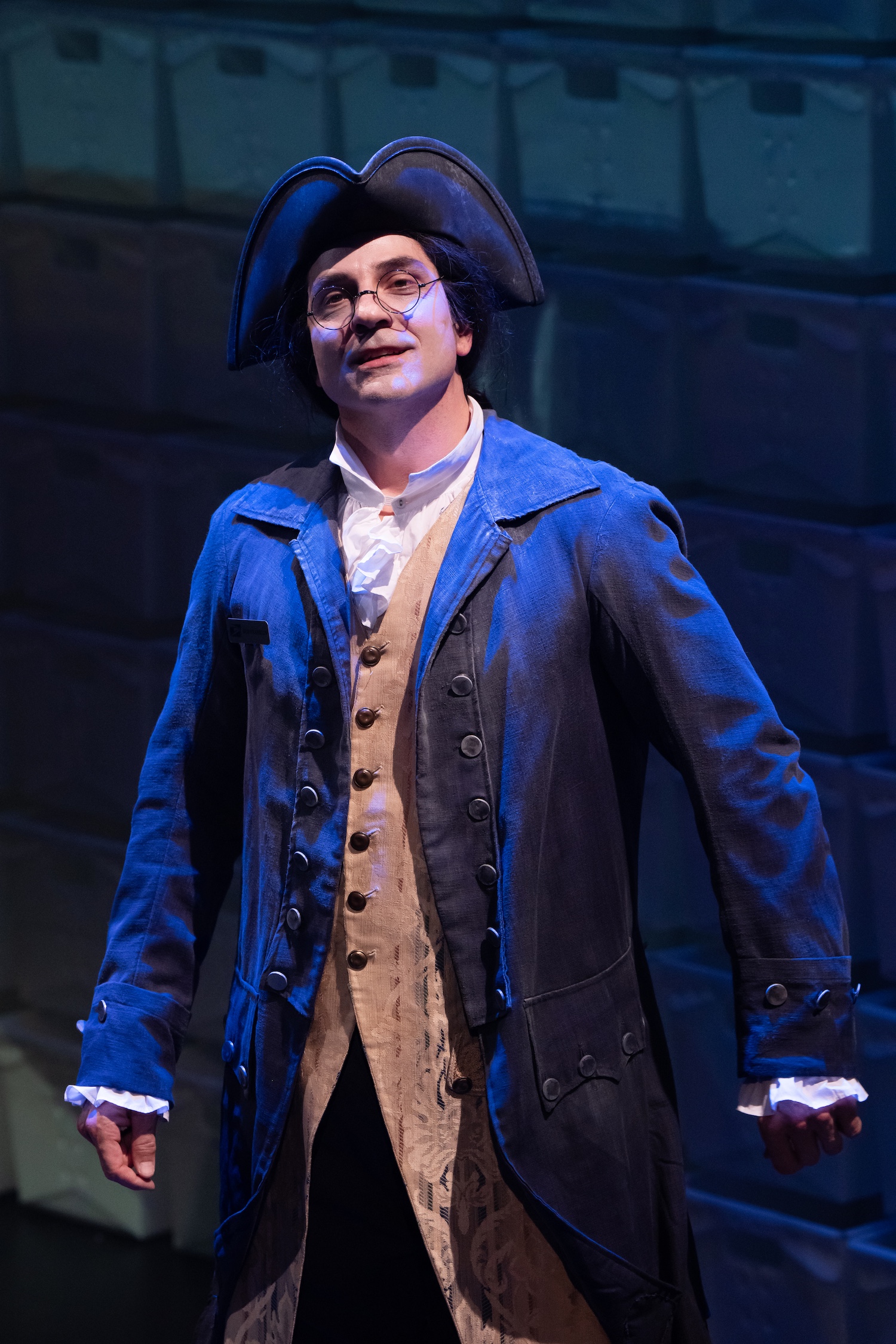 Benjamin Franklin (David Adam Moore) in The Post Office. BAM Fisher, Fishman Space, May 2026. Photo: Julieta Cervantes.
Sexton frames her libretto with a question that is itself a seeming quagmire: Democracy: now dead, still beautiful? Though the performers ultimately find consensus and agree to move forward within their relational structures and shared ethos, the audience is left confronting an outside reality that stubbornly refuses forward motion. In this, Sexton's language defies what Wittgenstein understood at the limits of philosophical speech in the closing proposition of his Tractatus Logico-Philosophicus: "whereof one cannot speak, thereof one must be silent." Because the performers of The Post Office cannot be silent, they remain vocal, speaking in circles, in obvious truths, in the exhausted repetitions of people who have been having the same argument for generations. The meaning of democracy is not lost here so much as perpetually postponed. And what Sexton and Kaminsky together seem to ask is not whether it can be recovered, but only to what extent that postponement can be sustained. Against this verbal dissolution, Kaminsky's piano writing sounds increasingly elegiac, as though suspended above the ruins of democracy's own founding promise. What persists is an insistence that the question itself still deserves to be asked.
From May 16 through 21, 2026, American Opera Projects and BAM presented the New York premiere of The Post Office at BAM Fisher's Fishman Space—music by Laura Kaminsky, libretto by Elaine Sexton, design by Charles Renfro, directed by Kevin Newbury.

Raphy Sarkissian
Raphy Sarkissian received his masters in studio arts from New York University and is currently affiliated with the School of Visual Arts in New York. His recent writings on art include essays for exhibition catalogues, monographs and reviews. He has written on Rachel Lee Hovnanian, Anish Kapoor, KAWS, David Novros, Sean Scully, Liliane Tomasko, Dan Walsh and Jonas Wood. He can be reached through his website www.raphysarkissian.com.
view all articles from this author