Whitehot Magazine
September 2026
"The Best Art In The World"
"The Best Art In The World"
September 2026
Artist Viviane Silvera Explores the Visual Language of Memory
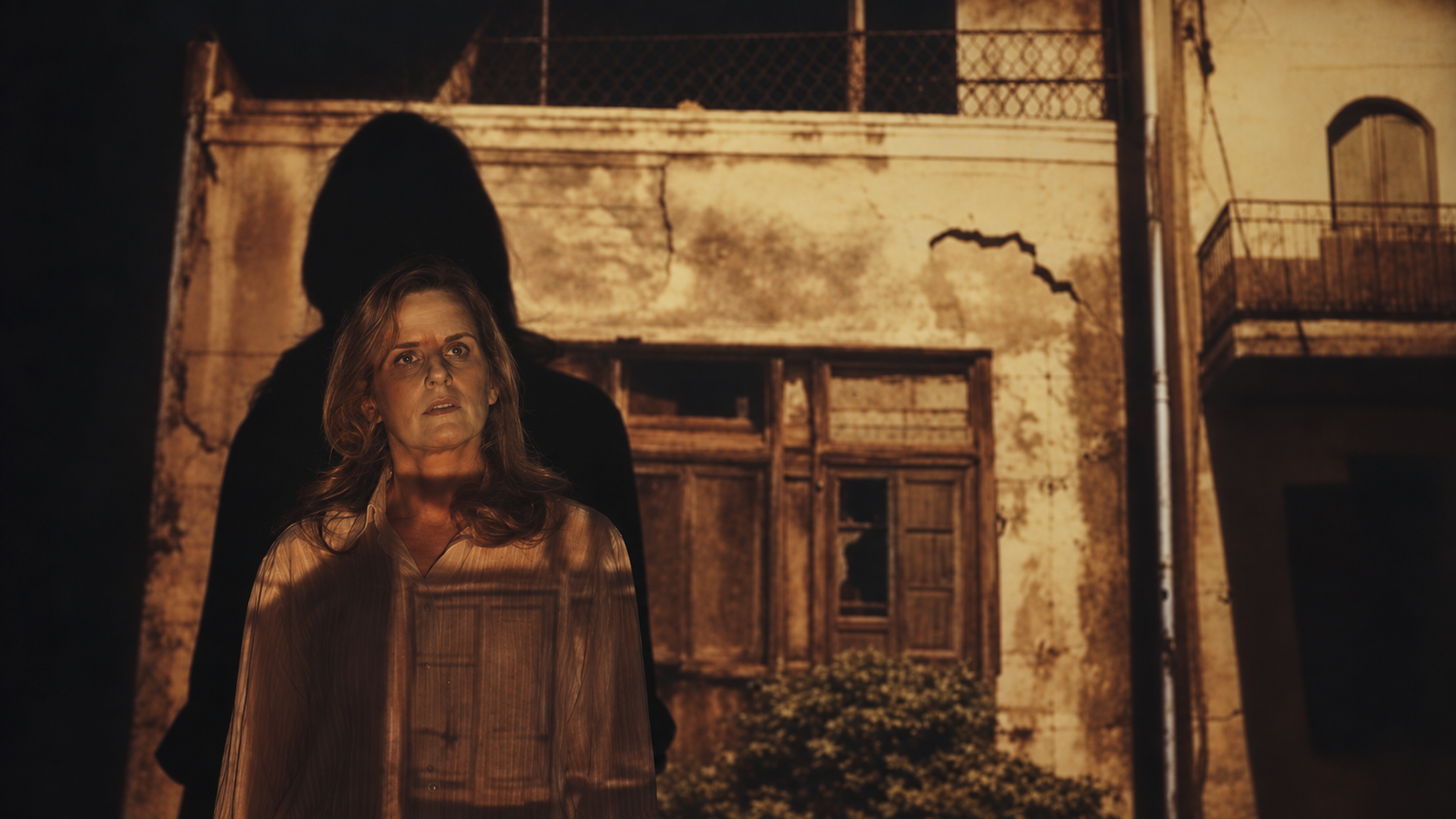 Take yourself.
Try to remember to put yourself back together.
I don't know.
Can you know who you are if you can’t remember things out of your own life?
What is the truth? How do you know?
- Viviane Silvera, See Memory, 2025
By HARPER KINCAID September 27th, 2026
Well-known in New York collector circles for her work as a painter and sculptor, it is Viviane Silvera’s voice-a sopranic lilt of a whisper-audiences first encounter. The audio is its own visual, my mind’s eye picturing her wandering in an ether between girl and womanhood. That’s how Silvera opens her Emmy-nominated, animated work, See Memory, a nonfiction film that exists as a monument to the impermanence of memories held and the narratives shared.
Composed of over 30,000 individually hand-painted frames, the animated film strips away the clinical sterility of digital rendering, replacing it with the tactile: countless brushstrokes, pigment and paint strata rising and contracting through each frame. By painting, layering, and reapplying over the same surfaces, Silvera leaves behind impasto residue; phantoms of previous frames haunting the present image. The result renders less like traditional cinema and more like a durational palimpsest. Silvera has created a thoroughly original, physical analog to memory reconsolidation: the process by which recalled memories can become open to change.
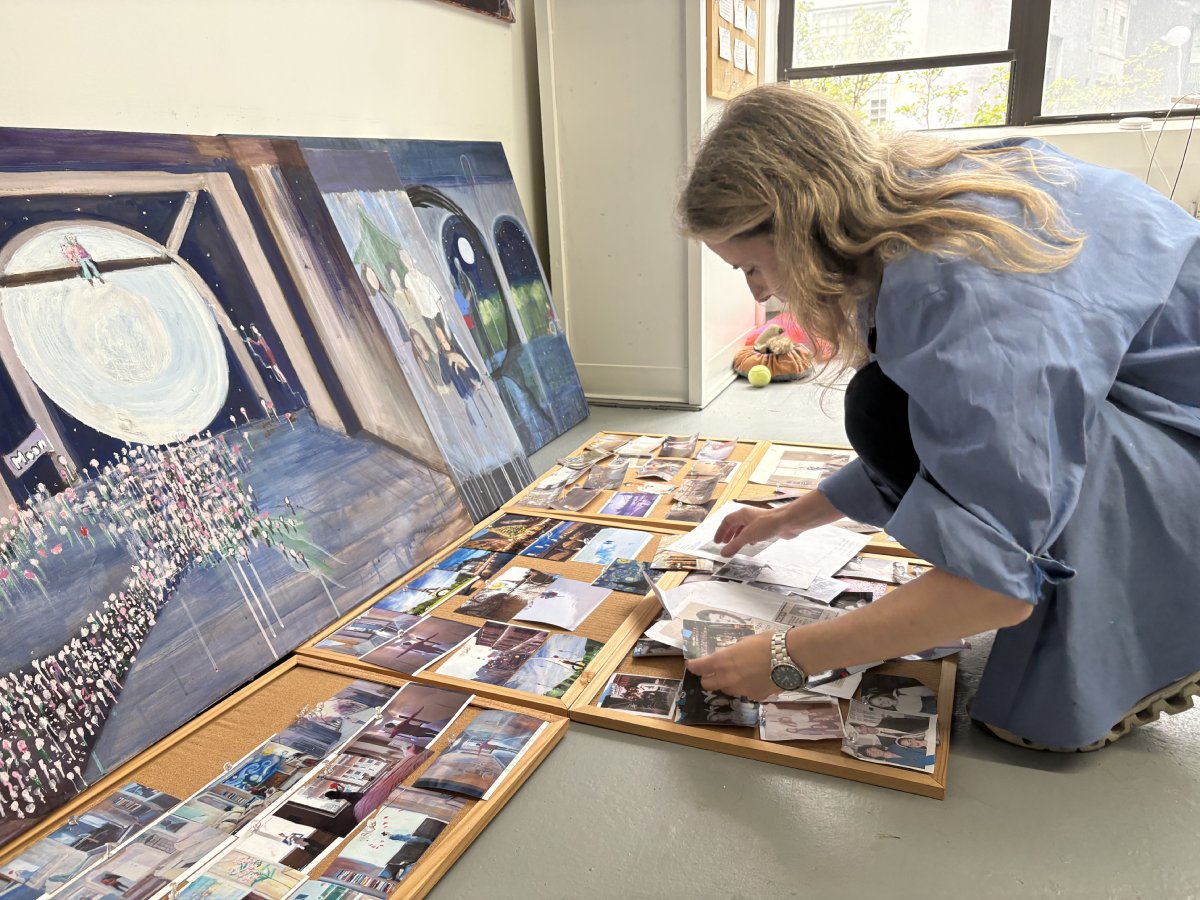
Silvera in her Long Island City Studio, 2026
Her seminal work is also rooted in interviews with memory science pioneers, including Nobel Laureate Eric Kandel. See Memory avoids the trap of being reduced to clinical scientific illustration. Instead, the film functions as an inventive, phantasmagoric exploration of trauma, displacement, and the legacy of diaspora.
Born in Hong Kong, raised in Brazil, and carrying a family legacy shaped by displacement from Aleppo, Syria, Silvera translates the fragmented geographies of the self into a fluid visual language.
Silvera’s transition to national television and a staggering three Emmy nominations—including Best Health/Medical Documentary, Best Graphic Arts, and Best Director—marks a rare institutional crossover. Ahead of her highly anticipated follow-up projects, The Memory Loophole and Projecting Aleppo, and a major inclusion in the Honolulu Museum of Art's NeuroArts exhibition, Whitehot Magazine’s guest feature writer, Harper Kincaid, sat down with Silvera to unpack the materiality of time, the politics of ancestral trauma, and the deliberate destruction of the canvas.
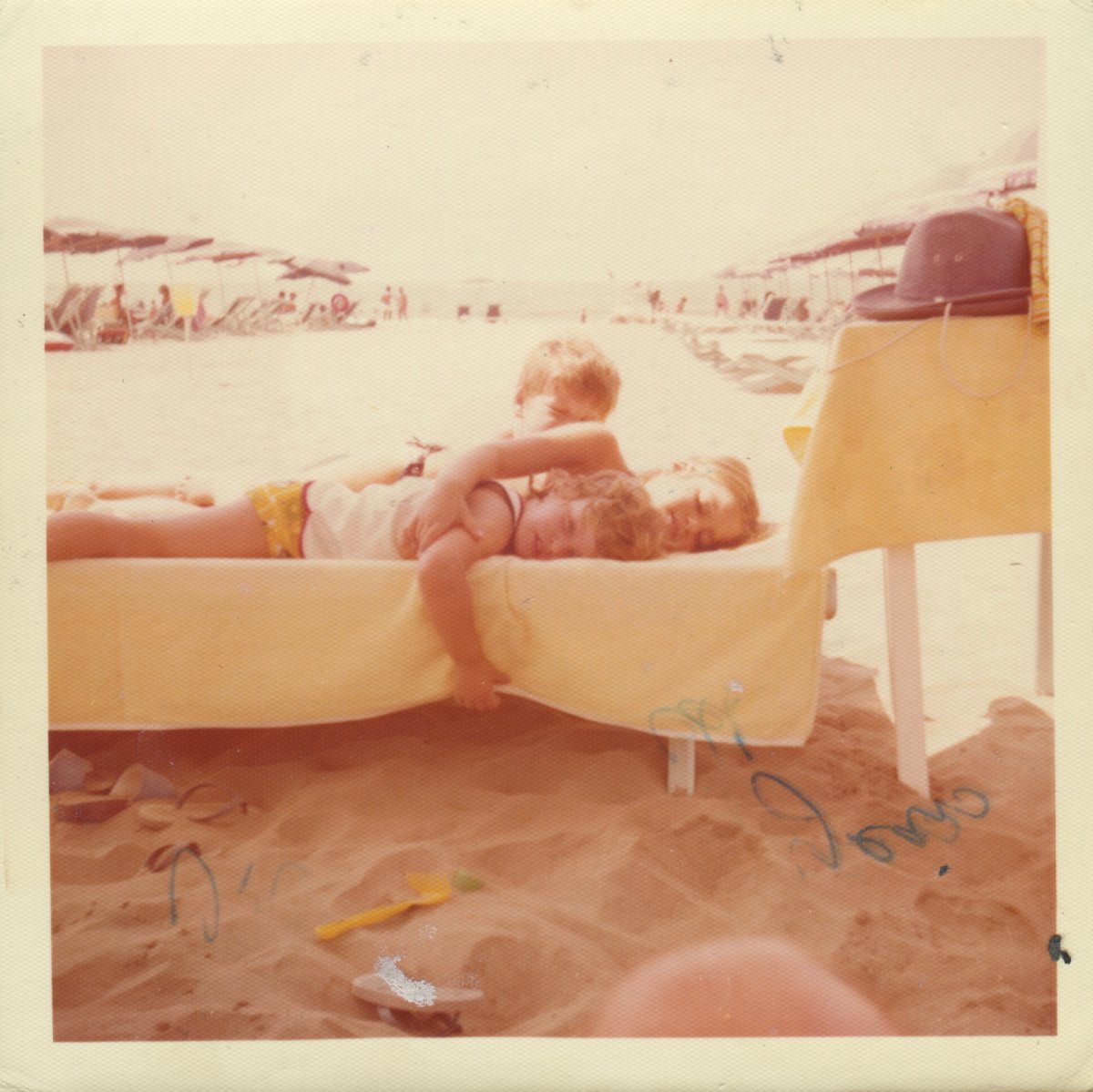
Forte dei Marmi, Italy, (1975). "We spent summers here with family and other Aleppine Jewish families. Our childhood involved a lot of moving and traveling, but my brother, sister and I were always a team—often literally piled on top of one another, as we are here."
You were born in Hong Kong, raised in Brazil, are of Italian heritage, and now live in New York. How has moving between these vastly different cultures shaped your own perspective on what "home" and "memory" mean?
My memories of Hong Kong are fragmentary, but incredibly sensory: heat, humidity, sunlight, water.
I remember my mother walking home from tennis one day and fainting from the heat, and the three of us running to get her juice. I remember the boats and ferries, swimming constantly, and the opposite sensation downtown—being packed so tightly into the shopping districts that I felt I would suffocate.
I remember the sounds too. British accents at school, Chinese spoken around me in the streets and shops, and Arabic between my parents at home.
It was also an extraordinarily international place to grow up. The children at school came from everywhere, so I understood very early that there wasn't one simple answer to the question, “Where are you from?”
Brazil was also hot and sunny, but it had a completely different texture. One of my strongest memories from there is the first real artist’s studio I ever entered. I studied with a painter on weekends, and I remember the northern light coming through the skylights and this beautiful feeling of peace washing over me. I think that was the first time I understood physically what a studio could be—a place where visual experience took precedence over everything else. There was very little speaking. It was mostly hours spent rendering the light and shadows in people and things - and I loved that feeling. It's a gear in my mind that still flips on when I enter a studio.
 Viviane Silvera in the studio, 2026.
Maybe because we moved so much, I never attached home entirely to geography.
Home was my family. It was the strange continuity of seeing the exact same furniture travel from Asia to South America to the United States. We could arrive on a different continent, in a different climate and language, and once our things were unpacked, the apartment suddenly looked familiar again.
Being Jewish was another continuity. Countries changed around us, but there were traditions, stories and rituals that remained.
And there was my mother's cooking. She made Syrian food—lahmajun, sambusak, lentils and rice—but she was also an amazing cook who studied French cooking. Dinner could be Syrian one night, Hungarian goulash another, fondue the next. That table traveled with us too.
Food is still one of my strongest triggers for memory. In Hong Kong, I loved beef chow mein, and on Sunday nights we would often eat Chinese food at the club while watching The Muppet Show. Although most of the television I grew up with was British.
It's funny what remains in my memory. Not the important facts, but the taste of noodles, a television show, the light through a skylight, your mother's food, the furniture arriving again in another country.
I think that is still how I understand home. Not as one place, but as a collection of sensations, people and rituals that somehow survive the journey.
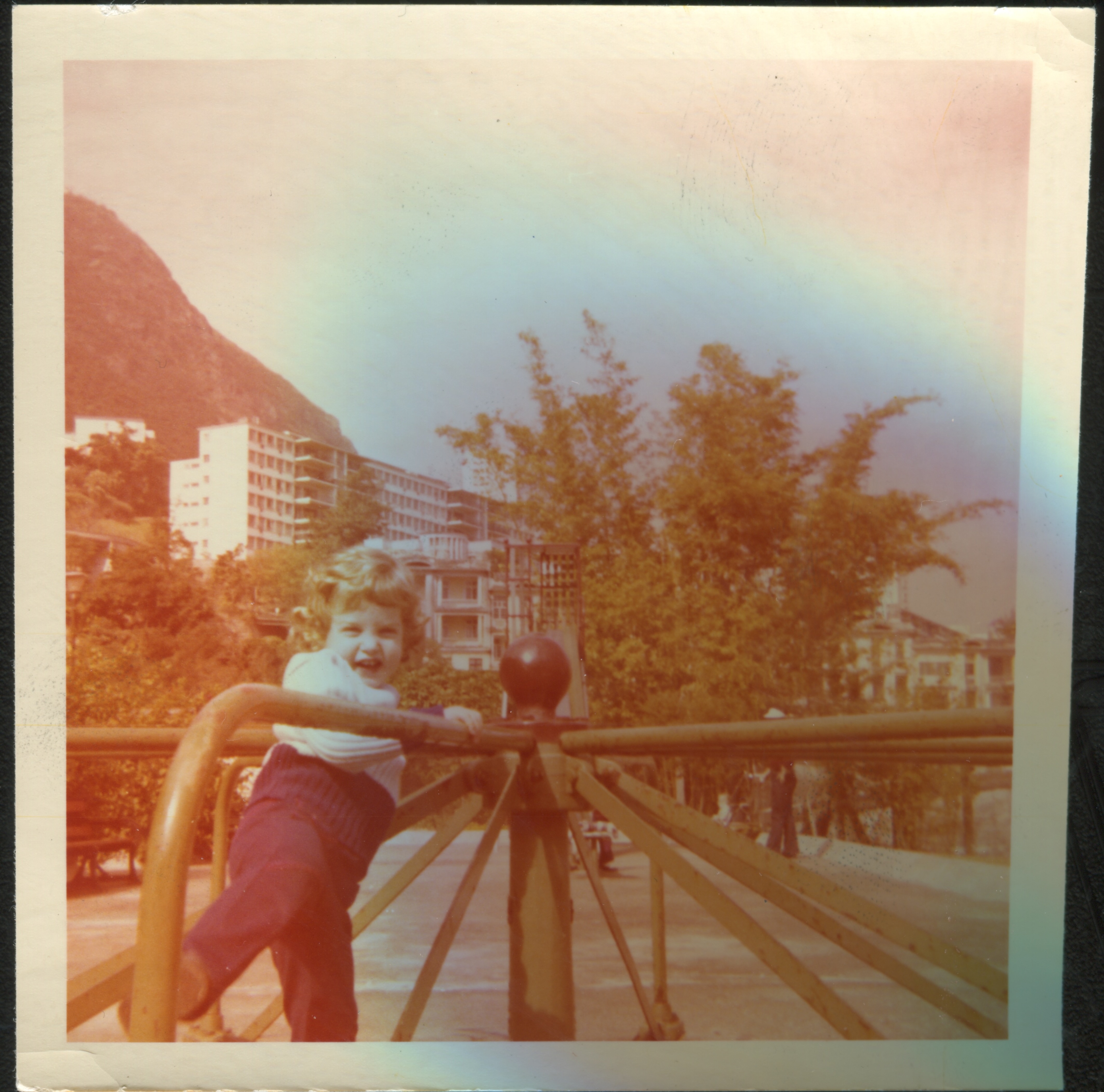 Hong Kong (1974). "I remember waiting for the merry-go-round to spin and trying to find the exact moment to jump on. It is such a small memory, but it has stayed with me—the anticipation, the motion, the instant when you decide to enter it."
How does moving across these disparate geographical landscapes alter an artist's visual memory bank? Are your color palettes and textures tied to specific geographies of your youth?
Very much so, although not always consciously.
I made an entire series about Hong Kong called Borrowed Memory. The Peak (Victoria Peak), the mountains, the junks, the roads near where I lived—all of those places began reappearing in the work. What interested me was that they weren’t returning as accurate representations. They were returning as remembered places, which is something different.
Hong Kong also quite literally frames See Memory. The film opens with a junk on the water against the Hong Kong skyline, and at the end of the fourteen-minute animated section, the junk drifts away again. That image had been living in me for decades before it became part of the film.
And Hong Kong is appearing again now in The Memory Loophole, sometimes in very small ways—little vignettes tucked into corners of the larger moving paintings, almost hidden inside them.
My hand-painted animation exists somewhere between planning and letting go. I storyboard only slightly, usually just for critical scenes. I know where a sequence needs to go. But after I’ve been painting for a while, I sometimes enter what I think of as a kind of waking-dream state. I’m no longer making every decision intellectually. Images begin to surface.
Sometimes they are clearly connected to the story I’m telling. Sometimes something from my own visual memory slips in—a landscape, a shape, a place—and it may only make sense to me.
I love that part of the process. I don’t think every image needs to be decoded for the audience. Some things can exist in the work the way fragments exist in memory: partially hidden, associative, and even mysterious to the person making them.
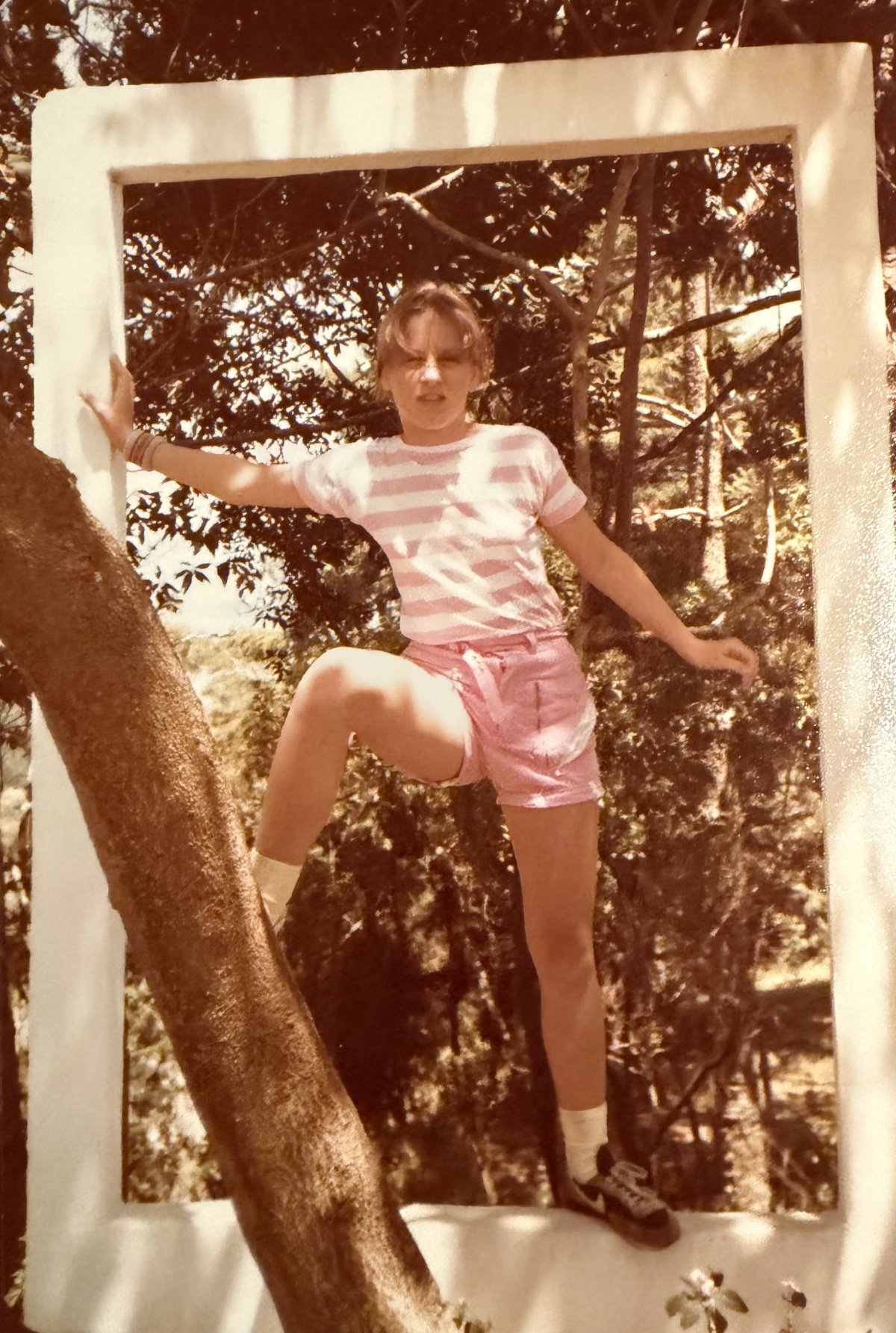 Silvera in Brazil, 1983. "Displacement has a weight unseen."
You have spoken about your father’s harrowing escape from Aleppo, Syria, and the lifelong nightmares your grandfather suffered as a political prisoner. How did growing up with these intense inherited traumas influence your desire to explore memory through your art?
I'm going to complicate things here and address the word “trauma” here, because that isn’t how my father ever told the story.
Growing up, I heard about his escape from Syria almost as an adventure. He was eighteen and desperate to get out, to see the world, to be free from living under an oppressive regime. He would tell us about getting to Damascus, hiding in a freight train, jumping off the train and following the lights, searching for the Jewish quarter while pretending to be Muslim.
He still does not describe himself as having been frightened.
The fear enters the story almost sideways. It is only when he talks about other people who tried to escape around the same time and were “disappeared” that I understand what the stakes actually were.
And over the years, when I tried to put his story together for myself, I became aware that there were missing pieces. That interests me now—the difference between the story we inherit, the story someone chooses to tell about himself, and the story we reconstruct around the missing pieces.
My grandfather is different because I never knew him; he died before I was born. It was my grandmother who told me that after being imprisoned as a political prisoner, he suffered from nightmares for the rest of his life. I’m not even sure my father knew that.
So what I inherited was not one clear narrative of trauma. It was fragments: adventure, danger, family lore, things I was told and things I only understood much later.
That has profoundly shaped the way I think about memory. I’m interested not only in what happened, but in what survives the telling: what someone emphasizes, what disappears, what another generation fills in, and what may remain unknowable.
In some ways, that may be why I keep returning to memory in my work. I’m less interested in memory as a record of the past than in the strange process by which we construct a story from what remains.
See Memory consists of over 30,000 individually hand-painted frames animated through stop-motion. Can you walk us through the daily discipline and physical toll of creating short film frame by frame?
I never began by thinking, “I am going to paint over 30,000 frames.” There was no grand plan, and I don’t think of it as having taken some enormous physical toll. I started by experimenting with stop-motion and then just kept going. It happened bit by bit, day by day, over years rather than in one sustained production period.
On a productive day I might photograph as many as 500 changes to a painting. At twenty-four frames per second, that can amount to only about twenty seconds of animation. But I wasn’t really thinking in those terms while I was doing it. I was thinking about the next change to the image.
The process made me a much better painter.
When you are working on a painting, drawing or sculpture, one of the dangers is staying too close to it for too long. You stop seeing it clearly. With animation, I was forced to step back after every few brushstrokes to photograph the painting. Over and over again, I had to move between the smallest decision—a brushstroke—and the entire image.
I think that trained my eye.
There were certainly moments when it was frustrating. Sometimes I wanted to stay inside the painting and keep working rather than stop, step back, photograph it, and then go in again.
But I never reached a point where I thought, “I can’t keep doing this.”
There were too many moments of flow for that. Sometimes it became meditative, almost transcendent. Those moments kept me going.
I listen to podcasts, audiobooks and music while I work. Technically, I created a small blacked-out area inside my studio, with curtains and photo lights so the illumination stays consistent as the daylight changes outside. I can disappear into that space for hours.
So when I look back at the number—30,000 frames in the finished film, perhaps 100,000 actually made—it sounds completely insane.
But that isn’t how I experienced it.
I experienced it as one brushstroke, one photograph, one small decision at a time.
Rather than using digital rendering, you choose the physical friction of paint. How does the weight, texture, and materiality of oil paint capture what digital pixels cannot when dealing with the human psyche?
I have to make things with my hands.
Painting is one step removed from where I began. My master’s degree is in sculpture, and for years I only wanted to make things I could physically touch, build, move around, and experience in space.
That tactile need never went away.
“I don’t work like a photographer, seeing an entire image in one decisive moment and capturing it. I need to find an image bit by bit. Stroke by stroke. I make something, look at it, respond to it, change it, and gradually understand what the image wants to become..”
Painting allows me to think through making.
And then the material starts doing things I haven’t asked it to do. That became one of the discoveries of making See Memory. Paint drips, bleeds, smears and runs. When you put those changes into motion, suddenly a drip can feel like sweat, blood or tears. It feels bodily. Human. Raw.
I didn’t sit down beforehand and think, “I’m going to make paint behave like memory or emotion.” I discovered that as I was painting and photographing. Something accidental would happen, I would see it moving, and an idea would appear.
Sometimes I’ll turn the painting upside down while I’m working. Then, when the sequence is played back, the paint appears to drip upward. Gravity stops behaving properly, and you get this strange, surreal effect.
I could presumably imitate many of those effects digitally, but for me that would reverse the process. I would already have decided what I wanted and then constructed it.
With paint, I can be surprised - which is essential. The material participates. It gives me things I didn’t know I was looking for until they appear.
You chose painting because paint "moves, drips, and layers, behaving like memory itself". How do shifting brushstrokes and changing colors help the audience visualize the difference between explicit (conscious) and implicit (unconscious) memories?
What I’ve heard from audiences is that the painted animation seems to bypass language.
That interests me because implicit memory operates without conscious recollection. It may live as sensation, emotion, bodily response, atmosphere—something you feel or respond to before you can explain it.
The brushstrokes, color, layering, smearing and dripping can reach that level directly. You don’t have to name what you’re seeing in order to respond to it.
At the same time, the constantly changing image makes visible something else about memory: that it is shifting, layered, and being transformed bit by bit, often without our awareness.
A color changes. A face dissolves. One image remains faintly underneath another. Something recognizable becomes abstract and then reforms.
So for me, the moving paintings don't function as an illustration of neuroscience. They create an experience that is closer to the way memory can actually feel—partly conscious, partly inaccessible, always in motion.
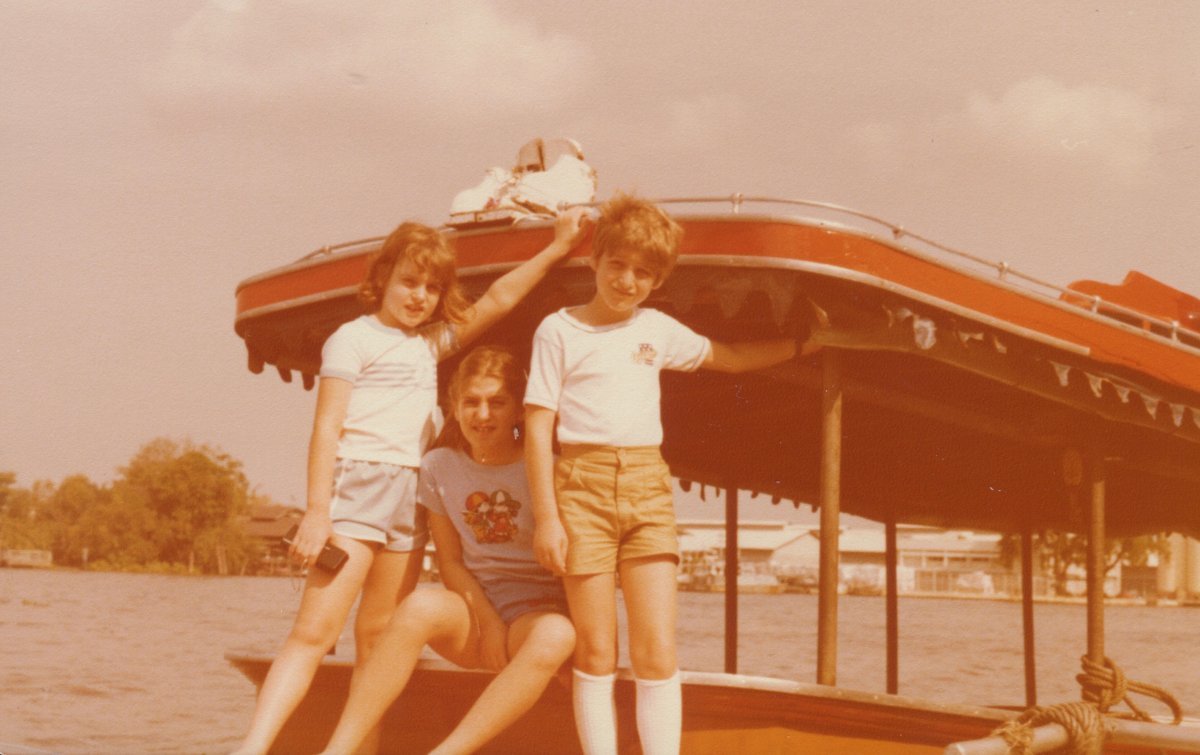
Pattaya, Thailand, (1980). The three of us again, this time on a boat. We moved and traveled constantly, and when I look through these photographs, what strikes me is how often the landscape changes but the configuration stays the same: my brother, my sister and me.
In your process of painting, erasing, and re-painting on the same surface to create motion, the residue of the previous frame remains visible. Is this palimpsest a technical byproduct, or is it a deliberate aesthetic choice to show how our past memories stain our present?
It was an aesthetic choice.
I knew from William Kentridge’s work that the residue of one image inside the next could be incredibly powerful. But Kentridge works in charcoal, where you see the black of the charcoal and the marks of erasure.
I was doing something different. I wasn’t erasing so much as accumulating—painting over and over and over again.
I knew the material and the process would matter, but I didn’t know exactly what visual effects they would produce. I had to trust that if I followed my intuition and really used the properties of paint—its opacity, translucency, drips, smears, buildup, traces of what came before—it would begin to create its own language for memory.
And it did.
The residue is not a technical accident. It is part of the storytelling. The previous image is never completely gone. It remains inside the next one, just as earlier experiences remain inside us even when they are no longer consciously visible. What interested me was using everything paint could do materially—not just to depict memory, but to behave like it.
As a trained sculptor and painter, fine art training historically emphasizes the "masterpiece" as a static, archival object frozen in time. How did you mentally untrain yourself from the pursuit of the single perfect canvas in order to embrace a medium where every painting exists to be destroyed by the next?
I should probably correct one part of the premise: I’m actually not formally trained as a painter.
Aside from about a year studying with a painter in Brazil when I was twelve—when I was still mostly drawing—I’m largely self-taught as a painter. My focus in art school, and in graduate school was sculpture.
So I’m not sure I ever had to untrain myself from the idea of the perfect canvas. I’ve always been more interested in process than in the final, perfected object.
In fact, I’ve often wished that the earlier versions of a sculpture, drawing or painting could somehow remain visible inside the finished piece—that you could see the searching, the corrections, the decisions that led there.
You see that in Michelangelo’s drawings, and in the idea of pentimento: traces of earlier choices remain visible. You are allowed to see the artist thinking.
That has always been beautiful to me.
Modern art opened that door much more explicitly, of course, but museums still tend to present the finished object as the thing of value: the masterpiece, complete and resolved.
Animation gave me a way to make the process itself the work.
And, in fact, the earlier image is never really destroyed in my process. I photograph every stage, so I have thousands and thousands of stills documenting the evolution of the painting. I can go back and look at almost any point in its development, the way a printmaker might look at different states of an etching.
I can even make a print from one of those earlier stages.
So in a strange way, I’m very lucky: the “memory” of the painting is literally preserved. The physical surface keeps changing, but the earlier versions are not lost.
That feels deeply connected to the subject of memory itself. The image transforms, but what came before still exists—sometimes visibly in the paint, preserved in the archive.
So painting over an image doesn’t feel like destroying it to me. It feels like allowing it to become the next thing while still preserving where it has been.
The narration of See Memory relies heavily on dialogues with neuroscientists, including Nobel Laureate Eric Kandel. What was it like bridging the gap between rigorous laboratory science and the subjective, emotional language of fine art?
That was one of the hardest parts of making the film, and probably the place where I most needed outside input in the edit, because I can get very enamored with neuroscience.
I would hear a scientist explain something beautifully and want to keep all of the language, all of the specificity, all of the complexity. My producer, Jon Cornick, was enormously helpful in pushing me to ask a different question: not just, “Is this scientifically interesting?” but, “Does the audience still feel something while hearing it?”
One of the editing principles I kept returning to came from Walter Murch: maintain the emotional connection with the viewer. An audience will forgive a lot technically, but once you lose that emotional connection, it is very hard to get it back.
So that became a kind of test for the film.
We would watch a sequence, and if there was a scientific term that made you stop and think, “Wait, what does that word mean?”—if it pulled you out of the emotional experience—we would usually remove it or simplify it.
That was difficult for me because I didn’t want to dilute the science. But I gradually understood that rigor does not necessarily mean including every technical term. Sometimes rigor means finding the clearest language possible without distorting the idea.
The science had to remain accurate, but it also had to live inside a film.
For me, that became the bridge between the two: the neuroscience could provide ideas and structure, but the art had to keep the viewer emotionally inside them.
Your work heavily features the concept that long-term memories are not fixed records but are reconstructed—and can be changed—every time we recall them. How has understanding the science of "memory reconsolidation" changed the way you view your own past?
It made me realize that I have an ongoing relationship with my past.
Before I understood the science of reconsolidation, I think I assumed certain memories were fixed—that if something had happened, the emotional meaning attached to it was more or less permanent.
What I began to understand is that memory is much more dynamic than that. Remembering is not retrieving a perfect recording of an event. We are encountering that memory again from the vantage point of the present, and under certain conditions it can become open to change.
That was freeing for me because it suggested that I could negotiate with memory.
Not erase the past, and not pretend something happened differently than it did, but change my relationship to it.
And then I realized that, in a way, I had already been doing that for years through art. I was constantly returning to memories, repainting them, reframing them, shifting perspective, changing emphasis, placing them in new contexts.
Art had been giving me a way to rehearse this process before I had the scientific language for it.
So learning about reconsolidation didn’t introduce a completely new idea into my life. It gave me a biological framework for something I had already been doing intuitively.
That changed the way I think about the past. I no longer see memory as a fixed archive I have to live under. I see it as something I can remain in dialogue with—something I can revisit, reconsider, and sometimes transform.
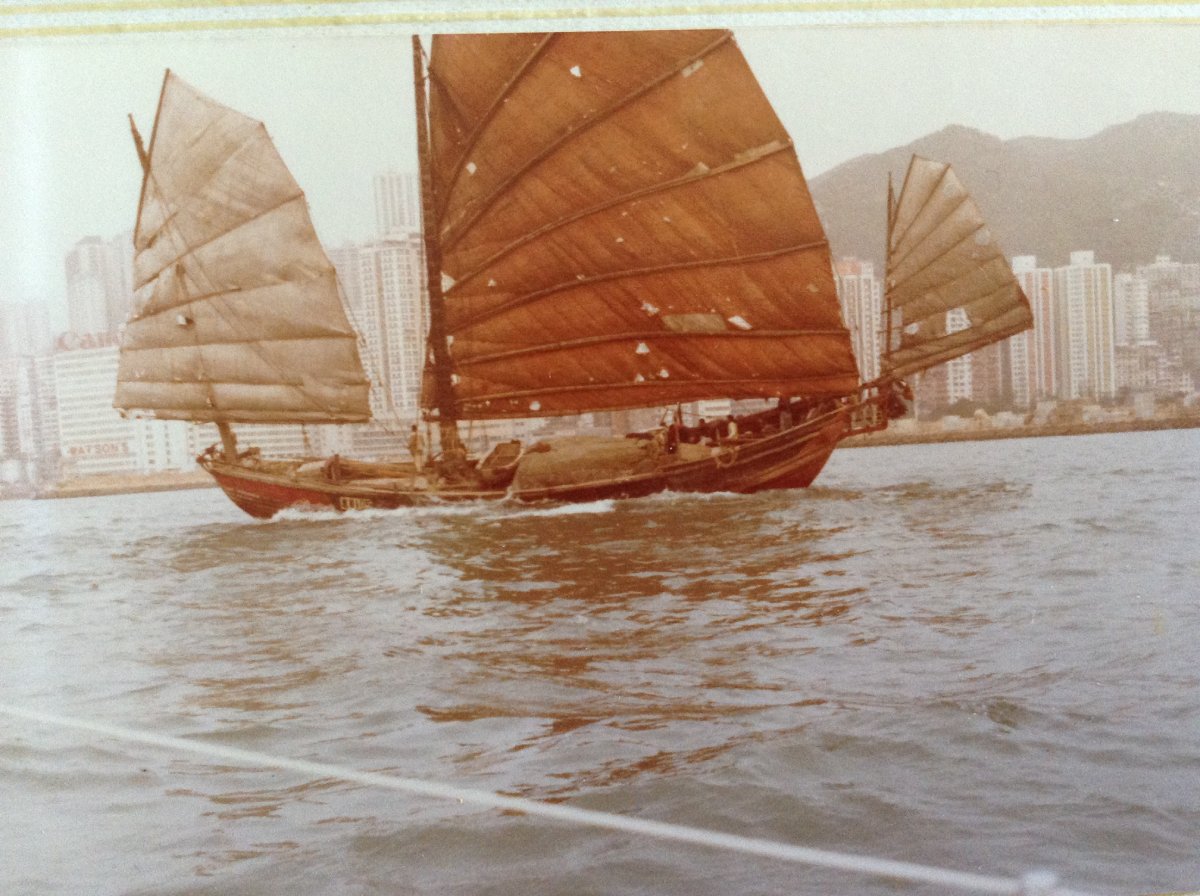 Hong Kong, (1979). This is very close to the Hong Kong I carry visually in my memory: bright water, intense sunlight, and the dark silhouette of a junk moving across the harbor against the skyline and mountains. That combination of water, boats, city and light became part of my visual memory of Hong Kong—and decades later found its way into See Memory.
Therapists and clinical educators are now using See Memory to help facilitate conversations about trauma and memory. Did you anticipate that a fine-art film would find such a powerful practical application in medicine?
Not at all.
When I started making See Memory, I didn’t even know it would become a film. I certainly didn’t imagine television, streaming, or a wide audience. I thought it might exist in a gallery for a month and then disappear.
So the way it is being used now has been a revelation to me. I’m thrilled by it.
It has also been deeply energizing because the work has moved beyond the narrow confines of the art world. It is reaching people who may never walk into a museum or gallery.
What therapists have told me is that one of the limits of talk therapy is that traumatic experience does not always arrive in language. See Memory seems to help because the imagery can bypass language. People can recognize a feeling before they can explain it.
Some clinicians have told me that patients feel understood or seen by the film in a way they had not yet been able to articulate themselves. And then, almost paradoxically, that recognition can help them begin to find words.
The science matters too. The film explains that PTSD is an understandable response to a traumatic event. For some people, understanding what the brain and body are doing can reduce shame and stigma. It gives them a framework for why they may be reacting the way they are—and hope—the possibility that those responses may not be fixed forever.
That practical use was never something I anticipated. But now it has become one of the most meaningful parts of the life of the film.
Congratulations on See Memory receiving three Emmy nominations, including Best Health/Medical Documentary, Best Graphic Arts, and Best Director. When you were exhausted in your studio painting these frames, did you ever imagine this project would reach the scale of a national PBS broadcast and television academy recognition?
Never.
When I was alone in the studio painting frame after frame, I had no idea what the life of the work would be. I wasn’t imagining PBS. I wasn’t imagining television. I certainly wasn’t imagining Emmy nominations.
I was just trying to solve the next image.
That is probably what makes the recognition so moving to me. The film began in such a private, incremental way—one brushstroke, one frame, one experiment at a time—and then somehow it traveled far beyond the studio.
The PBS broadcast meant that people who would never necessarily enter a gallery or museum could encounter the work in their homes. The Emmy nominations were another kind of surprise because they recognized three very different dimensions of what I was trying to do: health and medicine, the visual language of the film, and directing.
That meant so much to me because See Memory was never meant to fit neatly into one category. It is part art film, part science film, part personal inquiry.
I could never have imagined this outcome while I was making it.
And I’m glad I didn’t. If I had been thinking about awards or audience size, I might have made different decisions. The work came first, and the rest happened later.
Can you share with our readers about your next project?
I’m working on two films now, and together they feel like the next chapter of the work I began with See Memory.
The first is The Memory Loophole, which follows writer Victoria Loustalot as she revisits and reconstructs memories of her father, who died when she was a child. I’m interested in what happens when a memory that has shaped your identity for decades begins to shift—not because the past changes, but because your relationship to it does.
Formally, I’m pushing the language I developed in See Memory much further. The film combines nonfiction, archival material, hand-painted animation and projection. I’m taking fragments from Victoria’s past—photographs, recordings, places, stories—and physically projecting them around and onto her, so she can move through the architecture of her own memory.
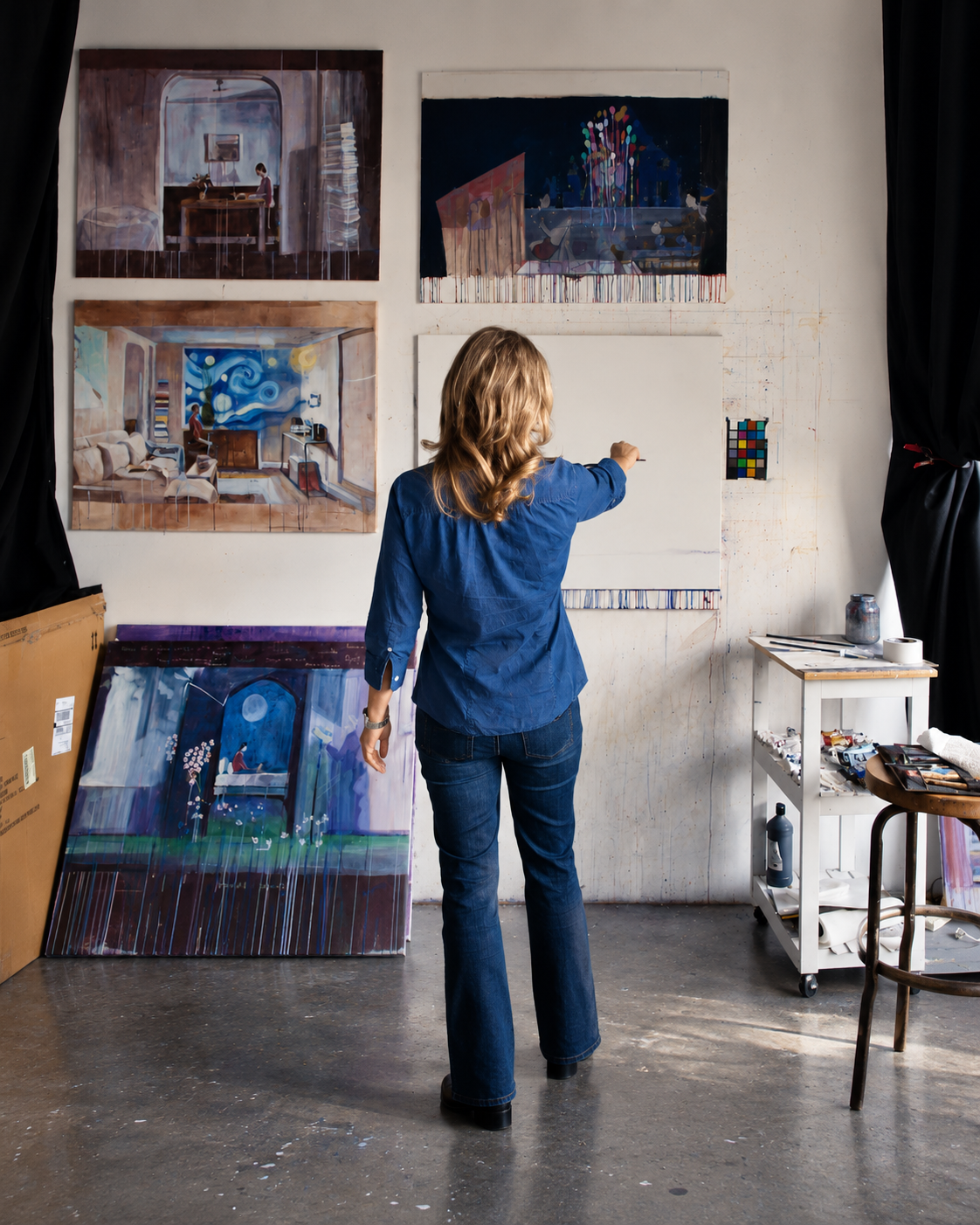 Viviane Silvera in the studio
What excites me is that I’m no longer only exploring how memory works. I’m creating a cinematic space in which someone can actually encounter, inhabit and reconsider the memories that have shaped her.
The second film, Projecting Aleppo, turns that inquiry toward my own family.
It grows out of interviews I filmed with my father about his childhood in Aleppo and his escape from Syria at eighteen. I’ve heard versions of that story all my life, but the more closely I look at it, the more interested I become in its gaps—the things he remembers vividly, the things he barely describes, the danger he insists he never felt, and the history that a daughter inevitably reconstructs around what a parent leaves unsaid.
That film is about memory, but it is also about exile, diaspora, inheritance, and the stories families use to make sense of where they came from.
What connects these projects for me is that I’m developing a body of work around memory not only as subject matter, but as a visual and cinematic language. Painting, projection, archival material and live action allow me to move between what happened, what is remembered, and what the mind creates in between.
See Memory was where I discovered that language. The Memory Loophole and Projecting Aleppo are where I want to see how far it can go.
Readers can stream See Memory online for free on pbs.org and through the PBS App.
Viviane Silvera is a New York–based painter, sculptor, and Emmy-nominated filmmaker whose work explores memory through painting, animation, and film. Her film See Memory has been broadcast nationally on PBS and is used in educational and clinical settings.
Harper Kincaid
Harper Kincaid is a USA TODAY bestselling author, licensed clinical psychotherapist, and multimedia artist who splits her time between Washington, DC and New York City. @HarperKincaid @ArtistAppel