Whitehot Magazine
October 2026
"The Best Art In The World"
"The Best Art In The World"
October 2026
An exhibition can be a grimoire: A conversation with queer artist Alexander D’Agostino about his show Something Wicked (2026)
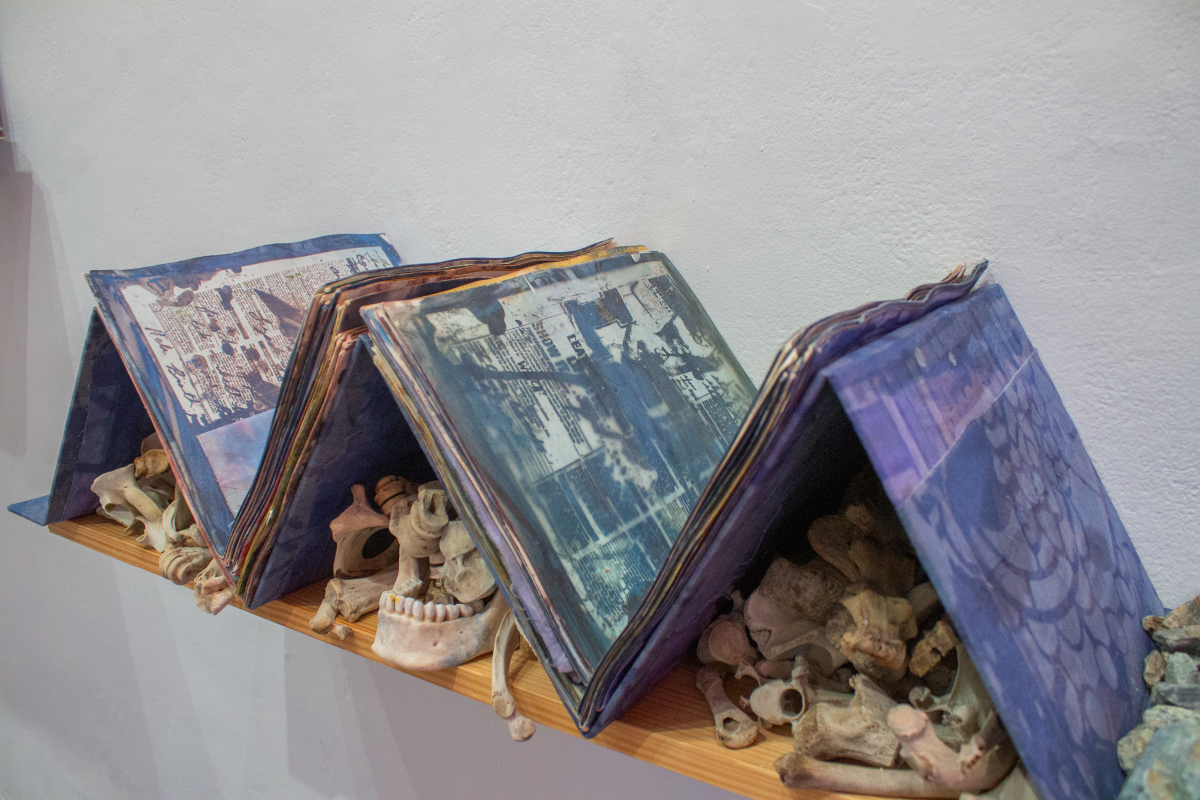
Installation shots of Something Wicked, photo by Mei Matute.
BY EMMA CIESLIK April 4th, 2026
This past Friday, Baltimore-based interdisciplinary artist Alexander D’Agostino (also known as Glitterwitch) debuted his show Something Wicked at the Transformer DC. Presented in collaboration with the Folger Shakespeare Library, Something Wicked represents the latest installment of his project The Fairy King’s Grimoire which he is working on as part of his Artistic Research Fellowship at the Library.
During this fellowship, he engages with Folger Manuscript V.b.26, a 16th century manuscript book of magic in the Library’s collection. The work he is creating--which explores queer magic as a tool of liberation and reclamation--reimagines Oberion, the king of the fairies in V.b.26 and in Shakespeare’s A Midsummer Night’s Dream, as a queer archetype.
After his installation opened, I sat down with D’Agostino to learn about the power of deconstructing and reclaiming the “fairy” stereotype within queer communities and the potentials of creating a queer magical archive that blends historical research with this manuscript and living ritual through his performance as Glitterwitch.
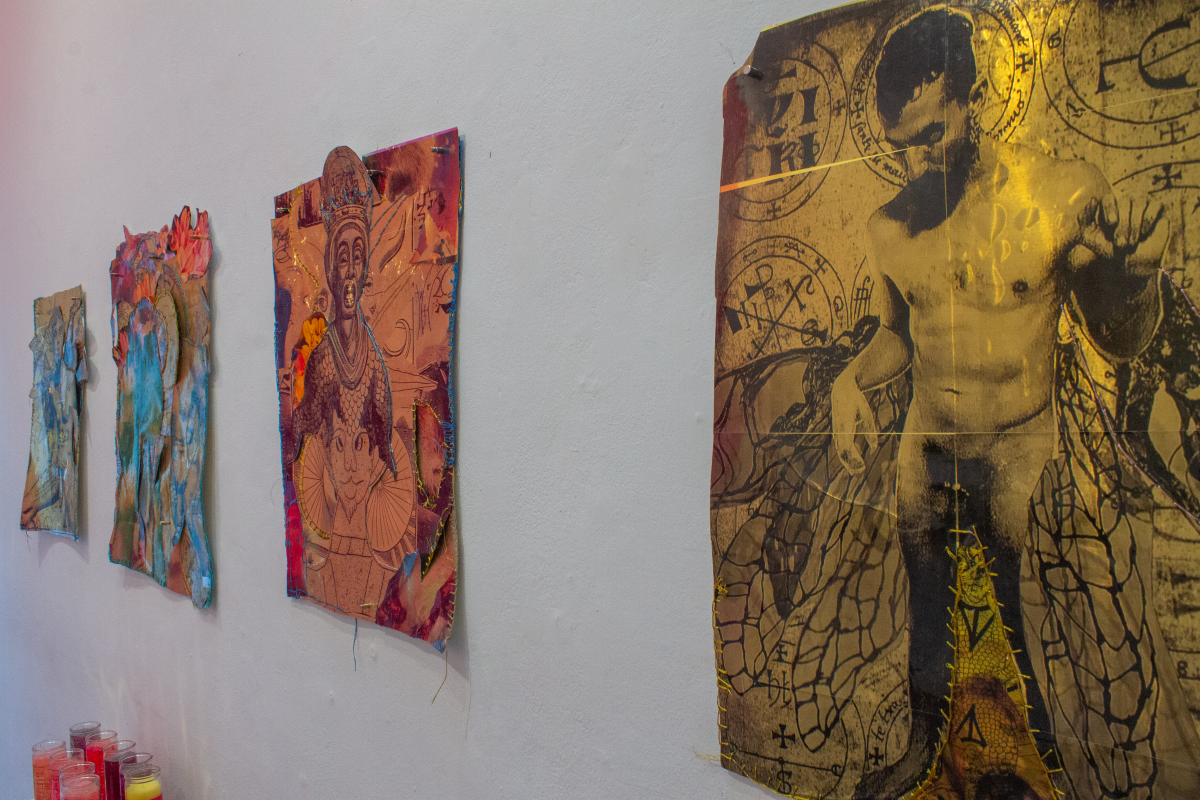 Installation shots of Something Wicked, photo by Mei Matute.
Emma Cieslik: What inspired your artistic research fellowship at the Library--and further The Fairy King’s Grimoire? I immediately thought of one of my favorite queer grimoires--Contagion Press’s First Protocols of Queer Goetia. Can you walk us through the artistic and magical ancestral lineages of your creation? What mediums do you use and why?
Alexander D’Agostino: I had seen a call for artistic research fellowship applications on the Transformer DC’s social media stories, and I knew that they had a copy of a Book of Magic called the Folger Manuscript V.b.26. I already had a copy of that book, like a published version that had been transcribed, and I’m always studying magic, studying grimoire history, the history of why we create magic, so this seemed like a really exciting opportunity because at the time when I applied, it was a virtual fellowship. I had already seen images of the book. The project I proposed was essentially to create my version of what I would call the Fairy King’s Grimoire because they do have an invocation to Oberion or Oberon, the Fairy King, in the book.
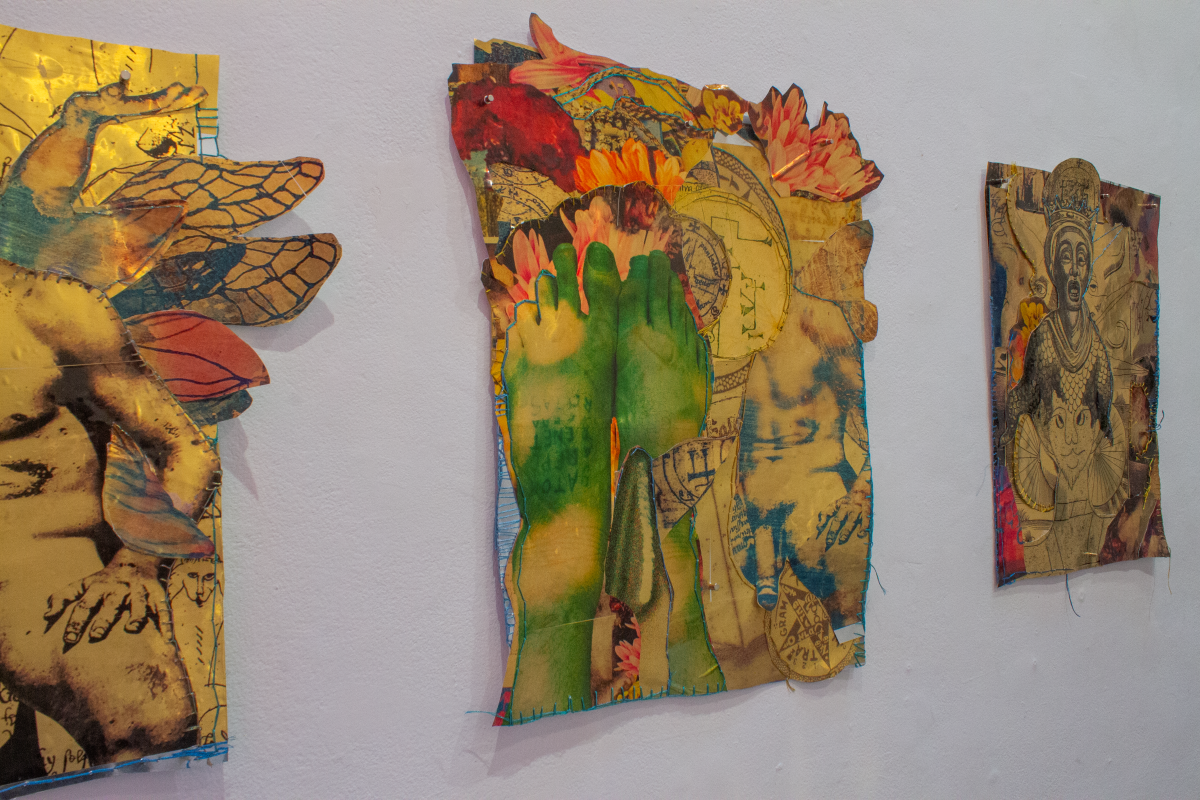
I’m not necessarily a hardcore Shakespeare person, but I grew up seeing Shakespeare in the Park, watching A Midsummer Night’s Dream--the one with Michelle Pfeiffer and Ruper Everett. I feel like that was a root for me, so I just thought this would be an interesting way to look at the magic and the way that I had been working with the character of the witch and the idea of queering witchcraft and magic itself, to create sort of a reimagining of the book with consideration of what queer culture might need from it, looking at the history of the Radical Faeries, working with my collage practice of working with an archive of vintage gay porn that I was given during the pandemic.
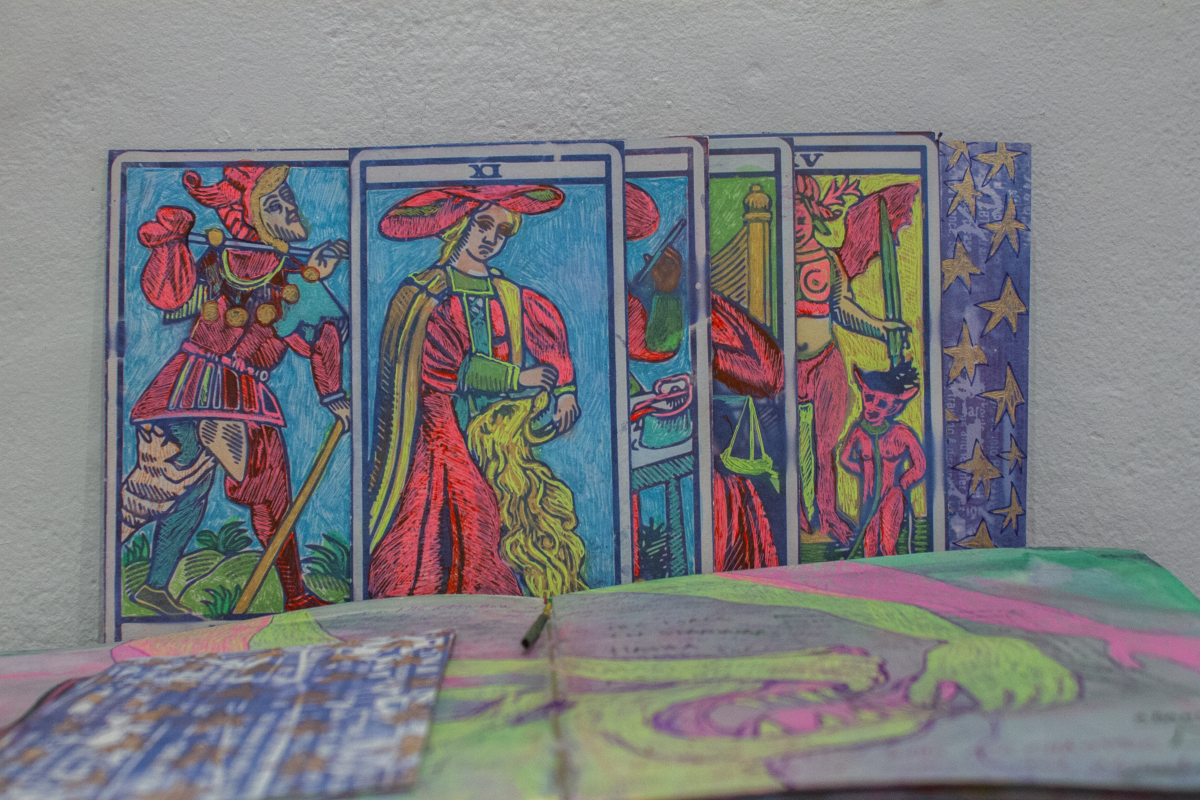
So I created this artist book using solar reactive dyes where I would take images both from the Folger collection book and then also collage it with images from this vintage archive of gay porn, almost thinking of it in the way you would think of a queer Ouija board where if the spirits are out, they might notice the reference to queer imagery, they might start to see the magic, and it could pull the energy in. The books always are like the seed or germ of the universe, and then a world builds around them, so when I started the project, performance started to evolve. I started reexamining specific parts of Shakespeare’s plays involving magic, specifically The Tempest, Macbeth, and A Midsummer Night’s Dream, and it has evolved since then.
I feel like this exhibition is probably the culmination of all the work I’ve been doing. I would say not the end of it, but at this point, I feel like this is sort of a way to take everything I’ve thought of and see what it’s become.
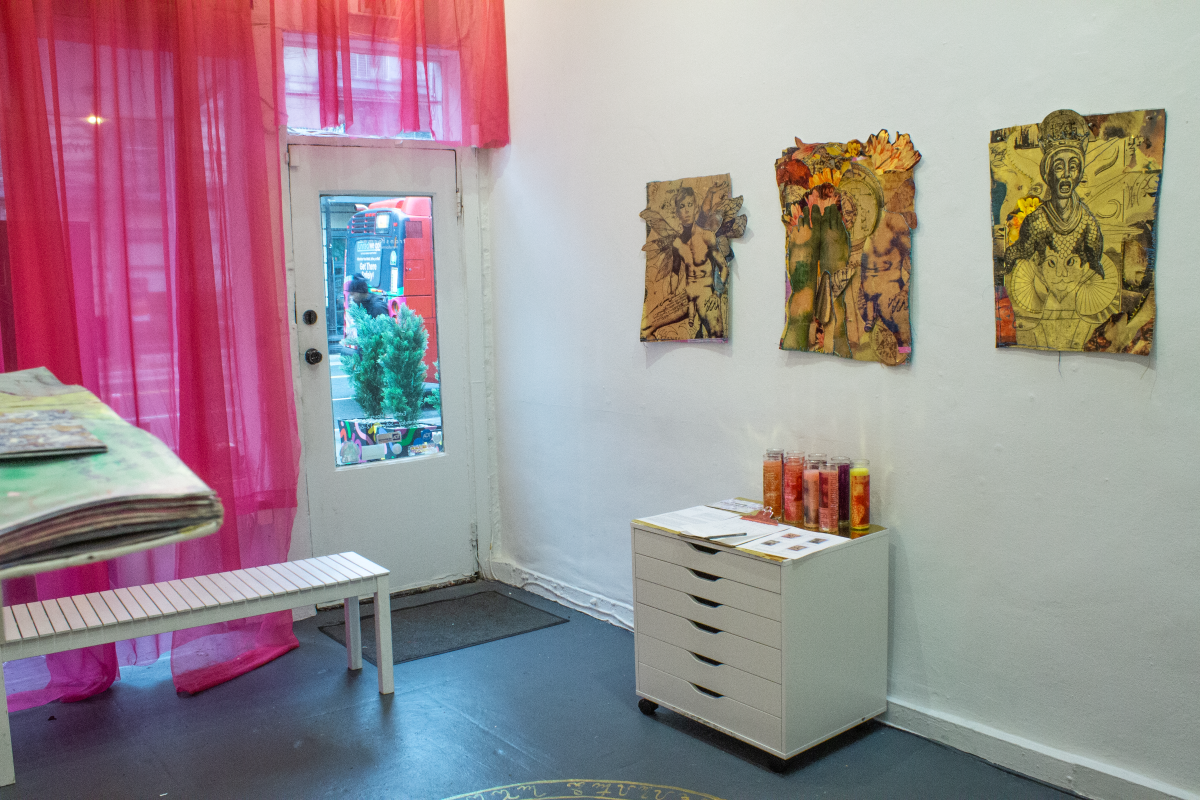 Installation shots of Something Wicked, photo by Mei Matute.
Cieslik: For this specific show, place is important. Your work excavates Transformer’s gallery, which was a former spiritual healing shop, into a site of archaic magic and queer memorymaking. How do you connect with and root into this past--ecologically, politically, and bodily--through your art?
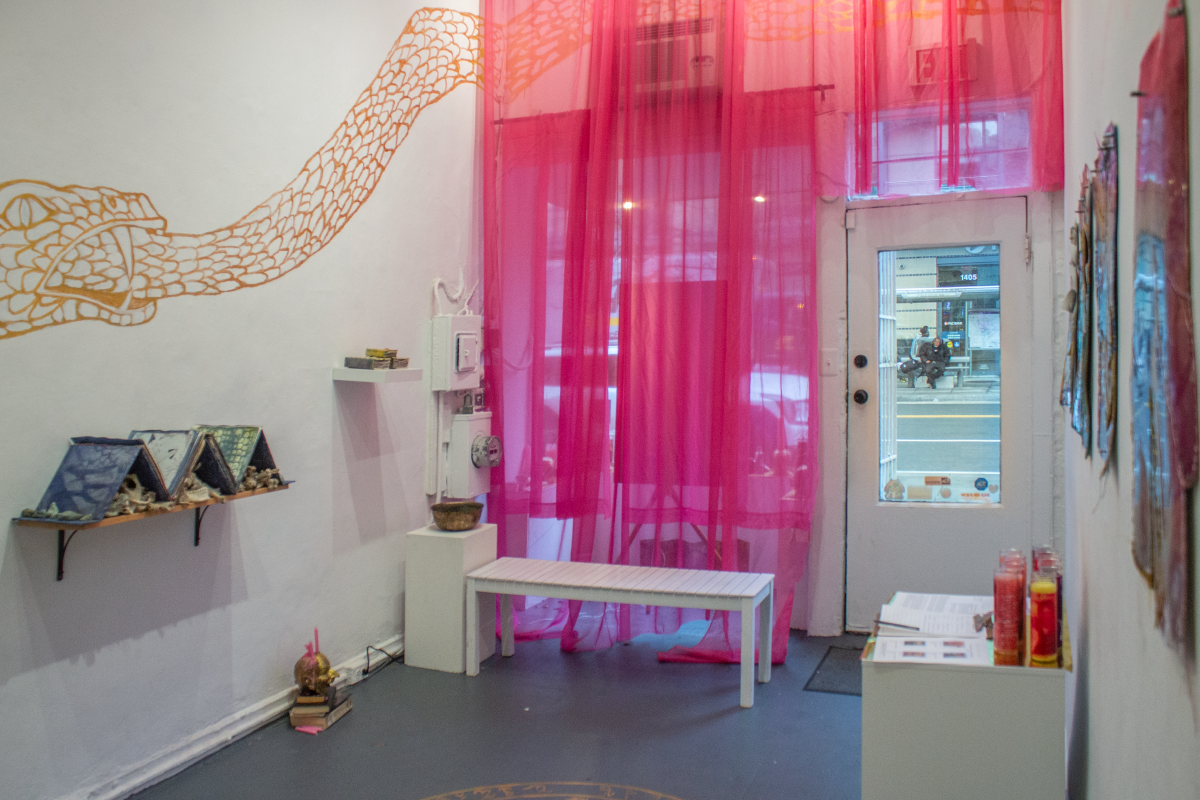
D’Agostino: For me, I feel like all of the work I do starts in the archives, starts in the libraries, so I had started the project and was sorting through the images in my head that pop up with how I would install the work I have, and as we were getting closer to planning out the final elements of the exhibition, Victoria Reis, the artistic director of Transformer, had mentioned that an artist Renee Stout had recreated a miniature storefront when it was the Prosperity Shop, so I did some digging. I wanted to learn about what the shop was. I wanted to learn more about Reverend Hazel Cassell who was the spiritualist, the medium, the healer, who ran it [the shop].
I really did relate quite intensely to the Folger spellbook itself, but my favorite part of the book is the provenance of who owned the book. There were a lot of people who were mediums who did seance work. There was a spiritualist who had owned the book in the 19th century, so that already felt really connected. Then one of the things I did in the space was painting like a giant golden Ouroboros, the snake eating its tail. It was the vision that came through, and then in one of the Rockville newspaper archives I found there was a pentagram with an Ouroboros, and I’m like, ‘this feels great.’
Every show I do, I want to know about the space as best I can. That’s just something I think if part of the practice, sort of the site specificity of it, so I didn’t want it to be like a complete homage or exclusively about that shop, but I wanted that sort of echoes of her work, so I made a bunch of votive chandlers with images of her from newspaper articles I had found because she would use candles to heal and pray.
Working in Transformer, it’s a small space. It’s a neighborhood that definitely has sort of the echoes of transformation, gentrification, so I felt like making these votive candles would be the most personal connection to me because candle lighting and meditating with candles and praying with candles is my own personal thing.
Installation shots of Something Wicked, photo by Mei Matute.
Cieslik: Do you consider yourself a spiritual practitioner along with an artist? If so, what spiritual traditions do you draw on and incorporate into your creative work? What is your religious background? Who is invited to participate and how do you consecrate the space?
D’Agostino: I was raised in a very open-minded community. I come from a Catholic family. I would say my parents were traditionally Catholic in the sense that you should go to Sunday school and go through all of the sacraments, but I remember when we were getting our confirmation, my parents were like, ‘you don’t believe in this? This isn’t something we want to force you to do.’ I was given my first deck of tarot carts when I was 12 and learned about witchcraft very early on. When I was between 11-13, I was writing my own Book of Shadows and learning about magic, and my parents really nurtured and encouraged spiritual curiosity.
When I came into my queer identity more in high school, I spent more time getting involved with queer-striaght alliances, but I didn’t leave spirituality because I felt like that was sort of an ingrained part of myself. The identity of the witch kind of started to evolve, especially when I was at art school. All of the work I was doing as energy work was sort of a ritual based in myth. All of the stories that inspired me were the stories of witches, even the witch persecutions, the narratives of who we accuse. So I feel like that just was an evolution.
It evolved especially during the pandemic when I got the vintage porn and started collaging and making these prints that I called Queer Shrouds because they felt sort of like the Shroud of Turin. That led me to think about different parts of queer history, and I sort of stumbled on the Lavender Scare and that kind of witch hunt. Witch hunting became a lens that I think I put this sort of spiritual practice through.
I was always raised to believe in the universe, to believe in magic, to believe in intuition, but I feel like there’s also a balance of you live your life, like you don’t need ritual or faith or magic to be a good person, or to navigate things, but it can be a way to process the existential, or the things we don’t have control over. I think art itself is very akin to magic and witchcraft. You’re taking ideas, working them through something, through an osmotic process, and something is birthed.
Installation shots of Something Wicked, photo by Mei Matute.
Cieslik: And I’m intrigued. How did you come to acquire this gay porn collection during the [COVID-19] pandemic?
D’Agostino: I had a neighbor. I live on a really cool street in Baltimore, in Mount Vernon, which was considered a gay neighborhood. I was having a heated discussion with one neighbor, and it got wild. Then another neighbor came out just to be like, ‘is everyone okay?’ And after everything settled down, we started talking about queerness in general, and the conversation of vintage gay porn came up, and they offered all of this porn that they had discovered in her late uncle’s antique shop that they had inherited. I guess they went into a basement and saw a workout bench, a mirror, a giant fisting dildo, and then a box of porn magazines, videos, and stuff, so they just gave us a huge collection of it.
I feel like it was a treasure. My favorite parts and the parts that show up the most in the Fairy King Grimoire are the Dear Sir ads, where you get people who are just communicating with others through a pre-social media structure. Some of them are cruising for interaction to meet up with people. Some people are sharing their unique kinds and curiosities, and so I feel like it’s a record of queer longing and desire. It’s one of those things where I feel like I could find other archives, but these objects themselves hold a local narrative.
Something I find interesting in studying books of magic, especially Crusader-time period, people who own books of magic ran the risk of them being found out, so they might hide the books, or maybe if they were dying, they might bury them so no one would know that they had them. And that’s very similar to generations of queer people with their archives of porn. People will erase their identities, hide their identities. You hear about people cutting out any evidence of people in their lives who had AIDS or who were living in a time when queerness was persecuted, but look where we are today?
I think that this is the magical part that connects the two. There’s a song or spoken word piece by the band Fisherspooner in their album Sir where he talks about looking at porn like these ancient grimoires, and that’s correct.
Cieslik: The Folger Shakespeare Library will host an artist talk and performance with and by you on Saturday, March 28th. During this event, you will invite audiences into a living ritual: a queer spirit invocation drawn from a 16th-century book of magic in the Folger Manuscript collection. This performance and your work is situated at the intersection of Early Modern Ceremonial Magic and Glitterwitch Burlesque. How is your body part of your art, and how is burlesque and magic a conduit to connect with queer ancestors?
D’Agostino:It’s funny, I got the name Glitterwitch when a performance artist asked if I wanted to join a burlesque troupe called Rude Girls Burlesque. Glitterwitch just seemed to be the correct persona, and I would say even in the realm of burlesque, I think more in terms of performance art, less like I’m trying to entertain. But I’ve always used my body as a tool in art, both visual representations of it, dancing and moving. I love burlesque as an art form. There’s something about burlesque that’s transformative. I was a go-go dancer and a stripper, and I don’t see any difference between those things, but I think you present something that then throughout the course of the event, you change, you reveal, and that itself is a magical process.
I also think the juxtaposition of the bodily work I’ll be presenting in the old reading room will be really interesting. I do a lot of performance art with deconstructed ballet, so I think of the scary witch from Macbeth and do a ballet version of it. Then the interactive element of the ritual is a way to pull people into it through sometimes audible call and response. It’s also just the fact that when I’m performing in a room with people who I’m engaging with, there’s a push-pull of how the audience responds. But the witch, the Glitterwitch, will be appearing without any actual glitter because it’s in a reading room.
The performance is also the same day as the No King's March, so I feel like this piece is very much looking at Oberon, or my version of Oberon, the Fairy King. In the book, he’s described as having the powers of nature, of the moon, of the sun, of the ocean, but he can also grant the gift of invisibility, and I think visibility and invisibility are kind of queer superpowers. I feel like at a moment when people are saying no kings, to bring in the fairy king is a different entity. It’s kind of fun. The idea that we want everything to be visible is great, but I also think there’s something about hiding in plain sight, which is sort of the nature of the occult in general, something that’s hidden.
Installation shots of Something Wicked, photo by Mei Matute.
Cieslik: I love how you draw on queer magic and ritual. How has queerness been conflated or connected to magic historically--both as a tool of liberation and used as a moniker of discrimination and accusation? I refer specifically to how “fairy” has been used as a derogatory term against gay and bisexual men.
D’Agostino: I mean ‘queer’ itself too was a derogatory term, and I believe there’s a weird moment when ‘queer’ was the more butch derogatory term whereas ‘fairy’ was the delicate, effeminate character. I’ve never really been negatively called a ‘fairy.’ I don’t think that would ever offend me, but I do think that history itself is just in the word. When I worked on the project, I wanted to consider the Radical Faerie movement and the different evolutions of what that was.
There’s a really important text--Witchcraft and the Gay Counterculture by Arthur Evans, that I would say is more of the fairy-like approach to consciousness, to seeing the world through a sort of gender and sexual noncomforting lens. When I think on an academic level, I think if I’m describing someone whose gender or sexuality was non-conforming, that’s what I would see as queer. I think one thing that queerness and magic have in common is that people believe in them, and people don’t believe in it and yet it exists.
You might not believe in the result of magic, but the history of magic is a global thing. People are practicing magic all day, every day in the world, and so it exists in the same way that people might have an idea of queerness. There’s a lot of misinformation right now that makes people perceive queerness as something that it’s not, but then the witch is sort of like the middle finger to all that. I think that there’s a playfulness too of being the Glitterwitch. I feel immune in a way. I have this sort of alter ego but spelled like ‘altar’ that imbues me with a certain kind of almost supernatural confidence.
Something Wicked will remain on display until April 25, 2026.

Emma Cieslik
Emma Cieslik (she/her) is a queer, disabled and neurodivergent museum professional and writer based in Washington, DC. She is also a queer religious scholar interested in the intersections of religion, gender, sexuality, and material culture, especially focused on queer religious identity and accessible histories. Her previous writing has appeared in The Art Newspaper, ArtUK, Archer Magazine, Religion & Politics, The Revealer, Nursing Clio, Killing the Buddha, Museum Next, Religion Dispatches, and Teen Vogue
view all articles from this author