Whitehot Magazine
October 2026
"The Best Art In The World"
"The Best Art In The World"
October 2026
Helene Schjerfbeck’s Self-Analysis by Donald Kuspit
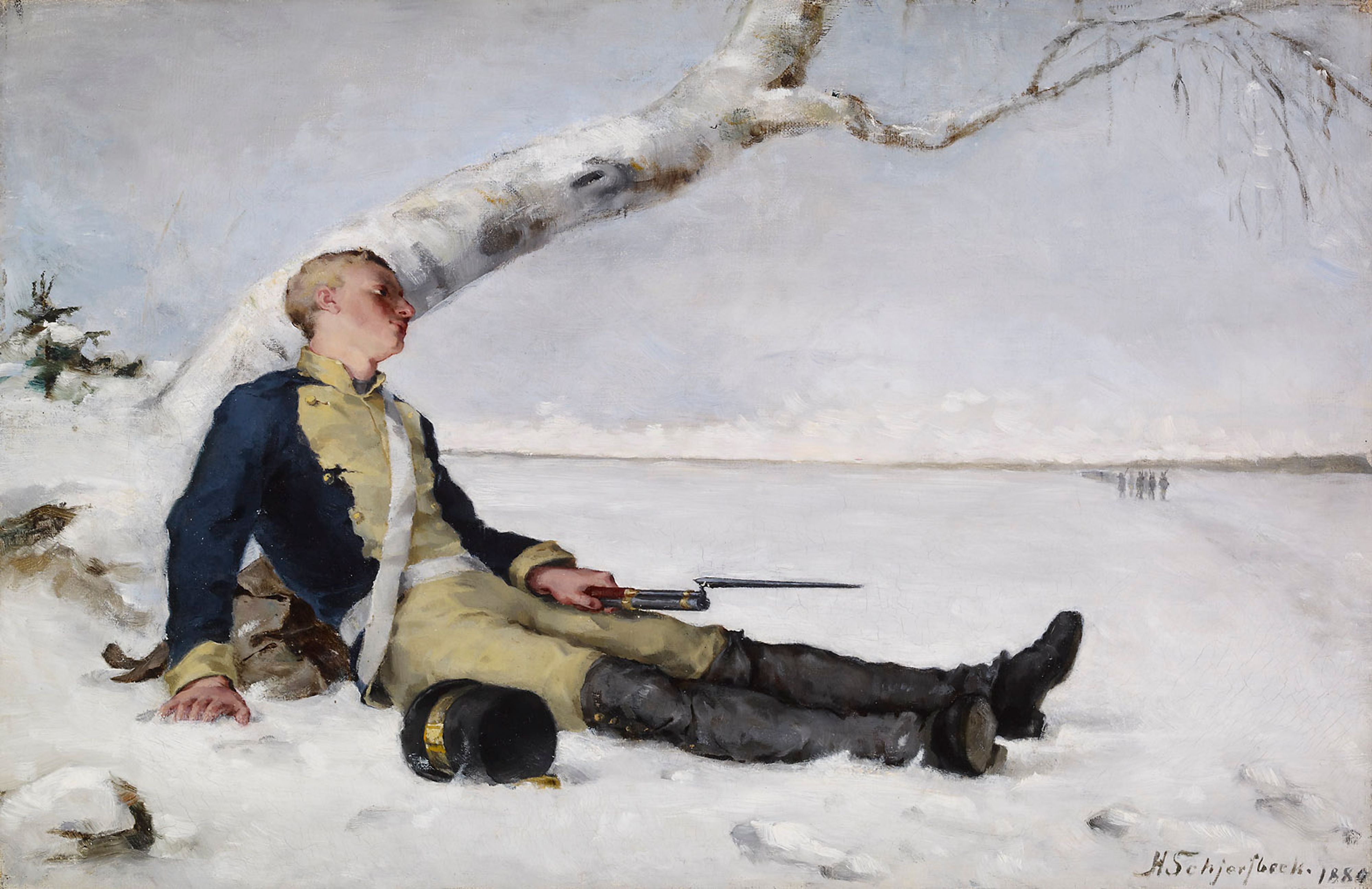 Helene Schjerfbeck: Wounded Warrior in the Snow
By DONALD KUSPIT March 26th, 2026
Finland has consistently been ranked as one of the happiest countries in the world, but one wouldn’t be able to surmise that from the rather unhappy self-portraits of the Finnish painter Helene Sofia Schjerbeck (1862-1946). They outdo Munch’s in their picturing of misery, not to say psychotic despair, and their experimental handling, emblematic of a crumbling reality principle or reality testing. But Schjerfbeck began her career as a very accomplished realist painter, as such history and society paintings as Wounded Warrior in the Snow, 1880, Girl with a Madonna, 1881, At The Door of the Linkoping Jail in 1600, 1882, and The Death of Wilhelm von Schwerin, 1886 make clear. Strange as it may be to say so, an inkling of what was to come—the psychotic self-portraits of her old age, outdoing Munch’s The Scream of Nature, 1893 for their unrelenting searing insight into self-destructive insanity—is Schjerfbeck’s Clothes Drying, 1883. The clothes laid out on the earth are implicitly corpses or ghosts, on the verge of becoming abstract will o’ the wisps, the thin leafless dead tree—a forlorn lifeless figure--is implicitly male and a grave marker. In The Sailor, 1918 Schjerfbeck painted the male nude, half length, from the front, and in Robber At the Gate of Paradise, 1924, she painted the male nude, full length, from the back, works suggesting that she was not without sexual desire. Whether she satisfied it is not clear.
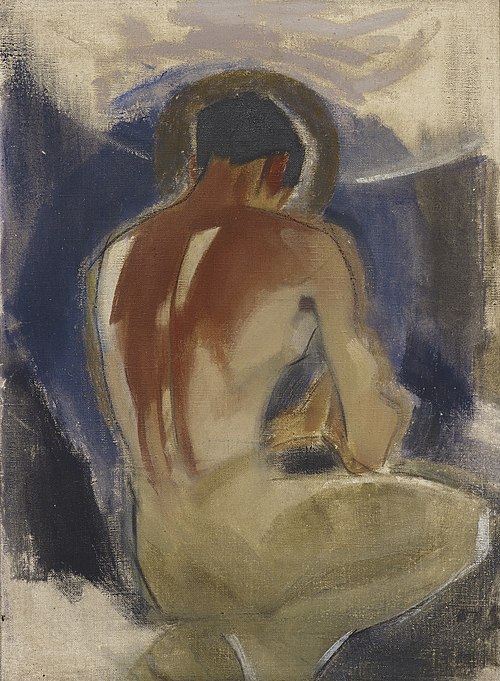 Helene Schjerfbeck: Robber at the Gate of Paradise
 Helene Schjerfbeck: Self Portrait
Schjerfbeck painted some forty self-portraits in her lifetime. The last ones--those made as she approached death--are among her most aesthetically radical and emotionally insightful, not to say existentially courageous and daring, for they engage her impending death directly—they show her in her death throes and unrelieved anxiety. I don’t think they can be easily categorized. They stretch the limits of style--to put a stylistic label on them is to sell their originality, uniqueness, and insightfulness short--which testifies to their radical autonomy and emotional authority. I venture to say one puts a stylistic label on them to avoid being blinded by their emotional honesty and overcome by their existential daring. They instantly engage the unconscious, all the more so because they have a nightmarish character. They are perhaps the most introspective of Schjerbeck’s last self-portraits. Their radically free handling suggests her emotional helplessness, more pointedly her death anxiety, and with that an underlying sense of the futility of art, and the creativity one musters to defend against if not defeat death. The panic that appears in many of them, undefended by style, brings to mind Hans Baldung Grien’s Death and the Maiden, 1517, but Schjerbeck’s maiden is Death. She painted at least forty self-portraits in her lifetime, many in the last year of her life, probably a defense against death that accepted its hideous reality. It is hard to know if they show death in the service of narcissism or narcissism in the service of death or whether they simply make clear that we all owe nature a death, as Freud said.WM

Donald Kuspit
Donald Kuspit is one of America’s most distinguished art critics. In 1983 he received the prestigious Frank Jewett Mather Award for Distinction in Art Criticism, given by the College Art Association. In 1993 he received an honorary doctorate in fine arts from Davidson College, in 1996 from the San Francisco Art Institute, and in 2007 from the New York Academy of Art. In 1997 the National Association of the Schools of Art and Design presented him with a Citation for Distinguished Service to the Visual Arts. In 1998 he received an honorary doctorate of humane letters from the University of Illinois at Urbana-Champaign. In 2000 he delivered the Getty Lectures at the University of Southern California. In 2005 he was the Robertson Fellow at the University of Glasgow. In 2008 he received the Tenth Annual Award for Excellence in the Arts from the Newington-Cropsey Foundation. In 2013 he received the First Annual Award for Excellence in Art Criticism from the Gabarron Foundation. He has received fellowships from the Ford Foundation, Fulbright Commission, National Endowment for the Arts, National Endowment for the Humanities, Guggenheim Foundation, and Asian Cultural Council, among other organizations.
view all articles from this author