Whitehot Magazine
April 2026
"The Best Art In The World"
"The Best Art In The World"
April 2026
Sediments of Interaction - Introducing Yucen
 Yucen, Eware
By LARA PAN April 17th, 2026
My recent encounter with Yucen’s work revealed a rigorous and finely attuned inquiry situated at the intersection of art and technology. His practice engages deeply with language, technological systems, and references drawn from medical and computational infrastructures. Grounded in an economy of means, his work activates seemingly simple objects as carriers of complex thought. These elements function less as static forms than as conceptual devices, structures that generate meaning beyond their material condition, operating almost as living formulas.
Central to his approach is a methodology akin to archaeological excavation- a process that resists imposed interpretation in favor of situating objects within layered cultural, temporal, and sequential contexts. Meaning, in this sense, is neither immediate nor singular, but accumulative embedded within strata that require careful and sustained attention to unfold.
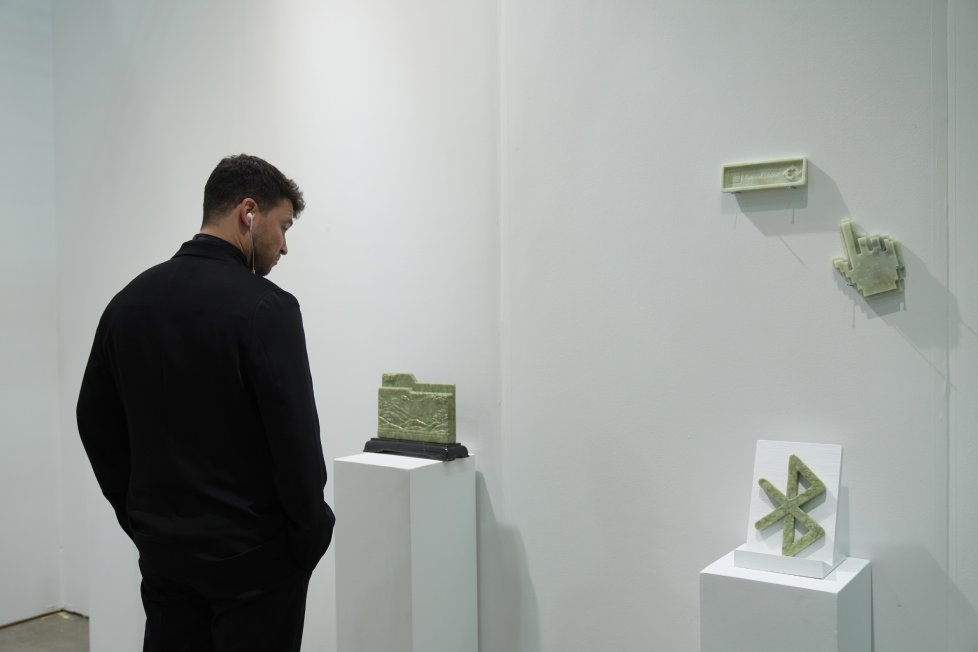 Work by Yucen at Expo Chicago
Within the context of Jade UI Archives, Yucen engages one of the defining paradoxes of contemporary technological culture. Despite the constant evolution of systems designed to respond to shifting environments and human needs, the limitation lies not in innovation, but in language. Our current lexicon remains largely instrumental, dominated by command, efficiency, and execution, while lacking the vocabulary necessary to articulate ambiguity, reflection, or transformation.
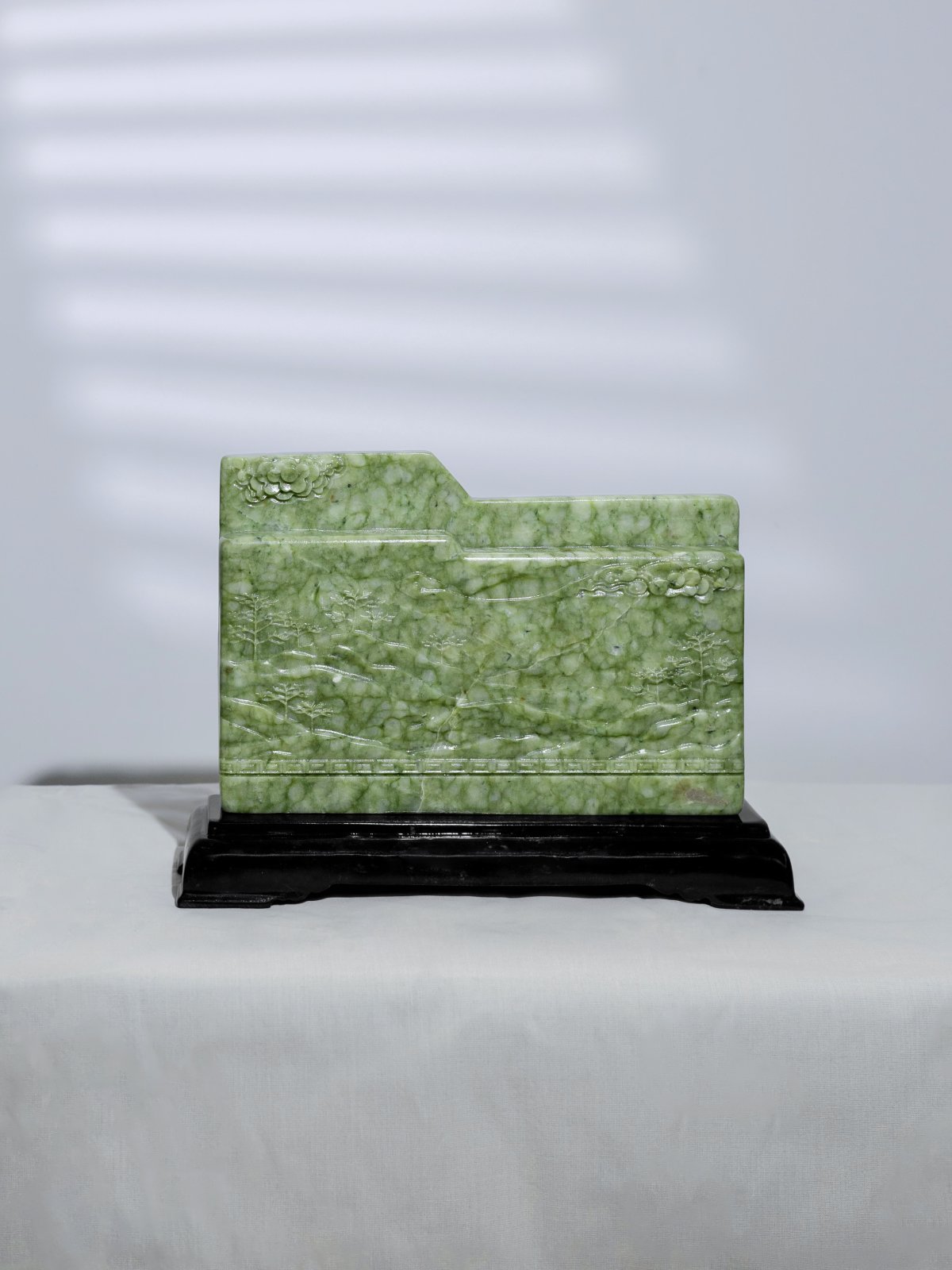
It is precisely this linguistic deficit that the work renders visible. Through a subtly dystopian lens, Yucen turns to once-familiar technological symbols Enter, Delete, Folder, Bluetooth, or the Mouse Cursor, extracting them from their functional context and reconstituting them in jade. In doing so, these signs are displaced from the domain of use into that of memory. They become monuments to a recent past, evoking the optimism of late twentieth-century technological imaginaries while simultaneously marking their obsolescence. Language itself is here treated as material, subject to erosion, sedimentation, and eventual fossilization.
 Yucen, File Folder
The use of jade is critical. Historically revered as the “stone of heaven,” it carries connotations of durability, transcendence, and continuity. By rendering transient digital symbols in this enduring medium, Yucen produces a temporal inversion, what was designed to be instantaneous and replaceable is recast as permanent, even sacred. This gesture not only elevates these signs but also exposes the instability of the systems they once served.
A subtle yet incisive layer of irony runs throughout the work. The phrase “I am not a robot,” carved in jade, encapsulates this tension. Detached from its original function as a verification mechanism, it becomes speculative, almost absurd. One is invited to imagine a near future in which such declarations might be made by machines themselves. In this reversal, distinctions between human and non-human, authenticity, and simulation, begin to dissolve, revealing the fragility of the categories through which these distinctions are maintained.
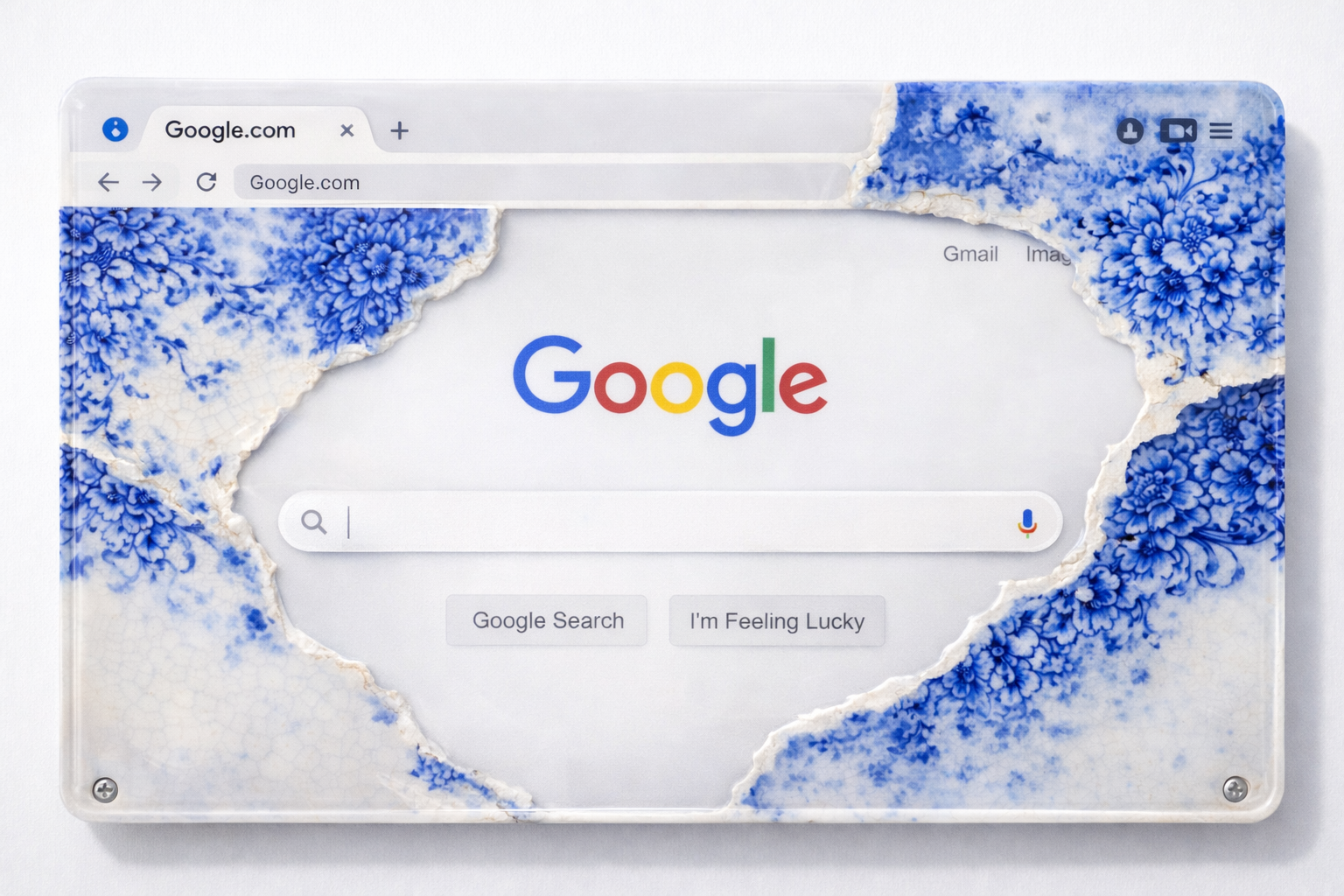
This line of inquiry extends further in the Eware series. Here, the artist stages a deliberate confrontation between two systems of circulation: the historical networks of porcelain trade and the contemporary infrastructures of digital exchange. Rather than reconciling these domains, the work insists on their friction. Porcelain, once a vehicle of global cultural transmission, is reintroduced into the logic of digital interfaces not as ornament, but as disruption.
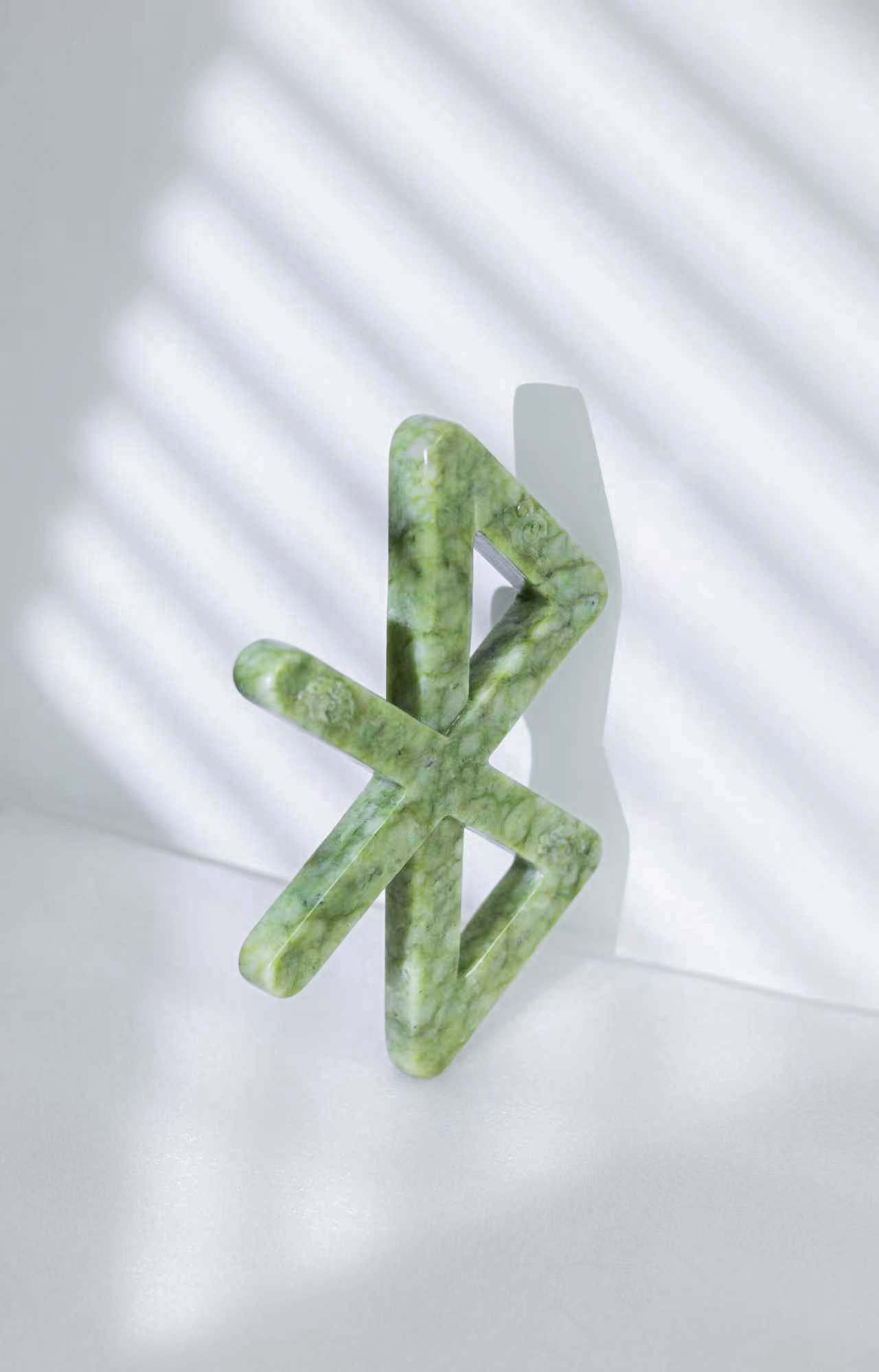 Yucen, Synch
In this context, decorative motifs assume an active, almost invasive role. They proliferate across the surface of technological forms, interrupting their clarity and undermining their promise of seamless operation. What emerges is a form of visual interference a slowing down of perception, where opacity replaces transparency and historical memory interrupts the immediacy of the present. The interface is no longer neutral or efficient; it becomes a site of accumulation, tension, and resistance.
Through these gestures, Yucen’s practice articulates a critical position within contemporary discourse. It does not simply reflect on technology but reconfigures its language, exposing its limitations while proposing alternative modes of reading and engagement. The work operates in a space where past and present remain in constant negotiation, and where meaning is never fixed, but continuously produced through encounter.
My interest in Yucen’s work deepened through his project Candle System, which centers on a series of numbered and standardized candle devices that construct a speculative system of survival. Here, the candle is no longer symbolic but redefined as a governable energy interface: heat becomes nutrition, combustion becomes ingestion, and time is measured as continuous output.
The system, comprising Medi-Candle, Ration-Candle, Gourmet-Candle, and Elixir-Candle maps different scenarios of care, sustenance, and enhancement. Each unit is structured through components such as the Nutri-Burn Unit and Caloric Ignition Module, adopting the language of medical and industrial protocols. Within this framework, energy intake is ritualized and mechanized, the individual no longer eats, but approaches, ignites, and regulates consumption through a controlled temporal process.
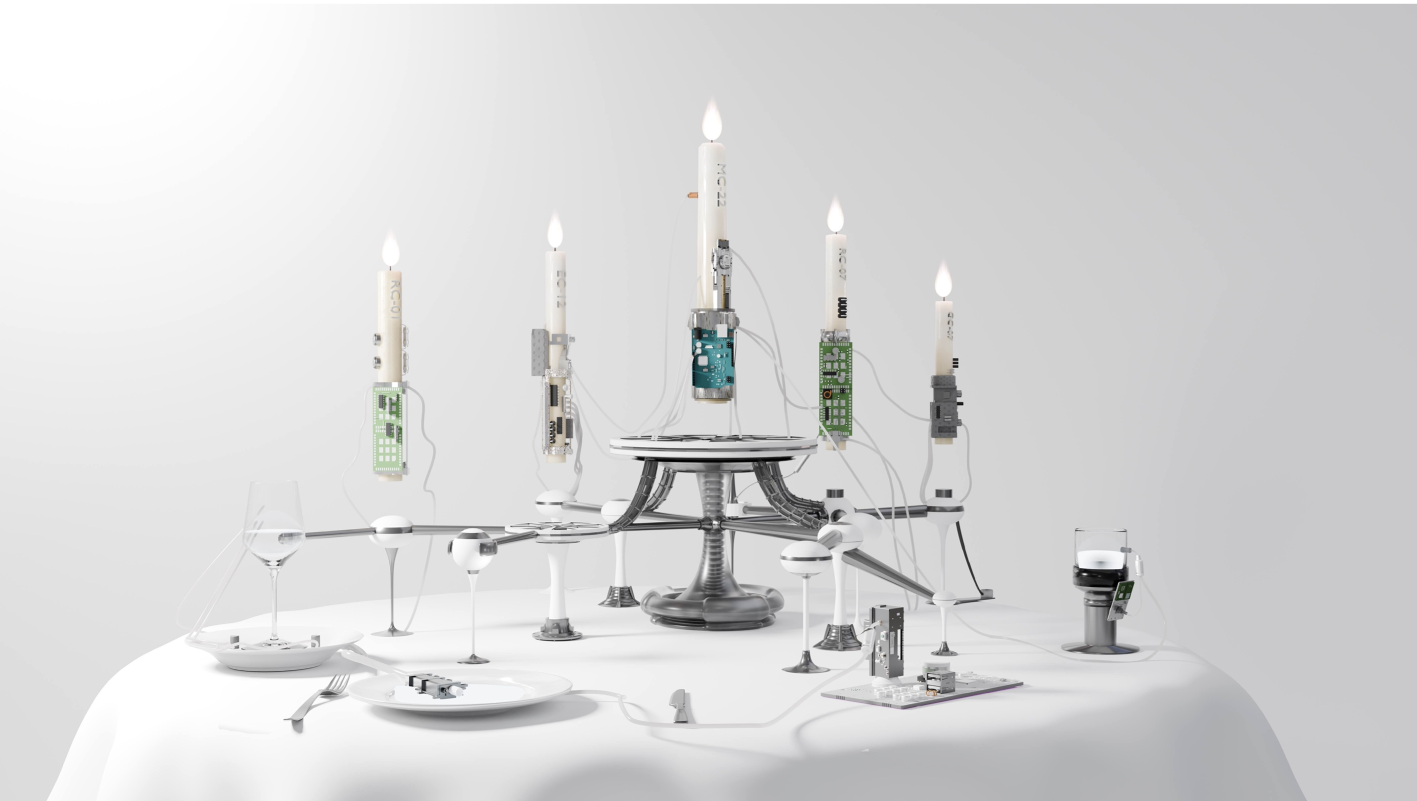 Yucen, Candle System
The complexity of this work recalls the early, seminal project Cloaca by Belgian artist Wim Delvoye, with whom I have collaborated on several occasions. As Dan Cameron observed in 2002 at the New Museum: “Another recurring element in Delvoye’s art has been the contradiction between civilization’s veneer of purely cerebral reflection and the tendency of the body to assert itself as a vehicle for the return of art to its earthy origins.”*
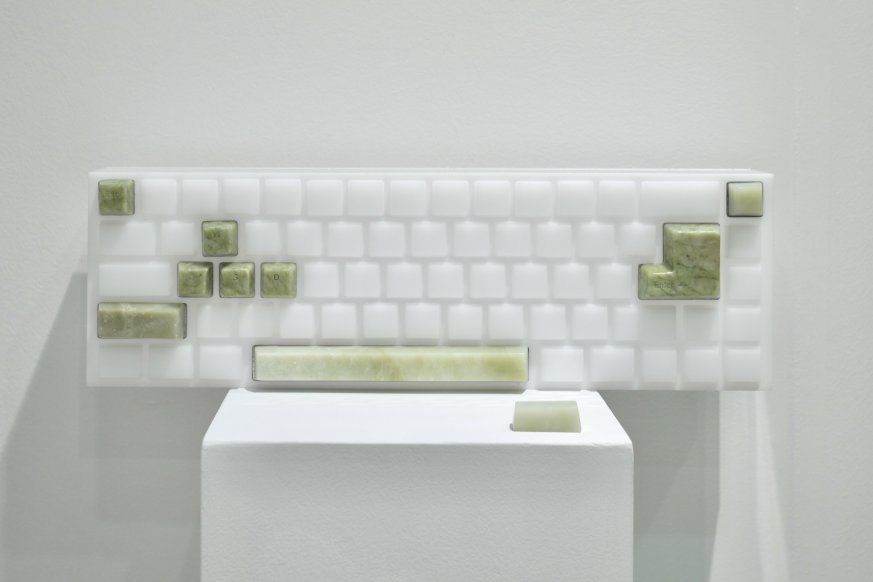 Yucen, Keyboard
It is precisely within this tension between system and body, machine and biotechnology, that a clear resonance emerges between Delvoye’s artistic logic and Yucen’s approach. Similarly, Yucen engages with themes of biological processes and commercialization, translating them into controlled, almost clinical environments in this project. Aesthetically, the installations evoke hybrid spaces, combining elements of laboratory, industrial apparatus, and display systems, where the logic of production and the poetics of the body and machine converge.
Nowadays, where technology, science, and art increasingly blur and struggle to define their own boundaries, we are reminded of the enduring necessity of the artist as a unifying consciousness. Like a Renaissance figure, the artist does not separate disciplines but moves fluidly between them, holding knowledge, intuition, and imagination in a single gesture.
It is precisely through this expanded vision rooted in the past yet oriented toward the future that meaning can still emerge. The contemporary artist becomes a mediator of complexity of our time.
Ref* Dan Cameron from the New Museum Digital Archives

Lara Pan
Lara Pan is an independent curator,writer and researcher based in New York. Her research focuses on the intersection between art, science, technology and paranormal phenomena.
view all articles from this author