Whitehot Magazine
October 2026
"The Best Art In The World"
"The Best Art In The World"
October 2026
Peter Schuyff Interviewed by Noah Becker
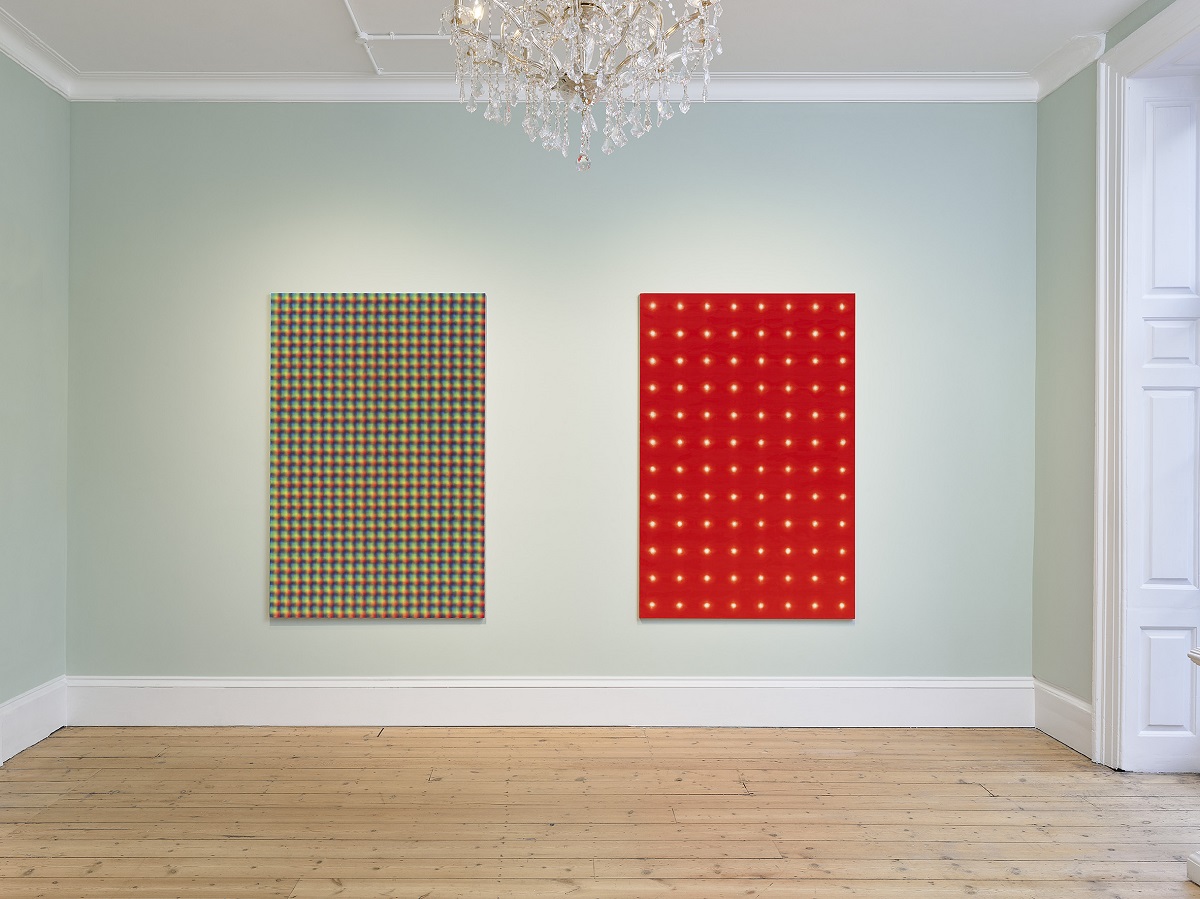 Installation view, 2026, Peter Schuyff, courtesy of the artist and Massimo de Carlo, London UK
By NOAH BECKER February 5th, 2026
In this conversation on the eve of his exhibition in London at Massimo de Carlo, the artist Peter Schuyff discusses counting as structure, repetition as liberation, and painting as a form of disciplined endurance. Moving between mysticism, measurement, and muscle memory.
Noah Becker: Titles like Ninety Six Nurses or One Hundred Golden Eggs sound like inventories. Why use counting to structure a painting?
Peter Schuyff: I use counting — the sums — to title the paintings. I’m happy you recognize them as inventories. These paintings are all grids, so the structures are more or less default. I’m painting tickets or coupons.
NB: A “gross” is a practical unit of measure. Are you borrowing the logic of labor to organize something as “expressive” as painting?
PS: Reliability more than logic. I described my sculptures as being an accounting of the calories I burned making them. I’m mining and amassing, generating and collecting. And counting. I’m definitely measuring.
NB: Repetition seems to replace composition. Does it free you from decisions, or just move them somewhere else?
PS: Yes, it frees me from decisions. It makes freedom. Decisions are the problem in the Michael Morris painting The Problem of Nothing. It’s not me being lazy. It’s easier said than done. I see the repetition like repeating an incantation, etching it in stone. Lamont Young has always been an inspiration to me.
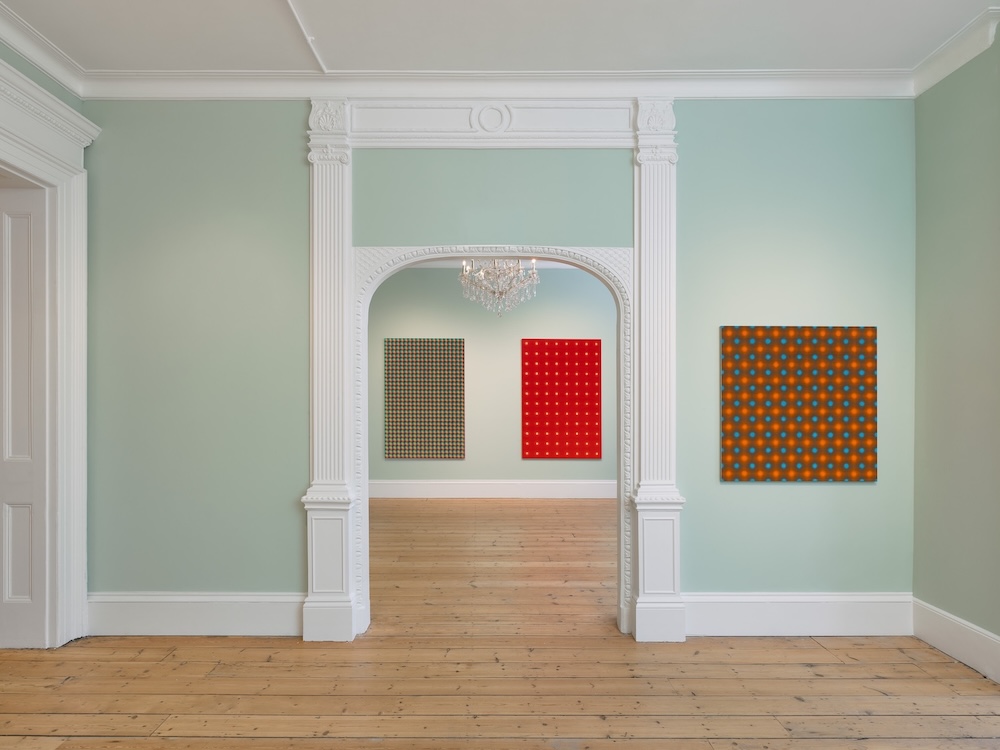 Installation view, 2026, Peter Schuyff, courtesy of the artist and Massimo de Carlo, London UK
NB: You’ve said the optical effects are results, not plans. So the work reveals itself after?
PS: Yes and yes. I don’t think I have ever been graphically motivated. The optical effects are the result of repeating those incantations. The work definitely reveals itself after.
NB: The surfaces feel unstable, almost vibrating. How do you keep everything so consistent?
PS: Do you mean the materials? I’ve invented and engineered some very clever cheats and tricks. I have a very practiced, trustworthy dexterity. I know where things go.
NB: You call these paintings therapy and not the work you make when you’re happy. What does painting do for you in those periods?
PS: I really wish I hadn’t used the word therapy. I meant therapy like making license plates might be therapy for a convict. It shuts off my brain. Or rather, I’m at my best when my brain shuts up. My work tends to get dense and obsessive during dark times. I want to work longer hours. Hence the counting.
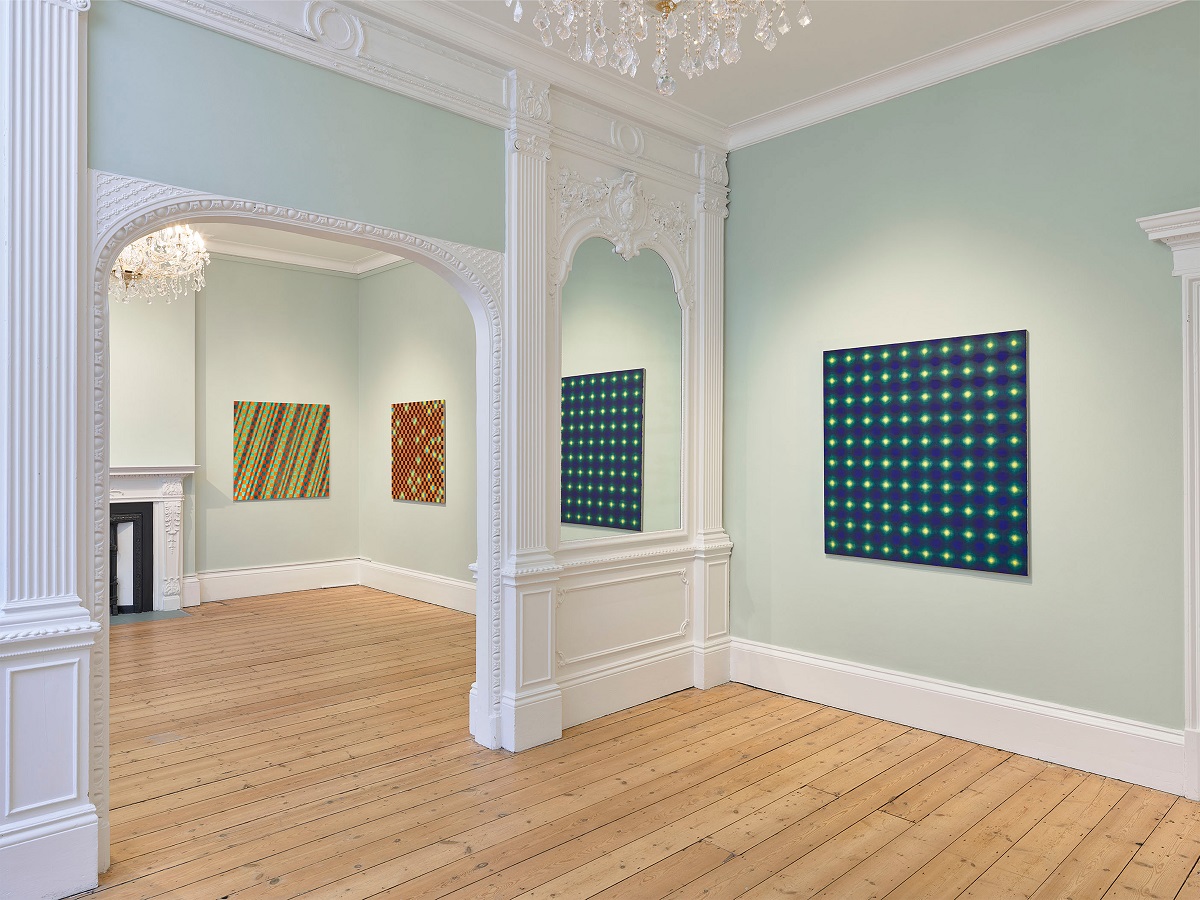 Installation view, 2026, Peter Schuyff, courtesy of the artist and Massimo de Carlo, London UK
NB: Saying you’re “more an athlete than a poet” points to stamina and discipline. What does that mean?
PS: I’m talking mostly about dexterity. Wrist action is something I’m comfortable taking credit for.
NB: These works take weeks of repeating certain things. Other than repetition, how do you think up a piece? How do you start a painting or think of an idea for a painting?
PS: Once I get going, each painting will inform the next. I try to stay out of it. The best ideas aren’t mine.
When I start something new — let’s say I’ve been gone for a while, or suddenly I’m in a new studio, or I have new paint — I’ll begin with something I know, and if I’m listening, the painting will have an idea. It’s always more listening than thinking. In October I came back to the studio for the first time in over a year. I started from scratch and everything is different from the paintings I’m showing in London, but I started with something I know. I didn’t start running until I was sure I could walk. It’s always like that. I’ll show you photos if you want.
NB: Your career has moved through different places without settling. Does that distance help you stay focused on painting rather than narrative?
PS: I’m not sure what you mean. Geographically? I’ve settled pretty well everywhere I’ve ever been.
Attention to narrative is something I did with music. "The Woodwards" music was entirely biographical. Painting has never expressed much interest in my narrative - painting in the daytime and music at night.
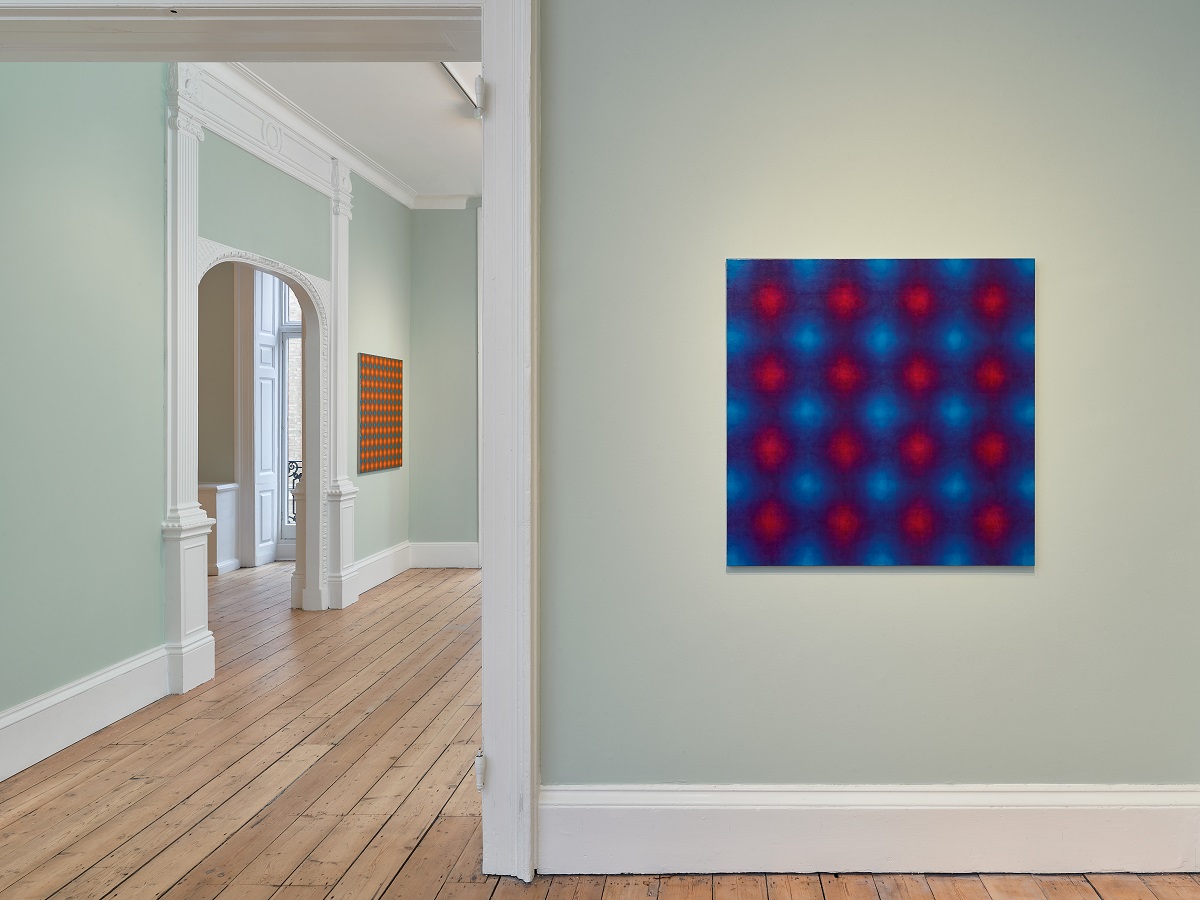 Installation view, 2026, Peter Schuyff, courtesy of the artist and Massimo de Carlo, London UK
NB: You talk about a painting reaching “a great sufficiency.” How do you know when nothing more is needed — and how do you stop?
PS: Actually, “A Great Sufficiency” comes from a story Neil Campbell — do you know Neil from Vancouver? — told me years ago. He had a friend from India come for dinner and when he asked if she’d like more, she said, “No, thank you, I have had a great sufficiency.” I’ve been accounting, and a great sufficiency seems like a nice sum or balance.
I usually stop when I’ve run out of room, and I listen to the paintings to tell me nothing more is needed. I’ll (hopefully) stop with a group of paintings when they no longer reveal themselves afterwards, when I know what they’re going to say. Then it’s time for a holiday.
A Great Sufficiency, Peter Schuyff’s first solo exhibition with Massimo de Carlo gallery in London runs from February 21, 2026 - March 7, 2026

Noah Becker
Noah Becker is an artist and the publisher and founding editor of Whitehot Magazine. He shows his paintings internationally at museums and galleries. Becker also plays jazz saxophone. Becker's writing has appeared in The Guardian, VICE, Garage, Art in America, Interview Magazine, Canadian Art and the Huffington Post. He has written texts for major artist monographs published by Rizzoli and Hatje Cantz. Becker directed the New York art documentary New York is Now (2010). Becker's new album of original music "Mode For Noah" was released in 2023.
Becker's 386 page hardcover book "20 Years of Noah Becker's Whitehot Magazine of Contemporary Art" drops Aug 8, 2025 globally on Anthem Press.
Noah Becker on Instagram / Noah Becker Paintings / Noah Becker Music / Email: noah@whitehotmagazine.com
view all articles from this author