Whitehot Magazine
October 2026
"The Best Art In The World"
"The Best Art In The World"
October 2026
Sanford Biggers: The Art of Transcendence
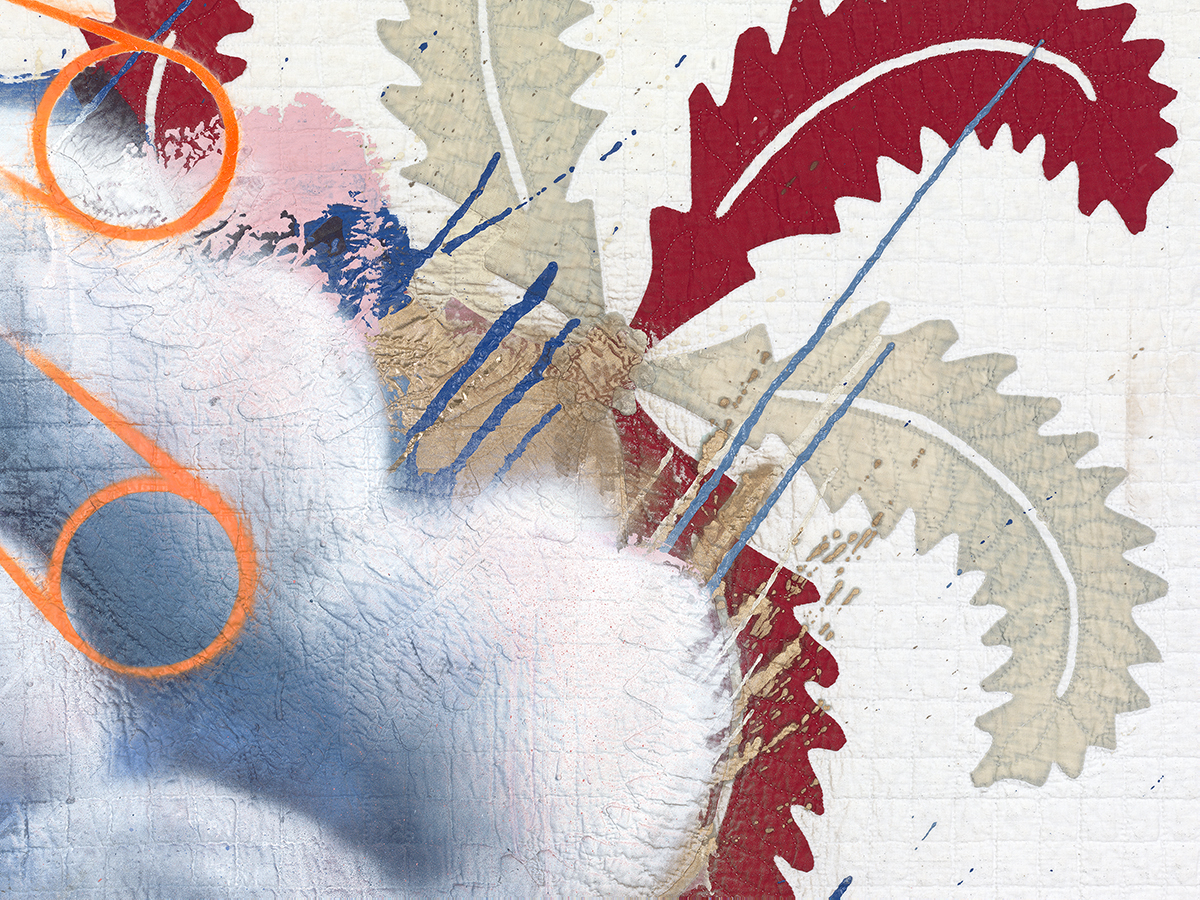 SANFORD BIGGERS, Sirocco, 2016
By AYSE SARIOGLU June 19th, 2026
Ayse Sarioglu: At Morehouse, the limited art curriculum forced you to cross over to Spelman College — your career began, before it even began, with an act of transgression. Looking back now, do you think that “necessary detour” inscribed itself into the DNA of your practice? How deeply has constraint shaped your creativity — and do you think you would be the same artist without it?
Sanford Biggers: That’s an interesting question. I think I probably would have become the same artist, but I was incredibly fortunate. Frank Toby Martin, my professor at Spelman, saw that I was very serious. He made me the monitor of the sculpture studio, which allowed me to work extra hours and get an immense amount of hands-on time with the materials. He also introduced me to a friend of his in Atlanta who was a master sculptor, and I became his apprentice. That’s how I learned how to work with steel, metal welding, and heavy sculpting. It was an after-hours, part-time job during my sophomore year, completely separate from school. So while the constraint was there, the community and the access that opened up because of it became foundational.
A.S.: Your mother was a teacher briefly, your father a neurosurgeon. One constructs meaning; the other descends into the architecture of the brain. You, in turn, both re-teach cultural memory and engage with its deeper structures through your practice. Have you ever consciously traced those two figures in your work — or is everything you make, in some sense, an attempt to move beyond their inheritance?
Sanford Biggers: It is very much a combination of both of them. My mother was a teacher, but she was also incredibly aesthetically inclined. She used to design and sew her own clothes for fun. She would take me with her to these massive fabric warehouses to browse textiles. I spent a lot of my childhood navigating those spaces and sifting through materials with her. My father was a brain surgeon, but he possessed that exact same passion for art, poetry, and music. He wanted to raise “Renaissance” children; he insisted that his sons and daughters understand science and math, but also the arts. Their dual interest in the aesthetic and the scientific is still very much the bedrock of my practice. Rather than just making objects, I am constantly thinking about the science of the materials, the deeply embedded history of those materials, and the stories they can tell—not just through what I make, but through what I choose to use.
A.S.: Your residency in Japan in the early 1990s transformed you profoundly. Unsui — the drifting of clouds, the philosophy of moving through the world without attachment or resistance. What did that concept do to you when you first truly encountered it? For an American artist raised in Los Angeles, educated in Chicago, living in New York — what does it mean to genuinely internalize a Zen philosophy? Is it paradox, liberation, or both?
S.B.: It is absolutely both paradox and liberation. The most vital realization I walked away with was that moving through the world without attachment meant I didn’t have to be attached solely to the identity of being an American or African American—I could also be a citizen of the world, not limited by nationality. It allowed me to create without self-imposed expectations or external limitations. The paradox comes in because Buddhist philosophy is centered on finding a middle ground between contrasting, opposing ideas. That was an incredibly liberating tool for me when I returned to the U.S. Living between Los Angeles, Atlanta, Chicago, and New York, I realized I wasn’t stuck in or defined by any single one of those places. I had access to all of them, and by extension, access to the global landscape. It opened my mind to be influenced by everything I observed throughout my travels and experience.
A.S.: You position yourself as an artistic intermediary. But an intermediary is never neutral — in the passage from one place to another, something is always transformed, and something of the carrier inevitably remains. What exactly are you transforming in your work, and how much do you yourself get transformed in the process?
S.B.: The process of artistic creation is always an act of metamorphosis. I look at it in two ways. First, there is the material transformation in the studio. I frequently use found objects and antique fabrics. What I try to do is transform them into something entirely new. I don’t just rely on what those objects originally referenced; I want to push them toward new meaning, new presentations, and alternative aesthetics. The second part is personal transformation. When I am working on a piece, my creativity feels as if it is driven by muscle memory. My hands and eyes know exactly what to do. That physical certainty allows my brain to wander, imagine, and manifest. It becomes a meditation. While I am physically constructing the art, my mind is floating around finding new forms, much like a cloud. I challenge myself with every single piece to transform, to learn a new skill or to push a technique that has already worked for me in the past even further. I want to constantly develop new material, artistic, and conceptual skills.
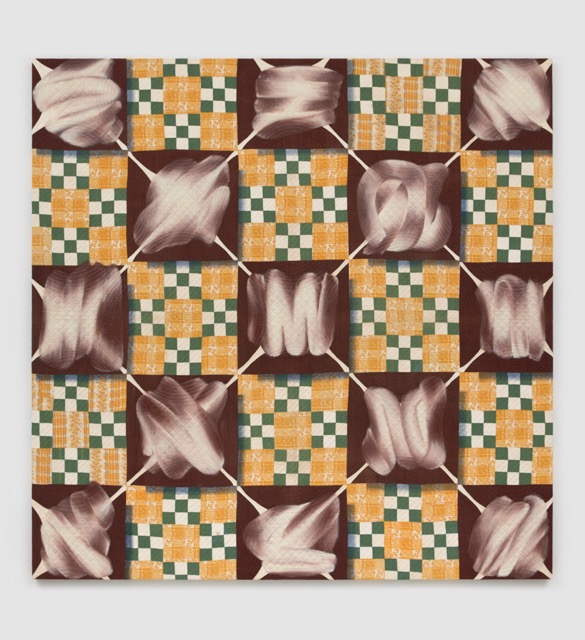
SANFORD BIGGERS, Kind of Real, 2024
A.S.: “Conceptual patchworking” — to patch is to repair, but also to join. What, precisely, are you repairing: history, memory, identity, or the rupture between all three? And a patch always carries the trace of the original wound. Does that trace trouble you, or is it exactly what you are after?
S.B.: I view that process as entirely generative. Yes, there is a degree of repair, but it’s fundamentally about creation. It’s not just about patching a wound; it’s about looking at a wound, a disruption, or a breakage, and finding a way to re-present it. It’s about letting that rupture become the birth of a new concept.
A.S.: You’ve said you impose no hierarchy on chronology, reference, or medium. That sounds like radical freedom — but doesn’t it also carry the potential for chaos? In a practice where everything can be placed beside everything else, what is the center that holds? Where is the discipline inside the apparent indiscipline?
S.B.: It comes down to intent. There is always an initial intention when I begin making something, even if I know the final result might far exceed what I originally put into it. I think of it like jazz musicians playing a standard song. Everyone in the room knows the original melody and structure. But when the musicians start to perform and improvise, they create a brand-new work on the spot. They don’t necessarily know exactly where the music is going, but when we listen to that recording years later, it delivers a profound, distinct feeling. If that same group plays the exact same standard the next night with different improvisations, they create yet another unique work. When I choose not to be overly determinant about a piece, it’s because I want the work to have the freedom to express itself. I don’t want a rigid, one-to-one translation of my ideas. I want the object to become something beyond me.
A.S.: Syncretism — revealing the hidden connective tissue between practices that appear wholly separate. But here is the question that haunts me: were those connections always already there, waiting to be uncovered, or do you construct them? Is the artist an archaeologist, an architect — or something that refuses to be either?
S.B.: Artists are always contending with history — with the history of art, or painting or sculpture or performance or video. In our study of these histories, we have the ability to make connections and create new intersections of ideas. When I do try to navigate some of the connections, I do so with specific ideas in mind. When a viewer then sees artwork and brings their own experience to it, another layer of syncretism can happen. They think “Oh, I remember the quilts that my grandmother made”, and even if they come from a different part of the world than I do, there is a connection between us. Materials have a very deeply embedded history that transcends any geography, any chronology. Similarly, artworks are bridges between the maker and the receiver but where those bridges lead to is totally subjective. I think that’s what differentiates us from architects and archaeologists, we present an entirely subjective world and invite others to traverse it with their own subjectivity.
A.S.: You inaugurated two major exhibitions at the same time — The Gift of Tongues at Marianne Boesky Gallery in New York, and Drift at the Parrish Art Museum in the Hamptons. One transforms the white cube into a labyrinth of curtains and false walls; the other fills museum spaces with luminous, suspended cloud sculptures. What are these two exhibitions saying to each other? Is there a conscious dialogue between them — or a deliberate tension?
S.B.: There are direct, literal conversations between the works. For instance, there is a clear cross-reference between the quilt paintings in Drift and those in The Gift of Tongues. If a viewer sees them in tandem, they can construct their own narrative and trace how the pieces inform one another. However, I approached the two shows with entirely different tones and attitudes. Drift is lofty, open-ended, and ephemeral. The Gift of Tongues is more grounded, specific, and directly engaged with narrative. The titles of the works, the title of the show, and the physical labyrinth you must walk through create a deliberate yet interpretive narrative journey. In contrast, Drift allows you to walk into any room at any time, gather information, and carry that fluid sensation into the next space. If I had to summarize them, I would say The Gift of Tongues feels more like a statement, and Drift feels more like a thought or dream.
A.S.: In The Gift of Tongues, your marble bust Narcissus dissolves into the surface of the quilt behind it at a precise angle, the figure simultaneously concealed and revealed. This idea of disappearance — of things hiding in plain sight — where does it come from? And when does an artwork stop speaking and begin only to point?
S.B.: In all of my work, there are layers of the visible and layers of the invisible. I want to create a mood where confronting the object opens a doorway to a much deeper conversation. With Narcissus, the sculpture is fully visible from one angle, and then it suddenly camouflages into the collage behind it. That is a direct metaphor for history itself. There is the history we are taught in textbooks, and then there is the history of what actually happened. A perfect example is how the modern world was introduced to classical Greek and Roman marbles as pristine, monochromatic white stones. But historical and scientific research has proven that in their original forms, many of those marbles were polychromatic—vibrantly painted and adorned. For Narcissus, I painted directly onto the marble to evoke that neglected history. It challenges the whitewashed narratives of Western art history we grew up with in school. The work feels intensely contemporary, yet it is rooted in an ancient truth that was hidden in plain sight.
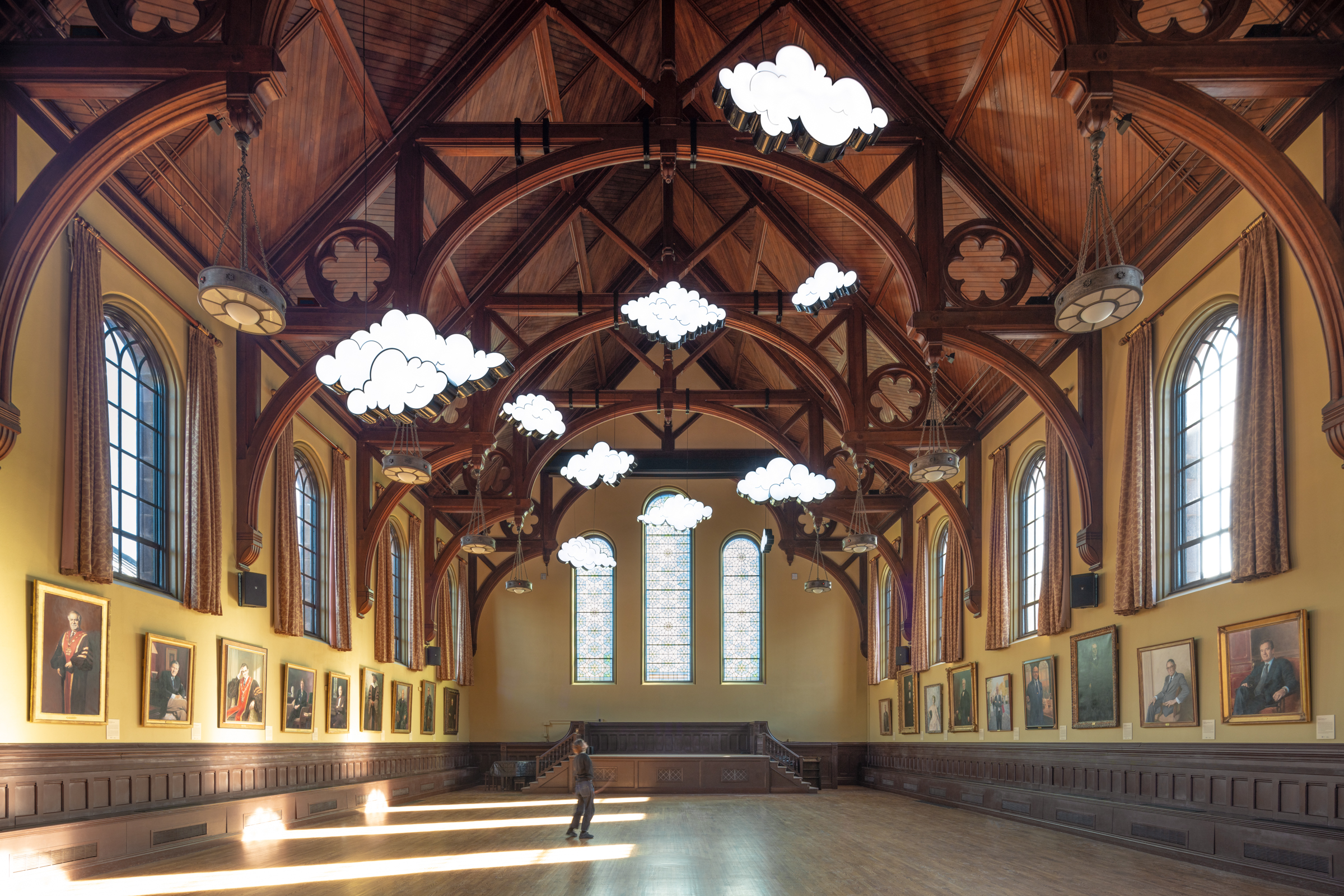
SANFORD BIGGERS, Unsui Cloud Forest, 2025
A.S.: Drift opens with Unsui (Cloud Forest) — luminous cloud sculptures suspended from the vaulted ceiling of the Parrish’s main gallery. You have deep personal ties to the East End of Long Island, and this is your first major museum presentation there. What did it feel like to return to that landscape under these circumstances? How conscious, and how instinctive, is the relationship between an artist’s personal geography and the work they make?
S.B.: I thought of the show as an exhibition of landscapes, which allowed me to exercise a different approach to my work. The history, critique, and dialogue are still there, but my focus was on the ever-changing cloudscapes and atmosphere of Sag Harbor, a place that has influenced me over the last decade or so. Sag Harbor is a place where I find respite and leave the density of New York City behind, and I wanted the show to feel like that.
A.S.: For the Codex series, you painted on antique quilts donated to you from historically complex family lineages. In the moment you first held one of those objects — when their history and your vision converged in the same cloth — what happened inside you? What kind of responsibility does it place on an artist to choose a starting point that heavy?
S.B.: I don’t view it as a restrictive responsibility; I view it as a prompt or a provocation. Growing up in Los Angeles, I used to do graffiti. That early form of expression was, for me, an act of taking an urban environment and making it beautiful. Some people viewed it as vandalism or desecration, but I saw it as beautification. When I am dealing with an antique quilt steeped in heavy history, I balance those same questions: Am I beautifying, am I desecrating, or am I collaborating? I spend a lot of time sitting with each quilt, letting the material inform me which direction to take—whether to work in stark opposition to its original pattern or in harmony with it. Many of these found quilts were discarded, ripped, or sitting forgotten in antique shops. There is an opportunity to resurrect them. It’s very similar to hip-hop production—the act of sampling an old, classic track, chopping it up, and re-engineering it into something entirely new and urgent for the present moment. It’s taking something dead to the world and giving it life again.
A.S.: The Chimera series fuses Greco-Roman and African sculptural traditions. In Oracle, you carve lotus flowers into Zeus’s throne — but beneath those flowers, layered historical references are concealed. Did you design that tension between concealment and revelation deliberately, or did it arrive on its own? Can a work of art genuinely surprise its maker?
S.B.: Absolutely. The majority of the works in The Gift of Tongues were complete surprises and revelations to me as they came together. The history of that lotus shape goes back to a large glass sculpture I made around 2006. When you look closely at the petals, you realize they are cross-sections of slave ships. I began using that shape with a specific long-term trajectory: over the decades, I would gradually remove the depictions of the human bodies from the diagrams. I wanted to turn a symbol of historical trauma into a symbol of transcendence. By removing the bodies over time, it implies that we can transcend the gravity of that dark period in world history. When that symbol was placed on the throne of Zeus at Rockefeller Center, it married that history to the broader global mythologies of African and Greco-Roman deities. Over the years, I’ve been building my own personal mythology, piece by piece, symbol by symbol. My newer works are constantly feeding on my older works, creating a map or an index for the future to decipher.
A.S.: When your work enters public space, it exists under a different kind of visibility and responsibility than in galleries or museums. How does that shift your relationship to the viewer — and to the work itself?
S.B.: I try to approach my public artworks the same way I approach the smaller works. I want to seduce the viewer in from afar and then introduce deeper layers of construction, material and contextual information as they lean into the work. Thankfully, we are living in a great moment for what in the past would’ve been considered “challenging” public artworks. This has allowed my approach to remain consistent even when scaling up into the public format.
A.S.: Blur — as concept, as method, as philosophy — sits at the very heart of Drift and your broader practice. You deliberately disturb fixed surfaces and allow materials to shift in perception. But this is an era that often demands clarity: clear identity, clear message, clear position. What does it cost an artist to defend ambiguity — in the art world and beyond?
S.B.: An artist lays out information but allows for multivalence or the ability for a viewer to then create meaning around it. It is not an artist saying “this is what this one thing means”, but this is the information that I have processed for you, the viewer, to take and put through your own filters and discussions to potentially find answers or a new way of thinking. Artists are investigators and instigators …we’re not historians.
I believe ambiguity, like silence or space, is an extremely powerful tool.
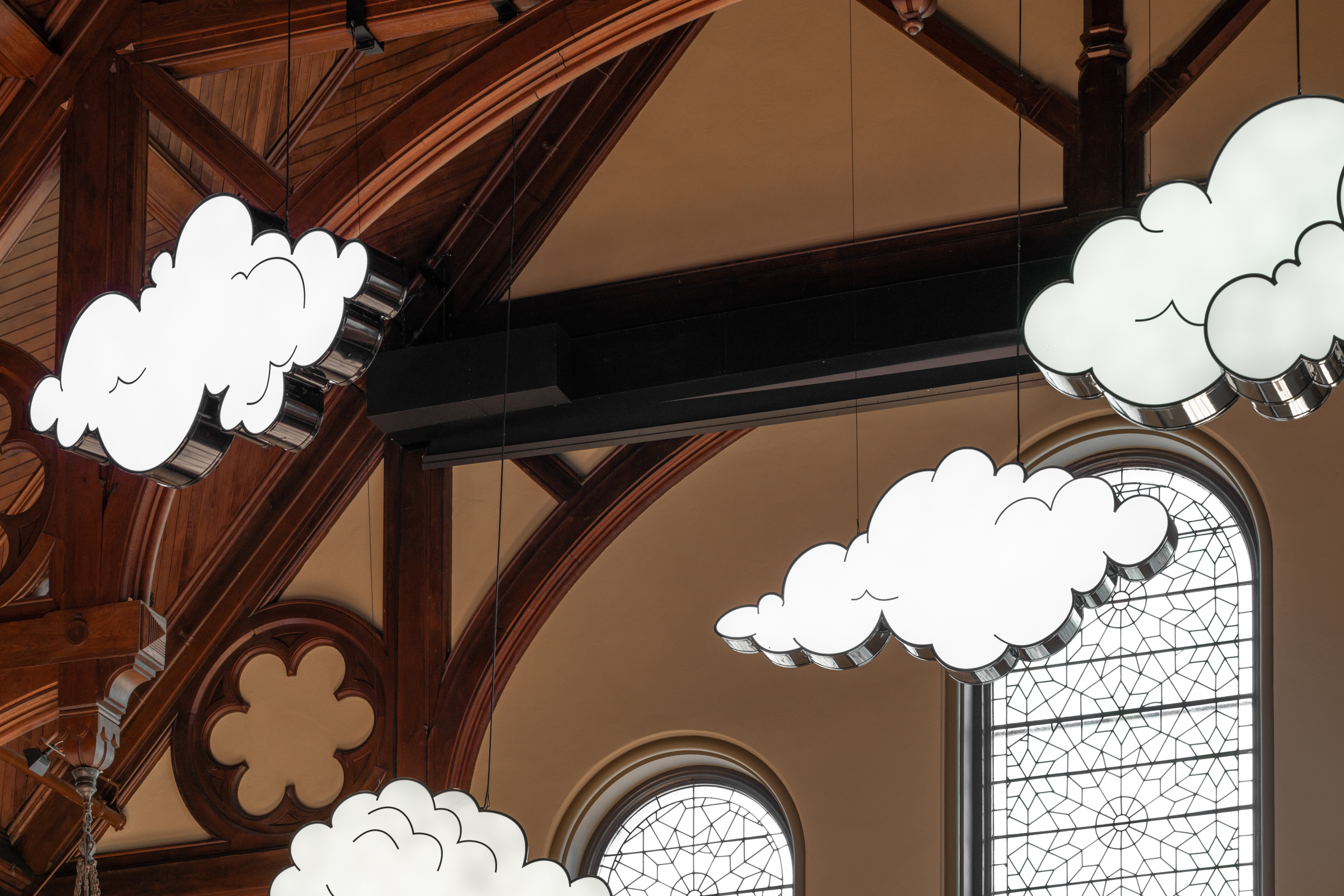
Unsui Cloud Forest, 2025
A.S.: You’ve said: “Time is malleable — but so is the reception of a work.” Which of your works has undergone the most unexpected transformation over time? Has a work ever returned to you with meanings you did not initially place in it?
S.B.: Two works come to mind immediately. The first is a controversial piece I made years ago: an inflatable version of the 1970s comic character, Fat Albert, created by Bill Cosby and a very popular tv show for many years. My version was titled Laoóoōn (Fatal Bert), instead of Fat Albert. In the inflatable sculpture, Fat Albert is laying face down, and there is a pump that makes his body go up and down as if he’s breathing very slowly; he’s injured, he’s down, and his breathing appears difficult. It upset a lot of people because it was viewed through the lens of police brutality, but to me, the piece was really about fallen icons and the error of hero worship. It was about reasserting that people and things that had a specific meaning to one generation can very easily take on new and even contrary meaning in a different time. The work also referenced pop art, performance, soft sculpture versus hard sculpture, inflatables versus marble, ephemerality versus stability. It takes on new meaning and changes every few years.
The clouds have also transformed over the years. I started incorporating clouds as a motif in the early 2000s, and in late 2024, I had the desire to revisit them. Clouds are always changing, always ephemeral. They take on different interpretations and meanings for everyone who sees them. They feel relevant to me now when we are in a moment of deep contemplation of seeing the world that we thought looked and felt one way, actually dissipating and turning into a different place, in the same way the clouds do as they change over time.
A.S.: Playing piano, founding the moonmedicin collective, and contributing to projects like The Omnichord Real Book — is music a separate territory for you, or is it the same thought expressed through another medium? When you move between sound and visual form, does your way of thinking change?
S.B.: My thoughts don’t change between the forms, but what I’m able to get out of them does. Artworks and installations communicate in a specific way, that can occasionally feel more restrictive or limited in comparison to how sound and music are received by listeners. With moonmedicin and our performance style, I’m able to string together so many different ideas so quickly and mash them up in a certain way that if I were to do it visually might be a bit incoherent. In music, our ability to understand multiple influences seems to operate with more fluidity. In the band, I am one performer working with several others, so although I can create a framework, I can never really determine the outcome, and that is a liberating act.
A.S.: Drift invites viewers into a more contemplative space, one that seems deeply concerned with time, memory, and transformation. How do you see this exhibition fitting within your ongoing exploration of history and remembrance? In what ways does Drift extend—or perhaps depart from—the questions you have been pursuing throughout your career?
S.B.: I do not see the broader historical context as directly shaping how my work is received or interpreted, largely because the kinds of cultural and historical tensions we are living through are not entirely new. While they may feel more intensified and visible today, they can be understood as part of a much longer intellectual and historical continuum.
I see this moment instead as one in which attention itself becomes more acute. At the same time, I remain mindful that without artists who engage deeply with history and memory, certain narratives risk becoming less visible over time. When memory is not carried forward through sustained reflection, particular threads can fade, and this fading can produce recurring cycles of return.
For me, this is less about a sense of obligation and more about an internal necessity to surface certain kinds of knowledge through my practice. An exhibition presented in 2026 is never a self-contained event; it exists in ongoing dialogue with my broader body of work. Each exhibition functions as a statement within a longer unfolding trajectory.
With Drift, I was interested in creating a contemplative pause—a space of condensation and reflection. Progress, as I understand it, is rarely linear; it is more accurately experienced as a kind of oscillation, where movements forward and backward are continuously interwoven. In that sense, I see time and history as constantly shifting and in motion, rather than fixed or resolved.
A.S.: Looking back across more than twenty-five years of practice, two simultaneous exhibitions, and a Grammy — what is the question you still cannot answer? The one you suspect you may never answer, yet cannot abandon?
S.B.: It is the quest to make a body of work that can contain the happiness, the pride, the joy, the fear, the anxiety, the vulnerability, the confidence, the strength, the weakness, all of the internal paradoxes that I feel as an individual and as an artist; the quest to find the form that can encapsulate all of that. I don’t believe that I will ever find it but I do believe the journey and the process are actually the goal. I feel that if I no longer seek that question or that answer or form, then my soul would die. So it is the constant quest to make tangible what is ineffable.
A.S.: And finally: you’ve said that when we look into clouds, we all see different things. When you look into a cloud — not as an artist, but simply as a human being — what do you see?
S.B.: Infinity. The symphony of all things, at once visible and invisible, and always changing form. Constant evolution.
My sincere thanks to Angella Forbes for their valuable support in facilitating this interview.

Ayse Sarioglu
Ayse Sarioglu-Guest is a senior Turkish media executive, writer, and art critic based in Istanbul and New York. With over 25 years of executive experience in Turkey’s leading media organizations, including Sabah and ATV Group, she has held key leadership roles overseeing national newspapers, magazines, and television networks. Sarioglu-Guest was instrumental in the launch of MTV and Nickelodeon in Turkey and led the market introduction of Eurosport. She currently contributes to Vogue Turkey and Harper’s Bazaar Turkey, focusing on contemporary art, culture, and international creative industries.
view all articles from this author