Whitehot Magazine
October 2026
"The Best Art In The World"
"The Best Art In The World"
October 2026
Cinga Samson: Ubuntu, Terror Management and Belonging
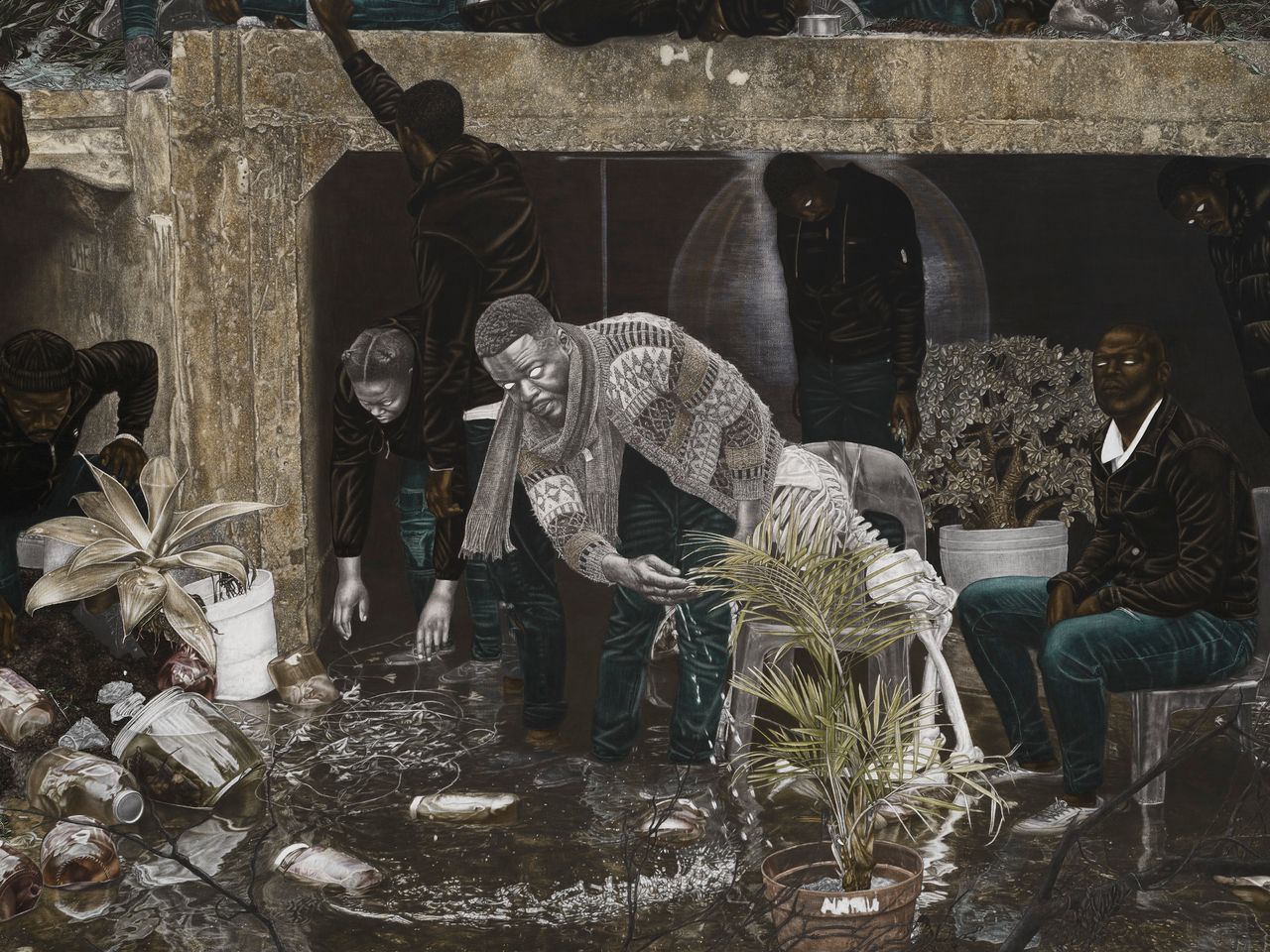
Cinga Samson, (detail) Ukuwelwa komda, 2026. Oil on canvas 96 1/4 × 124 × 2 3/4 in. | 244.5 × 315 × 7 cm © Cinga Samson. Photo © White Cube (Nina Lieska)
By JAKOB DWIGHT May 3rd, 2026
“Above all, the artist’s work seeks out the authority of the unnameable and the territory of the sublime, one in which the divine is not found elsewhere but present in the vernacular of all things.”
The essential and highest level questions into who or what we really are as humans and what our place is within the rest of the Universe has eternally been caught up with art and art-making. Archaeologists now have evidence in the Trinil Engraving found in East Java that the first known abstraction through art goes back to Homo Erectus, about 500,000 years ago, shells bearing cross-hatched patterns, intentional marks that are the earliest known expressions of consciousness or thought.
In 2017 I came across Cinga Samson's work in the midst of nearly losing my faith in our collective expectations from contemporary art, fearing that we'd lost the appreciation for images with philosophical gravity, forgetting a significant ancient aim of art as our first mirror of consciousness as a species. It was refreshing to discover his work. Samson's newest paintings feature bodies that are compositionally and often tonally inseparable from both the environment and one another. As further evidence of this connectedness, this near-indistinguishment of the human and the scene, in this exhibition the paintings with figures are all counterpointed nicely by the smaller painting Iinyembezi neenkwenkwezi I, (2026) that features no human at all, or what, in our present description is nature by itself. But it might be clear to the viewer from this inclusion that for the artist it doesn’t matter, it's all one.
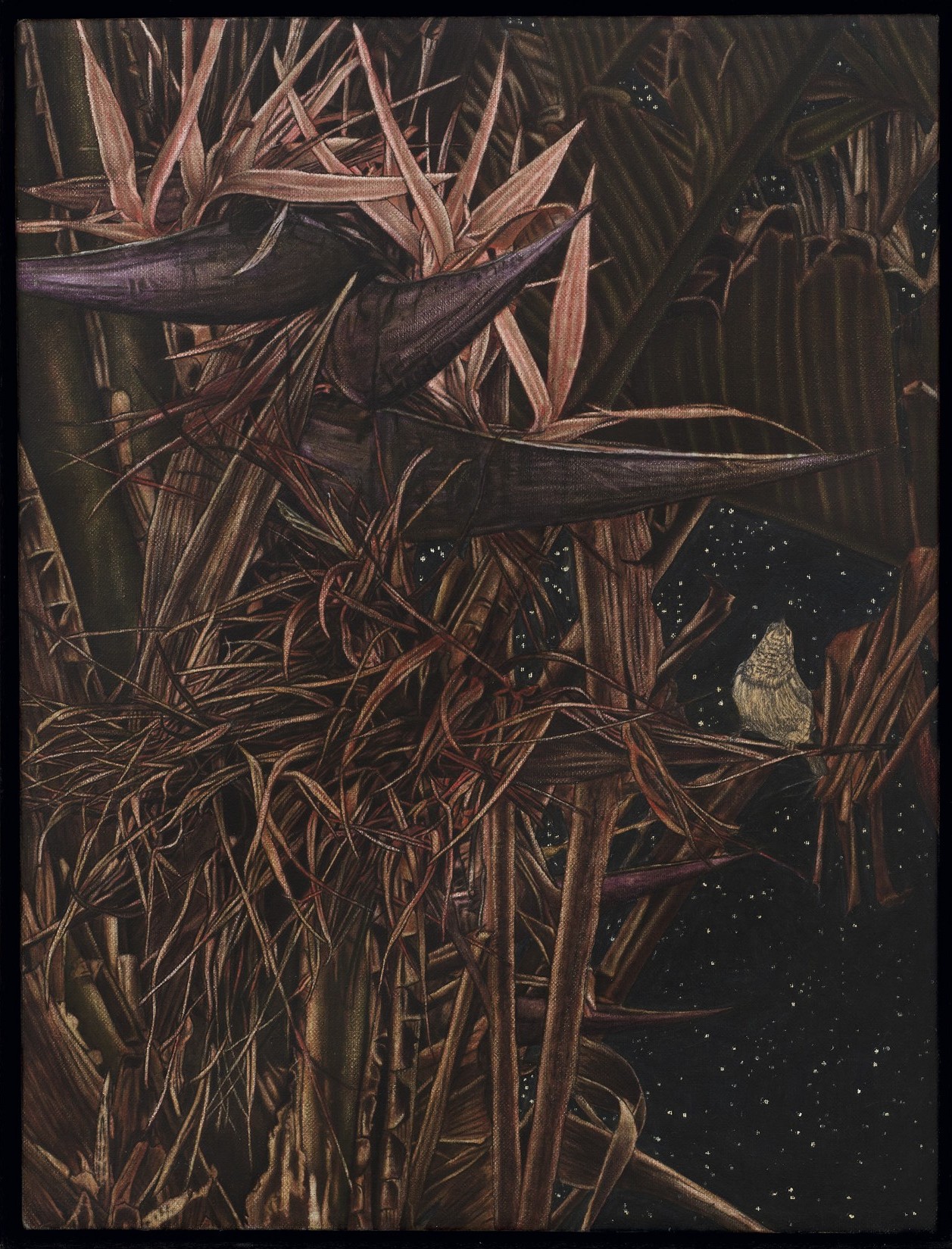
Cinga Samson, Iinyembezi neenkwenkwezi I, 2026. Oil on canvas 15 3/4 × 12 1/4 × 2 1/2 in. | 40 × 31.1 × 6.4 c © Cinga Samson. Photo © White Cube (Nina Lieska)
Two ideas that could apply to Samson's scenes come to mind: terror management theory from psychology and then from neurology and perception studies, the (re)orienting response. The “terror” to be managed in terror management theory (TMT) is a subconscious existential fear of meaninglessness in the face of uncertainty/death. Terror management is also thought to be one way that in-groups form, giving members a sense of belonging and meaning if only to one another, a cause to fight for, thusly increasing each individual's chances of being remembered. In this light the actual cause matters less than the gathering around it.
Whatever this nucleus is in Samson's paintings provides for and offers an abstract religiosity that very simply allows these figures to be together. The theory out of which TMT grew was impression management, where the ultimate fear is not actual death since we can't know exactly what death is, but rather a social death, not belonging or being connected.
Both related fears seem to exist and be managed here in Samson's paintings. For the well dressed humanoid figures here there is a shared amor fati - love of one's own fate - if not a love, perhaps some kind of acquiescing with a stylish exhaustion and long-sought-after sense of belonging to one another and the nightmare.
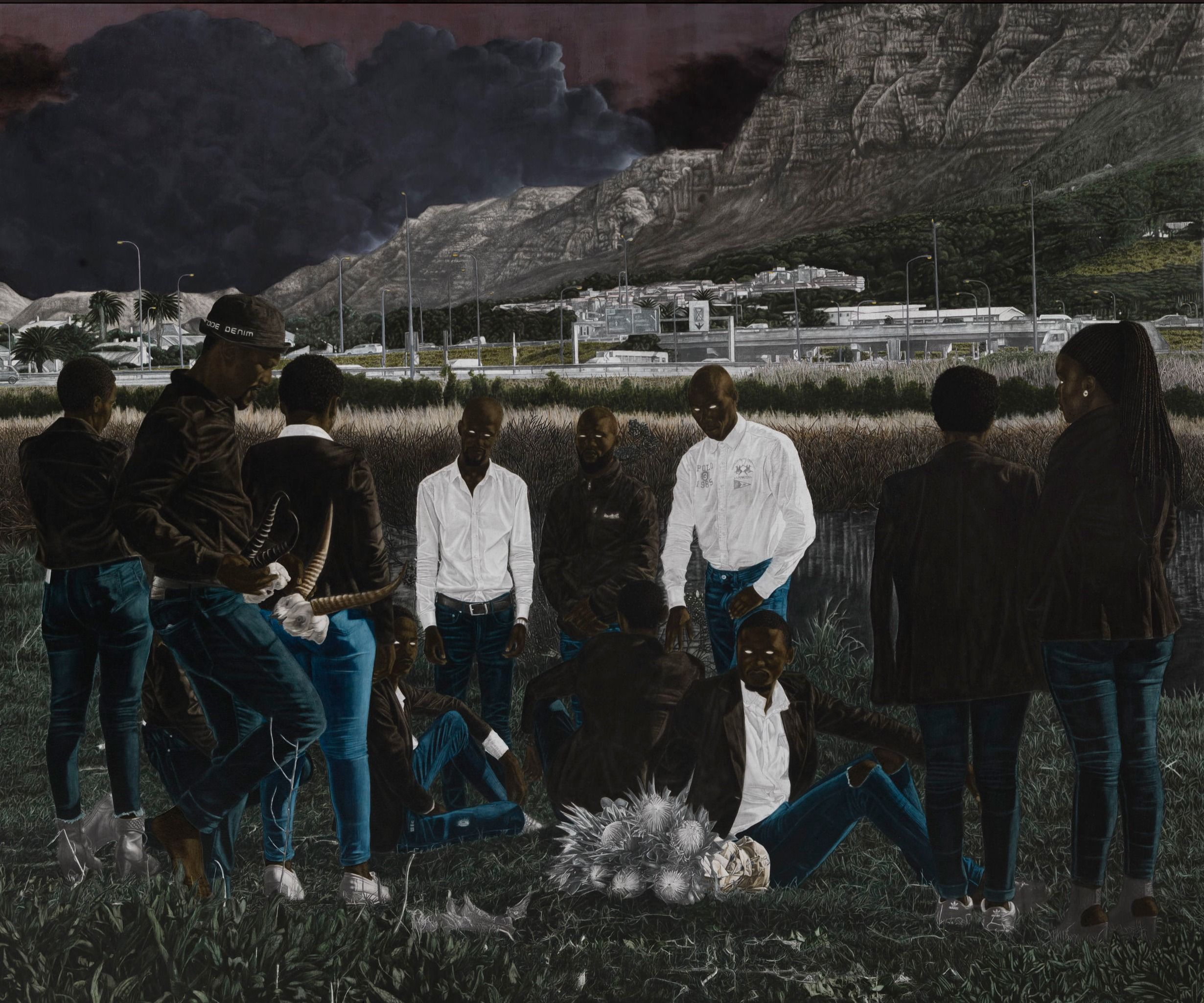 Cinga Samson, Ingxakeko, 2023. Oil on canvas 220 x 260 cm | 86 5/8 x 102 3/8 in.© Cinga Samson. Photo: © White Cube (Nina Lieska)
The other idea, the orienting response refers to an ancient deep brain mechanism tied to our fight-or-flight sense in the amygdala, where every new piece of environmental information has to be processed and assessed as either hostile or welcoming or neutral. This sense is alternately called the re-orienting response because it is continually resetting with each change in our frame of view, a subconscious hypervigilance, watching for dangerous shapes and changes. So while our prefrontal cortex is processing content, thinking about the scene in film we’re watching for instance, in addition to thinking about what we’re having for our next meal, the brainbody and amygdala are busy trying figure out what we’re seeing, re-analyzing and re-orienting with each movement in our environment. All of this flooding of the sensorium and perception is thought to be what creates that stupor that led to television being called an “idiot box” or the new “opiate of the people”.
Samson’s work pulls us into that state through this kind of perceptual barrage. The most detailed and attention-demanding parts of Cinga Samson's canvases feature such a delightful microhandling of line and tonality through chiaroscuro that a viewer’s attention can’t help but to be driven almost immediately from the ominous yet somehow peaceful whole down into a tight particularity. As viewers we are trying to figure everything out, attempting to assess each sharp and well-rendered mark and looking for hidden swords and knives in the grasses. Each area at first possibly dangerous and then simply beautiful, yet the rest of the field may still hold other threats.
In his White Cube solo exhibition Ukuphuthelwa the overall conversation created by the paintings altogether, with their abstracted humanoids, allows us to, or makes us forego the body politic as our main path of inquiry and mode of interpretation, and the works instead ask the largest philosophical questions about Being itself: What is our place in everything, the cosmos? What is human nature essentially? What do we owe one another?
Or, are we, in fact, one another? The mapping of the human genome has shown that all human beings to have ever existed are 99.9% genetically the same or virtual clones of one another, one superorganism whose living thinking parts are separated only by these simultaneously unique and the same bodies, our coordinates in spacetime and the trillions of points of view of the universe produced thereby. Additionally genealogy has found that due to isopoints in human history - periods where every person alive then is an ancestor to everyone alive now, attributable to a dwindling of the genome through populational minimizing and near-extinction events - the rather remarkable result has been that no two human strangers alive now are more than around 50th cousin.
I reached out to Samson to discuss his newest paintings and had a conversation about this eternally mysterious and heavy aspect to his work. We talked about his Xhosa upbringing and the principle of ubuntu - “I am as you are", an ontological and ethical principle that aligns with yet predates by centuries what we now know conclusively about how close we all are together. We talked about his origins in artmaking, and how he came to this imagery that resonates with the massive pathological depth and confused intensity of our time.
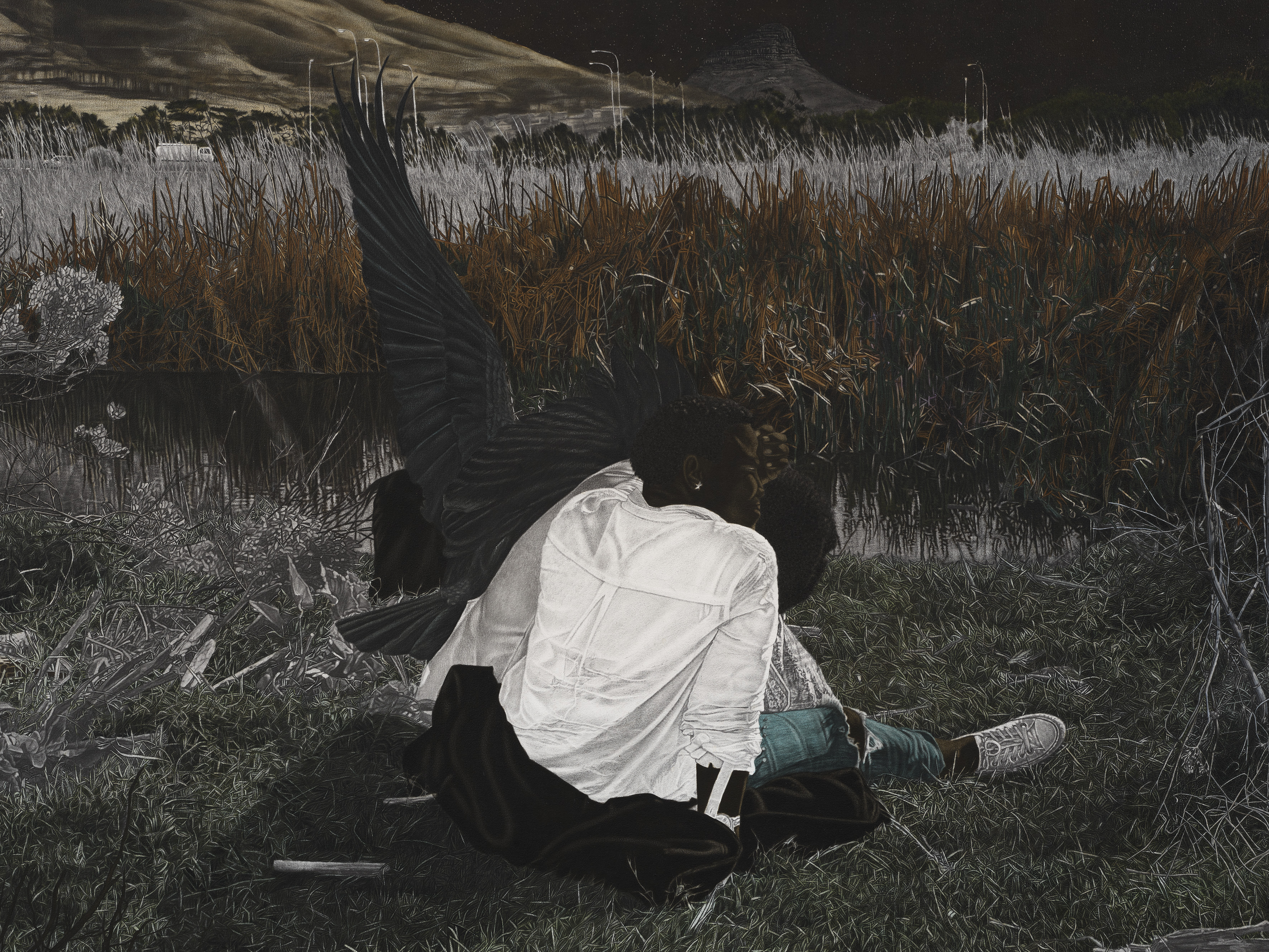 Cinga Samson, (detail) Imfihlo, 2026. Oil on canvas 57 × 112 1/2 × 2 3/4 in. | 144.8 × 285.8 × 7cm © Cinga Samson. Photo © White Cube (Nina Lieska)
Your work seems to present something like what in philosophy are called wicked problems, those questions with no definitive formulation, where what we could call answers are not framed as “good/bad” or “true/false” but rather just managed over time, having no real solution. Can you tell us about your own evolution in thinking, for instance what drives you to want to represent this atmosphere or sense of the mysterious, this bittersweetness and endless questioning in your paintings?
There’s something embarrassing about not knowing answers to questions of our true nature and it is almost overwhelming to try to find answers. We give up on these questions to a point we find them ridiculous in our mind, even to think is silly. Religion and science have given some answers but we are still searching. These are questions about ourselves and our environment.
Can you say more about the blank illuminated eyes of your figures?
Sometimes material can reveal something as a lack and also it can be the way to be brave, to step out and experience more….
I have left the eyes blank because they allow the figures to be one with the painting, and they hide the reliable nature of the figures. They remove the weight of the figure which create doubt whether the figures are human.
These works in White Cube now have taken what can be perhaps described as giant steps in dimensionality and detail from your earlier works. To what can this heightened visual complexity and intensity in your newest work be attributed?
I have spent more time doing these works than any works I have done in the past, because of being desperate for them in a vibration I need them to be in, which also means spending many hours in the studio.
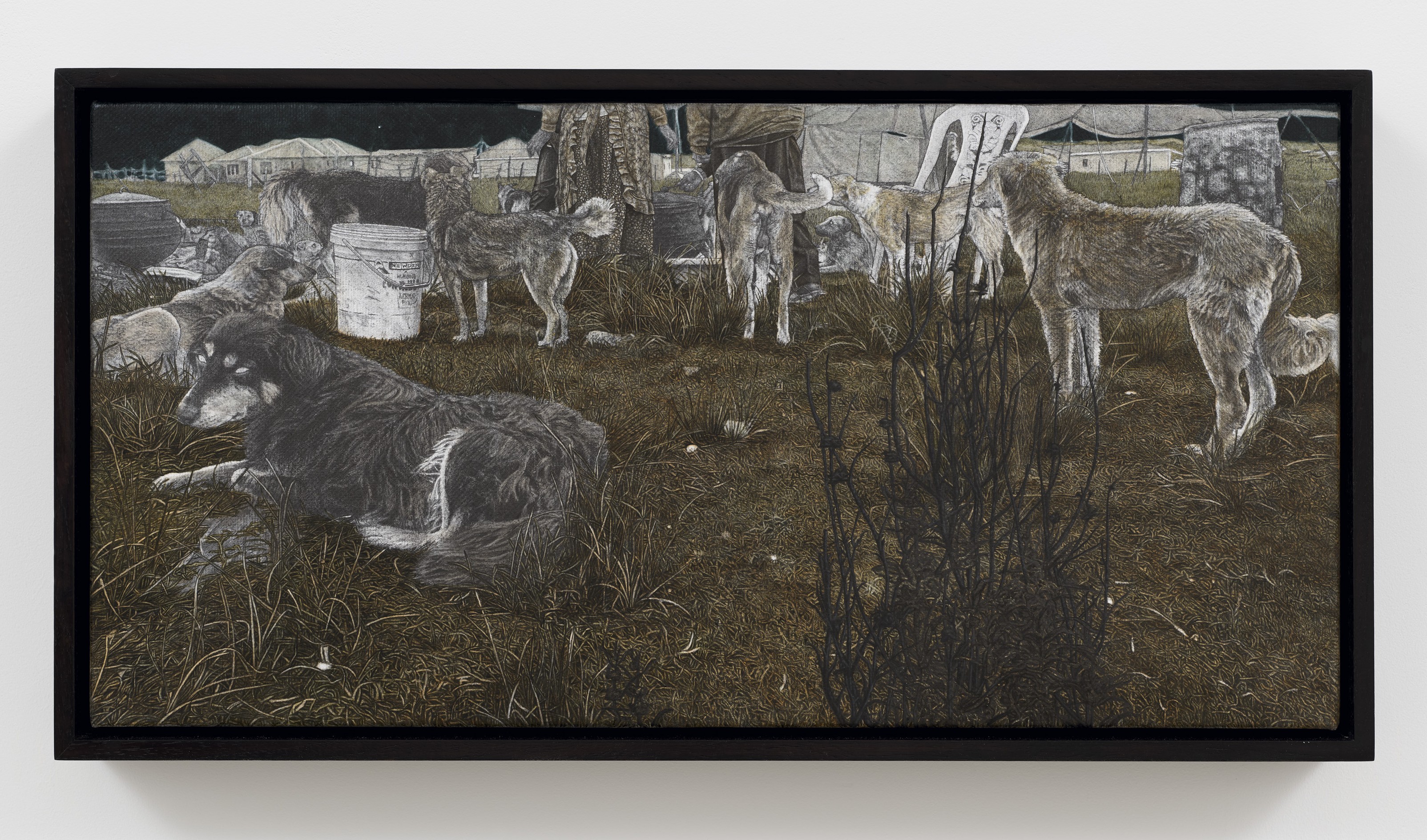 Cinga Samson, Intsingiselo I, 2026. Oil on canvas 13 × 24 3/4 × 2 1/2 in. | 33 × 62.9 × 6.4 cm© Cinga Samson. Photo © White Cube (Nina Lieska)
You've spoken about your father's saying to you that “you don't have to be like everyone else” - what are some other ways your family, your Xhosa heritage and upbringing in South Africa have influenced you and your work? To what extent does the philosophy/principle of ubuntu contribute to your approach to your work or life, for example?
It was very important for me to hear my father say that to me. It freed me from the pressures of some world’s agenda and expectations that are not consistent with me. The Xhosas believe that everything is a manifestation of something beyond the physical. Having grown up in a culture and society that performs rituals and spiritual ceremonies, I became more interested to look closely at our existence with more questions.
In South Africa ubuntu is a way to be a human, it is a fall when one lacks ubuntu, to have ubuntu is considered a status.
"We are the saddest loneliest generation with happiest pictures.” says a meme in circulation years ago. Can you give your thoughts on this idea?
Everything has a lesson. Even the worst things, I believe, can lead to our own betterment.
I was surprised to find out that you are self-taught, how did you come to artmaking?
I don’t remember a time when I wasn't creative. In 2006 I walked into a local art studio named Isibane creative arts (Cape Flats Artist Organization) in Khayelitsha and joined and I became a full-time artist. During those years, I had the privilege of observing and being guided by various artists. After I left, I did artists’ workshops and enrolled for short courses in graphic design and commercial photography.
Your work has been spoken about as having a similar feel to religious imagery, yet unlike religion's insistence on its own truth, your scenes offer no real answers but rather a fierce curiosity into Being/Existence. Are you yourself religious/spiritual?
I like that being an artist demands you to see something about life and the beauty of God. I believe that makes me very religious and spiritual.

Jakob Dwight
view all articles from this author