Whitehot Magazine
October 2026
"The Best Art In The World"
"The Best Art In The World"
October 2026
Endurance Under Tension: Angela de la Cruz’s ‘UPRIGHT’ at Ikon Gallery
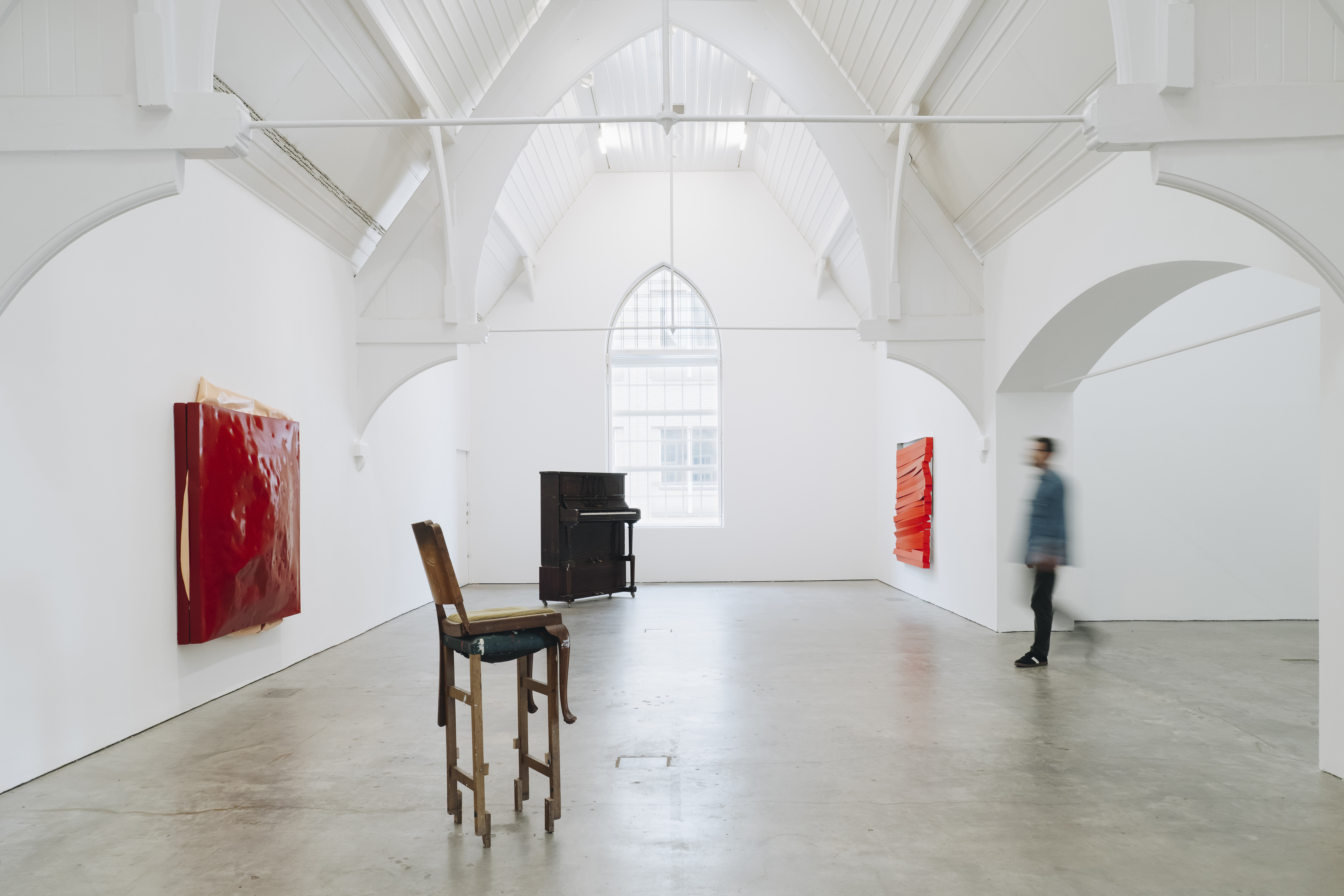 Installation imagery, ‘UPRIGHT’: Angela de la Cruz (2026). Photography by Jack Bird.
By GRACE PALMER May 16th, 2026
Angela de la Cruz seeks “effectiveness” in her paintings, and her latest exhibition, ‘UPRIGHT’, at Ikon Gallery, Birmingham, demonstrates this intention abundantly. Born in La Coruña, Spain (b. 1965), de la Cruz has been a tour de force of sculptural exceptionalism since the late ‘70s. Nominated for the Turner Prize (2010) and the National Prize for Plastic Arts (2017), it’s a marvel that this is the first time her work is being displayed in the UK outside of London. This exhibition, featuring works from the early 2000s through the present day, is not a retrospective but a snapshot of the immensity and prominence of de la Cruz’s oeuvre. Guest curated by Carolina Grau, ‘UPRIGHT’ reflects both her curatorial skills and the longtime friendship between the artist and curator. Adapting Ikon’s unique architectural confluence of Victorian and modern, Grau and de la Cruz amplify the upstairs gallery, with sculptural works that complement and counter their surroundings. There is a political necessity in works like Angela’s. Humanity is woven into every corner of this exhibition – one that’s structural surface belies profound depth. ‘UPRIGHT’ puts its objects to the test, forcing them to endure under tension. It is a powerful message from Angela de la Cruz – endure as much as you can, for through endurance, strength is gained.
Despite the title’s fixity, this exhibition is unconcerned with stasis. As with de la Cruz’s repertoire, Ikon’s showcase highlights the body’s ability to adapt, both physically and emotionally. Grau aligns with de la Cruz’s espousal of adaptability through the chronological progression in ‘UPRIGHT’. Beginning with the earlier monochrome works like Limp (Brown) (2000) and Still Life with Table (2000), Grau then transitions to the colourful approach de la Cruz adopts in her later pieces, exemplifying colour as crucial to the artist’s “language”. The red, orange, and brown hues that emanate in the final room convey a sense of fearlessness and ownership – a statement of the self and its presence. As the dimensions of the gallery expand, so too does de la Cruz’s riotous collision of vibrancy and grandeur. Those initial pieces, particularly Still Life with Table, appear marred, dystopic, and self-cannibalistic compared to her subsequent sculptures. Grau encourages us to endure with de la Cruz, to go on this journey of self-discovery – not yet completed but laden with intrigue and change.
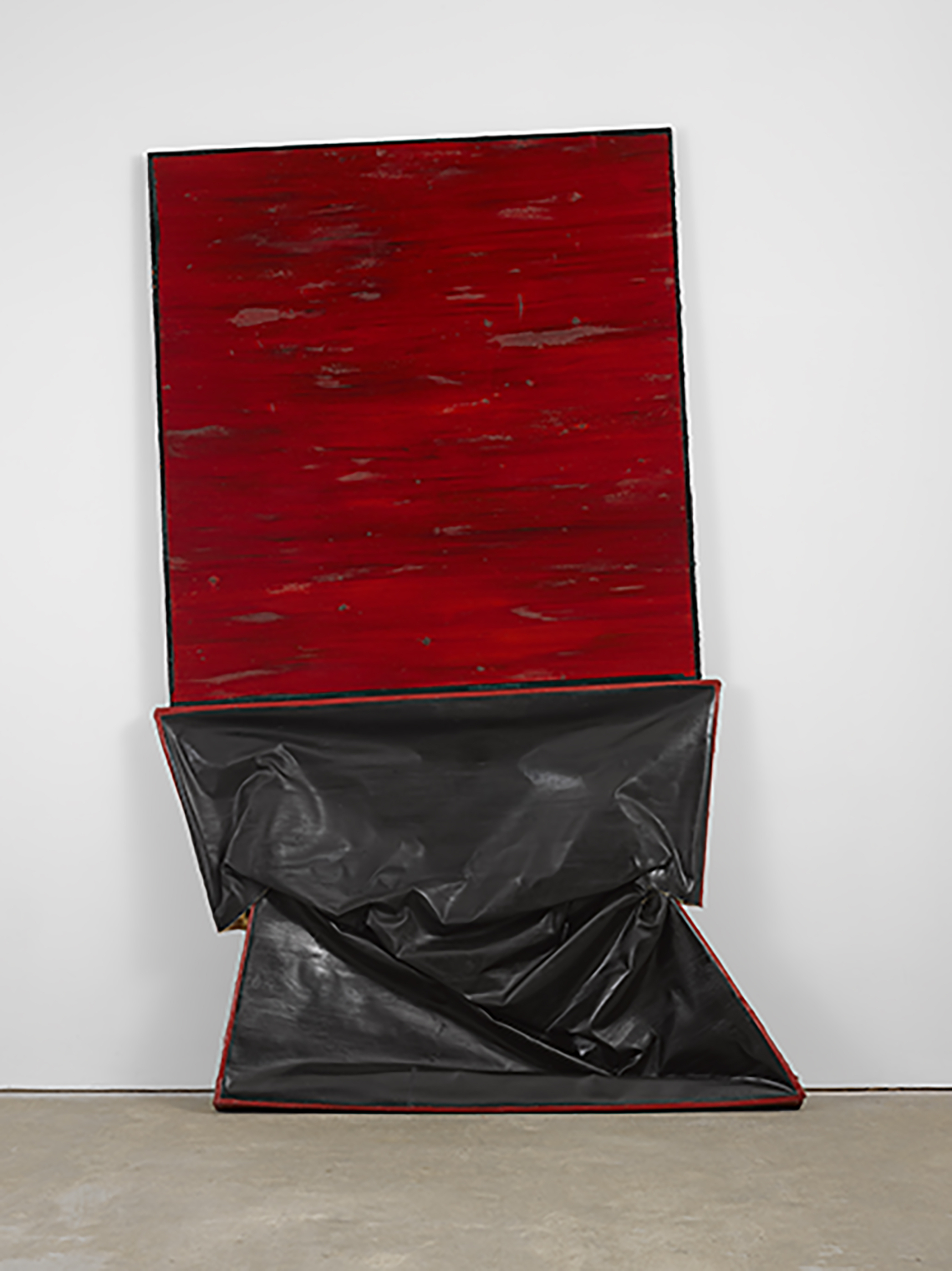 Angela de la Cruz, Reach (Red/Black) (2002), Oil on canvas, 317 x 182 x 40 cm, © Angela de la Cruz. Courtesy Lisson Gallery.
Scaling 3 metres, Reach (Red/Black) (2002) is the largest piece in the exhibition. This monumental oil-on-canvas construction speaks to de la Cruz’s earlier Minimalism. The glossy black foundation has the hallmarks of her abyssal tendencies. Yet, instead of succumbing to these encompassing depths, it crumples beneath the structured, deep red canvas. As much as Reach (Red/Black) is a feat of sculptural engineering, it is imbued with rich cultural and political allusions. Inspired by the Castells – the Catalan tradition of human pyramidal towers – de la Cruz emblemises the importance of community. Despite its tempestuous foundations, they build upwards. The red canvas is her enxaneta (the final climber to ascend to the top of the tower), a marker of collective fortitude. For de la Cruz, there is also something whimsical in the sculpture’s design. Resembling a friend standing on the shoulders of another to sneak into someone’s private space, de la Cruz describes the work with charm and pathos. Regardless of its geometric architectural influences, Reach (Red/Black) embodies collaboration, community, motion, and vitality. It is the combination of fixity and adaptability in works such as this that push Angela de la Cruz to the heights of sculptural mastery.
Whilst de la Cruz builds monumentality, she simultaneously creates confinement. Blister (2026), despite sharing the space with its 3m-tall compatriot, does not match its grandeur. Hidden beneath an orange, stiff, plaster-like exterior, this cream-coloured conceptual form struggles and bulges. Squashed between the façade and the wall, it fights for dominance – seeking its own freedom. By creating an object that physically opposes itself, de la Cruz confronts the assurity of fixity. It is Derrida’s consideration of painting as object that feels most apt here: “for the frame is what produces the object of art, is what sets it off as an object of art – an aesthetic object.” De la Cruz’s disregard of the frame and the instability of dimensions affords her work an anthropomorphic objecthood that traditional painting lacks. In the most direct sense, it is her non-adherence to convention, yet there is nothing straightforward in de la Cruz’s oeuvre. Altering, escaping, reforming, and adapting – all these aspects are a refusal to accept your designated space. Her approach to sculpture has an inherent parabolic quality: like the Parable of the Prodigal Son, no matter where her forms go, what mistakes they make, or what obstacles they face, they can always return.
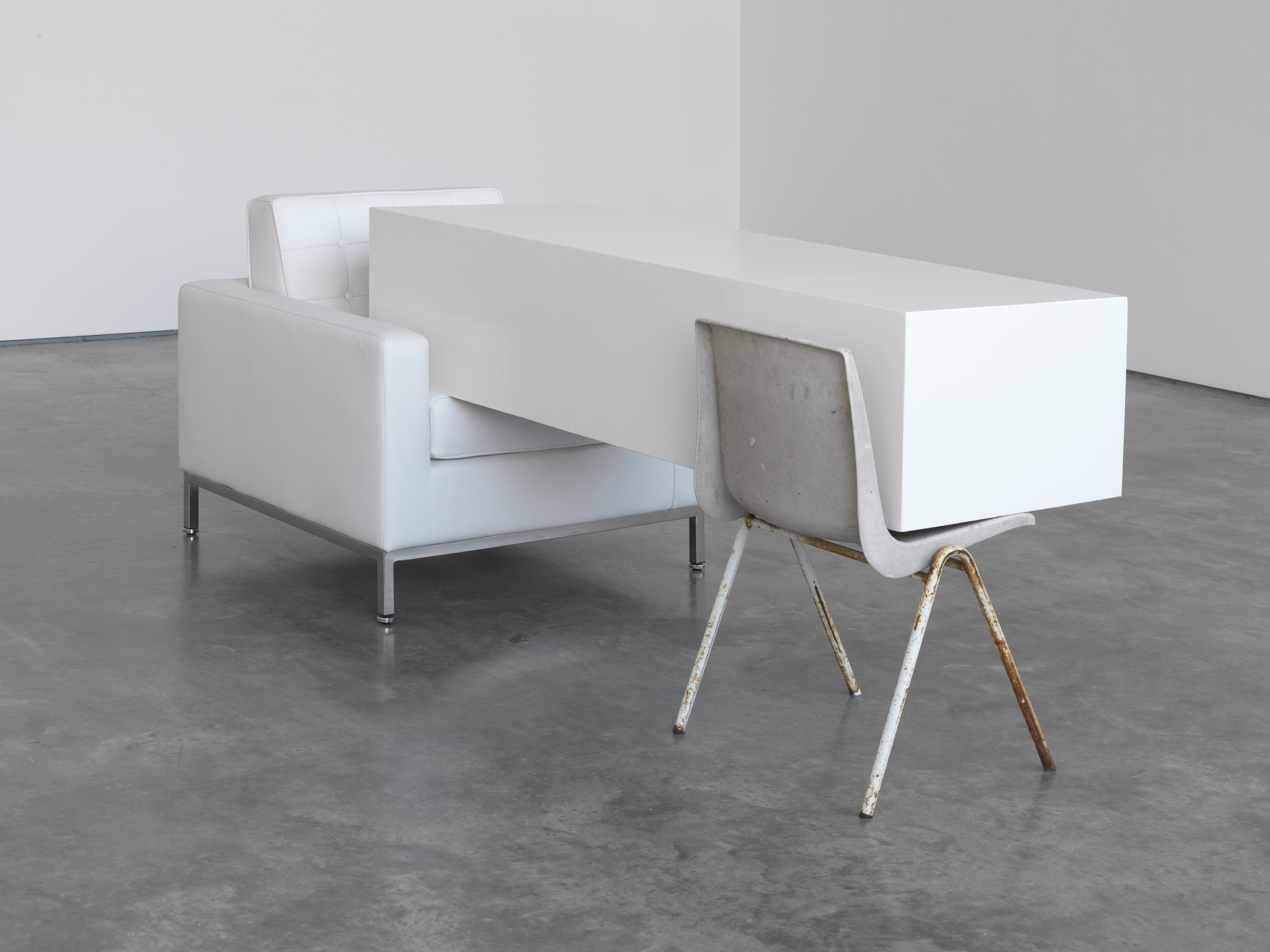 Angela de la Cruz, Transfer (White) with armchair (2011), Oil on wood, armchair with plastic chair, 80 x 180 x 84 cm, © Angela de la Cruz. Courtesy Lisson Gallery.
Etymologically, ‘upright’ shares its roots with ‘just’ and ‘honest’ – a virtue of moral integrity. For de la Cruz, the exhibition’s title is twofold: one relating to her structural dichotomies, the other with rectitude amid adversity. With its bold capitalisation, ‘UPRIGHT’ stands tall within chaos. Addressing the current climate of displacement, disenfranchisement and division, this exhibition reminds us to remain steadfast. De la Cruz’s sculptural materiality becomes the vessel to explore the political and cultural. Transfer (White) with armchair (2011) showcases her first use of aluminium. In practice, this shift towards durable metals highlights de la Cruz’s concern with longevity. Unlike the deteriorating Rothko paintings or the crumbling Petroglyphs, these sculptures feel as if they were made only yesterday. It is de la Cruz’s endurance to exist beyond herself, preserving presence despite natural decay. Beyond durability, Transfer (White) with armchair relays a message of social incompatibility. Two chairs are separated by an imposing wooden cuboid: one, the high-end designer armchair; the other, the studio’s plastic chair. Representative of two classes, Transfer speaks to a very real detachment between the art world and the artists themselves. These notions of incompatibility are also felt through de la Cruz’s personal relationship to the chair. Suffering from a stroke in 2005, the artist found herself suddenly discordant with her environment. Relying on others to move her, she spent that year sitting in these eternal, dystopic waiting rooms. Lying across two chairs, the cuboid functions as her body, suspended in time. Compared to other works, Transfer (White) with armchair feels especially sterile and uncanny.
De la Cruz’s studio lies at the further end of West London, near the original site of Grenfell Tower. In the corner of the last room, her piece Shutter (Red) (2017) responds to the high-rise fire that devastated the building. Created in the months following the tragedy, de la Cruz watched every day as the charred funerary pyre dominated her skyline. With its aluminium cladding collapsing in on itself, Shutter (Red) is a protest against the inhumane building regulations from the Royal Borough of Kensington and Chelsea Tenant Management Organisation. Painted in vivid red acrylic, Shutter is impossible to overlook, to forget, to hide away. It is a continued reminder of the consequences of negligence and mismanagement. Despite working with these industrial materials, de la Cruz continually places the human at the centre of her work. In the fire’s aftermath, she observed the local community’s displacement - families and individuals carrying their livelihoods in plastic bags. While Shutter (Red) criticises the building’s structural inefficiency, it also aims to honour those affected: the 73 lives lost, the hundreds made temporarily homeless, and the neighbourhood’s collective grief. De la Cruz’s work is a response to the world around her – reactive and insightful, not isolated. In her words, she is “trying to find themes and forms that can touch people, that they can relate to, without imposing a particular interpretation.”
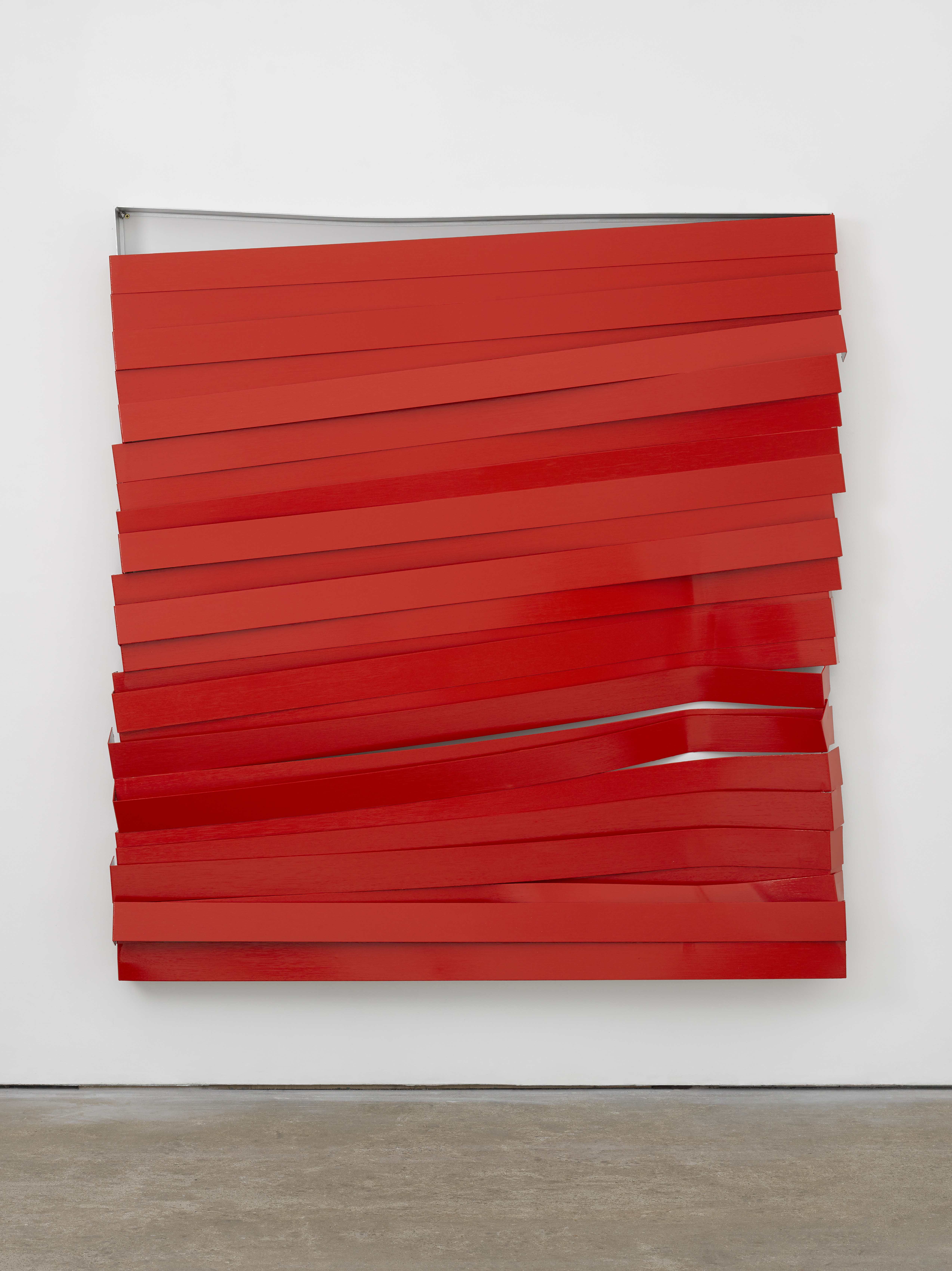 Angela de la Cruz, Shutter (Red) (2017), Oil and acrylic on aluminium, 154 x 162 x 16cm, © Angela de la Cruz. Courtesy Lisson Gallery. Photography by Jack Hems.
Situated in the heart of the city centre, Ikon Gallery is a staple within Birmingham’s contemporary cultural scene. Through ‘UPRIGHT’, Ikon extends beyond its walls with a new commission from the Birmingham Royal Ballet (BRB), complemented by regular performances from BRB ballerina Olivia Chang-Clarke in response to the piece. Both founded in the mid-late 1900s, Ikon and BRB share a synchrony of experience, development, and change. After viewing the company’s production of Sir Peter Wright’s ‘The Nutcracker’, de la Cruz’s new work celebrates the talent of this cultural institution through her distinctive approach of sculptural experimentation. Like her materials, there is a dichotomy in the ballerina’s fragile strength – elegant yet robust. The dancer’s point shoes, beaten and worn, are a deep fascination for the artist. Despite their wrecked appearance, these shoes carry the weight of their wearers; a symbol of endurance that echoes the ethos of ‘UPRIGHT’. It is at this pressure point that de la Cruz operates – choosing whether to persevere or to crumble.
Musicality is a recurring theme throughout Angela de la Cruz’s body of work. In the late ‘80s, she moved to London, not for the visual arts, but for the music; obsessed with the likes of New Order, The Residents, The Fall, Big Audio Dynamite and The Clash. Upright Piano (1999), perhaps the most compelling piece on display, epitomises these two selves: the artist and the musicophile. While a student, de la Cruz began collecting old wardrobes and pianos from antique stores in East London. Joining and restringing together the bottom section of one piano to the top section of another, she Frankensteined an instrument playable at human height – or rather, the height of her friend and collaborator, Neill Quinton. Huddled around the Upright Piano, press day visitors witnessed its activation, almost 22 years after its creation. Inspired by the minimalist, musique concréte styles of Steve Reich and Phillip Glass, Quinton’s composition is fragmentary, fluid and unbound. He describes it as a “groove trying to get out”, marrying perfectly with de la Cruz’s structural ideology. Positioned alongside her latest work, Upright Piano is a resurrection from the past; a dialogue between the artist and herself. Just as her newest piece embraces dance, this work’s musicality reflects themes of adaptability and resilience that run throughout the exhibition. The freedom to dance and create music despite oppression remains a vital human expression. Angela de la Cruz’s ‘UPRIGHT’ is the radical call for performance, noise, strength, adaptation, and endurance – reminding us that through endurance, power emerges.
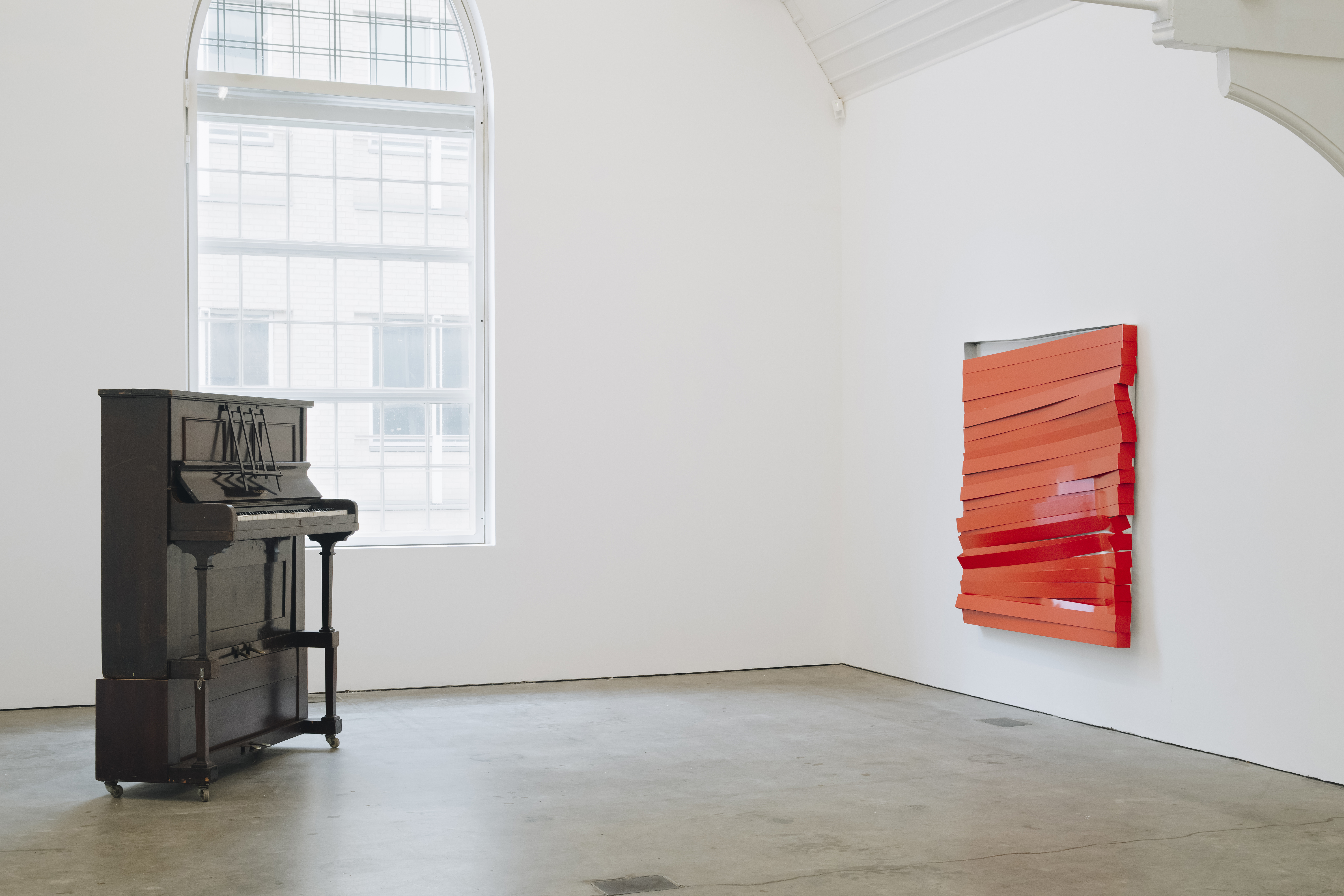 Installation Imagery,‘UPRIGHT’: Angela de la Cruz (2026). Photography by Jack Bird.
My considerable thanks go to Ikon Gallery for their time and willingness to share Angela de la Cruz’s work, and to Pelham Communications for facilitating this visit.
Angela de la Cruz’s ‘UPRIGHT’ runs between March 25 – September 6, 2026, at Ikon Gallery, Birmingham.

Grace Palmer
Grace Palmer, an art historian and writer, specializes in the history of contemporary art and 1960s New York performance art. She contributes to Whitehot Magazine and is currently located in London, England.
view all articles from this author