Whitehot Magazine
October 2026
"The Best Art In The World"
"The Best Art In The World"
October 2026
From Fragments to Vision: Xin Song’s On the Way to Utopia
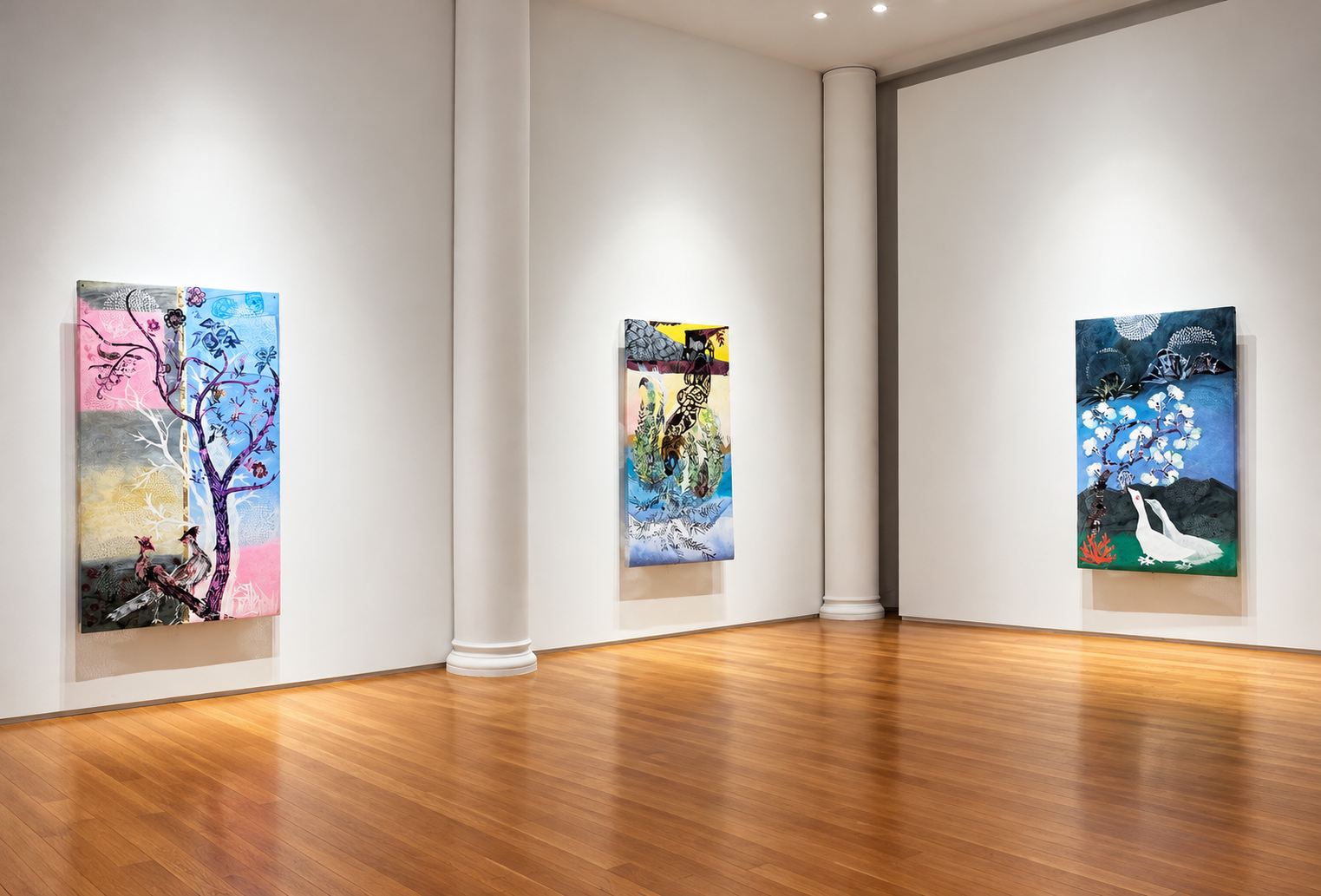
Installation view of Xin Song’s On the Way to Utopia, Tenri Cultural Institute, New York, September 30–October 14, 2026.
By SOOJUNG HYUN October 29, 2026
Across the worktable lay papers and fabrics, threads, magazines, and fragments waiting to be cut or assembled. Some pieces were unfinished; others had been set aside. They held the marks of repeated decisions, patient work, and the long search for a form. This was Xin Song's studio, on the day I visited.
Under the Tenri gallery's high ceiling, those papers and fabrics had become finished works that filled the room, each seeming to speak in its own voice. What had occupied the intimate space of the studio now addressed a public. But the traces of making remained: the cutting, layering, stitching, and assembling could still be seen beneath the vivid surfaces. A finished artwork presents itself as a result, yet it also carries an artist's long engagement with the world.
This transition made me ask what sustains an artist's practice over time. Song began her Tree of Life series in 2008 to examine both the human and natural worlds. The exhibition Xin Song: On the Way to Utopia, curated by Thalia Vrachopoulos at the Tenri Cultural Institute, conveys not only beauty but also rich content. Installed away from the wall, Song’s monumental paper sculptures sway in the slightest breeze. The artist’s inquiry takes shape in trees, mountains, and flowers built from cut paper, fabric, and magazine pages. Their visual pleasure is immediate; their underlying concerns emerge more slowly.
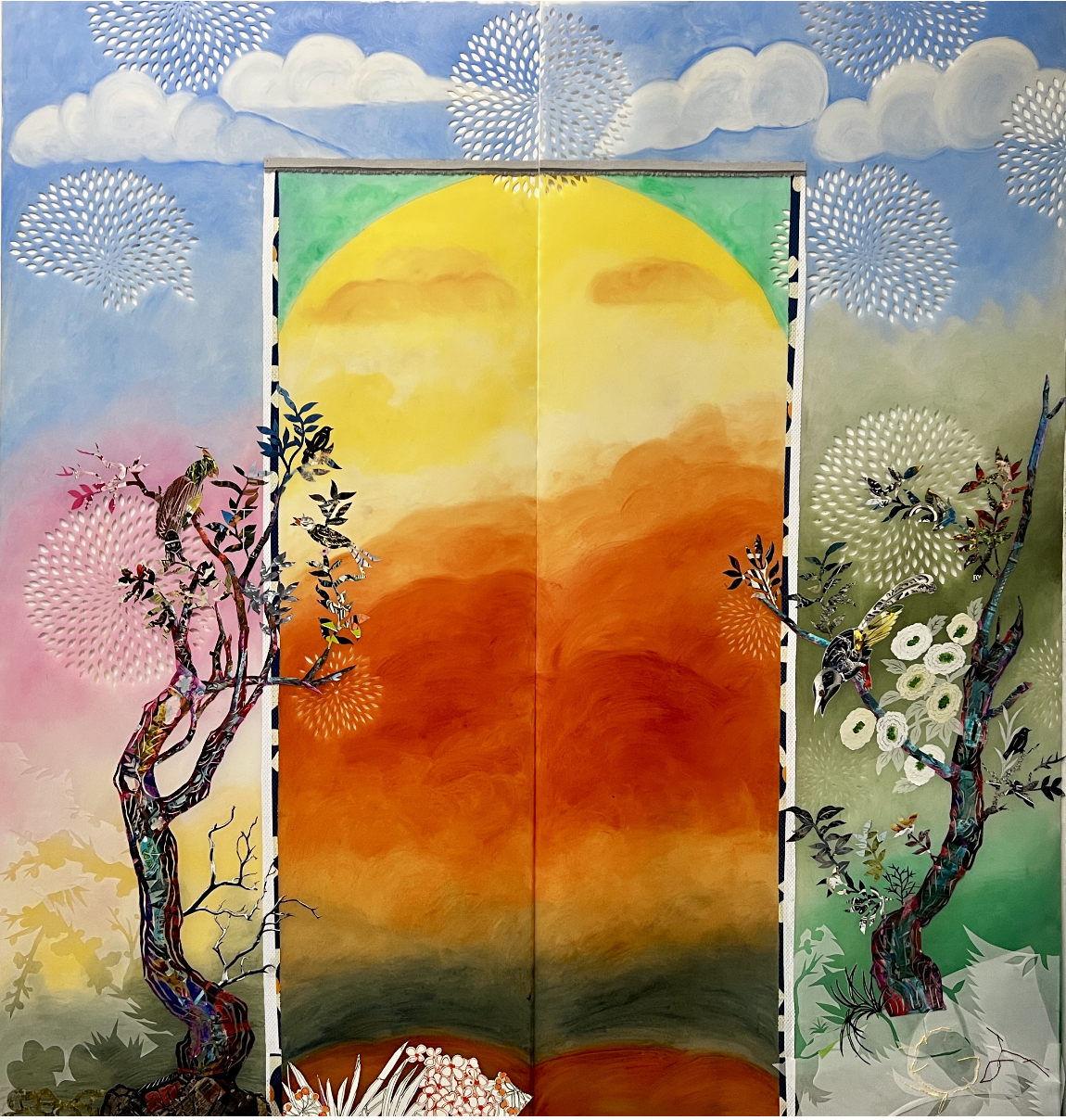 Tree of Life series— Gate to Paradise, 2026, watercolor, oil pastel, street photo prints and vintage magazine, block prints and mixed paper collage and fabric cutout collage on mylar, 36” x 76” each, two panels
The Material Life of Memory
Born in Beijing, Song learned papercutting from farmers in the Chinese countryside in her youth. She later graduated from the Central Academy of Fine Arts in 1994. Her work lives where those two educations meet: she did not simply inherit a folk craft, but found the point at which it could speak in the language of contemporary art.
Her materials came from the life around her. Song moved to the United States in 2000, and in that unfamiliar culture, American magazines caught her eye. She began collecting vintage issues from the 1960s, '70s, and '80s, and she still draws on them, cutting these American images apart and rebuilding them into Chinese ones. Fabric was equally close at hand: her studio stands near New York's Garment District, and its remnants now sit beside textiles her mother gave her in Beijing, so that memory enters the work through the materials themselves.
What interests me most is how freely she accepts all of this. Her cultural background, materials associated with domestic and traditionally feminine practices, and scraps of the city around her are all welcomed into her work. She cuts, collages, sews, and assembles without being constrained by boundaries between fine art and craft, tradition and contemporaneity, or Eastern and Western visual cultures. The same openness extends from gallery installations to public art projects. She makes the freedom of contemporary art her own.
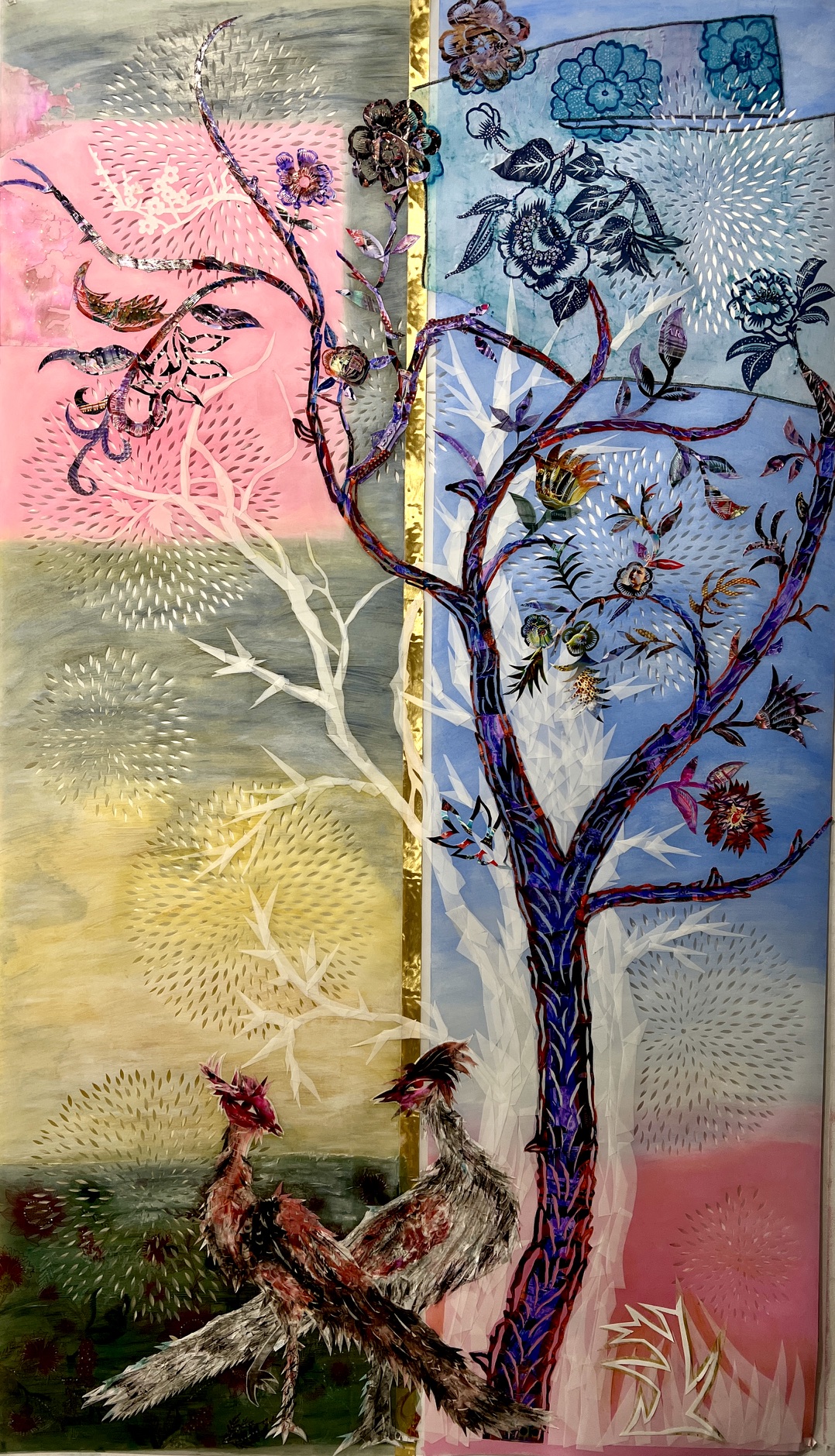 On the Way to Utopia #02, from the Tree of Life series, 2025, watercolor, oil pastel, street photography prints, vintage magazines, block prints, mixed-paper collage, and fabric cutout collage on Mylar, 42 × 72 inches.
That freedom shows most plainly in her color. Song's brilliant palette and ornamental abundance may tempt viewers to call the work decorative, but the label would be dismissive of its content. Chinese paper-cutting traditionally adorns homes during seasonal celebrations, expressing hopes for happiness, prosperity, and renewal. Her landscapes in the series, Tree of Life—On the Way to Utopia, evoke the folk tradition in flowers, elaborate branches, and fantastical birds like the phoenix. They invite delight; folk motifs collide with photographs, magazines, and the excess of consumer culture, and that collision gives the work its restless energy.
Together, these choices offer a way into the exhibition's central theme. She brings together materials and images from different cultures, histories, and everyday lives, and lets each keep its own identity. What emerges is not a seamless harmony but a world held together through encounters, adjustments, and transformations. Her artistic process itself suggests the possibility of coexistence without the erasure of difference.
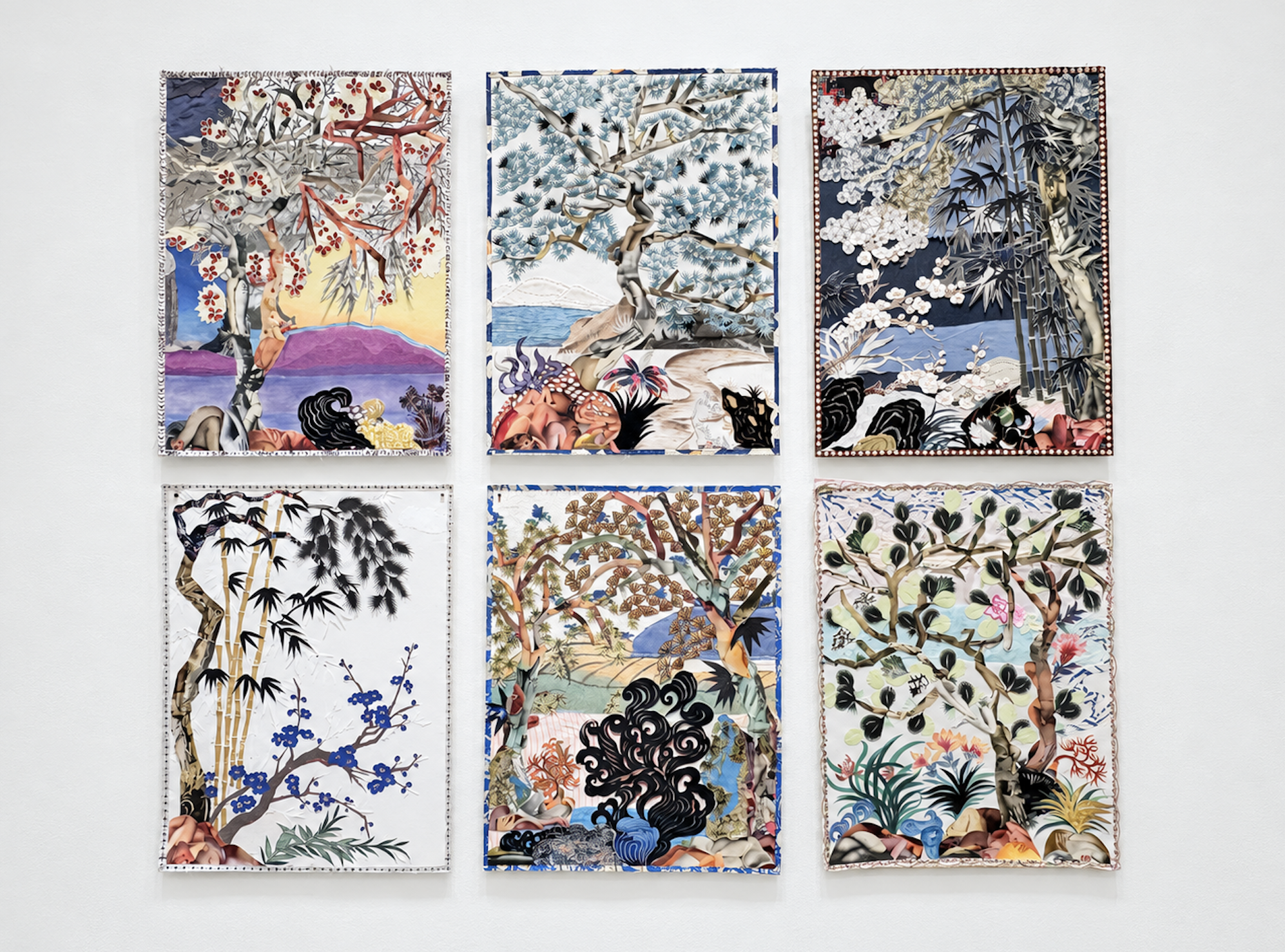 Branching Flows, from the Tree of Life series, 2026, mixed papers, vintage magazines, woodblock prints, watercolor, paper cutouts, hand stitching, and embroidery on paper. 23 × 30.5 inches each.
What the Cut Leaves Behind
Drawing deposits a mark; cutting removes material, leaving both a contour and an opening. In Song’s hands, repeated cutting becomes a vocabulary of edges, voids, and layered forms. In the Tree of Life—On the Way to Utopia series, cut paper, fabric, and magazine fragments gather on Mylar, a translucent polyester film used in architectural drafting. Their overlapping forms blur the boundaries between drawing, printing, and collage. Even the empty spaces become part of the image.
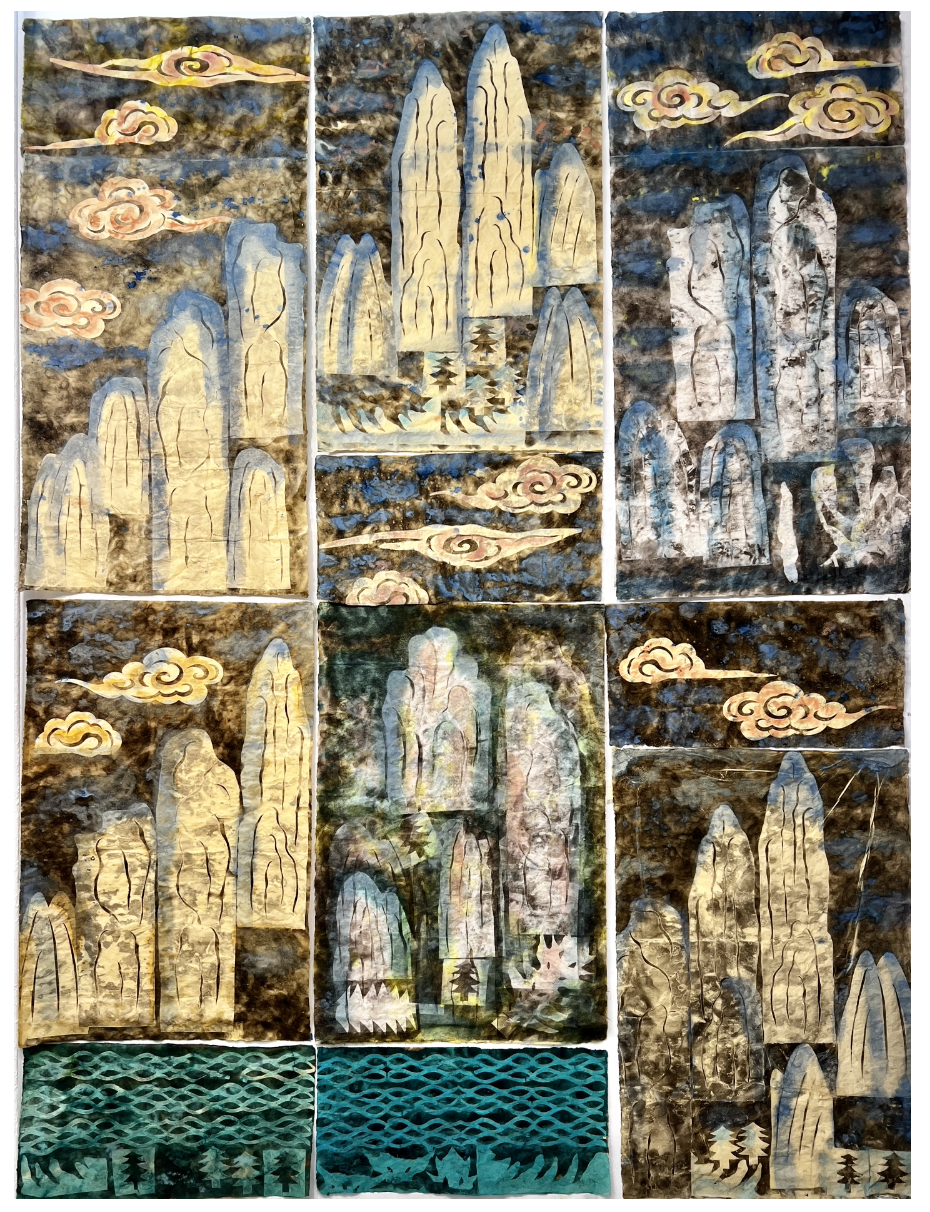
Beyond the Mountains, 2026, paper cutouts with ink and watercolor on rice paper, 27 × 48 inches each.
In Beyond the Mountains (2026), Song turns toward the visual language of traditional Chinese landscape painting. The long, narrow composition recalls a hanging scroll, with pale mountain peaks outlined in dark lines, stylized clouds, and a band of turquoise waves above a row of small trees. Yet its simplified forms and decorative rhythms retain the directness of folk art rather than the refinement of classical literati painting.
The work’s distinctive surface comes from a technique Song learned in China and has revisited for this exhibition. After cutting the mountain forms from paper, she carefully exposes them to a candle flame, allowing soot to settle into the surface rather than applying color directly with a brush. The process requires patience and technical control: the flame must leave its traces without destroying the delicate paper. She then develops the composition through additional cut-paper elements and collage. The resulting landscape carries both the physical marks of fire and the memory of a traditional practice.
Here, the past is brought into conversation with the present. The darkened surfaces suggest a landscape touched by environmental damage, while the mountains and clouds retain the imaginative beauty of Chinese landscape painting. Song layers an inherited technique with a contemporary awareness of ecological vulnerability. The title, Beyond the Mountains, points toward a world beyond our immediate reach, suggesting that the search for utopia begins with an awareness of the fragile world we inhabit.
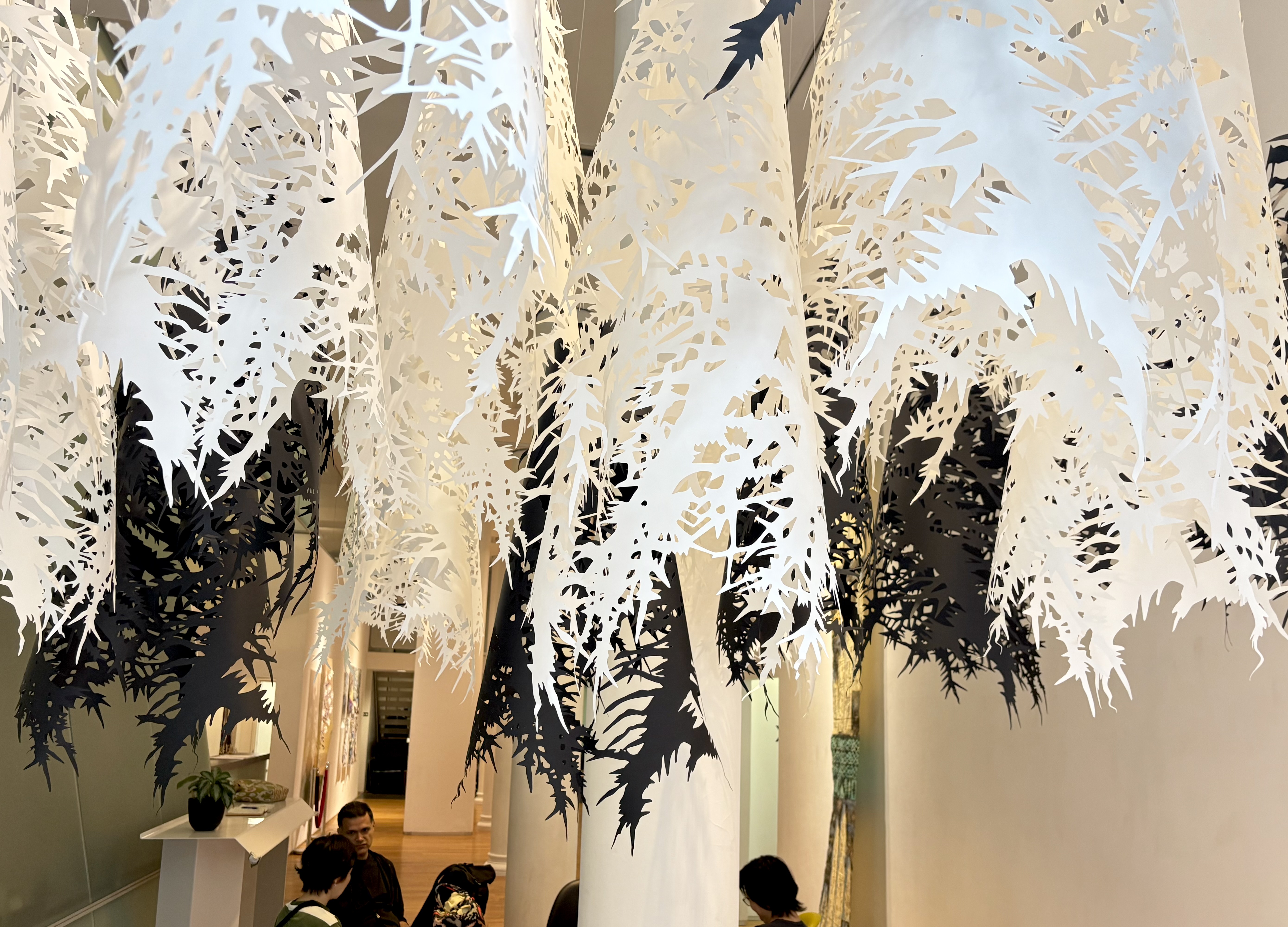 Message from Nature, 2026, site-specific installation, 36 × 30 inches each.
Message from Nature (2026), a site-specific installation, brings these concerns into the gallery itself. Suspended sheets of white and black paper, intricately cut into leafy patterns, evoke a forest. According to the artist, the black forms signify environmental damage. Light passes through the openings, casting shadows across the surrounding walls. Here, cutting becomes more than a technique; it also evokes absence and loss. The installation asks us to recognize nature’s vulnerability even as we admire its beauty.
These works suggest that Song’s utopia is neither a return to an untouched past nor a fantasy of a perfect future. In her artist statement, Song invokes Tao Yuanming’s Peach Blossom Spring, reading its hidden ideal community as a metaphor for humanity’s enduring search for harmony and belonging. For her, utopia is an ongoing journey shaped by memory, migration, and renewal. Vrachopoulos, for her part, connects the work to the Chinese tradition of retreat into nature, emphasizing how Song turns that historical impulse toward a reflection on contemporary ecological destruction. Taken together, these readings point to a utopia that does not escape reality but is built within it, from fragments of ordinary life. Like the work itself, it begins by affirming the little things.
Returning in my mind to Song’s studio, I think again of the papers, fabrics, and unfinished pieces scattered across her worktable. What I encountered there was an artist’s continuing effort to give form to her experience of the world. Perhaps this is the vision offered by On the Way to Utopia: not the promise of a perfect world, but the possibility of creating meaning and connection within an imperfect one. Art cannot deliver utopia. It can, however, sustain our capacity to imagine what lies beyond the world as it is.
Soojung Hyun
Soojung Hyun is a New York–based curator, writer, and art historian. She has organized exhibitions at venues including the Anya and Andrew Shiva Gallery, AHL Project Space, and PS122 Gallery. She teaches Asian and contemporary art as an adjunct faculty member and contributes to the Archive of Korean Artists in America (AKAA). Her writing focuses on diasporic identity, material memory, and the intersection of Eastern and Western aesthetics.
view all articles from this author