Whitehot Magazine
October 2026
"The Best Art In The World"
"The Best Art In The World"
October 2026
Tiffany Shlain’s “Moveable Monument” Heads to Austin
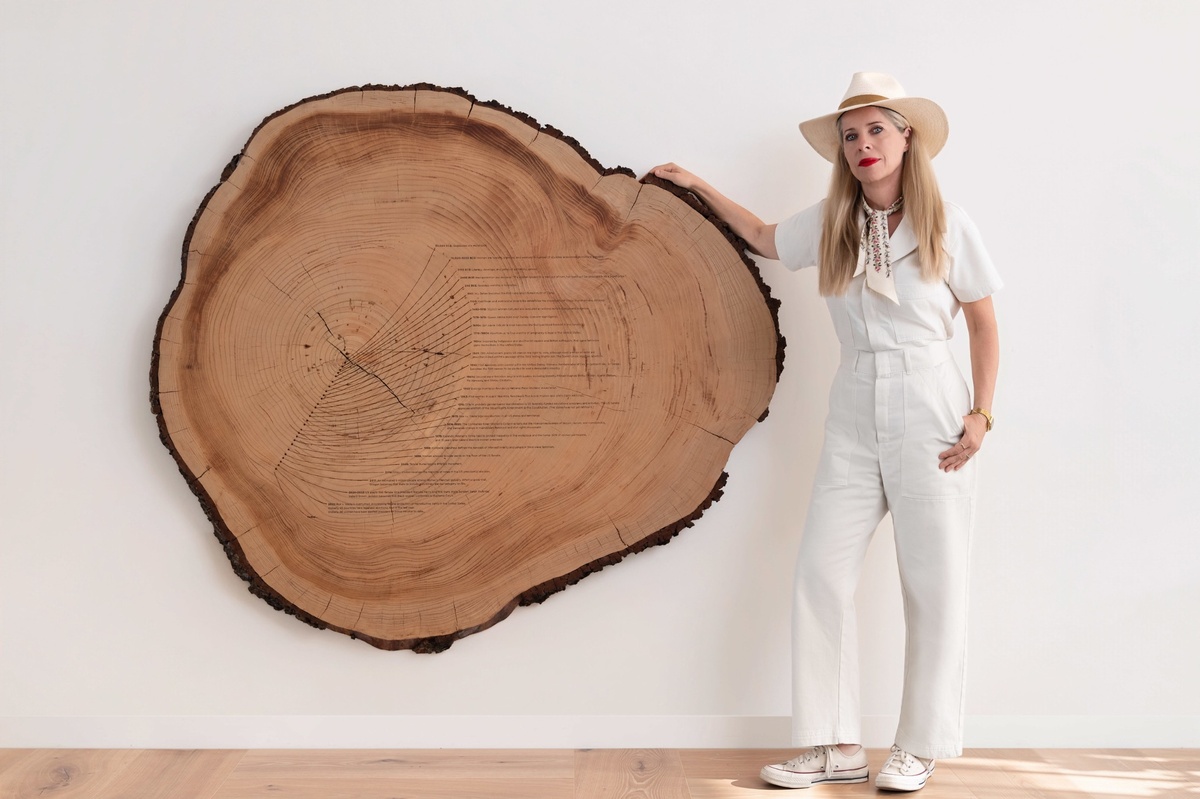 Tiffany Shlain with Dendrofemonology: A Feminist History Tree Ring. Photo: Thom Milkovic. Courtesy of the artist.
By KUN SOK October 2nd, 2026
Tiffany Shlain’s Dendrofemonology: A Feminist History Tree Ring will be installed at Austin Central Library on October 27, one week before the midterm elections. An artist talk, film premiere, and reception will bring audiences together around a sculpture that connects women’s history with the rights at stake today.
At her October 1 talk at Nancy Hoffman Gallery in New York, Shlain explained the timing: “We feel like it’s very good to gather right before an election. It’s so tense, and just to gather and talk about issues you care about matters.”
When I asked whether she speaks with residents before exhibiting in a new place, and how that process had unfolded in Texas, Shlain said she did not know many people there. Her newsletter and press coverage would help spread the word. Her answer also addressed why she wanted to bring the work to the state. Discussing women’s rights in Texas, she explained: “I think it’s an unexpected way to bring up issues.”
Created in 2022, Dendrofemonology uses pyrography to burn 32 milestones in women’s history, from 50,000 BCE to the present, into reclaimed deodar cedar. Its title adapts “dendrochronology,” the science of dating wood through its growth rings.
In a published account, Shlain traced its origins to a tree-ring timeline she encountered at Muir Woods in 2021. She admired the idea of a tree bearing witness to history but found the selected events weighted toward patriarchal and colonial perspectives. Drawing on two decades of research for feminist films, she created an alternative timeline for her daughters and others.
Its entries include Wu Zetian, Dolores Huerta, and the Combahee River Collective. Alongside achievements, it records reversals: the 1973 Roe v. Wade decision and its overturning in 2022 appear within the same tree rings. Women’s rights can expand and then retreat.
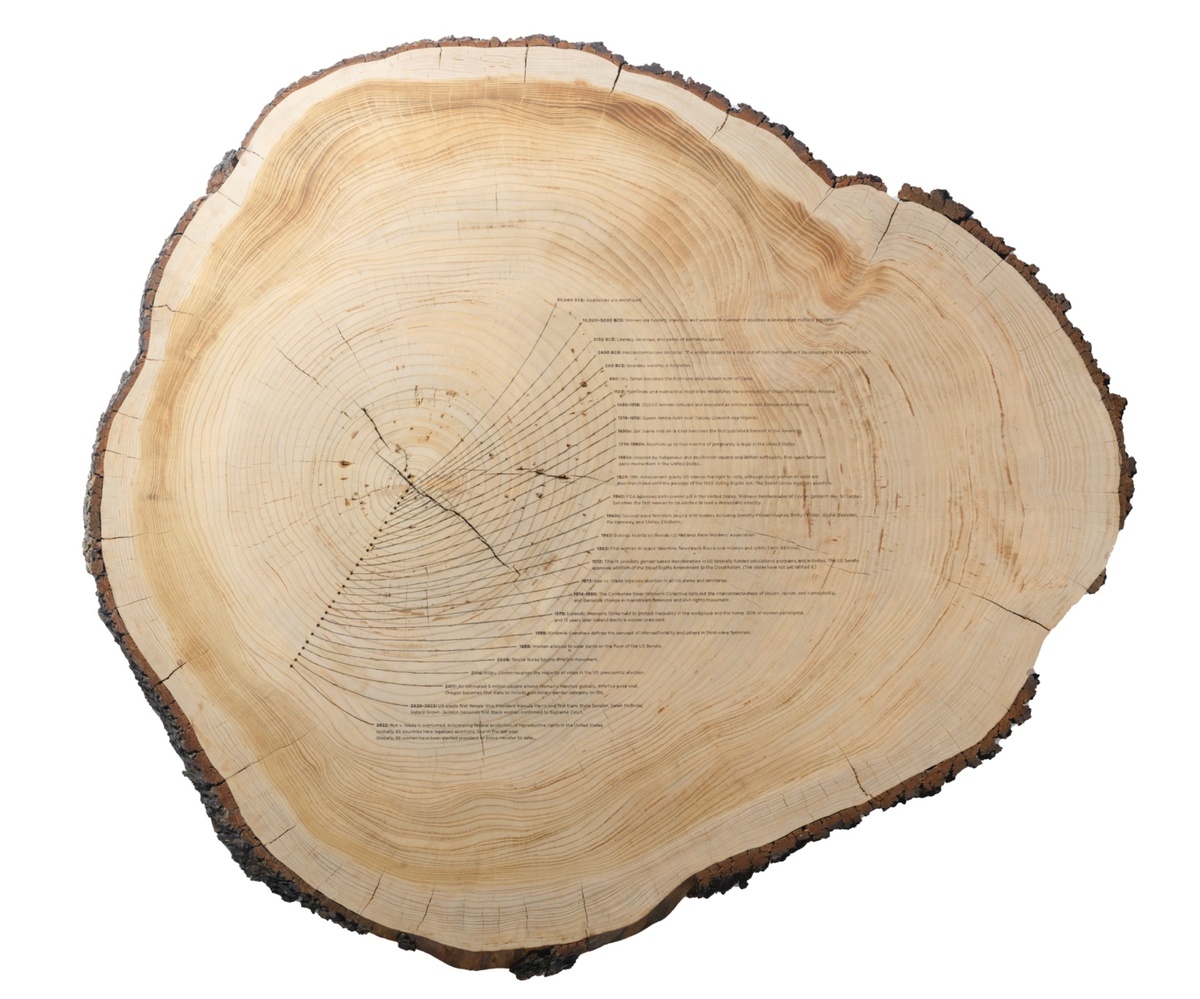 Tiffany Shlain, Dendrofemonology: A Feminist History Tree Ring (2022), photographed in 2024. Courtesy of the artist.
First presented in San Francisco, the work has traveled to the National Mall, Madison Square Park, and Seneca Falls. Shlain calls it a “moveable monument.” Austin brings another audience into that journey.
When I asked how she reaches younger generations who may understand feminism differently, Shlain turned to her daughter’s rights. “I had an abortion when I was 23 because I was not ready to be a mom,” she said, expressing concern that young women today do not all have the choices she had. She also recalled students encountering the work in Seneca Falls.
“I make my movies to try to reach younger people too,” she said. At the talk, she announced that a new version of We Are Here, following the artwork’s creation and travels, would be titled Where Are We?!. The latest version will premiere in Austin, with organizers also inviting people elsewhere to host screenings with friends and family that day.
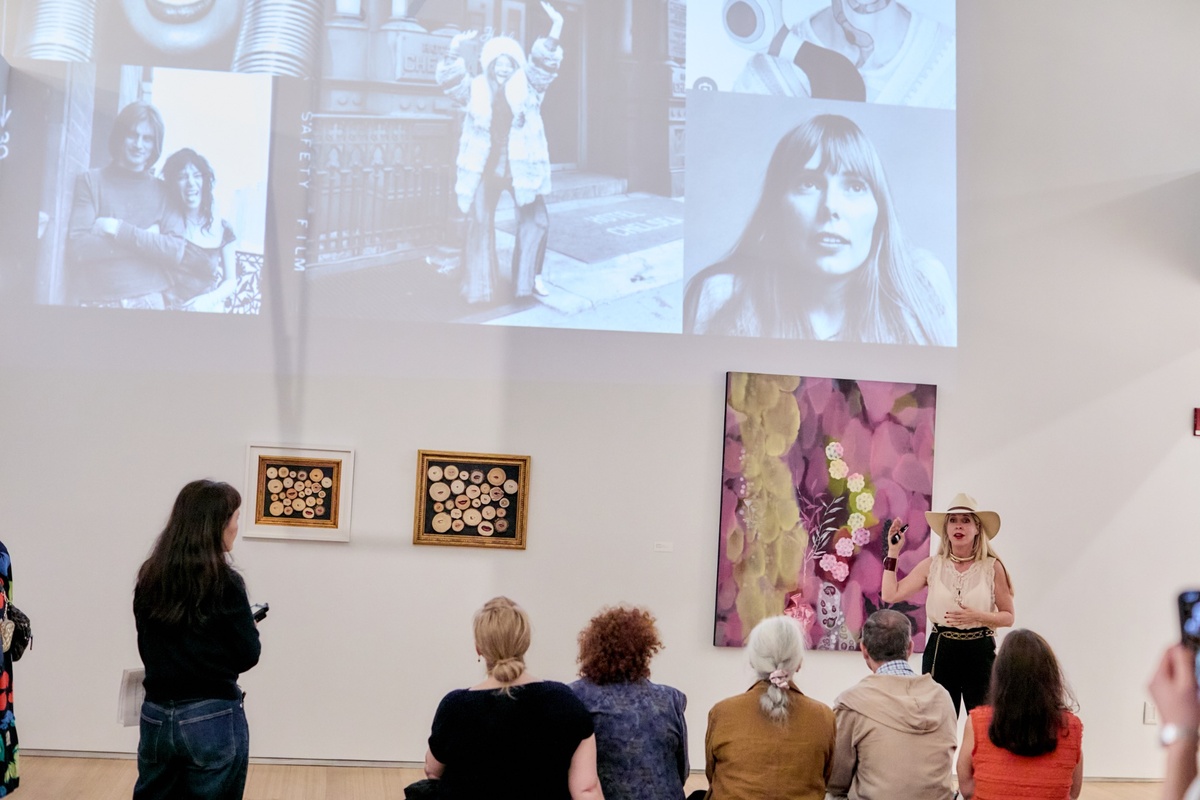 Tiffany Shlain speaking at Nancy Hoffman Gallery, New York, October 1, 2026. Photo: Daphne Youree (Daphne Photography)
The talk also introduced her new collage, If These Walls Could Talk: Women of the Chelsea. Created in 2026, the collage has entered the Hotel Chelsea’s permanent collection and hangs between the seventh and eighth floors, near the room where Shlain stayed in her twenties while making Zoli’s Brain.
The work gathers lips from photographs of women associated with the hotel, including Patti Smith, Joni Mitchell, Janis Joplin, Grace Jones, and Niki de Saint Phalle. Collaged onto wood sections against a black background, they form a single composition in a Baroque-style frame. Visiting the hotel before the talk, I saw how the mouths’ expressions and the wood’s varying shapes work together.
Shlain opened the talk with memories of red lipstick. Teased about her large lips as a child, she received lipstick from her grandmother, who told her it would make people pay attention to what she said. Shlain also discussed its association with women’s suffrage, linking family memory with women making themselves heard.
 A visitor viewing Tiffany Shlain’s If These Walls Could Talk: Women of the Chelsea at Nancy Hoffman Gallery, New York. Photo: Daphne Youree (Daphne Photography).
Asked how the new work differed from earlier pieces, Shlain emphasized humor: “I feel like this has my sense of humor more. If you see my movies, there is a lot of humor in them.” Rearranging the wood sections in her studio offered a different pleasure from the months spent burning words into wood. “I think this feels more like my movies,” she added.
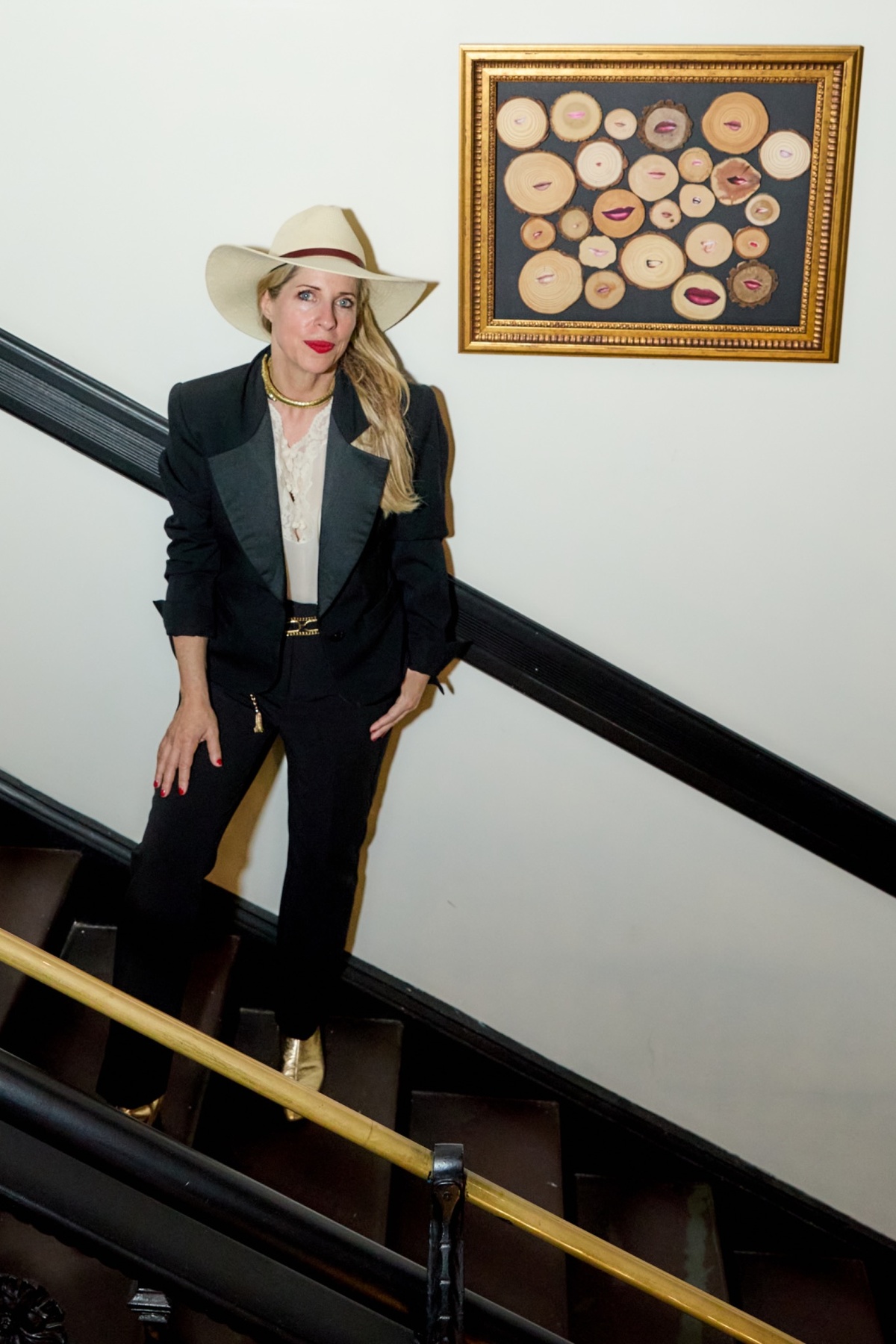 Tiffany Shlain with If These Walls Could Talk: Women of the Chelsea (2026) at the Hotel Chelsea, New York. Photo: Daphne Youree (Daphne Photography).
Where Dendrofemonology unfolds a long history, the Chelsea collage gathers women’s traces within one building. Both use tree rings to carry their stories. In Austin, that record becomes an invitation to gather before an election and discuss what matters now.
The October 27 event runs from 6 to 7:45 p.m. at Austin Central Library, 710 W. César Chávez Street. The artist talk begins at 6:15, the screening at 6:45, and the reception at 7. Admission is free; advance registration is recommended.