Whitehot Magazine
October 2026
"The Best Art In The World"
"The Best Art In The World"
October 2026
The Optics of Atrocity: Rachel Howard’s Harvest at 447 Space
By RAPHY SARKISSIAN | October 12, 2026
Peter Paul Rubens painted The Massacre of the Innocents twice, about a quarter century apart. The first, from around 1610 and now at the Art Gallery of Ontario, still speaks the Italian syntax he had just brought home: muscular bodies modeled in a Caravaggesque chiaroscuro. They crowd the foreground while classical buildings recede in perspective under an open sky. The second, from around 1638 and now in Munich’s Alte Pinakothek, loosens everything. The space opens, the brush quickens, and the slaughter acquires a fluency that Antoine Watteau would later make his own.
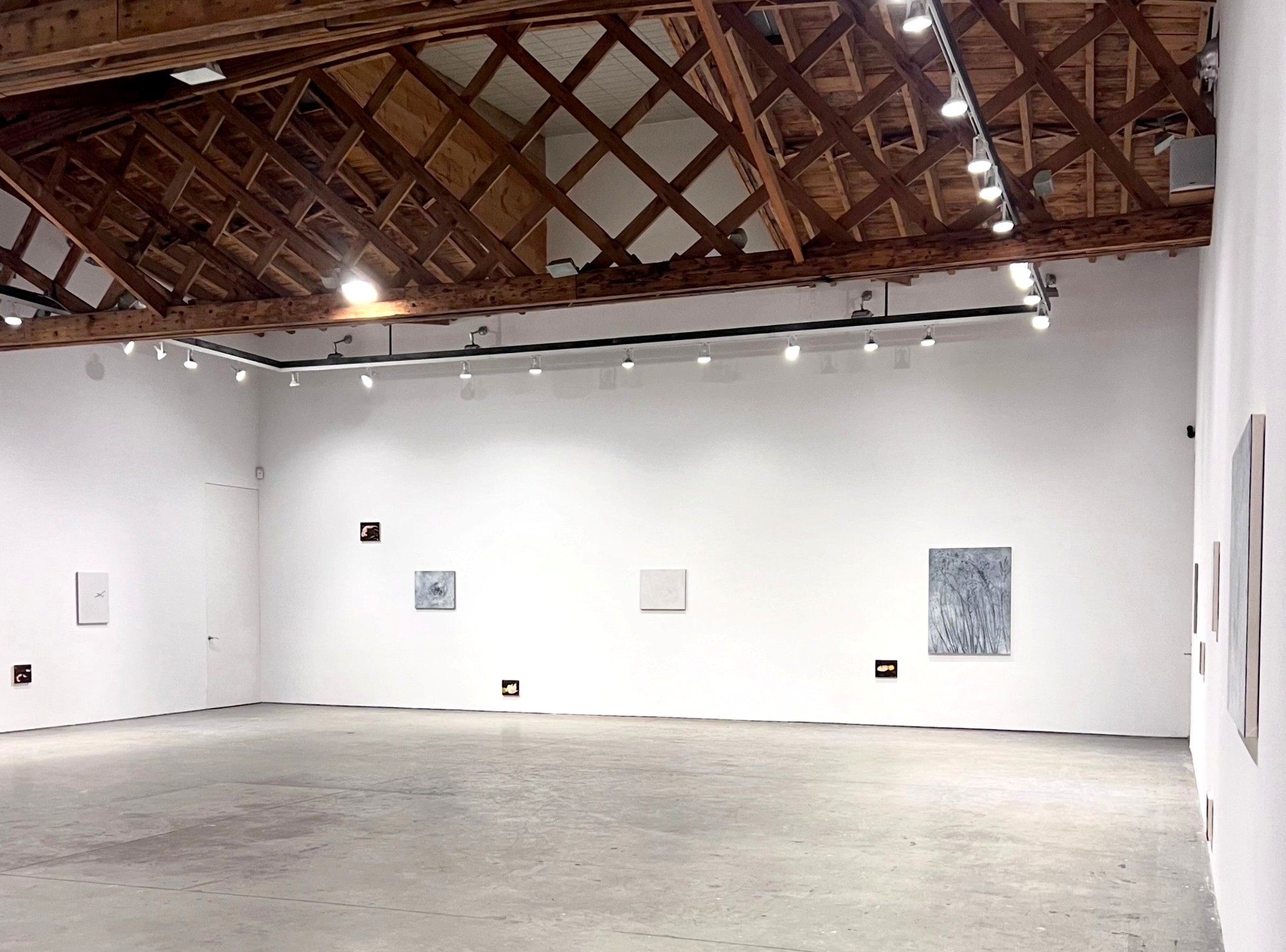 Installation view, Rachel Howard: Harvest, 447 Space, New York, 2026. © Rachel Howard. Courtesy of the artist and 447 Space.
At 447 Space, Rachel Howard’s Harvest abandons the gallery’s customary eye level. Twenty-one paintings hang at unpredictable heights, some near the floor, some above the expected height. The viewer is kept in constant adjustment, crouching, looking up, stepping back. We encounter apparitions of airplanes, then the bodies of infants Rubens had shaped. Rubens illustrates mankind’s monstrosities, and so does the terror of bombs. Then, bewilderingly, Howard presents a painting as if it were a floral wallpaper, hackneyed and bygone, along with a landscape so out of focus it survives only as a ghost, in acidic tones.
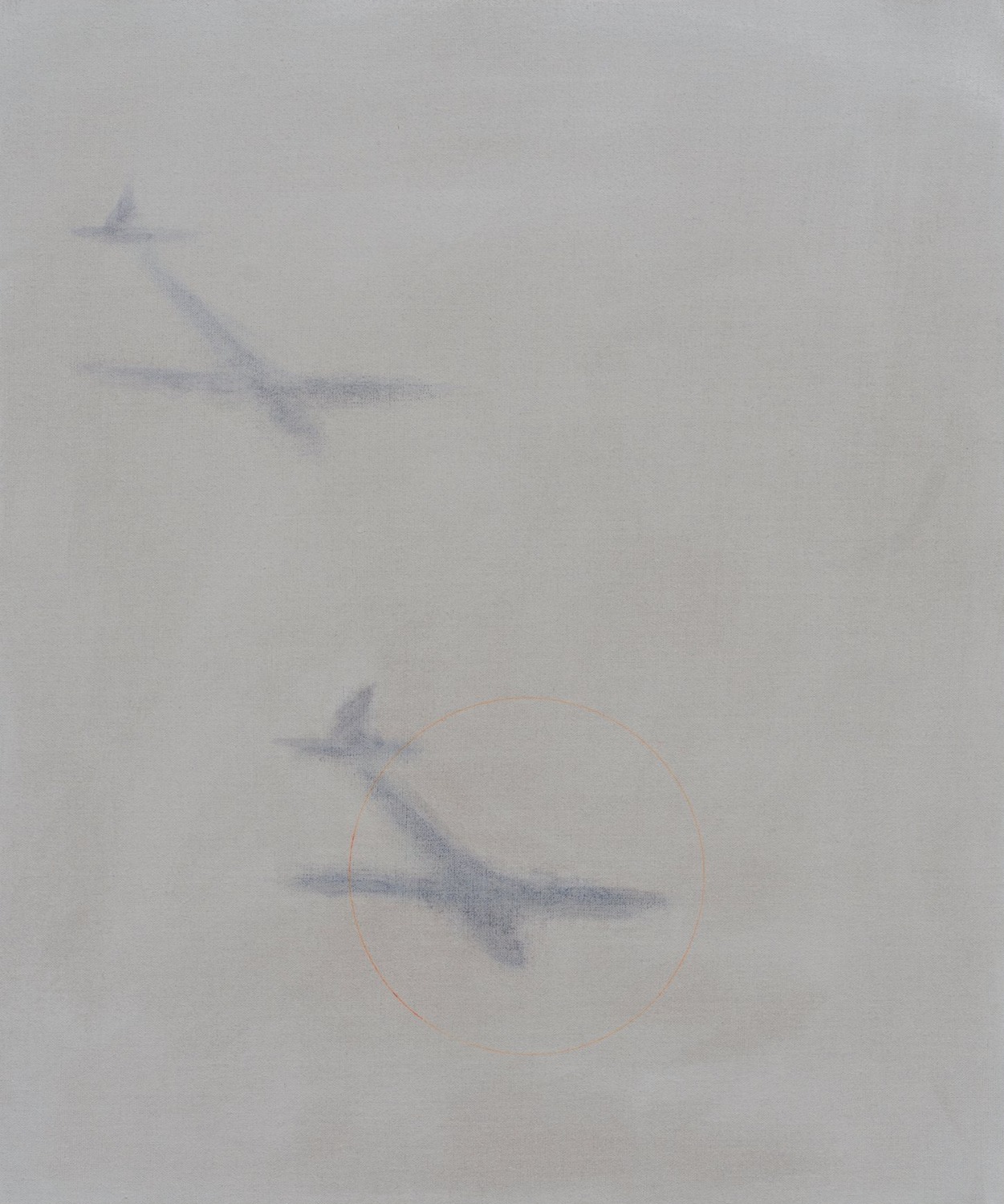 Rachel Howard, Unmanned Double Trouble (Drone 5), 2026. Oil and archival marker pen on linen, 24 by 20 inches. © Rachel Howard. Courtesy of the artist and 447 Space.
Across the walls of the space, Howard retains the motif of the flying drone through five paintings. Unmanned Double Trouble (Drone 5) and Tap, Tap, Tap (Drone 123) register as variations on the same theme, whereby off-white monochromes are punctuated with painterly depictions of descending aircraft. Through their titles, Howard transforms the flying object from its relative neutrality into a technopolitical message of destruction. Reaper (Drone 3) reverses the motion. Its single plane climbs at mid-height on the right, the only aircraft in the series that rises. Peeper (Drone 2) returns to the descent, its plane dropping through the middle of the canvas on the right. Taken together, the planes fall and rise, one, two, and three at a time, as if rehearsing a story not yet told: a proto-narrative of flight before anything has been struck.
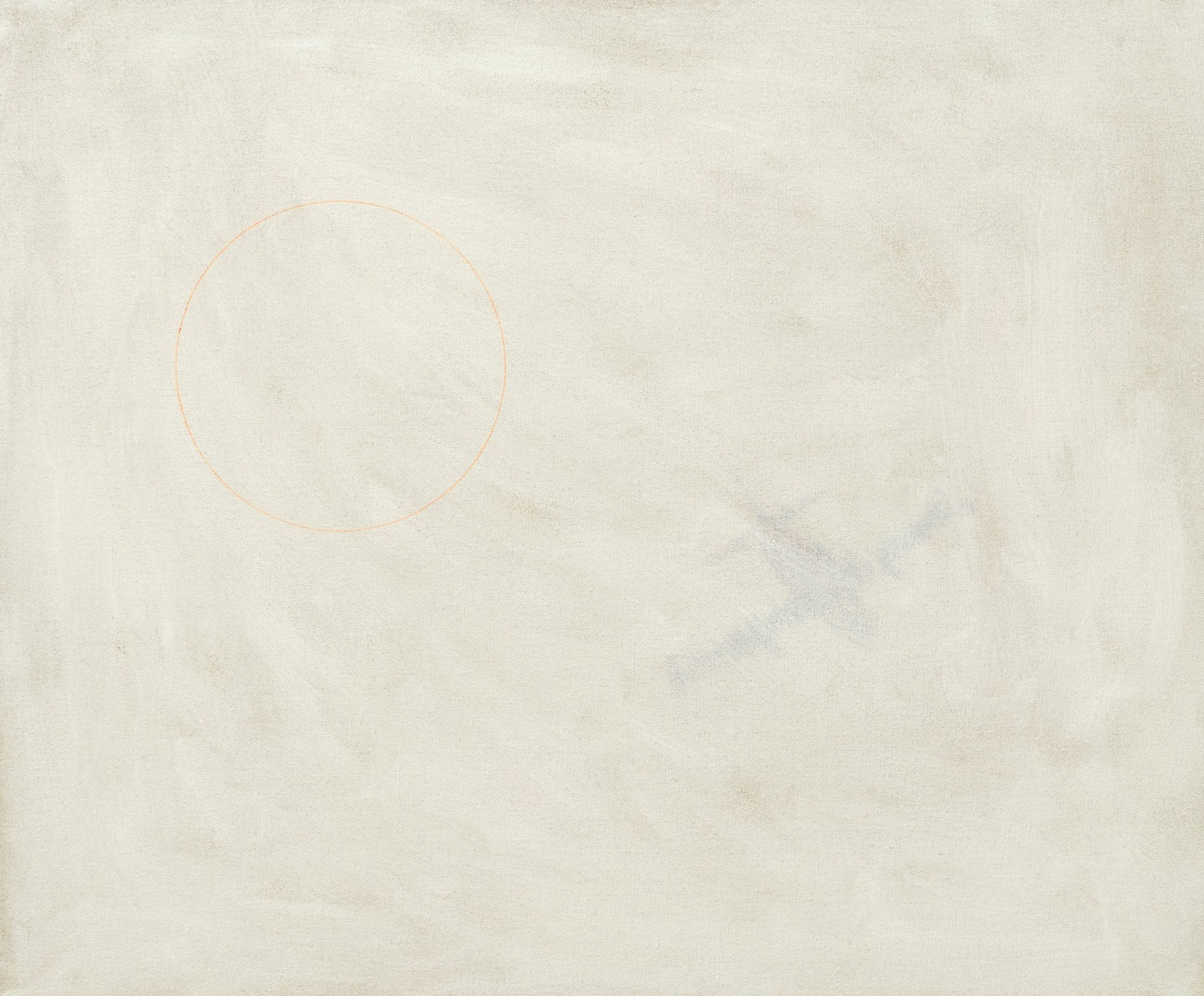 Rachel Howard, Blink (Drone 1), 2026. Oil, acrylic, and archival marker pen on linen, 20 by 24 inches. © Rachel Howard. Courtesy of the artist and 447 Space.
Blink (Drone 1) is the faintest of the five. From across the room it reads as a soiled monochrome, the aircraft neither visible nor invisible. Up close, a plane in chalky gray descends toward the lower right, while an orange circle of about the same size hovers in the opposite corner, imperceptible from a distance. Here a phantom defines a phantom. Is it an F-4 Phantom, the fighter-bomber of the Vietnam War, or a DJI Phantom, the consumer drone that films weddings and real estate?
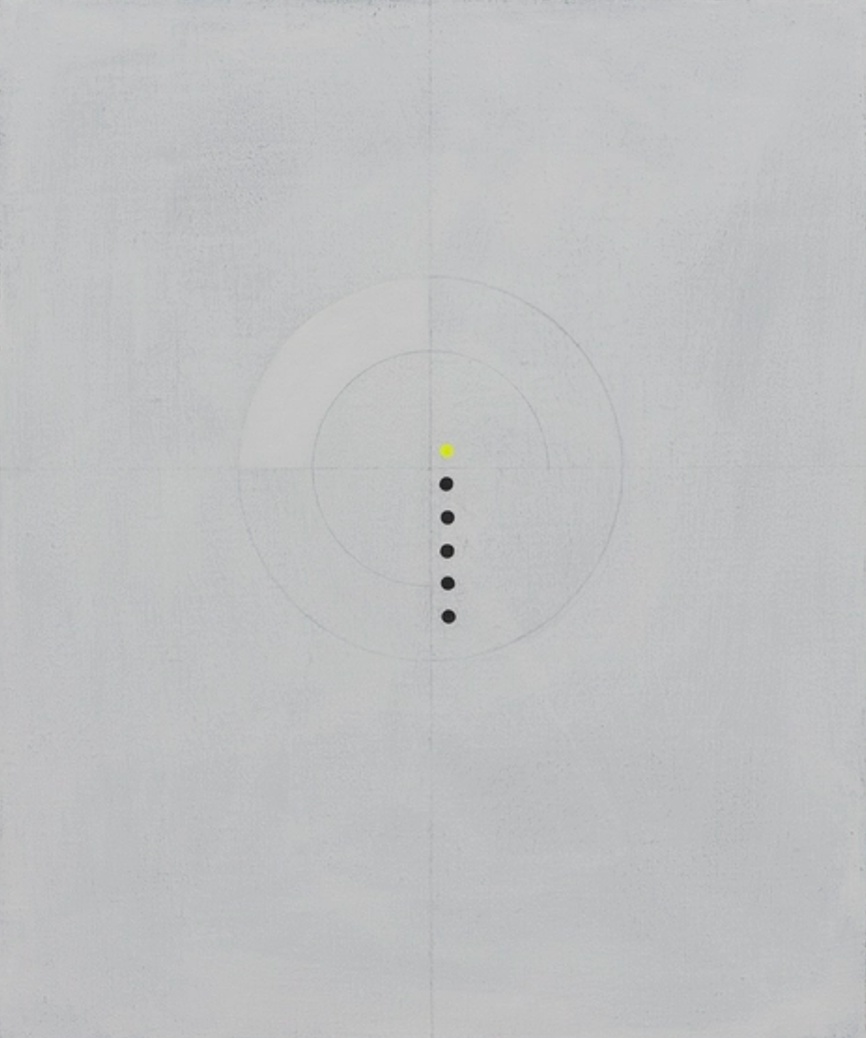 Rachel Howard, S.O.D.A., 2026. Acrylic and oil on linen, 18 by 15 inches. © Rachel Howard. Courtesy of the artist and 447 Space.
Dot Dot Dot and S.O.D.A. take the viewer to the base of the war. The aircraft disappears, and we look through its eyes instead. In Dot Dot Dot, a cross made of dots sits in the upper part of the canvas, like a targeting mark on a screen. S.O.D.A. pares the canvas down to two circles and a centered pair of axes. One quarter of the outer ring is filled in, like the sweep of a radar. Just right of the vertical axis, six dots form a column: five black, and at the top, beside the crossing of the axes, one in neon yellow. That single dot is the painting’s event: one point among several, singled out. In Understanding Media (1964), Marshall McLuhan held that the content of a medium is another medium. The content of S.O.D.A., Howard’s acronym for “Screen Of Death Awareness,” is the operator’s monitor, where the drone’s feed arrives overlaid with crosshairs and coordinates: a screen watched by a few, at the cost of those it shows.
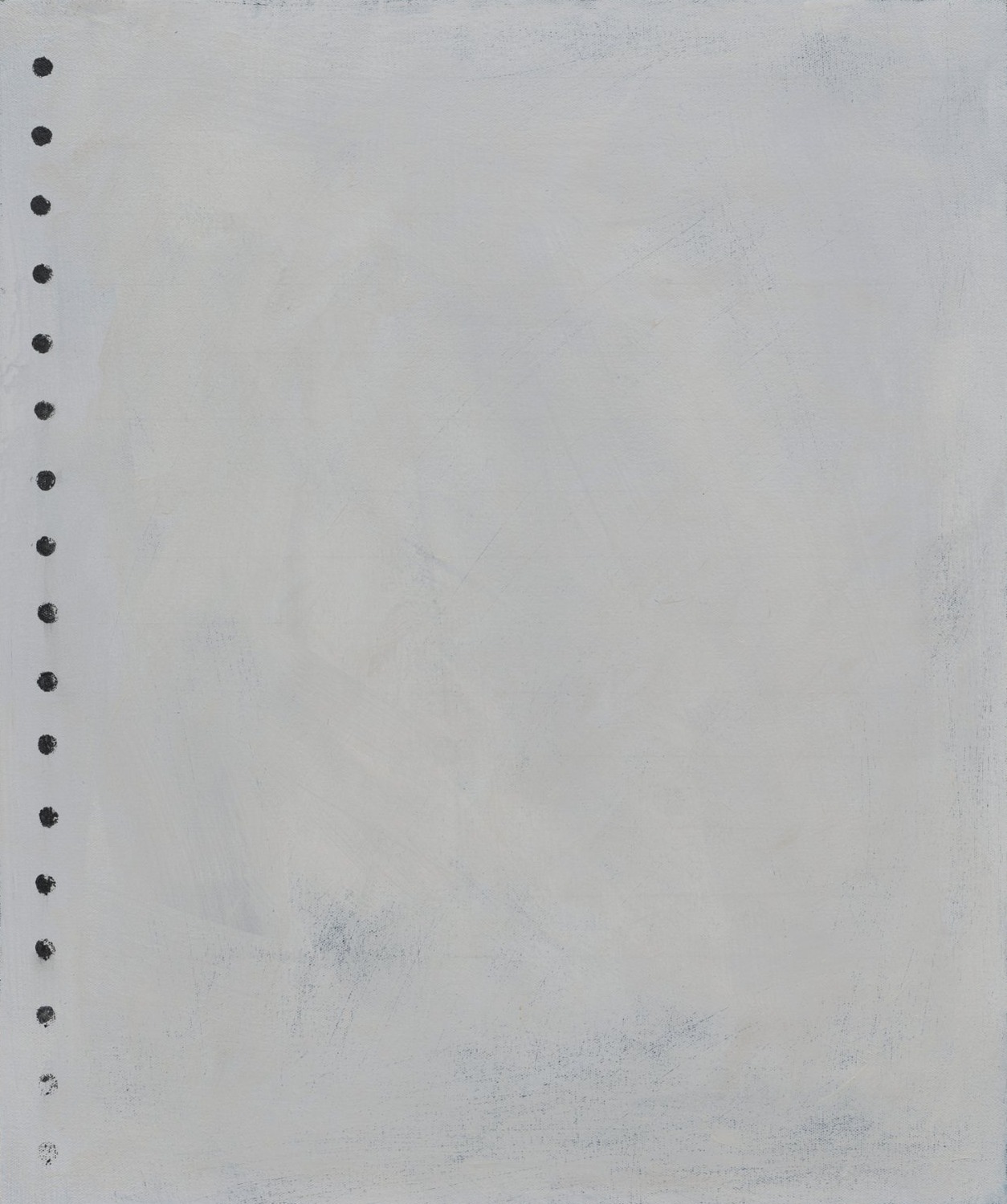 Rachel Howard, Notes Made While Falling, 2026. Oil and acrylic on canvas, 18 by 15 inches. © Rachel Howard. Courtesy of the artist and 447 Space.
The dots return in Notes Made While Falling, hung beside Airdrop. Here a pale, murky field carries a column of seventeen dots down the left edge, like the perforations of a notebook page: no tear, nothing written. On its own, it could pass for an Agnes Martin. But Martin drew her quiet fields away from the social world, toward a private serenity. Howard takes the same vocabulary and lets a technopolitical context do the writing. Between drones and dead infants, under a title that promises notes, the blank page fills with a meaning it does not contain. The dot that marks a target and the dot that binds a notebook are the same mark.
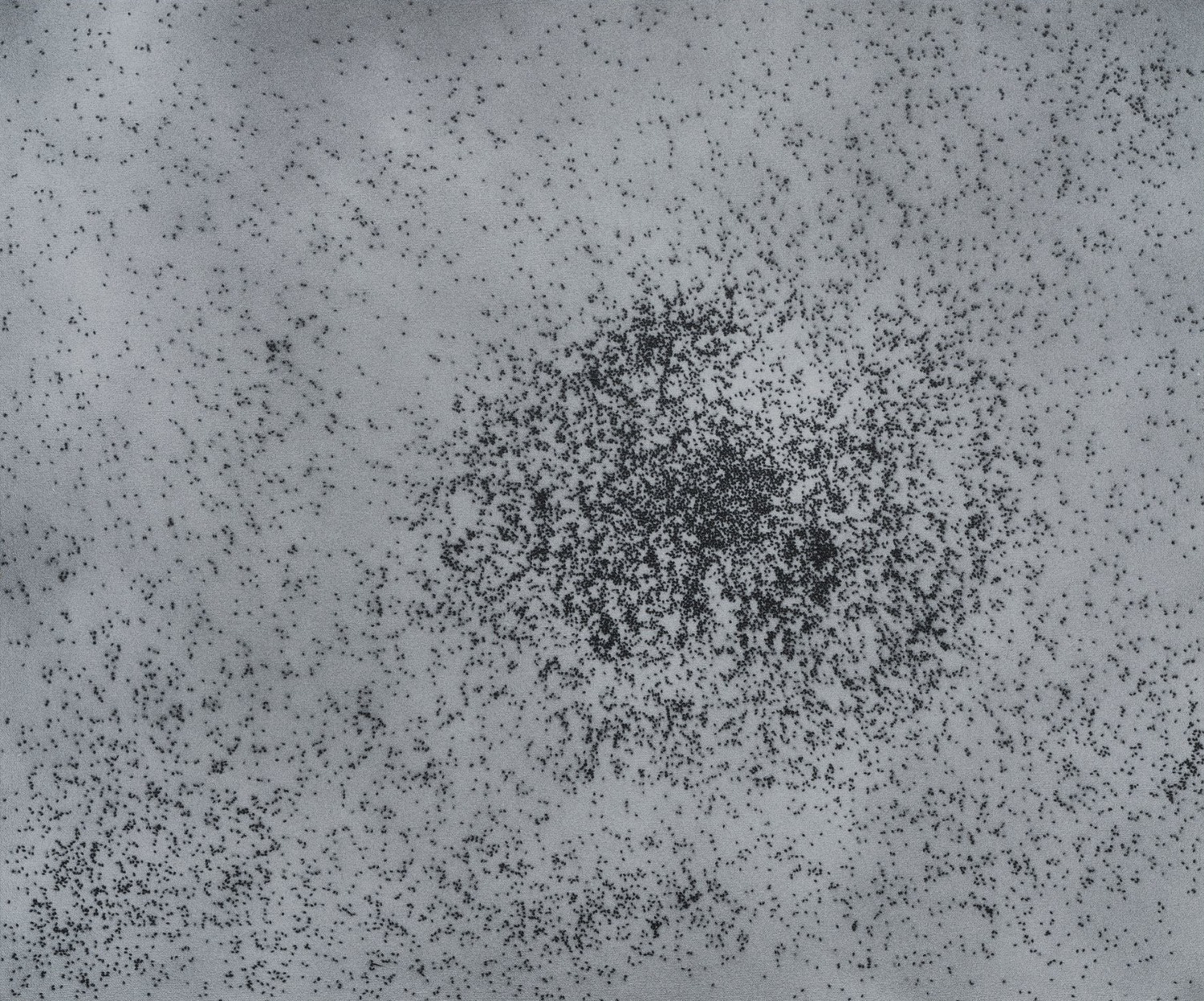 Rachel Howard, Swarm, 2026. Oil and acrylic on linen, 20 by 24 inches. © Rachel Howard. Courtesy of the artist and 447 Space.
Airdrop and Swarm arrive at the event itself. In Swarm, a dark cluster churns at the center of a gray field, its edges coming apart. Airdrop, one of the two largest works here and dated 2025, pushes further toward formlessness, as if the aircraft had dissolved into what it delivered. If the drones rehearse and the targets select, these two show what is left of form afterward. Howard’s planes keep company with Vija Celmins’s Flying Fortress of 1966 and her Bikini of 1968, a bomber in oil and an atomic blast in graphite, both taken from photographs and now at the Museum of Modern Art, with Gerhard Richter’s Bombers of 1963, blurred from a press image, and with Luc Tuymans’s bleached canvases drawn from the news.
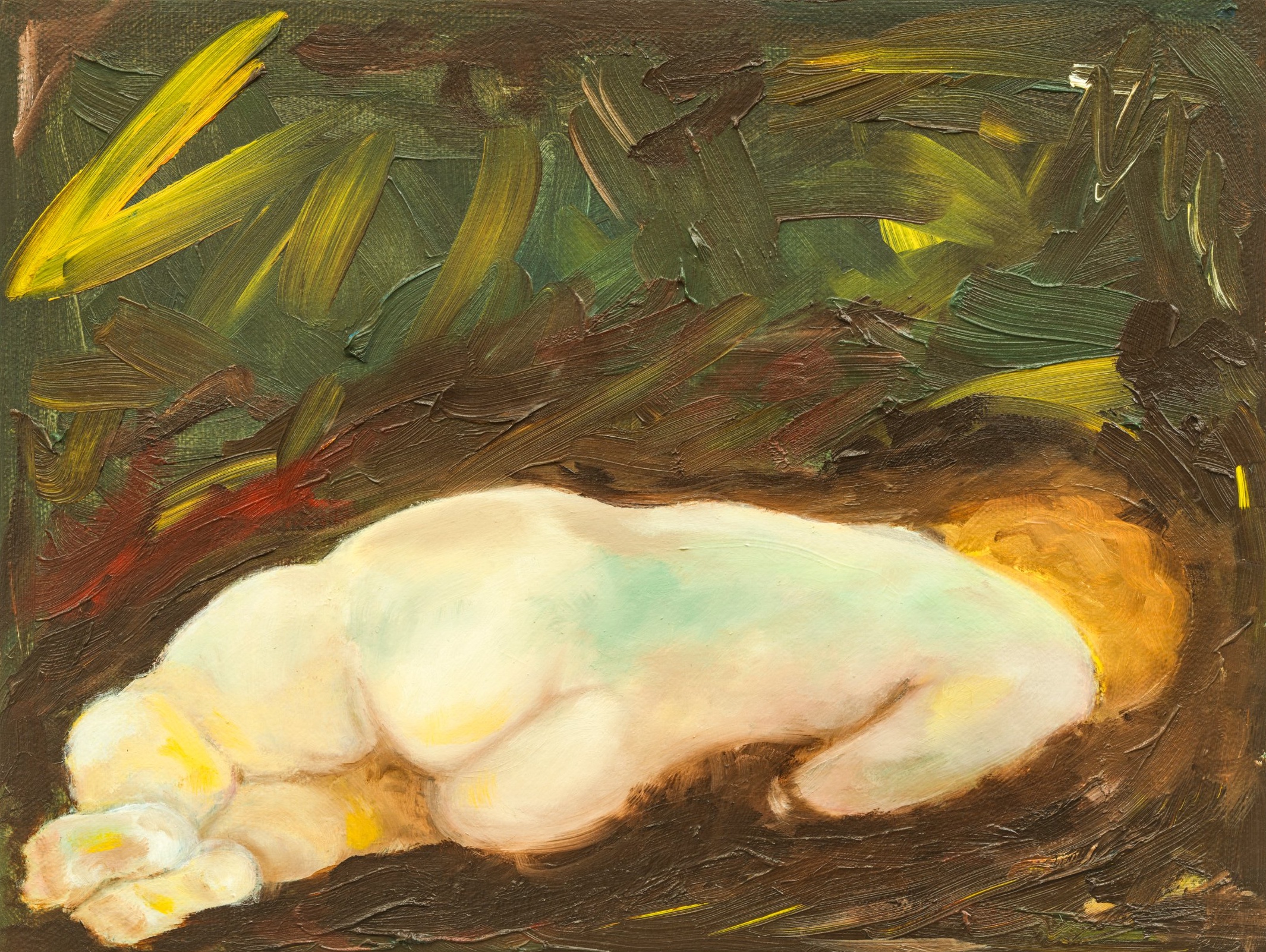 Rachel Howard, Mud Baby 3, 2026. Oil on canvas on board, 9 by 12 inches. © Rachel Howard. Courtesy of the artist and 447 Space.
On the walls Howard never prescribes an order: the sequence remains a quasi-narrative left to the viewer’s judgment. Cinematic in its montage, the arrangement follows the logic of the unconscious. Its deepest layer belongs to the eight Mud Babies, each no larger than a sheet of paper, several hung near the floor or high on the wall. From Rubens’s Toronto panel, which she saw in London in 2005 in Rubens: A Master in the Making, she keeps only the infants. The city is gone, and so is the open sky. His chiaroscuro has thickened into tenebrism: a leg, an arm, a back turned away, in flesh tones and traces of yellow, against dark and earthen grounds. There is hardly any face. Herod’s soldiers have vanished too, and with them the hands that did the killing. The massacre survives only as a latent narrative, waiting to be recognized. The brushstrokes are pronounced, the painter’s hand everywhere visible.
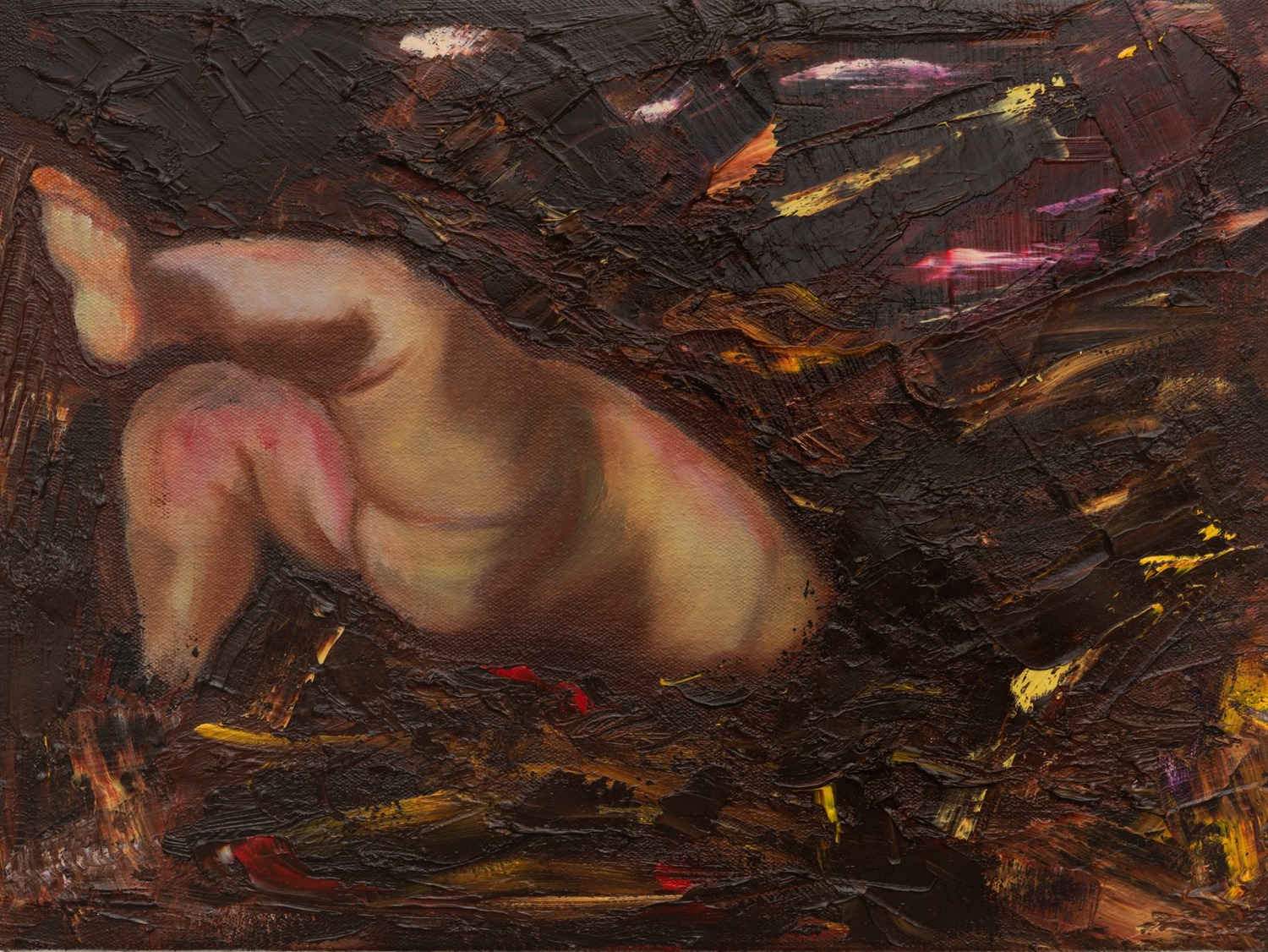 Rachel Howard, Mud Baby 6, 2026. Oil on canvas on board, 9 by 12 inches. © Rachel Howard. Courtesy of the artist and 447 Space.
Rubens painted the killers’ raised arms. Howard paints only aircraft, unmanned. The machine that removes the hand from killing has a longer history. The guillotine entered use in 1792 as a humane machine, swift and impartial, sparing the executioner’s hand. On 16 October 1793, Jacques-Louis David sketched Marie Antoinette from a window as the cart carried her toward it, a few lines drawn at a remove. Howard’s drones descend from both: the machine that spares the hand, and the witness who watches from afar. In A Theory of the Drone (2013), the philosopher Grégoire Chamayou describes drone warfare as a manhunt rather than combat. [1] The drone watches persistently, charting a target’s “pattern of life” until a routine becomes a reason to strike. It dissolves the reciprocity that once made killing in war defensible: one side hunts, the other cannot see its hunter, and combat gives way to slaughter. Blink lets the viewer feel that asymmetry before any theory names it.
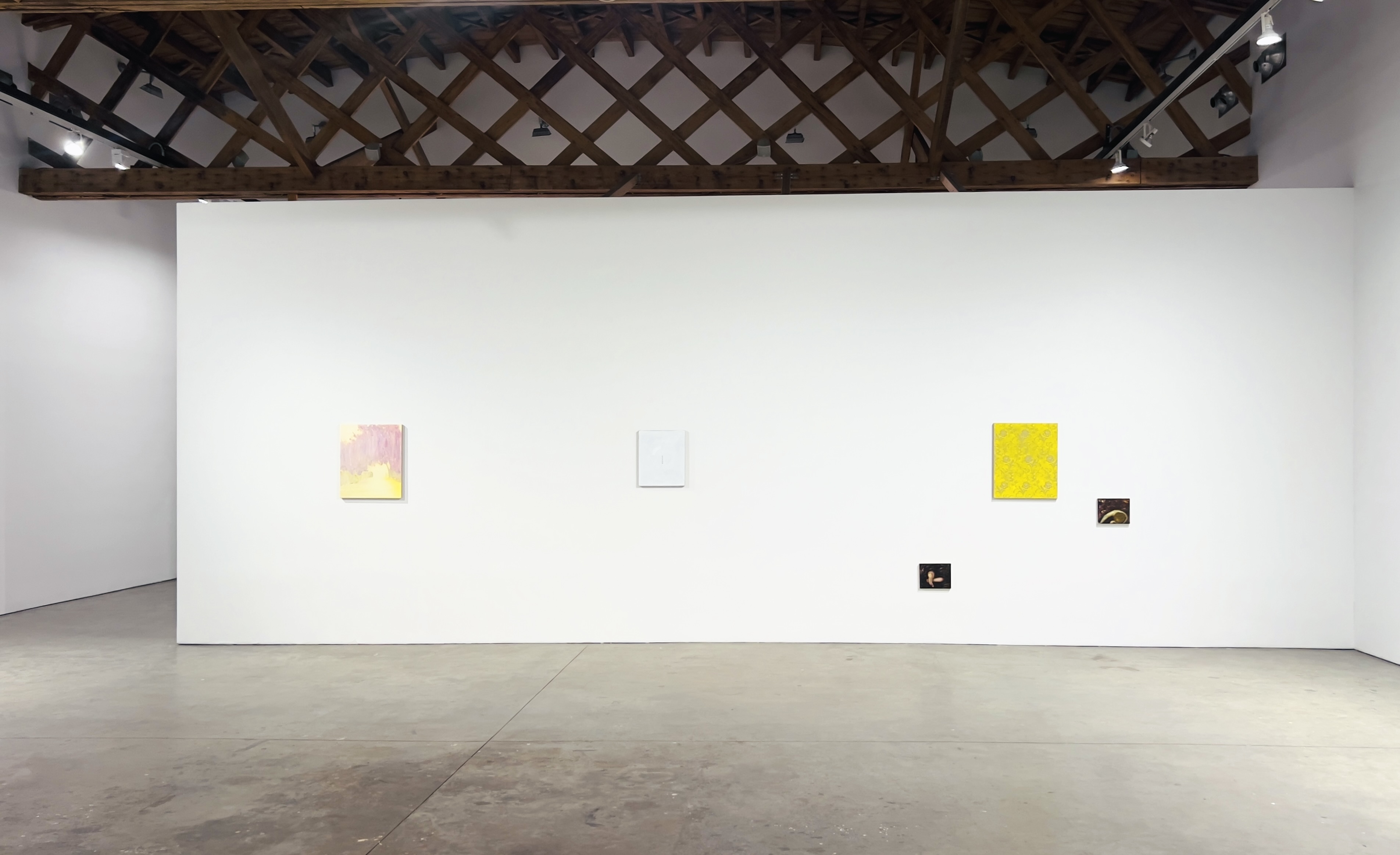 Installation view, Rachel Howard: Harvest, 447 Space, New York, 2026. © Rachel Howard. Courtesy of the artist and 447 Space.
Against the fantasy of an unblinking eye that sees everything, impartially, Howard’s arrangement binds the viewer to a body: crouching for one painting, craning for another, stepping back to find a plane. Nietzsche had already dismissed the dream of a pure, disinterested eye, “an eye turned in no particular direction.” In On the Genealogy of Morals (1887), he wrote: “There is only a perspective seeing, only a perspective ‘knowing’; and the more affects we allow to speak about one thing, the more eyes, different eyes, we can use to observe one thing, the more complete will our ‘concept’ of this thing, our ‘objectivity,’ be.” [2] Howard’s room works the same way. No single position yields the whole. Picasso’s Cubism folded the plurality of vantage points into its own system of signs on a single canvas. Howard unfolds them across the room, planes in one place, children in another. Nothing on the walls says that they belong to one event. The viewer makes that connection, walking from the descending aircraft to the dark panels near the floor, and must decide what it means.
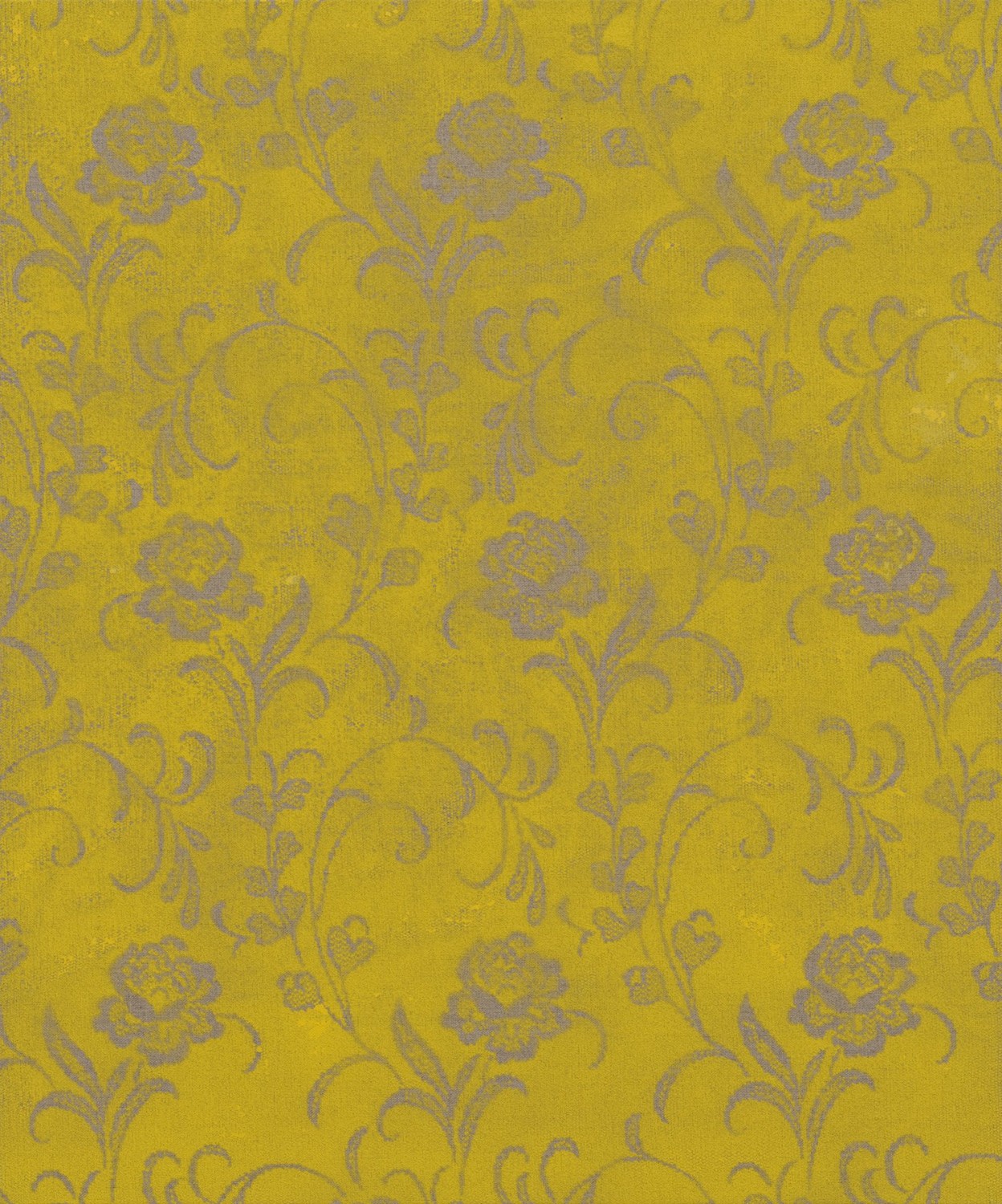 Rachel Howard, Harvest, 026. Acrylic and oil on linen, 24 by 20 inches. © Rachel Howard. Courtesy of the artist and 447 Space.
The exhibition takes its name not from the drones or the infants but from the wallpaper-like painting glimpsed at the outset. Titled Harvest, it hangs between two Mud Babies. The psychoanalyst Darian Leader, writing on Howard’s earlier work, observed that trauma seldom returns as the event itself. It returns as a detail: the color of a carpet, the pattern of a wallpaper. Read this way, Harvest becomes the surface on which atrocity is remembered. Path to Edge, the ghostly landscape, painted five years before the rest, promises a way out, yet its blur leads nowhere. What the viewer carries out of Rachel Howard’s exhibition at 447 Space is not a story but its pieces: aircraft, targets, infants, flowers, a vanishing landscape. A dispersed narrative, still being assembled.
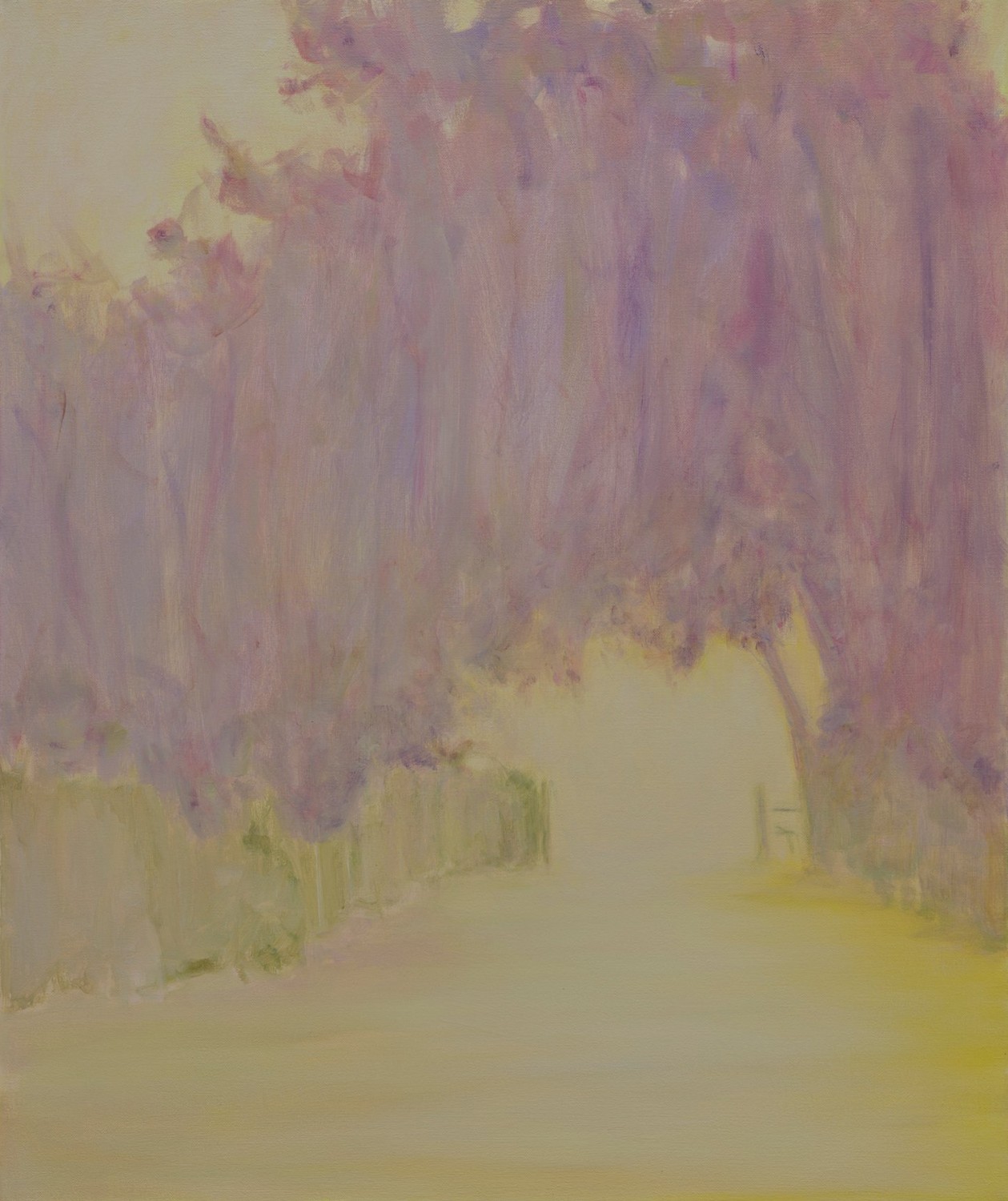 Rachel Howard, Path to Edge, 2021. Oil on linen, 24 by 20 inches. © Rachel Howard. Courtesy of the artist and 447 Space.
Notes
1. Grégoire Chamayou, Théorie du drone (Paris: La Fabrique, 2013); English translation by Janet Lloyd, A Theory of the Drone (New York: The New Press, 2015). Chamayou, a French philosopher at the CNRS, examines the armed drone as a new form of power: warfare recast as a manhunt, an operator who kills without risk and identifies targets by surveilling their “pattern of life.” The book traces what this does to the ethics of war, to the law, and to the state that wages it.
2. Friedrich Nietzsche, On the Genealogy of Morals, trans. Walter Kaufmann and R. J. Hollingdale (New York: Vintage, 1989), Third Essay, section 12, 119.
Rachel Howard: Harvest
447 Space
447 West 17th Street, New York, NY
September 25 – November 6, 2026

Raphy Sarkissian
Raphy Sarkissian received his masters in studio arts from New York University and is currently affiliated with the School of Visual Arts in New York. His recent writings on art include essays for exhibition catalogues, monographs and reviews. He has written on Rachel Lee Hovnanian, Anish Kapoor, KAWS, David Novros, Sean Scully, Liliane Tomasko, Dan Walsh and Jonas Wood. He can be reached through his website www.raphysarkissian.com.
view all articles from this author