Whitehot Magazine
October 2026
"The Best Art In The World"
"The Best Art In The World"
October 2026
Future Ruins / Diamond Seas on Robert Hobbs’s Chris Dorland Monograph Future Ruins and the Sonic Youth / John Oswald’s Diamond Seas vinyl LP
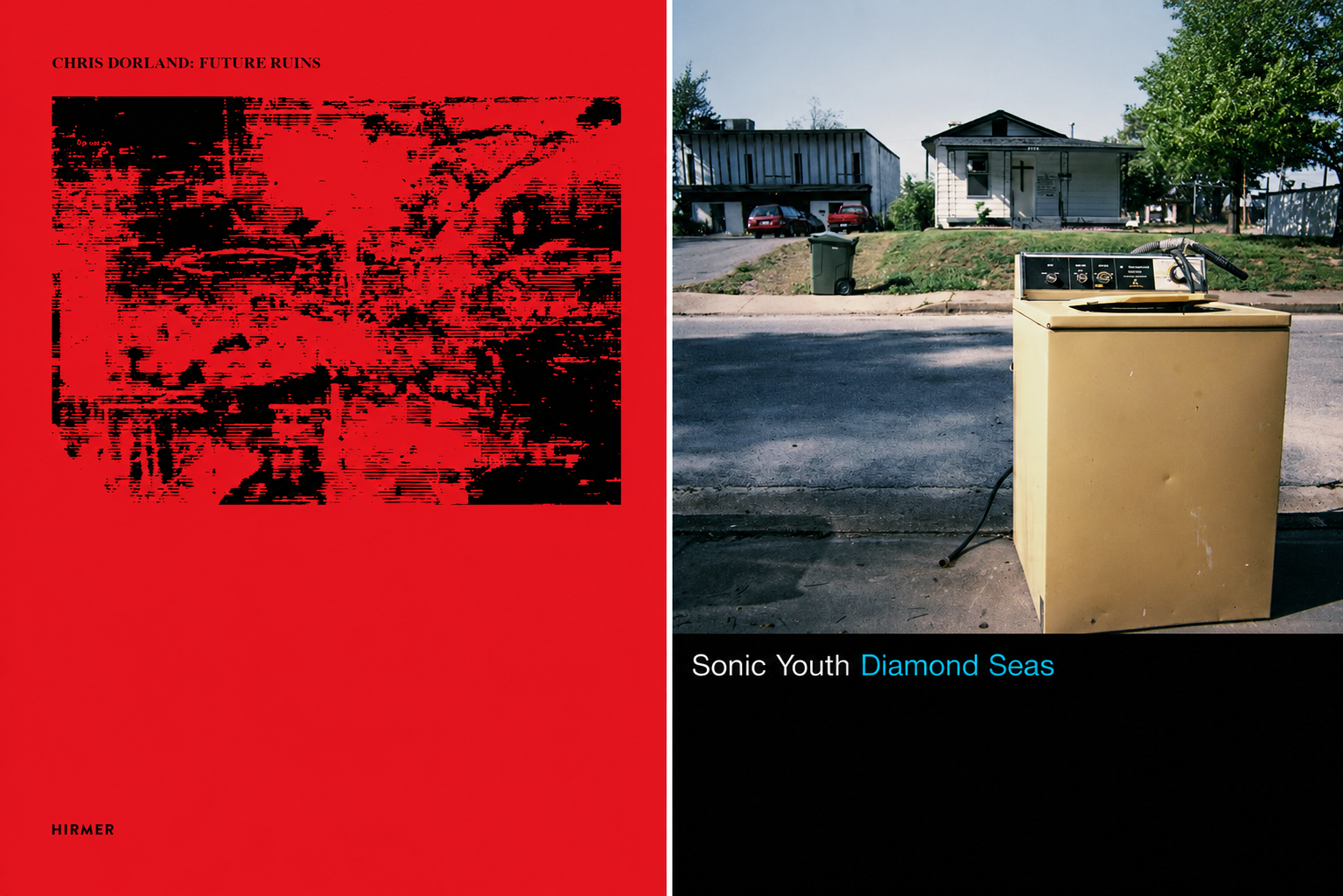 Future Ruins cover courtesy Chris Dorland Studio, photo Object Studies (left) and cover of Diamond Seas LP with photo Derelict Washing Machine Across from Easley Recording, Memphis, April 1995 by Lee Ranaldo
By JOSEPH NECHVATAL July 18th, 2026
I’ve found that comparisons between visual art and music (or sound art) are fruitful in defining the philosophical-aesthetics of a certain moment, and I’ve always wanted to write about both at the same time. Finally, I’ve found my subjects: this year’s release of Sonic Youth’s / John Oswald’s radical audio project Diamond Seas (published by Sonic Tooth Music) and art historian Robert Hobbs’s book Future Ruins (published by Hirmer) the first comprehensive look at Chris Dorland’s digital-media-paintings that augment Chrome Shelter, Dorland’s first institutional solo exhibition now at Museum gegenstandsfreier Kunst in Otterndorf Germany until October 4th. Chrome Shelter is curated by art historian Wilko Austermann, who in 2018 curated the show digital gods in Düsseldorf and since has been researching the influence of the digital on art production. Dorland’s 2026 New York exhibition at Lyles & King was titled Latent Stack, his fourth solo exhibition with that principled gallery that unfortunately just closed its doors.
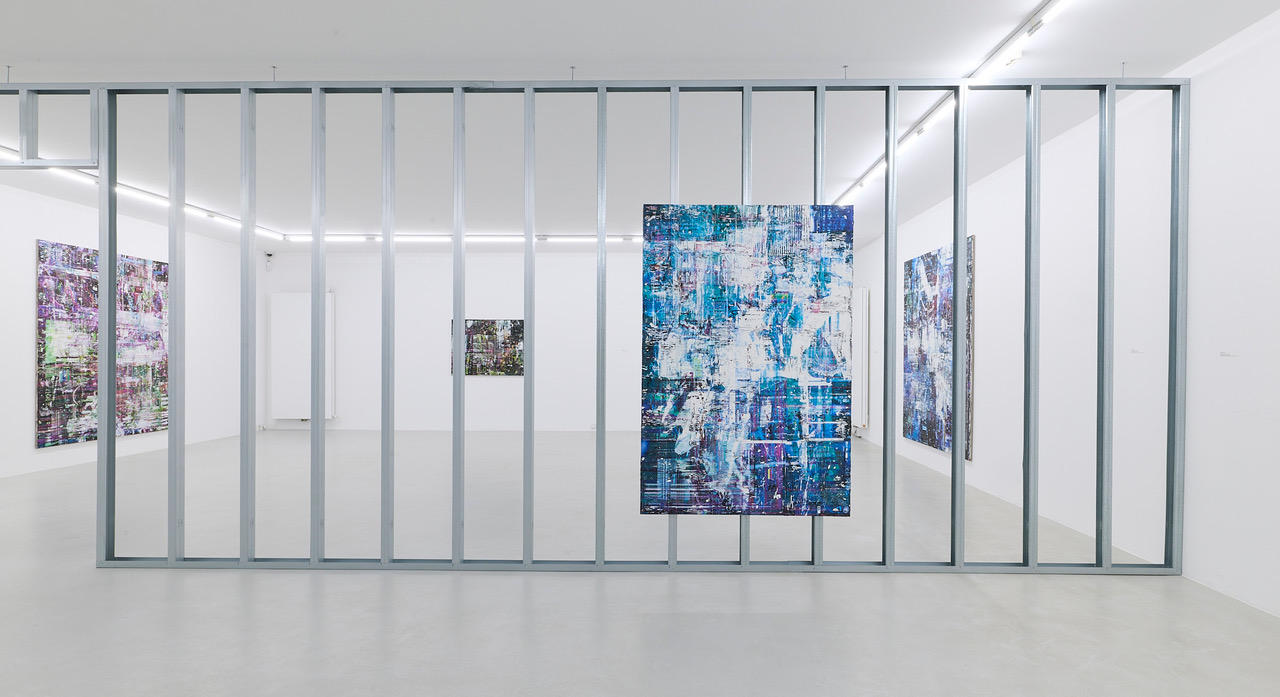 Chris Dorland Chrome Shelter partial exhibition installation view. Photo courtesy Museum gegenstandsfreier Kunst
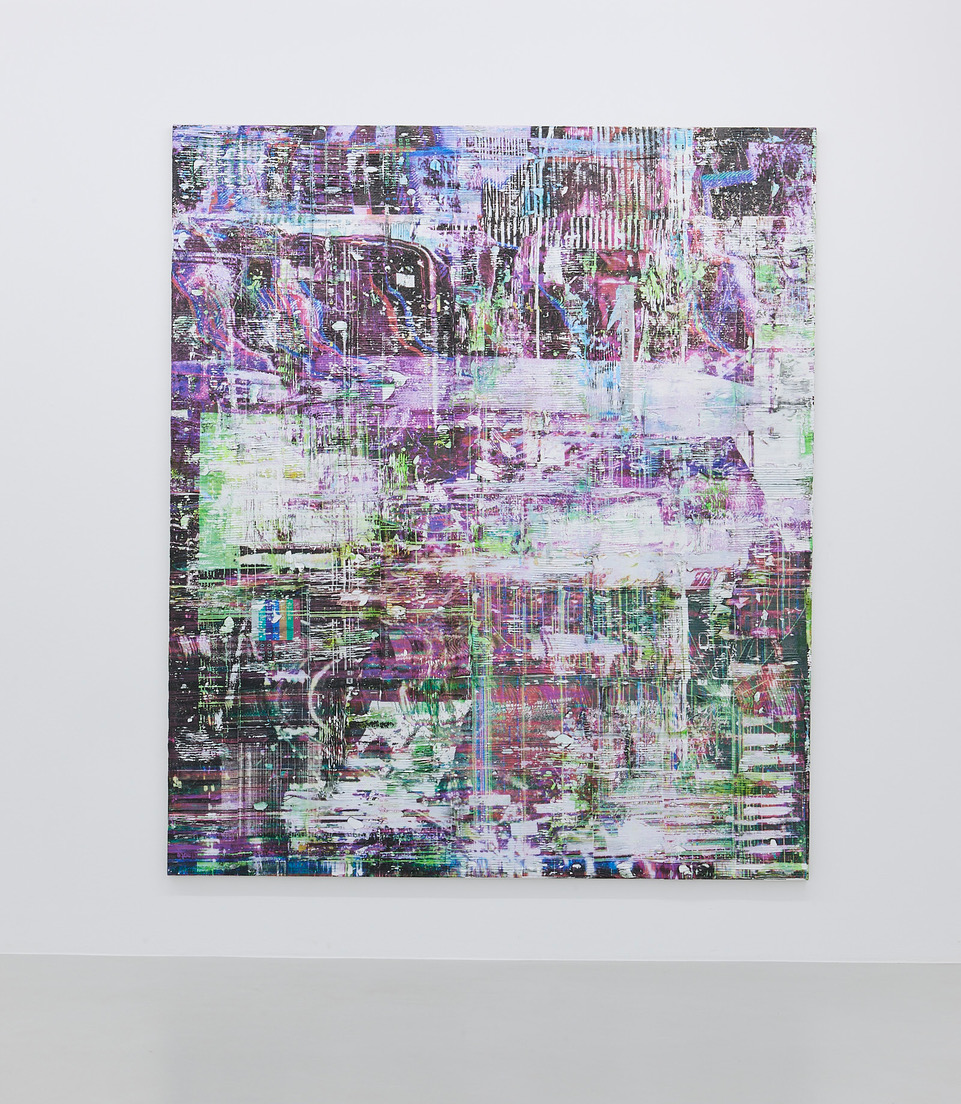 Chris Dorland Untitled (background host) 2024, 84x72 inches, acrylic polymer, pigment, gesso, UV coating on linen over aluminum stretcher bars in Chrome Shelter. Photo courtesy Museum gegenstandsfreier Kunst
Both the Robert Hobbs-Chris Dorland and Sonic Youth-John Oswald hauntology art projects compress, distort, stack, scrape or collapse their material into a fusion of subtleties that presses technological artifacts and decay together in a way that feels pressured, primordial, passionate, chaotic, frenzied, chthonic and decadent.
From more than two dozen live versions of the Diamond Sea song recorded during 1995 and 1996 that Sonic Youth’s studio engineer and archivist Aaron Mullan made available, Oswald (known for his plunderphonics, the practice of making new sound art out of previously existing recordings) gives a stack and squeeze to the much loved song. Oswald received from Mullan over seven hours of Diamond Sea sound, one of the band’s more rousing and longer (19:35 minutes) noisescapes that was performed by Kim Gordon, Lee Ranaldo, Steve Shelley, and Thurston Moore. Played by Sonic Youth frequently in concert during the mid-90s, the studio version was released on Sonic Youth’s 1995 Washing Machine album.
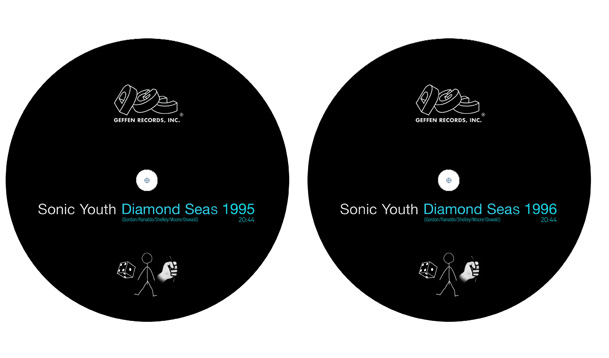
Diamond Seas LP labels, photo courtesy Sonic Youth
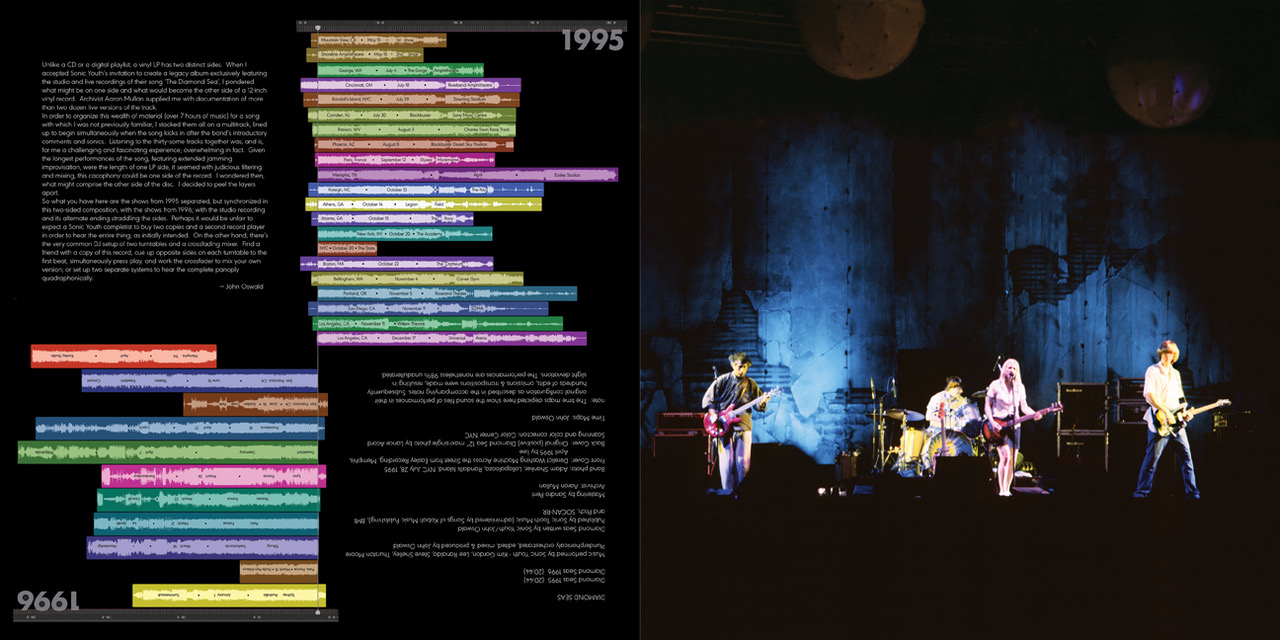 Diamond Seas open inner sleeve, photo courtesy Sonic Youth
For side A of the Diamond Seas record, called Diamond Seas 1995, Oswald superimposed every Diamond Sea track from 1995 starting at the first note of the song. But this includes some stacked spoken word material before the track builds and bursts around the five-minute mark into a shimmering sustained cacophony that can effectively be compared to some of the most intense modal sections of John Coltrane’s 1965 Ascension LP and/or the last three-minutes of The Ascension track from the 1981 debut studio album by Glenn Branca, called The Ascension (on which Lee Ranaldo played).
Flip the record over to Side B and its Diamond Seas 1996: every Diamond Sea recording made that year stacked on top of each other. The art experience is similar, with perhaps of a bit more wah-wah pedal perceivable in the mix early on. It’s similarity with subtle differences to Diamond Seas 1995 makes for an almost romantic reference to deep time.
Squishing and squeezing was applied to both sides of the LP as the ocean of sound surges and wanes and in all lasts exactly 20:44-minutes on each side. That required Oswald to make hundreds of cuts and transpositions which means Oswald’s cut-and-mash is not meant as an accurate documentation of these performances of Diamond Sea, but as an intoxicating experience in itself. Which it is.
Robert Hobbs’s Future Ruins documents the development of Dorland’s work in drawing, computer animations, digital prints and combine-paintings that begins with the 2001-2007 Memoryscapes series. This series is elaborate, heady, intricately composed, grotesque and artificial. Here Dorland begins pressing down on pop collage aesthetics with a twitch that produces something like a damaged Robert Rauschenberg print, subverting social systems of meanings, and so, offering the opportunity for the creation of applicable anti-social signs (absurd anti-signs) which may continue to conceptually move and multiply.
This passes through his Simulations, Logos, and Prototypes series (2007-2014) where Dorland has his pleasure with the full nothingness we discovered on the internet. The work comes into view as monochromatic dream noise-flows of governmental and corporate imagery. This image abuse can be favorably compared to Andy Warhol’s silkscreen-paintings from his Death and Disaster series (1962-1967) such as the left panel of Warhol’s Orange Car Crash Fourteen Times (1963) in the MoMA collection. I read it as providing a fundamental antithesis to the authoritarian, mechanical, simulated rigidities of the controlling technical world.
Then with the Scanners and Alumacores series (2009-2019) Dorland’s use of visual free floating signifiers, that French cultural philosopher Jean Baudrillard made the art world familiar with his seminal 1981 book Simulacra and Simulation, take precedent. (Baudrillard’s collection of art-related essays, which Sylvère Lotringer’s Semiotext(e) released in 2005, is called The Conspiracy of Art.)
Scanners and Alumacores morph into the most recent work, Screenscrapes and Their Whiteouts (2020-ongoing). This more painterly work cranks up the rapturous abandonment we feel about representation today, and the intended effect is that of de-simulation. The smeared paintings and data debris appear to me ritualistic. This work’s phantasmagorical semi-abstract aesthetic opens up for his art a sense of ecstatic possibility that I feel as indispensable, for it crushes and discharges accepted common consensus, like Diamond Seas. These paintings have both an explosiveness and a pent-up repressed aspect obtained through a looser, glitchier, dematerialization into the spectral spasms of a squeegee-scrape that might have been pulled by a jumpy Gerhard Richter.
What this double aspect of the late work suggest to me is ontological indecision that can be detected all the way through Dorland’s work just by reading the titles: all of which are Untitled with a lowercase subtitle in parenthesis. That means that if everything is Untitled then what is in the parenthesis (usually explanation or afterthought) is in fact the title.
To be or not to be. That is the question. And how better, as a painter, to engage with Baudrillard’s iconic concepts of viral seduction, simulation, and hyperreality. This interrogation accounts for much of the naked effectiveness of Dorland’s art.
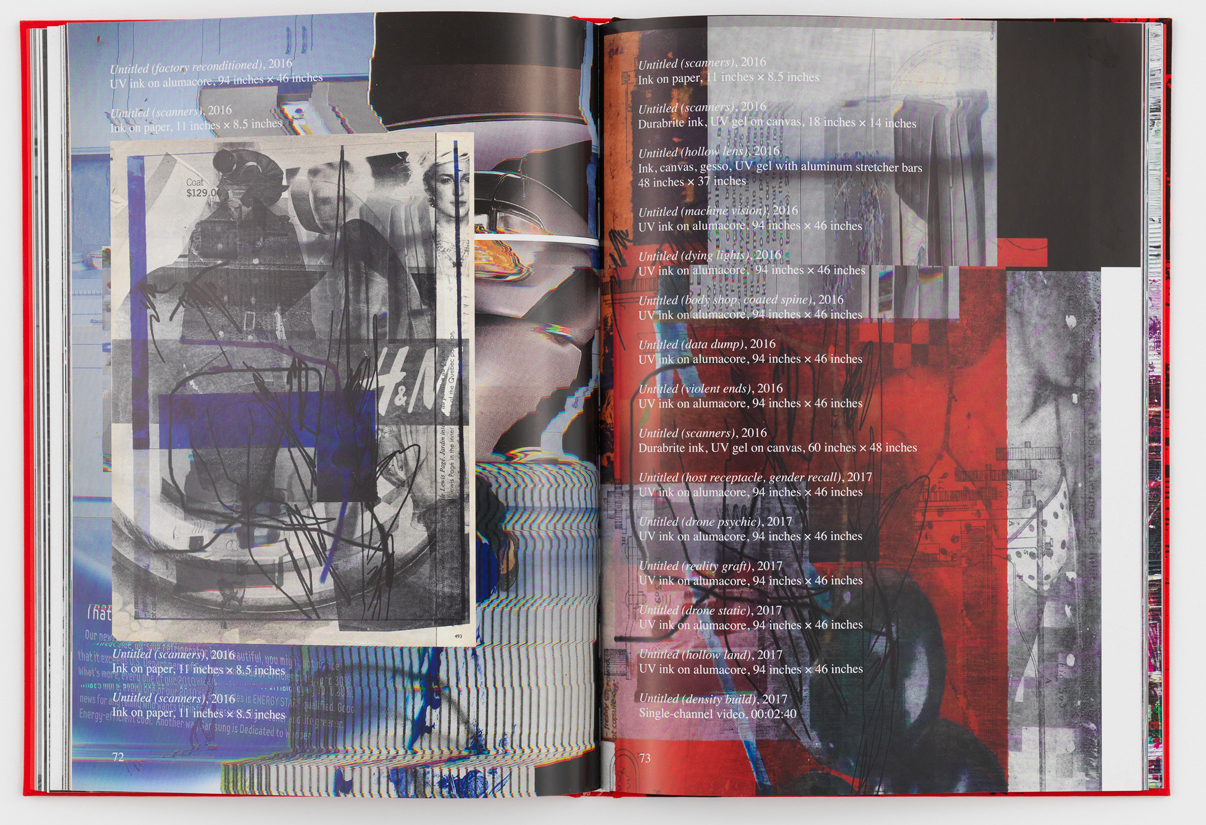 Open pages 71-72 of Future Ruins, photo Chris Dorland Studio and Object Studies
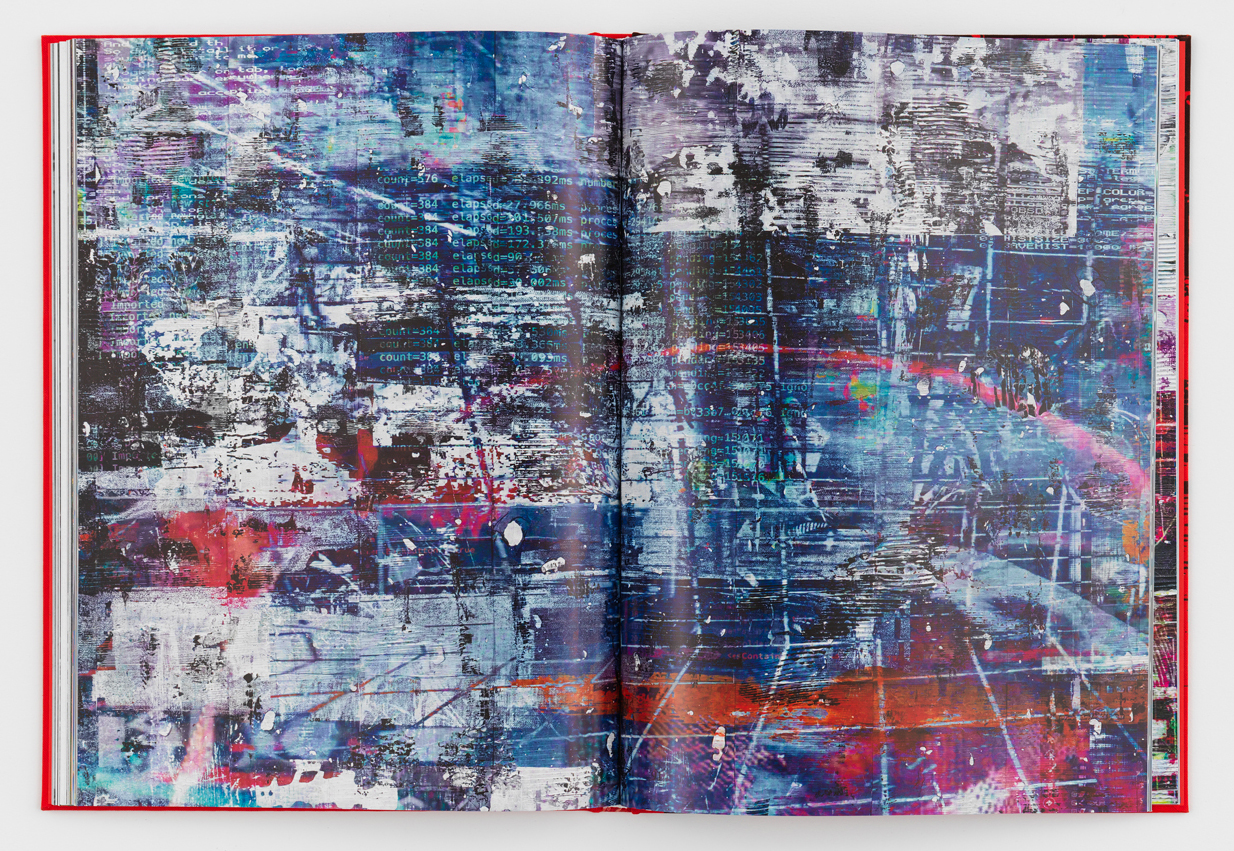 Open pages 90-91 of Future Ruins with detail of Untitled (data haven) 2021, 68x120 inches, acrylic polymer, pigment, gesso, UV coating on linen over aluminum stretcher bars, photo Chris Dorland Studio and Object Studies
Screenscrapes and Their Whiteouts makes the familiar world of simulation seem chaotic; annihilating the given in our minds with Nietzschean slyness. It is an art of further circulating fractured forms that represents the de-centered ideological space inherent in daily sensibility. The Screenscrapes and Their Whiteouts create hybrid and perplexing sacrificial compositions that open up a conceptual territory of arcane spiritual signification and de-territorialized meanings. They perform as cryptographs of our harrowed minds in our time of widespread AI-sucking surveillance and the prevalent sense of cultural staleness and artistic futility.
So in my opinion, both Future Ruins and Diamond Seas are creative works that address the question of media-culture, media-non-culture, not-yet-media-culture, and no-longer-media-culture. Both consciously exploit unfulfilled cultural expectations by compressing existing representational tradition to the point of apparent dissolution. In our era of frenzied late-capitalist circulation of signs, both artists create an almost erotic transference of voluptuous reverence that takes place beyond the point of consumption.
By taking this rather rough approach to their work, they both make something out of the too much of today and turn it into something wildly different, something willfully personal.
When in a tipsy disposition, and when I put these two achievements together in my mind, their roughness turns my nauseous thoughts about the horror and absurdity of our current political environment into some kind of relaxed majestic feeling: something like a positive-nihilistic state of mind that flourishes through the glory of a noise culture that functions as a kind of artistic ooze.
Coincidentally both with Canadian roots, Dorland and Oswald both seem to act out from a central concept of roughing up and slamming around cultural artifacts into an almost indivisible blur that I can read as harmonious. Their noisy cultural enterprises are ones in which their materials are placed subservient to emotional pressures that heighten my sensual experiences of their art. A vast behavioral magma seems to be the desire.
Of course they are far from alone in this pressing together of previously distinct cultural attributes and their work kind of reminds me of the Expanded Arts that flourished throughout the 1960s and 1970s. But both their works are simultaneously anarchic and rigorously disciplined in a fresh way.
But also, their radical experiments with crushing techniques that produces a squeezed-out loose gesture, cannot but recall for me also the grape-squeezing Dionysian tradition as a fruitful model for an art that embodies such a forced singularity. At the same time, their unified sense of a seamless union sweeps me towards a fascinating collapsed industrial world like the one I found in J. G. Ballard’s 1973 book Crash. (Hobbs informs us that the Ballard 1974 novella Concrete Island played a major role in establishing Dorland’s aesthetic direction, and Crash proceeds it by one year.)
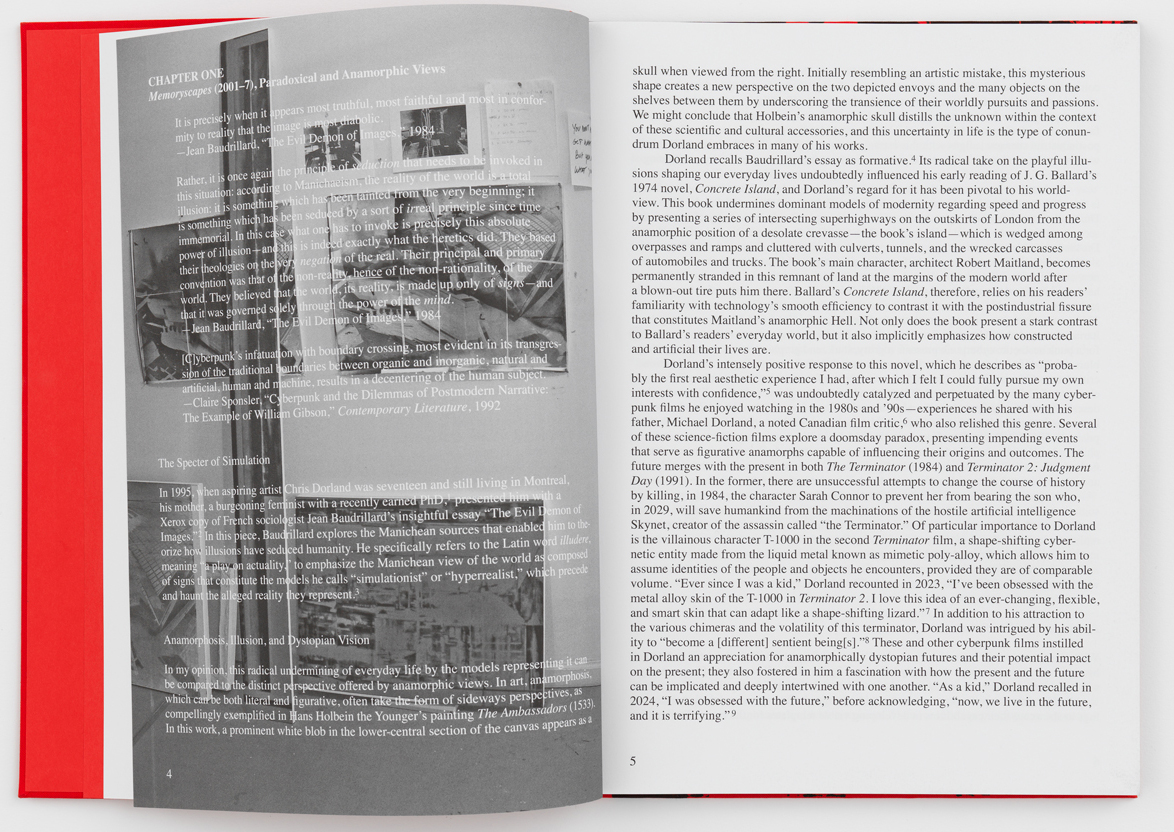 Open pages of Future Ruins courtesy Chris Dorland Studio. Photo credit Object Studies
In Crash, while making love to his wife Catherine, the narrator James Ballard fantasies himself in an act of sodomy with Dr. Robert Vaughan, a past scientist turned “nightmare angel of the highways.” The urge behind this impulse is the husband’s opinion that only this act of sodomy could “solve the codes of a deviant technology.”
With an emphasis on speed and trips on acid, soon in Crash the title of the novel takes on the new meaning of a narcotic crash that is inseparable from deviant excess.
This suggestion of crashing the codes of a deviant technology significantly extends the simple love of transgression at the heart of both Future Ruins / Diamond Seas, for they have a relationship to time that takes on a larger significance in the context of speeding and crashing. In both artists’ works, a compression of space and time is the capacity into which our sensibilities enter. And as such, we knowingly or not enter into the inexpressible depths of Dionysus: the indulgent, persecuted, intoxicated god; the suffering and dying god.
By describing Future Ruins / Diamond Seas as part of the contemporary ecstatic nature of Dionysus, I’m extolling the mad raving god who Friedrich Nietzsche perceived as a necessary response to something he sensed lacking in the modern world: a celebration of what he called the tragic disposition.
Indeed, Nietzsche stressed the importance of living with a tragic awareness of life, and asserted that only through the cultivation of such a state through art could genuine creative greatness occur; for such art lends us an acute capacity to affirm life.
That is why the creative-destructive art that is Future Ruins / Diamond Seas is the most spiritual art of our time, for they are damaged artworks that touch on tragedy. As such, they extend our psychic connections to acts of artistic greatness that affirms life through contemplating destruction. This lifts the spiritual from institutional authority to individual disposability.
In contemplating the significance of the intoxicated god Dionysus for Future Ruins / Diamond Seas, the most appropriate place to start is the madness that has fallen on us. For what can we do with culture when we are confronted with a stark awareness of the perplexing nature of the monstrous world now that everyone I know calls crazy.
Perhaps that is why the work of Dorland and Oswald helps me fall back into my private noise euphoria so to lose touch for a while with this crazy moment of transitory insanity. For Future Ruins / Diamond Seas is about an existence and non-existence that transfixes me with a spirit of fascination and confusion with everything we once thought we knew as normal. That transfixing is what our time evokes, and Future Ruins / Diamond Seas responds in the Dionysian spirit of wild being. A voluntary quest for the notorious sides of existence.
That is why I see Future Ruins / Diamond Seas anticipating the possibilities of a positive nihilism that supports in us a positive will for negation. Future Ruins / Diamond Seas are both Dionysian affirmations of the ugly world as it now is, while also being an expression of joyful ecstatic excess. Thus cultural examples of what Nietzsche called amor fati: the love of fate.

Joseph Nechvatal
Joseph Nechvatal is an American painter/writer currently living in Paris. His book of essays Towards an Immersive Intelligence (2009) was published by Edgewise Press. He has also published three books with Punctum Press: Minóy (ed.) (2014), Destroyer of Naivetés (poetry, 2015) and Styling Sagaciousness (poetry, 2022). His book of art theory, Immersion Into Noise, was re-published in 2022 in a second edition by Open Humanities Press. In 2025, Venus Voluptuous in the Loins of the Last God, his sequel novella to ~~~~~~~~~~~~~~~~~venus©~Ñ~vibrator, even (1995/2023) was published by Orbis Tertius Press. In 2025 his art exhibition Information Noise Saturation was presented at the Magenta Plains in New York City and in 2026 he exhibited a series of new paintings called Le Bateau ivre (The Drunken Boat) at Galerie Richard in Paris.
view all articles from this author