Whitehot Magazine
November 2026
"The Best Art In The World"
"The Best Art In The World"
November 2026
Cars as Canvases: Fairey, Haring, Scharf and Kruger Lead Larry Warsh's CART X Into Retromobile
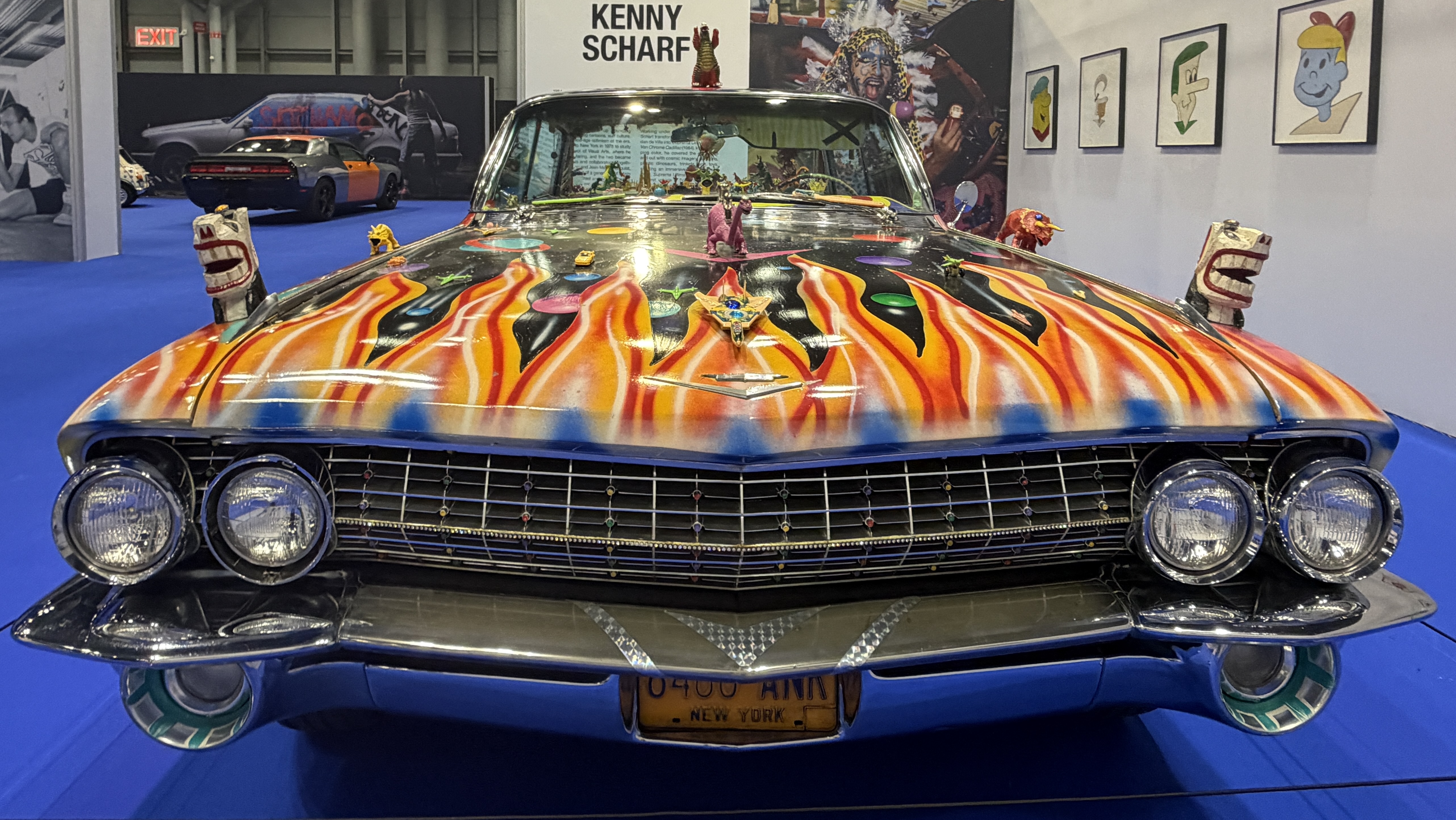 The front end of Kenny Scharf’s 1961 Cadillac. Photo: Lisa Freeman
By J. SCOTT ORR, November 19, 2026
Shepard Fairey went with a 1937 Packard 115C Touring Sedan. For Keith Haring, it was a 1971 Land Rover Defender. Kenny Scharf chose a 1961 Cadillac Sedan de Ville. Barbara Kruger set her sights on a yellow school bus. Their rolling canvases are as distinct as their artistic styles.
The four vehicles are among a dozen art cars on display now as part of Retromobile New York, a special edition of Paris’s annual classic car salon, open at the Javits Center through Sunday. In this, the first Retromobile ever staged outside of France, the art cars are sharing the stage with super-rare vehicles like Steve McQueen’s 1967 Ferrari 275 GTB/4*S NART Spider valued at more than $15 million and a 1962 Ferrari 250 GTO Berlinetta, one of only 36 built, a model that has sold for more than $50 million.
The man behind the art cars is Larry Warsh, who doesn't drive and owns more than 70 art cars that he keeps in New Jersey. Warsh was an early collector of Basquiat and Haring in the 1980s, buying painted objects before he bought cars.
His first two were a Scharf Cadillac and a Buick Special reimagined by Haring. Lending both to Venus Over Manhattan's "Piston Head" show in Miami Beach in 2013 awakened his passion for the medium and his collection grew from there. "They're not going to drive anymore. That's not the point for them," Warsh told Artnet recently. "For me, they turn into sculpture. They turn into objects. They turn into art."
But before the vehicles are turned into art, they have to be selected as a medium by the artist and that decision is the first, defining step in the art process. And in the case of these cars, the medium is very much a part of the art. Let’s look at a few examples.
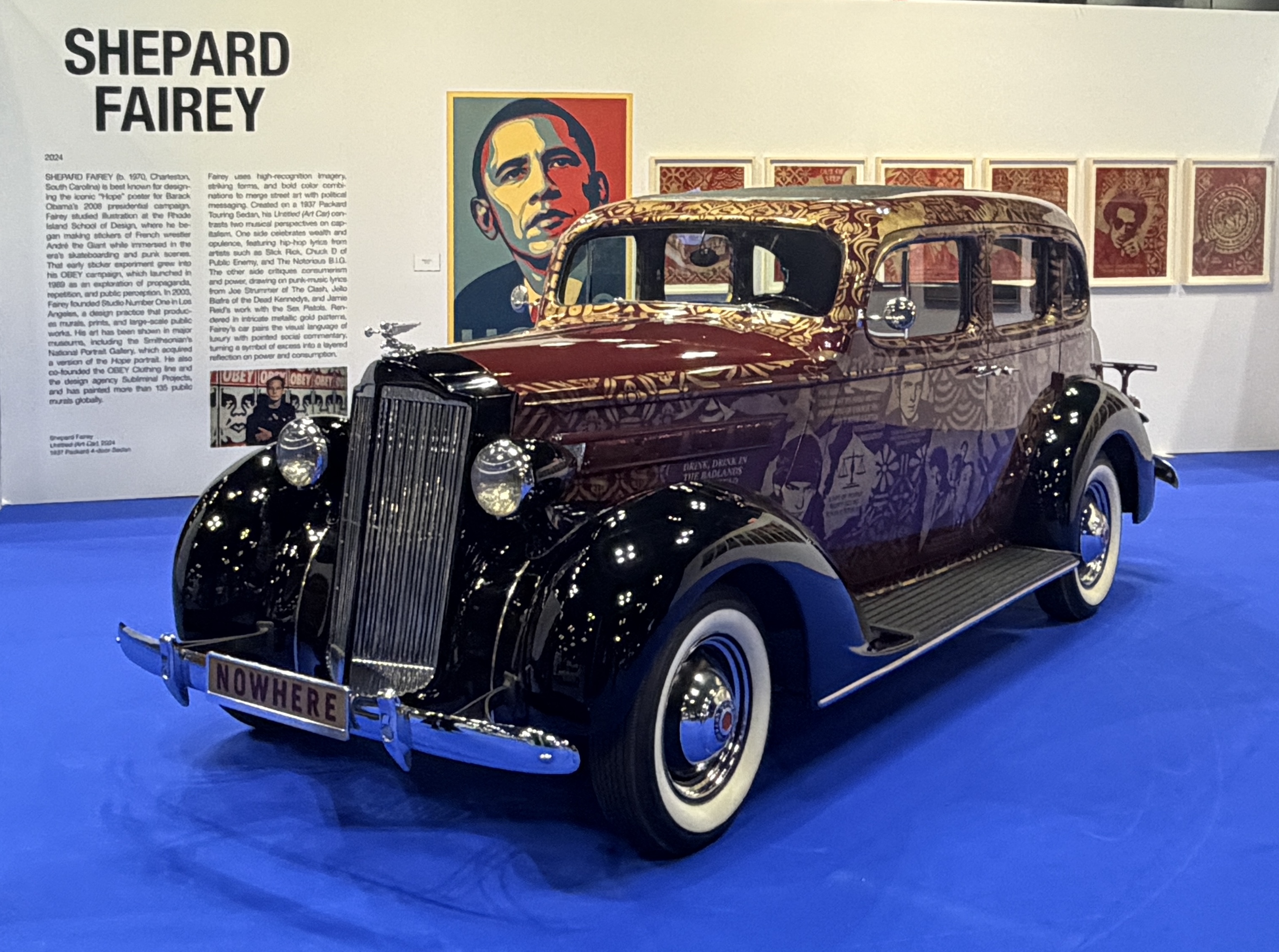
Shepard Fairey brought his punk rock advocacy to the design for this 1937 Packard 115C Touring Sedan. Photo: Lisa Freeman
Fairey’s Packard: Fairey’s art practice centers on speaking truth to power, issuing punk rock commentary on wealth, elitism, consumerism, prejudice and inequality. So a piece of Detroit steel from a prestige auto maker built during the Depression seems just the thing.
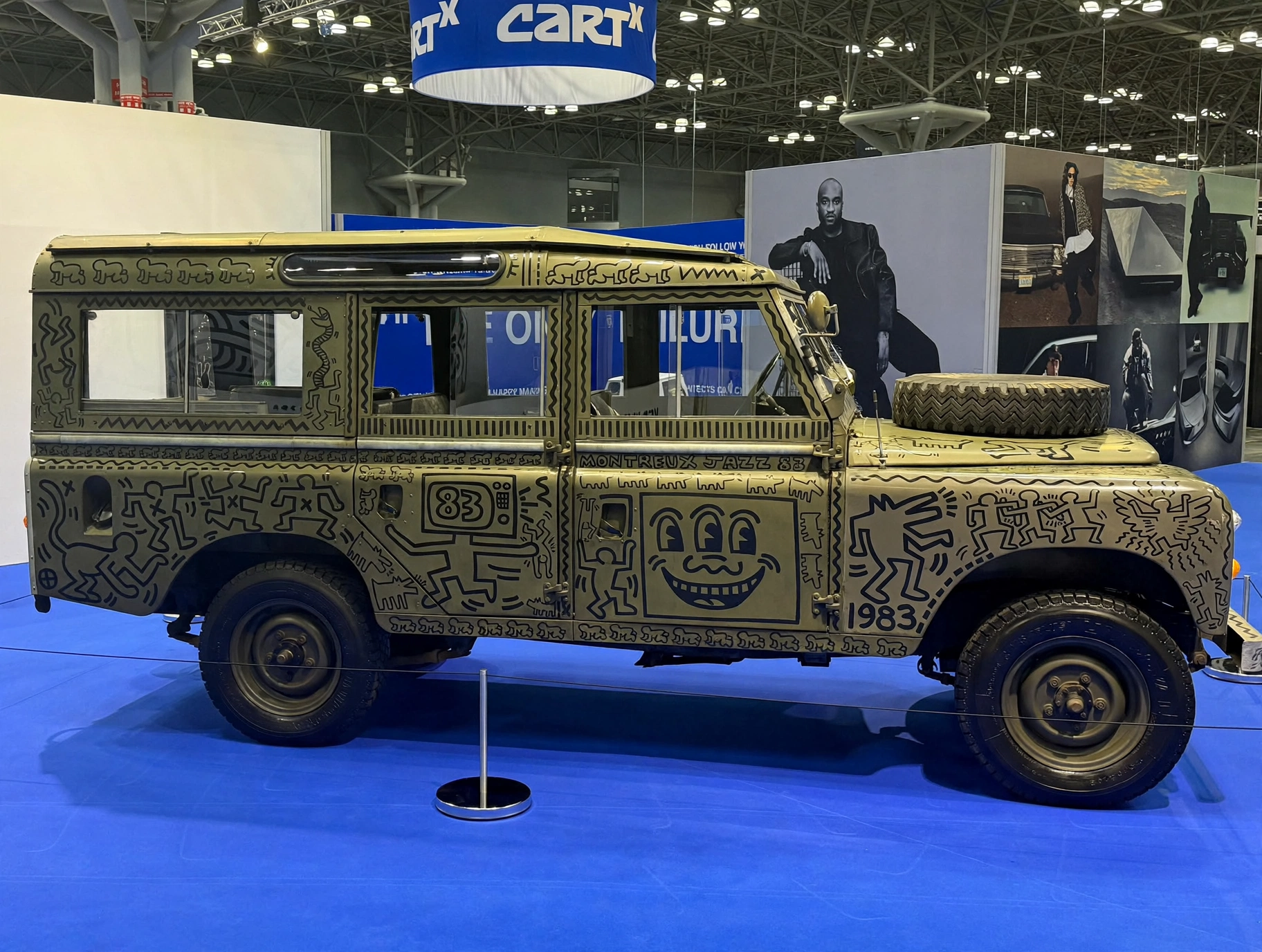 Keith Haring’s simple design on a no-nonsense vehicle, a 1971 Land Rover Defender. Photo: Lisa Freeman
Haring’s Land Rover: For an artist whose oeuvre is built around simple, bold black outlines, a flat-paneled utilitarian workhorse is as good as it gets. That Land Rover fits Haring perfectly; it’s a vehicle that is stripped down, nothing but what’s necessary to perform its mission. As simple and perfect as a radiant baby.
 Barbara Kruger’s school bus comes with a lesson. Photo: Lisa Freeman
Kruger’s school bus: This is a vehicle that’s used to educate, just like Kruger’s word art. It’s a 40-foot-long space used to deliver children to school, repurposed to deliver a lesson in white-on-red and black-on-white Futura Bold Oblique: Know Nothing, Believe Anything, Forget Everything. It’s the only one of the lot that is not a personal vehicle.
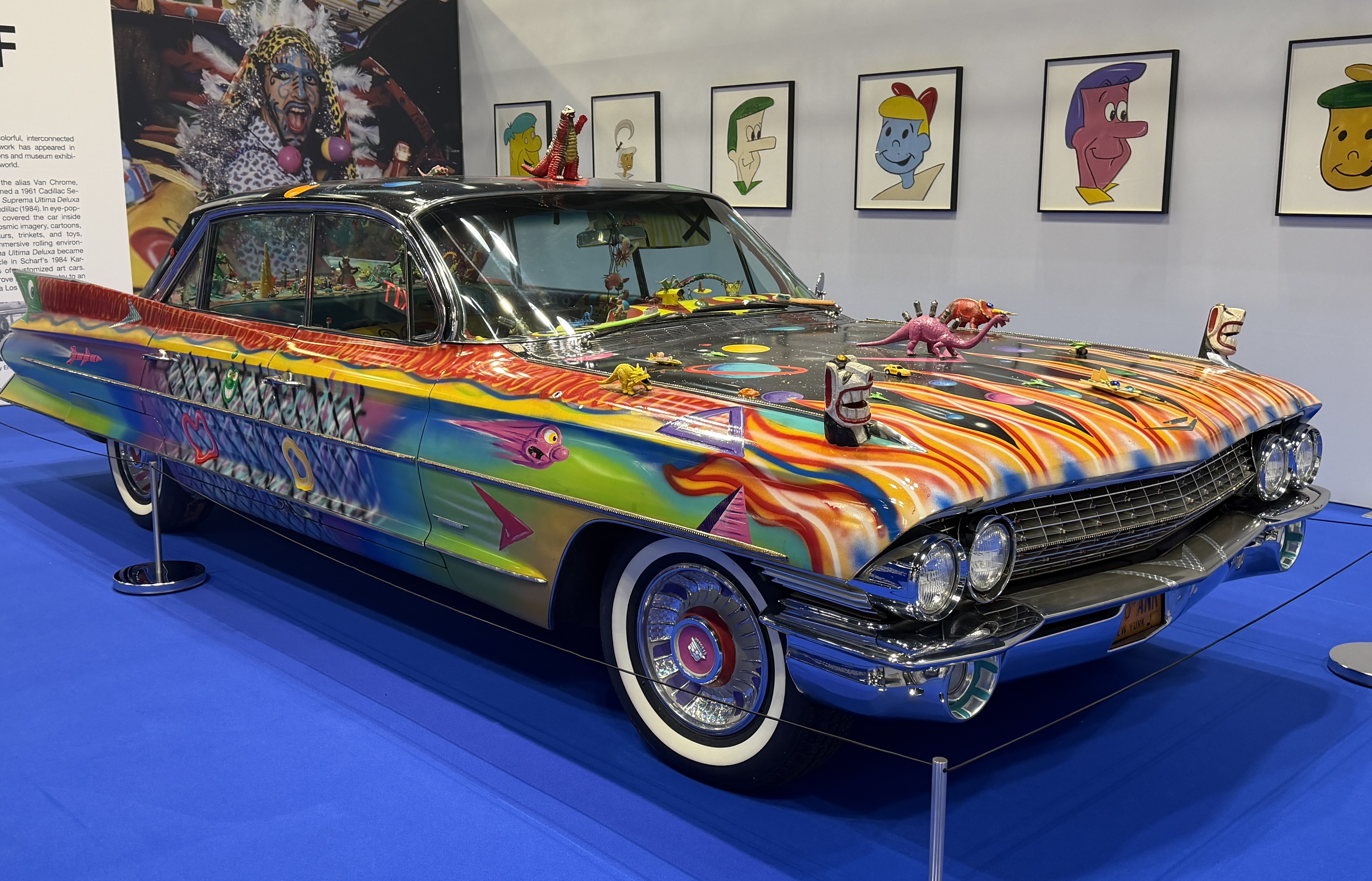 Kenny Scharf made a psychedelic futurescape out of a1961 Cadillac Sedan de Ville. Photo: Lisa Freeman
Scharf’s Cadillac: This one could hardly be for any other artist: it’s iconic midcentury modern Americana with spaceship lines. It looks like something the Jetsons might fly around in. He approached the thing with his usual commitment to excess, psychedelic imagery everywhere, augmented by plastic dinosaurs and toys.
So in choosing their rolling canvases, the artists started with vehicles that had some intrinsic identity to which they added their signatures. Fairey struck out against power, Haring complicated a simple vehicle with dancing figures, barking dogs and, yes, radiant babies, Kruger used a bus to school viewers and Scharf launched a jet-age car decisively into the space age.
Most of the art cars at Retromobile are part of CART X, Warsh's new global platform that merges cars, art, music and fashion. Other CART X vehicles on display include Futura’s 2002 BMW, rendered in a spray-paint camouflage as a nod to his graffiti history and his time in the military; Damien Hirst's Spot Mini from 2000, a Mini Cooper covered in polka dots; Zaha Hadid's three-wheeled Z.CAR, a hydrogen-powered two-seater; Ai Weiwei's LEGO Car from 2015, a BMW covered in thousands of LEGO bricks; and the stripped-down 2004 Maybach 57 from Jay-Z and Kanye West's "Otis" video.
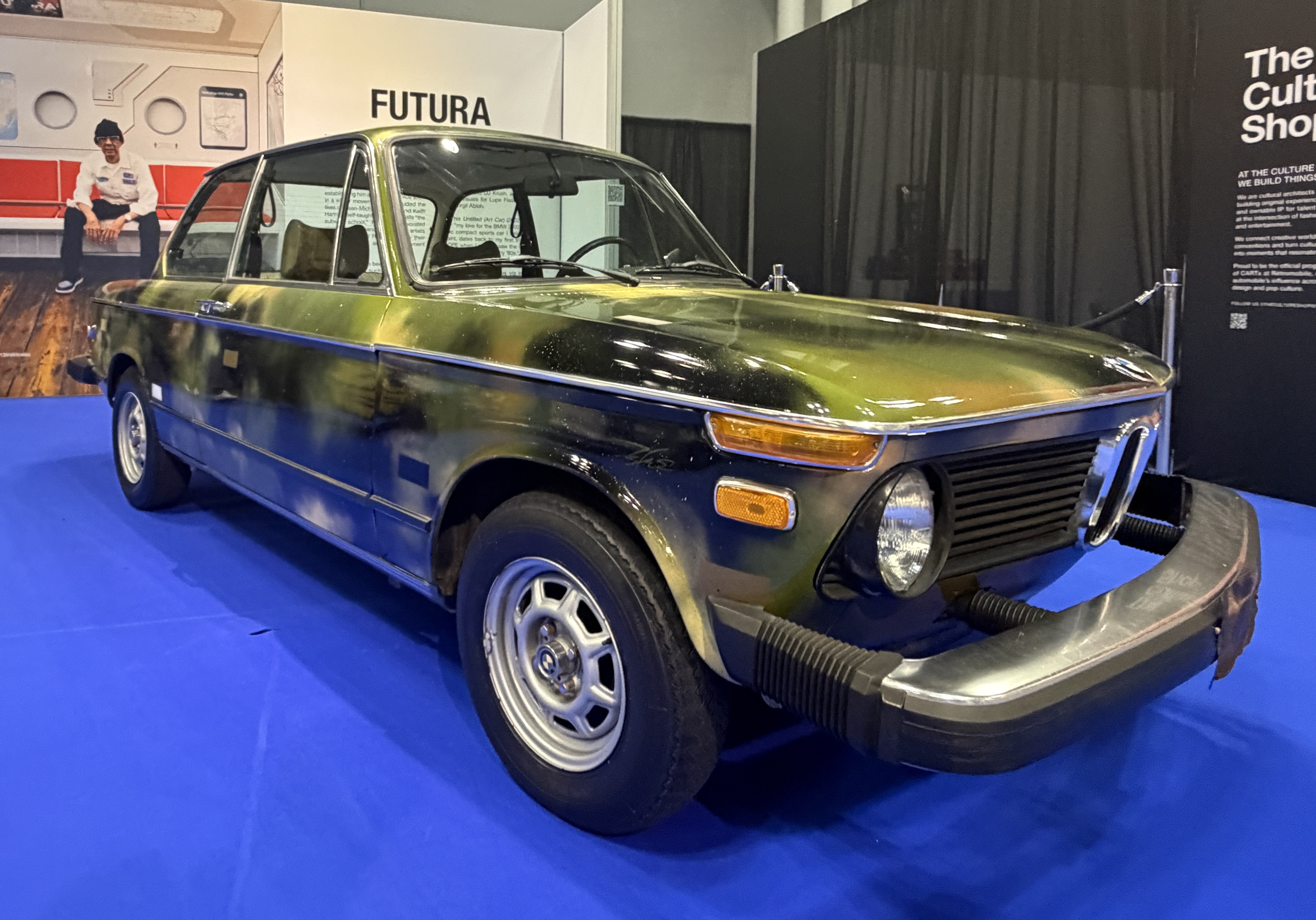 Futura’s spray paint camouflage on a 2002 BMW. Photo: Lisa Freeman
Jean-Michel Basquiat is included, but without a car. A monitor plays the scene from Downtown 81, shot in the winter of 1980-81, in which the young artist buys a Cadillac with a suitcase of cash and writes "Gold Wood" on it in gold marker. Maripol, who produced the film, explains the joke in the wall text: paper is made of wood, so "Gold Wood" was simpler for his genius mind than "Money."
While the thousands of fans of classic automobiles expected to descend on Javits this weekend may be more interested in historically significant cars like, say, the 1937 Alfa Romeo 8C 2900 or the 1937 Bugatti Type 57SC Atalante, they may also appreciate this different take on motor vehicle artistry.
“What makes this collaboration so special is the opportunity to look at the automobile from a different perspective,” said Gérard Neveu, CEO of Retromobile New York, adding that CART X happily merges the worlds of automobile design and contemporary art. “New York feels like the perfect place to bring those worlds together,” Neveu said.
Retromobile New York is on view at the Javits Center, 429 11th Ave., through November 22.

Scott Orr
Scott Orr is a career writer, editor and a recovering political journalist. He is publisher of the East Village art magazine B Scene Zine. He can be reached via @bscenezine, bscenezine.com, or bscenezine@gmail.com.
view all articles from this author