Whitehot Magazine
September 2026
"The Best Art In The World"
"The Best Art In The World"
September 2026
Review: “He Spoke To The Birds”
By Maurita Cardone August 3rd, 2026
The birds promised by the title never quite appear. What you find instead, walking through He Spoke to the Birds at Rome's AAIE Center for Contemporary Art, curated by Fanfan Yuxuan Fan, is smoke drifting across canvases, hybrid and semi-mythological creatures, zinc plates etched and soldered, hydraulic pipework. The title comes from Carolyn Christov-Bakargiev's writing on Saint Francis of Assisi, who "even spoke to the birds," and on paper the show reads as a meditation on human and non-human as part of the same nature, drawn from the ethos of Arte Povera. But the real energy of the exhibition seems to be buried in the matter itself, as a repository of memory.
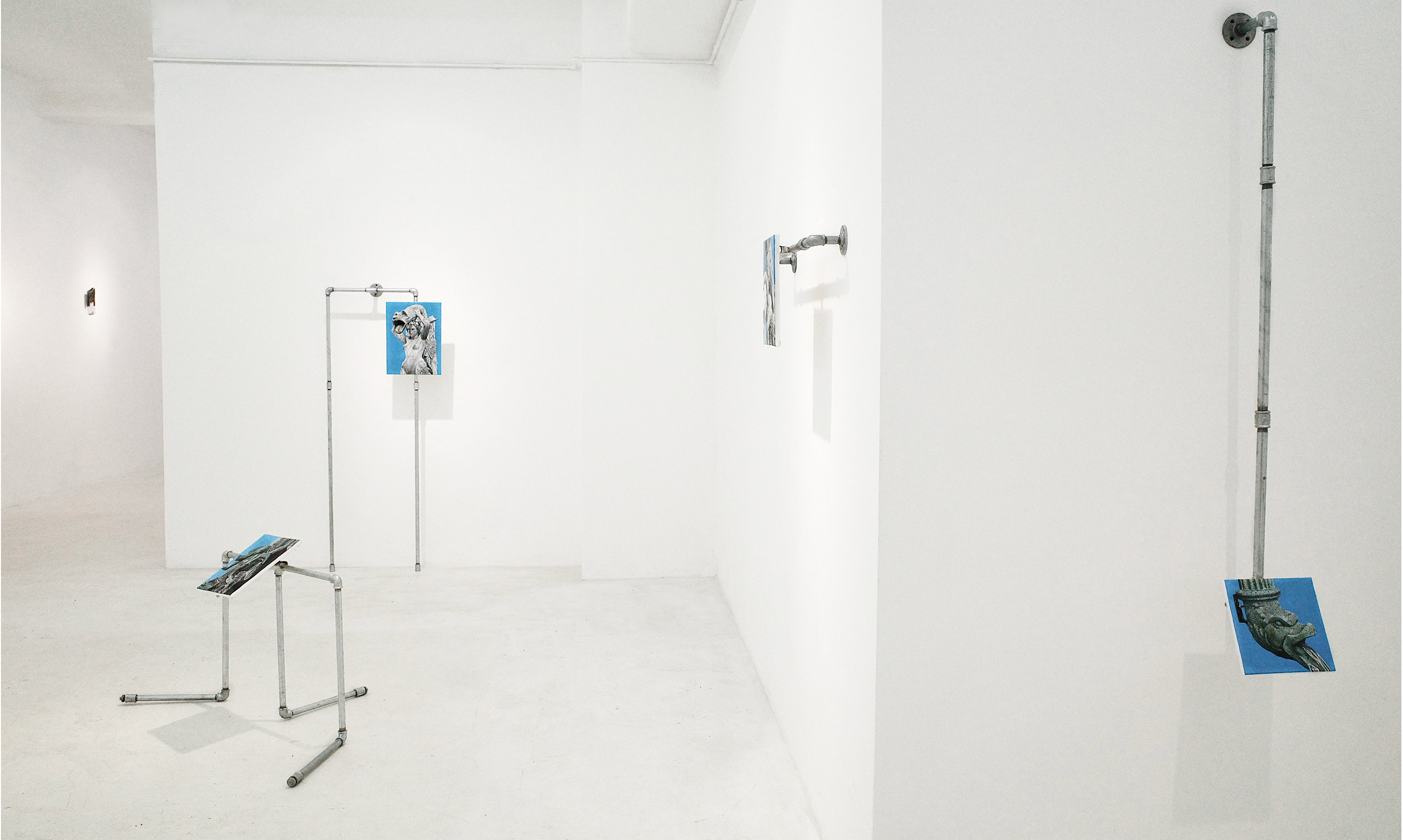 Installation view of He Spoke To The Birds, Rome. Artist: Diego Azzola. Curated by Fanfan Yuxuan Fan. Courtesy of AAIE and FanFlus.
The curatorial statement frames the exhibition through the legacy of Arte Povera. Yet more than a shared debt to the Italian art movement, what connects Jeremias Rumpl, Huang Zhe and Diego Azzola appears to be a refusal to treat material as an expressive surface and use it as an opportunity to record processes most of us can't watch happen.
Rumpl's zinc plates make this most literal. He transfers sketchbook drawings onto metal and then lets acid, welding, and corrosion take over, until it's hard to say where the image ends, and the damage begins. The rust is time acting directly on the surface. What's left looks like something dug up rather than made: fragments that could be architectural or archaeological. Decay is not represented but enacted on the work's body.
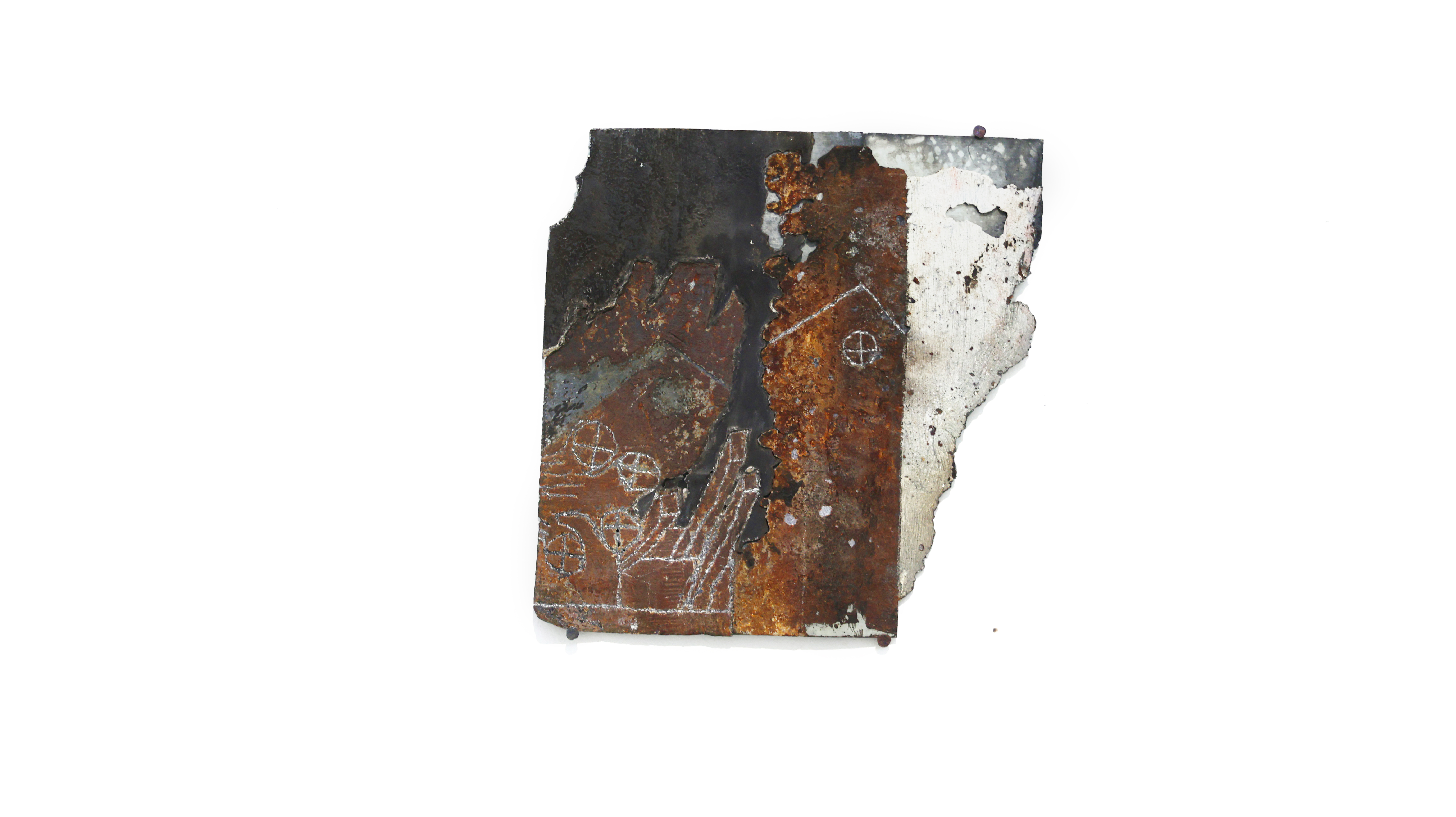 Installation view of He Spoke To The Birds, Rome. Artist: Jeremias Rumpl. Curated by Fanfan Yuxuan Fan. Courtesy of AAIE and FanFlus
Huang Zhe works differently but arrives somewhere adjacent. His paintings use smoke as a lens — the haze filters everything you're looking at. He grew up around Buddhist ritual, and incense smoke hangs over these canvases without ever being illustrated outright. Figures and landscapes surface briefly and then fade again, caught somewhere between being remembered and being lost. It's a way of painting memory as genuinely unreliable — not a story you can retrieve cleanly, just fragments that flicker into visibility now and then.
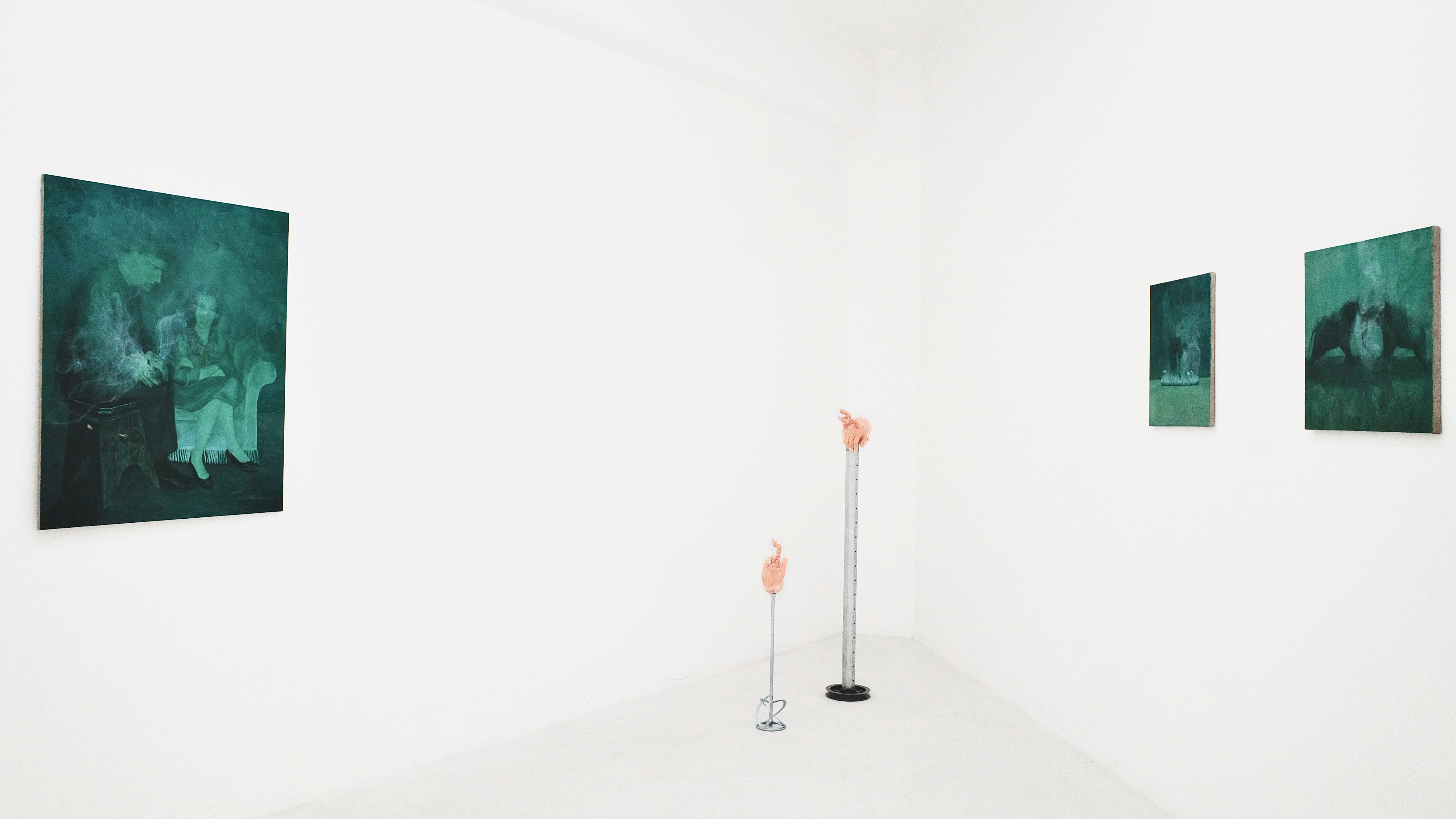 Installation view of He Spoke To The Birds, Rome. Artists: Diego Azzola, Huang Zhe. Curated by Fanfan Yuxuan Fan. Courtesy of AAIE and FanFlus
Azzola takes a more industrial route. He repurposes metal poles and water pipes into sculptural armatures, sustaining sculptures and oil paintings of uncanny sea creatures and organ-like formations. There's no actual water in the pieces, but you feel its absence structuring everything, in a world where the boundaries between industrial and organic blur, collapsing the distinction between what is made by man and what man is made of. The pipes evoke Roman aqueducts as well as present-day systems of extraction. Nature and infrastructure sit next to each other, each visibly shaping the other, without either one winning.
Rather than constructing explicit narratives or thematic pairings, curator Fan allows connections to emerge gradually through the behaviour of materials themselves. Corrosion, smoke and hydraulic structures recur across the galleries without ever becoming repetitive, encouraging viewers to move between the works by association rather than chronology. The dialogue between the three artists is therefore established through shared processes. Those processes unfold not only within the works themselves but also in the act of viewing, inviting visitors to move through the exhibition by association, accumulation and close observation. Huang Zhe's paintings invite sustained, intimate looking, while Jeremias Rumpl's zinc plates reward close attention to their unstable surfaces. Diego Azzola's sculptural interventions, by contrast, extend into the gallery space, interrupting the rhythm of viewing and introducing a bodily awareness of movement and flow. However, Fan’s curation spares the works from competing for attention; they create an organic sequence of shifting perceptual registers, allowing each practice to retain its distinct voice while contributing to a coherent spatial experience.
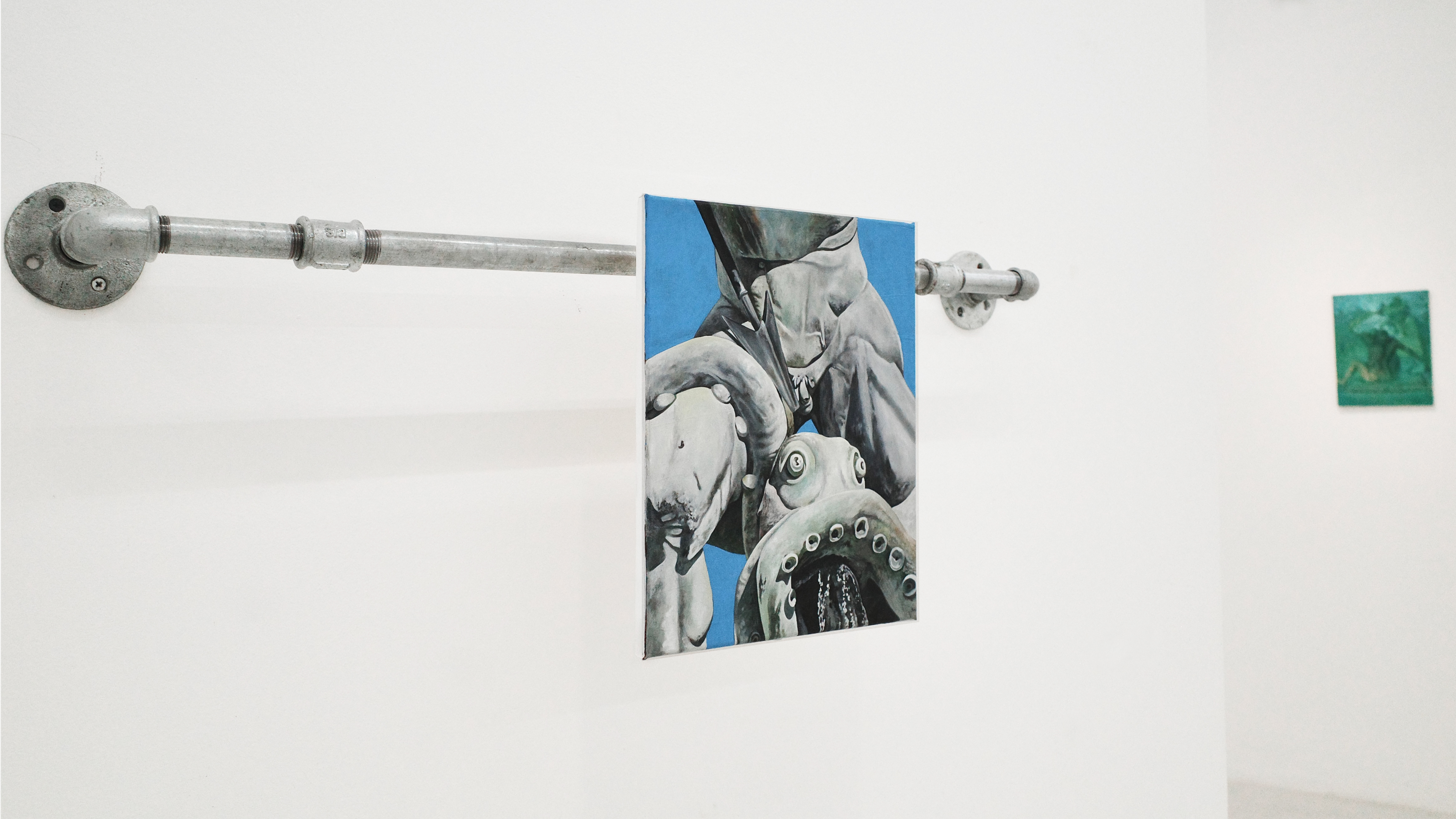 Installation view of He Spoke To The Birds. Artists: Diego Azzola, Huang Zhe. Curated by Fanfan Yuxuan Fan
A pattern emerges from three artists’ work together. Rust is chemistry doing its work over time. Smoke carries the residue of ritual. Pipework bears the traces of circulation, extraction, and displacement. None of the artists are illustrating this idea — the materials are just doing it, on their own terms, whether or not anyone's watching. That is how the show sidesteps the usual move of dressing up ecological anxiety in recognizable imagery, and instead treats materials as if they were already producing knowledge before the artist got involved. Nothing here gives nature a metaphorical voice. The world was already writing things down, in its own systems, long before language showed up to describe it. Going beyond Arte Povera, what Fan's curatorial concept actually foregrounds the three together is narrower and more interesting than "materials": it's an interest in how materials keep records. Matter itself holds memory; things record what happens to them and are able to tell stories without words, using a language that transcends the distinction between human and non-human.
So the birds end up being more of a metaphor than a subject — a way of gesturing at communication that doesn't need speech. The show then shows that this communication doesn't need language at all. Sometimes it just survives as rust, or sediment, or smoke hanging in a room after everyone's left. The challenge then is not to make nature speak, but to learn how to read the traces it is already leaving.
Maurita Cardone
Maurita Cardone is an Italian art journalist, critic and curator whose work explores contemporary art through the lenses of ecology, social change and geopolitics. She is a regular contributor to Il Giornale dell'Arte (the Italian edition of The Art Newspaper) and her work appeared in several international publications.