Whitehot Magazine
October 2026
"The Best Art In The World"
"The Best Art In The World"
October 2026
Unfolding Hidden Histories: Renee Magnanti’s Women Scientists
By SOOJUNG HYUN August 29th, 2026
Unfolding the Past
For centuries, much of women’s creative work took place outside the institutions that defined art and recorded its history. Sewing, embroidery, lace-making, and weaving were closely tied to domestic life and everyday necessity, but they were never merely utilitarian. They required skill, patience, imagination, and a sophisticated understanding of pattern, color, and material. Women passed these skills from one generation to the next, yet many left no individual names behind. What they made survived; the names of those who made it often did not.
This history provides an important point of entry into the work of Renee Magnanti. Trained as a printmaker, Magnanti has spent decades exploring pattern, textiles, encaustic, and weaving. Her early interest centered on the grid, repetition, color, and the formal structures of textiles. Over time, however, her attention shifted from the objects themselves to the people who made them. Through her research into textile traditions from different parts of the world, she became increasingly aware of the many women who created culturally significant objects without being individually recognized as their makers.
Magnanti’s current exhibition, Unfolding the Past: Women Scientists Across Time, at the Stanford Health Library, extends this concern into the history of science. Curated by Lauren A. Toomer, Visual Arts Director for Medicine and the Muse, and Gillian Kumagai, Director of Health Libraries, the exhibition focuses on women who made significant contributions to science but did
not always receive recognition commensurate with their achievements. The setting is particularly appropriate: within a library devoted to medicine, research, education, and the circulation of knowledge, their histories are brought back into view.
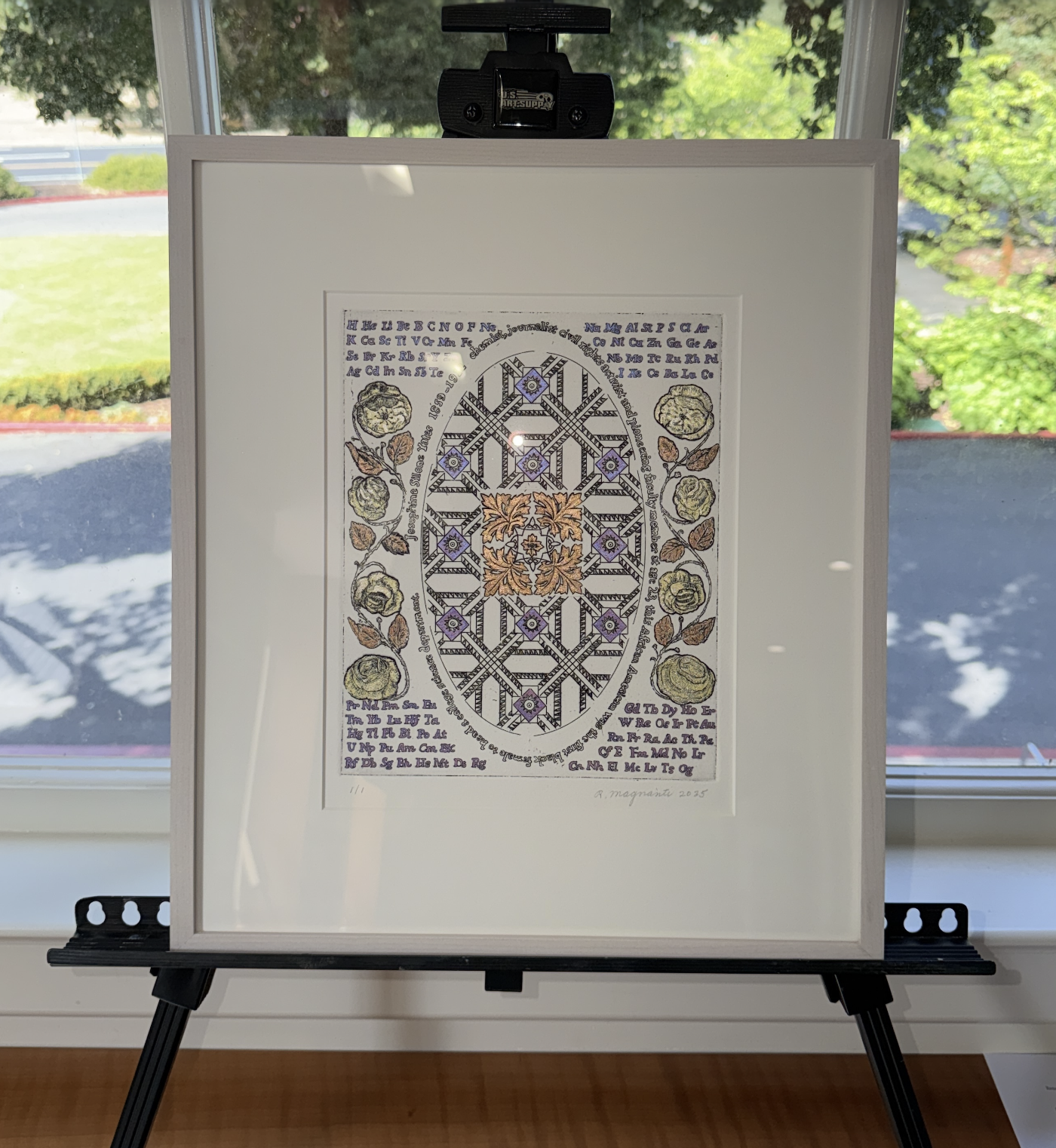
Installation view, Unfolding the Past: Women Scientists Across Time, Stanford Health Library, featuring Renee Magnanti’s work on Josephine Silone Yates (1859–1912). Courtesy of the artist.
Magnanti does not represent these women through conventional portraiture. Instead, she brings together written accounts of their names, lives, discoveries, and research with images of plants, animals, fossils, and lace-like ornamental forms. Text conveys information while also participating in the structure of the image. Forms drawn from scientific subjects create patterns through repetition and symmetry. Words and images do not occupy separate territories; they are organized within the same dense visual field.
This relationship changes as we approach the work. From a distance, color, pattern, and symmetrical structures register first. Moving closer, we begin to read names and sentences and discover the specific life and research of an individual woman. Looking again, forms that initially appeared decorative—a plant, an animal, a fossil—become connected to her scientific work.
This way of organizing an image developed naturally from Magnanti’s earlier practice. Her initial interest in Minimalism and the grid expanded through her study of textiles into pattern and the physical structure of weaving. In her print-weavings, printed images and information are cut apart and reorganized through the woven structure. In Women Scientists Across Time, the names, biographies, and scientific achievements of individual women enter this established visual language.
In front of these works, we look, read, and then look again. The depth of the carved encaustic surfaces and the intersections of paper and thread in the woven pieces add another dimension: the physical presence of something made by hand. Seeing, reading, and experiencing material are not separate activities.
From Printmaking to Weaving
Magnanti received her BFA from SUNY Buffalo and her MFA from Tulane University, where she studied printmaking and painting. Her early interests included Minimalism, Process Art, and Pattern and Decoration. Repetition, the grid, and the physical process through which an image is constructed remained important as her practice evolved.
Her interest in the grid led naturally toward textiles. At first, Magnanti was drawn to the structures and patterns of textiles from different cultures. Gradually, she became interested in the roles these objects played in people’s lives and, more importantly, in who had made them. In Indonesia, she encountered textiles associated with major passages of life—birth, marriage, and death—many of them made by unnamed women. In Greece, she found traditions of weaving and embroidery similarly connected to important moments in women’s lives. Pattern was no longer simply ornament. It carried memory, social custom, cultural knowledge, and women’s labor.
There is a personal history behind this interest as well. Magnanti remembers her grandmothers crocheting and recalls their stories of piecework and employment in textile factories. Her interest in things made by women’s hands is therefore also connected to her own Italian American family history.
In 2011, Magnanti began studying weaving at the Fashion Institute of Technology in New York. She was not changing direction so much as looking for a way to bring weaving into an already established practice of printmaking and painting. The following year, she made her first print-weaving, using her own prints as weft. Later experiments with Japanese paper thread and waxed prints gradually brought printmaking, weaving, and encaustic into a shared material vocabulary.
The relationship between print and weaving is crucial. Magnanti does not simply place an image onto a woven support. She cuts the print itself and incorporates it into the woven structure. Image and material become difficult to separate: the image is woven, and the weaving reconstructs the image.
Beginning in 2015, Magnanti developed Weaving Worked by Women, a large-scale print-weaving project examining women’s contributions to textile traditions in Nigeria, Korea, Japan, Spain, Peru, China, Ireland, and elsewhere. The monumental work of the same title, made between 2015 and 2019 and measuring 108 x 80 inches, resembles an elongated textile from a distance. Up close, printed images and information emerge from within its woven structure.
Through this body of work, Magnanti’s attention moved increasingly from textiles themselves toward the women behind them—women who created objects of remarkable technical and visual sophistication but were rarely recorded as individual artists.
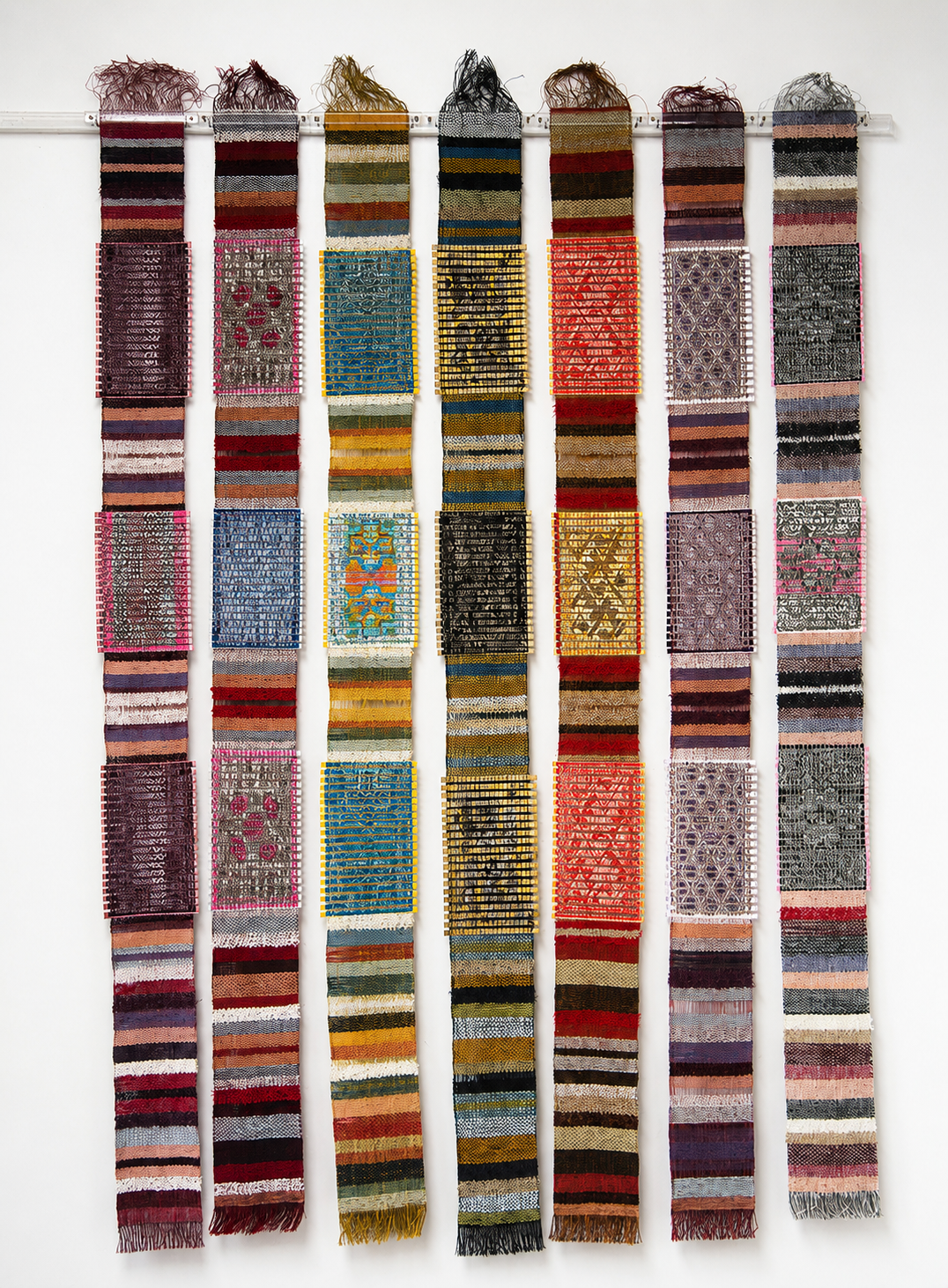
Renee Magnanti, Weaving Worked by Women, 2015–2019, print-weaving, 108 × 80 in. Courtesy of the artist.
From Women’s Labor to Women’s Science
Isabella Parasole (2023) makes this relationship especially clear. Isabella Catanea Parasole (1575 - 1625), active in Rome, designed lace patterns as woodcuts and published them in books. Magnanti’s account of Parasole contrasts this named woman with the many unnamed women who actually produced lace in homes and convents.
In Magnanti’s work, Parasole’s story appears alongside elaborate gold lace-like forms. Again, a face is unnecessary. What she made, her name, and the record of her life become a different kind of portrait.
The work also demonstrates Magnanti’s distinctive carved encaustic technique. Layers of wax are built up and then cut into, giving the surface physical depth and retaining the marks of the artist’s hand. Weaving and carving involve opposite physical actions: one connects separate materials, while the other removes material to expose what lies beneath. Yet both depend on repetition, time, and sustained manual work.
Magnanti’s engagement with women scientists began in earnest in 2018, when her daughter entered graduate study in biology. She began researching women in the natural sciences and developed works around figures including Alice Augusta Ball, Rachel Carson, Eunice Foote, entomologist Maria Merian, chemist Josephine Silone Yates, and Kenyan environmentalist Wangari Maathai.
The subject changed, but the direction of the work did not. Magnanti had previously focused on women who created important textiles without leaving their names behind. In Women Scientists Across Time, she turns toward a different historical imbalance: women whose names and research survived, but whose achievements did not always receive the recognition they deserved.
The distinction matters. An anonymous textile maker who has almost disappeared from the historical record is not in the same position as a scientist whose research and professional achievements were documented but undervalued. Magnanti does not need to make their histories identical. What connects them in her work is a broader question: How is what women have made and discovered recorded, recognized, and remembered?
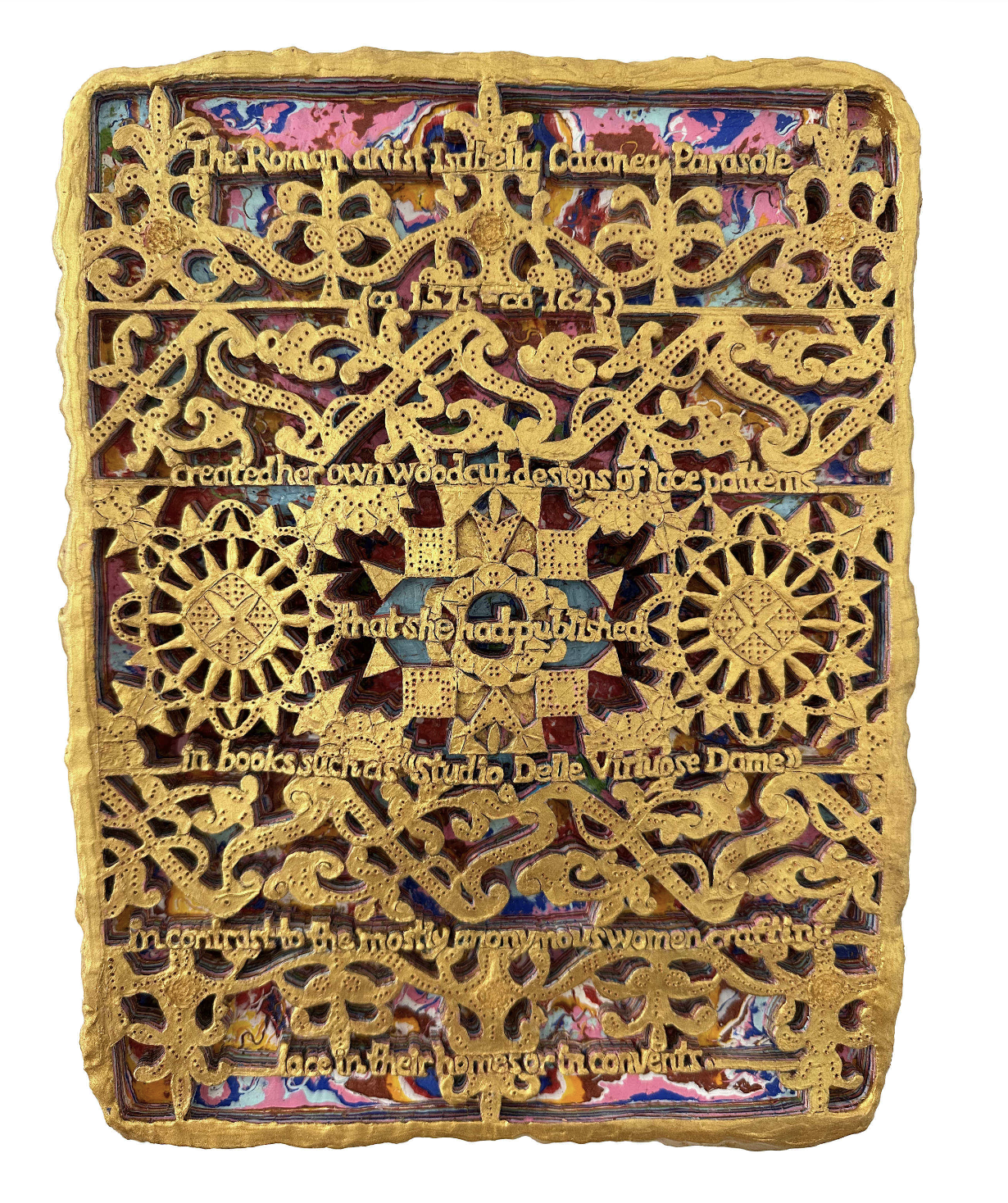
Renee Magnanti, Isabella Parasole, 2023, carved encaustic on panel, 12 × 9 in. Courtesy of the artist.
Reading Women’s Names
The Stanford exhibition includes carved encaustic, hand-colored etchings, print-weavings, and etchings printed on vintage textiles. Some women appear in more than one medium. Jeanne Villepreux-Power and Alice Augusta Ball, for example, are represented through both carved encaustic and print-weaving. This repetition suggests that Magnanti is interested not only in representing a historical figure but also in how the same life can be encountered differently through material and process.
In Alice Augusta Ball (2020), Magnanti recounts the story of the University of Hawai‘i chemist who developed an injectable treatment using chaulmoogra oil for Hansen’s disease. Ball died at twenty-four before she could publish her findings, and her contribution was recognized only much later. Magnanti incorporates this history directly into the work, placing text about Ball’s research among floral and lace-like forms. Her biography is not simply represented; it becomes part of the visual structure of the work.
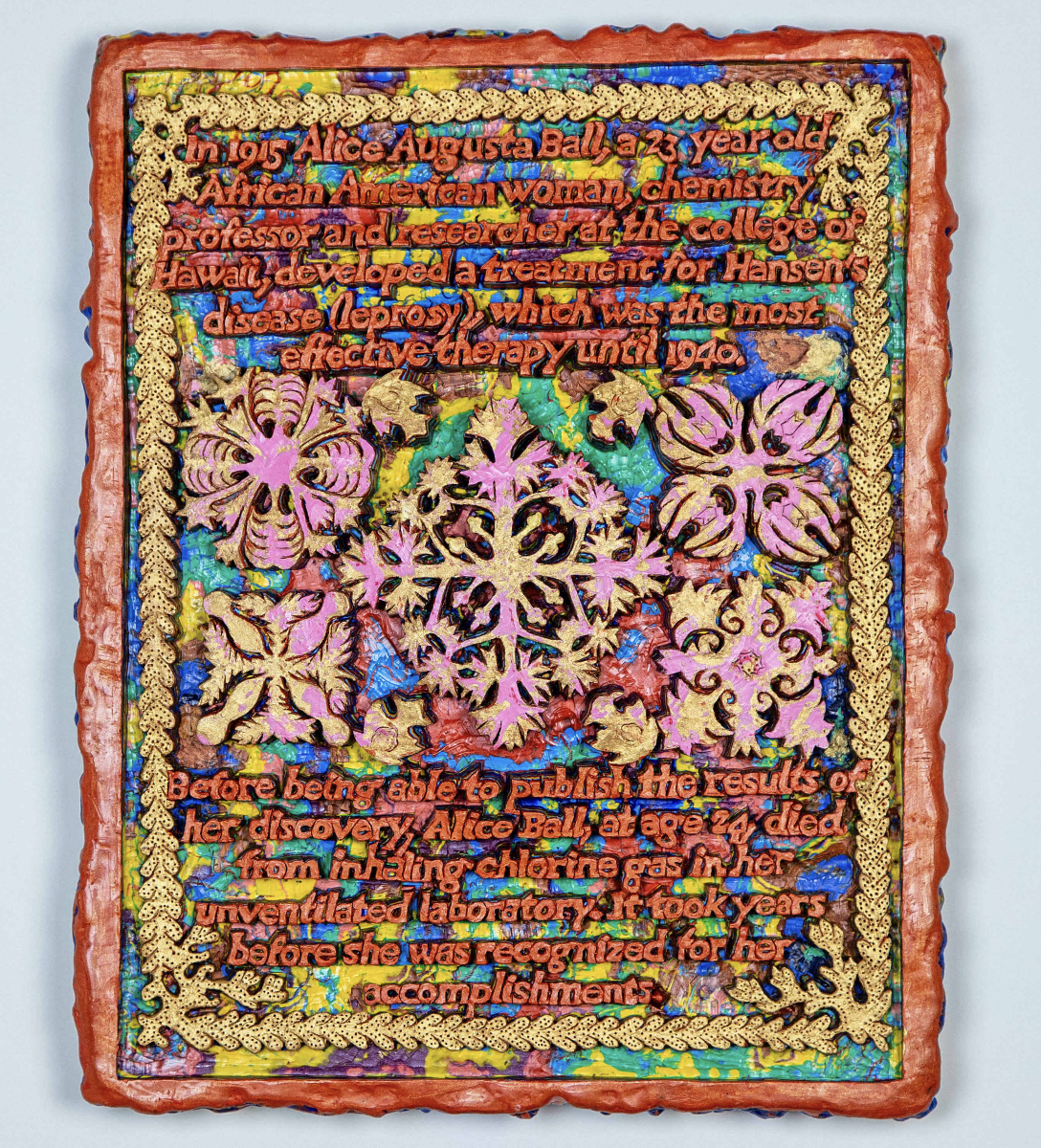
Renee Magnanti, Alice Augusta Ball, 2020, carved encaustic on panel, 14 x 11 in. Courtesy of the artist.
Other works follow a similar approach while drawing upon the particular worlds these women studied. In Eunice Foote and Rachel Carson (2020), plant forms accompany references to Foote’s research and its significance to the understanding of climate change. Maria Sibylla Merian (2020) combines the naturalist and artist’s words with floral imagery, while Jeanne Villepreux-Power (2022) brings biographical text together with forms suggesting the paper nautilus and marine life. In each case, scientific subjects mingle with patterns recalling lace and textiles. Words remain readable, but they also participate in the visual structure of the work.
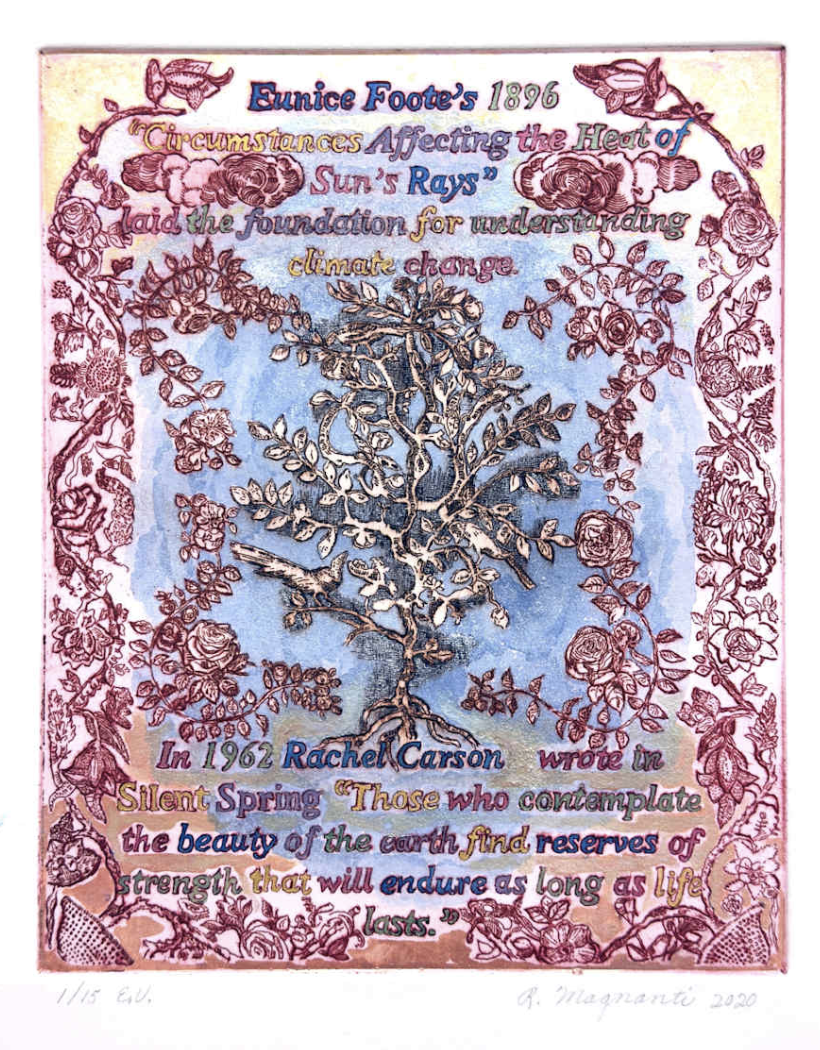
Renee Magnanti, Eunice Foote and Rachel Carson, 2020, hand colored echings, 1/15, 10 × 8 in. Courtesy of the artist.
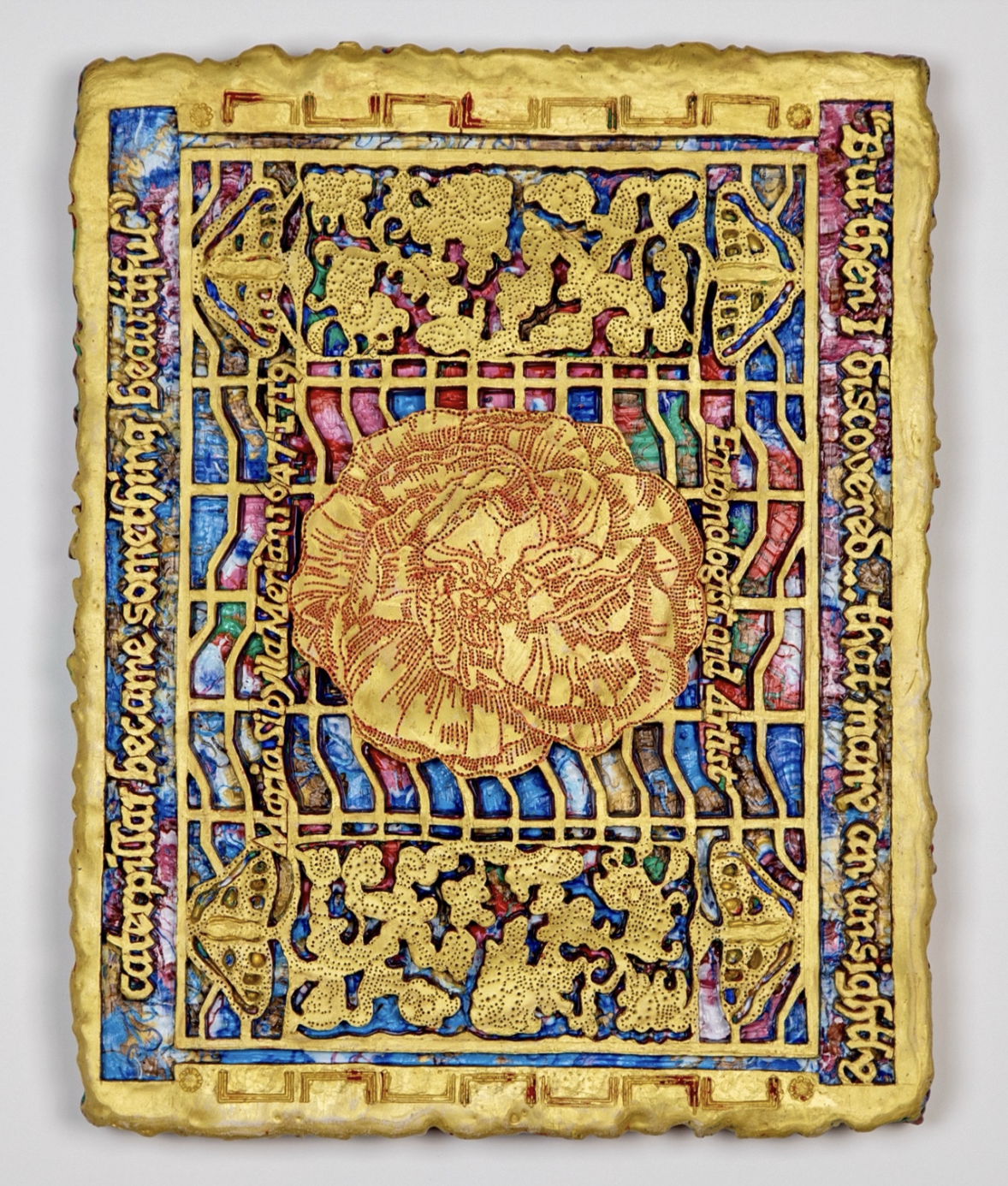
Renee Magnanti, Maria Sibylla Merian, 2020, carved encaustic on panel, 14 × 11 in. Courtesy of the artist.
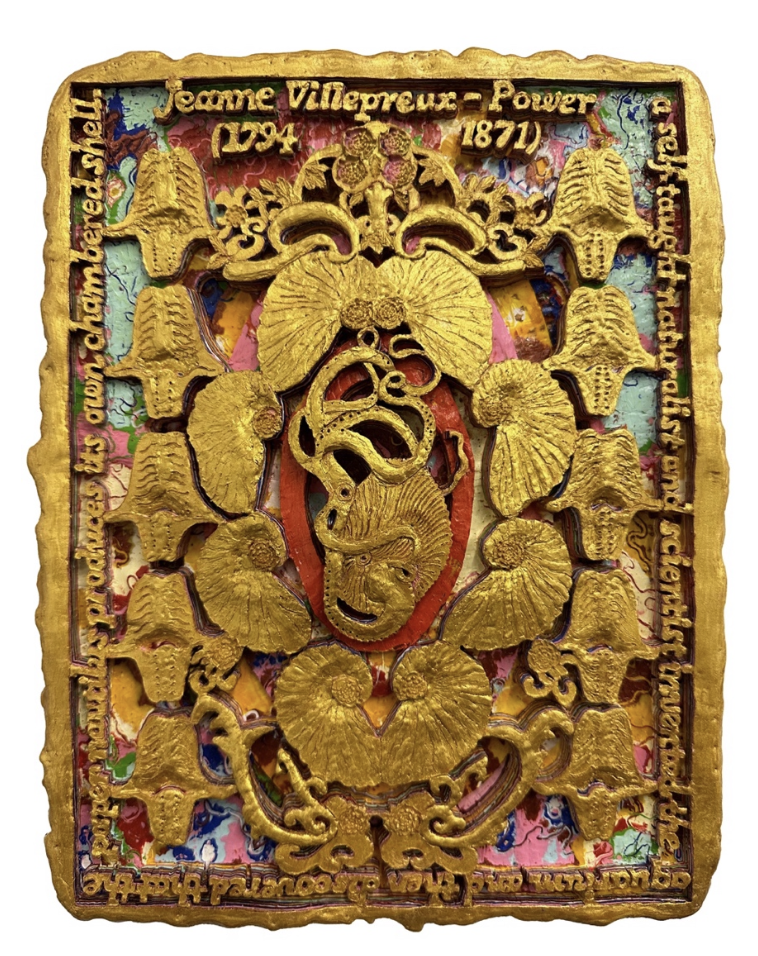 Renee Magnanti, Jeanne Villepreux-Power, 2022, carved encaustic on panel, 14 × 11 in. Courtesy of the artist.
The works printed on vintage textiles operate differently. Plants, animals, and words appear relatively directly against white cloth, but the support already carries its own history. Embroidery, crocheted edges, lace, and the worn texture of old fabric bring the traces of other hands into the work. In the piece devoted to Wangari Maathai, words about her environmental activism and the Green Belt Movement appear among images of trees and animals. Another work brings Eunice Foote and Rachel Carson together through scientific and environmental histories printed onto an older textile. Here, a newly printed historical narrative meets a material that already bears the evidence of use and handwork. Two different kinds of time occupy the same surface.
This difference among media is central to Magnanti’s practice. The same story changes when it is carved into wax, woven through paper and thread, or printed onto an old textile. The medium is not simply a support for information; it shapes how that information is encountered.
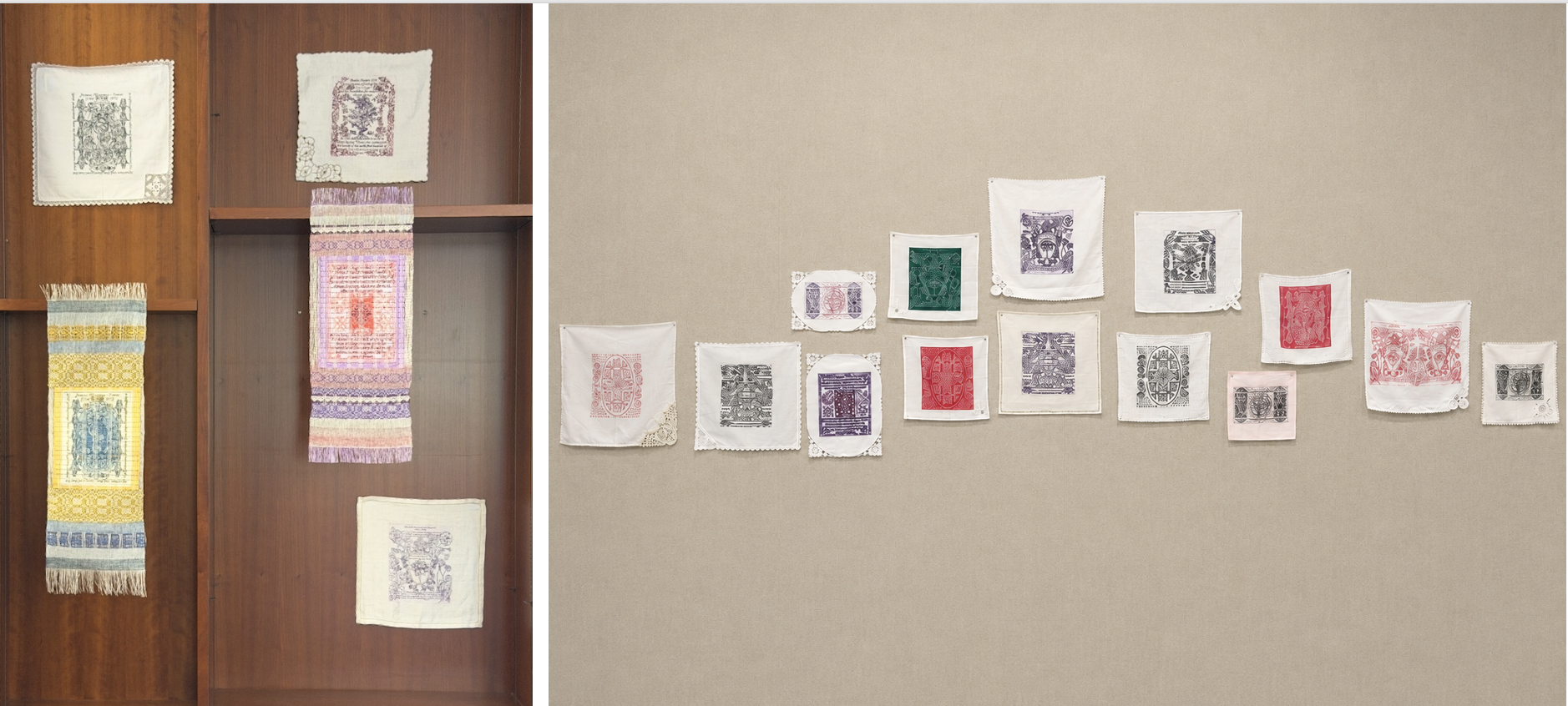
Installation view, Unfolding the Past: Women Scientists Across Time, Stanford Health Library, May 29–August 31. Courtesy of the artist.
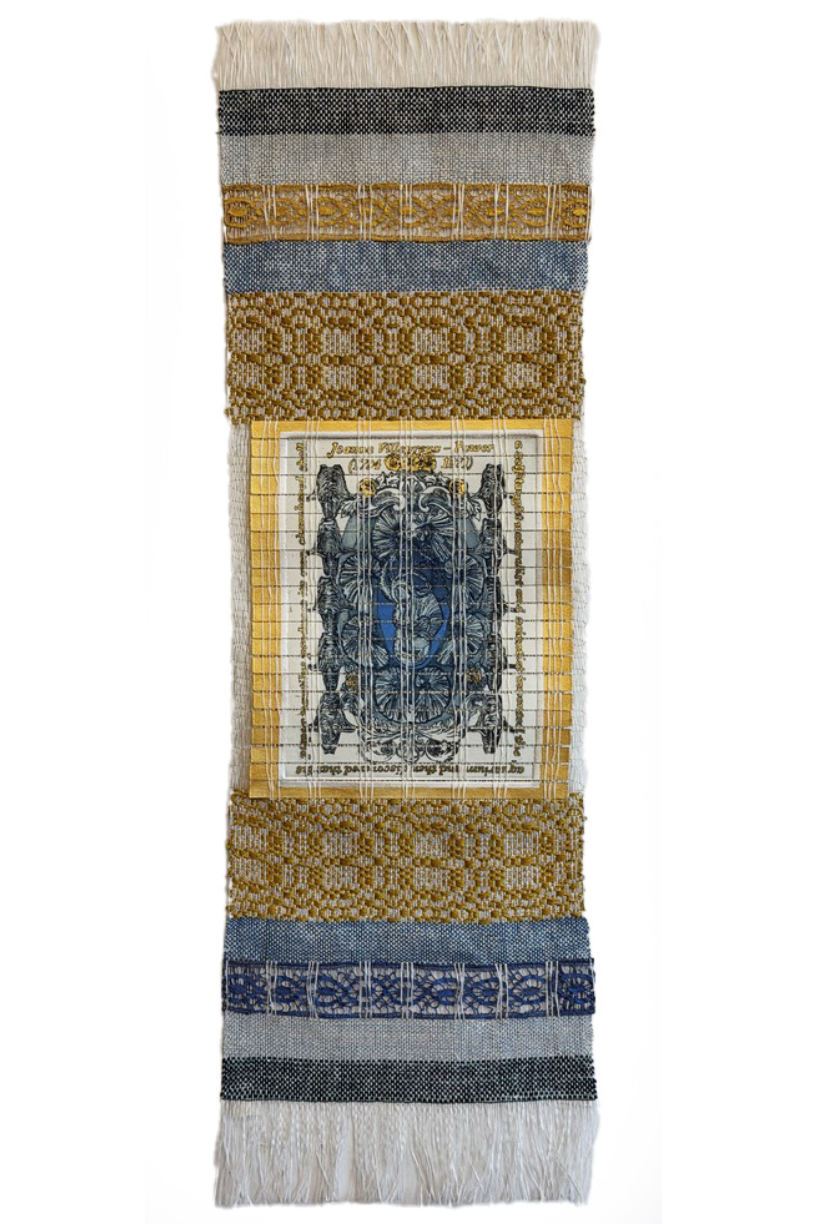 Renee Magnanti, Jeanne Villepreux-Power, 2026, etching with hand coloring, vintage lace, and paper yarn weaving, 36.5 × 11.5 in. Courtesy of the artist.
Unfolding History
Seen in this larger trajectory, Unfolding the Past: Women Scientists Across Time is not a sudden turn toward science. It is an extension of Magnanti’s long engagement with women’s overlooked labor and creativity into the history of scientific knowledge.
The women she brings together lived in different periods and did very different kinds of work. Some made textiles without leaving their names behind. Others studied plants, chemistry, fossils, insects, marine life, or the environment. Their histories should not be collapsed into a single experience. What connects them is the uneven way women’s acts of making and discovery have been recorded, valued, and remembered.
Alongside this inquiry, Magnanti has developed a material language of her own. Printmaking records; weaving connects; carving reveals. These need not be read as fixed symbols. They are, first of all, things she actually does—processes whose meanings have accumulated through years of working across different materials.
Color and pattern, wax and paper, thread and the evidence of the hand remain as important as the written information. We look at the work, read its words, and then return to its images and surfaces. What Magnanti wants to say and how she makes the work cannot finally be separated.
Unfolding the Past does more than retrieve women from history. Magnanti writes their names into her work, brings the worlds they studied into images, and places their stories within a visual language she has developed through printmaking, weaving, pattern, and wax.
We read their names. We see the worlds they studied. And we encounter the time of the hand that has brought these histories together.
Unfolding the Past: Women Scientists Across Time
Renee Magnanti
Stanford Health Library
May 29–August 31, 2026
Soojung Hyun
Soojung Hyun is a New York–based curator, writer, and art historian. She has organized exhibitions at venues including the Anya and Andrew Shiva Gallery, AHL Project Space, and PS122 Gallery. She teaches Asian and contemporary art as an adjunct faculty member and contributes to the Archive of Korean Artists in America (AKAA). Her writing focuses on diasporic identity, material memory, and the intersection of Eastern and Western aesthetics.
view all articles from this author