Whitehot Magazine
October 2026
"The Best Art In The World"
"The Best Art In The World"
October 2026
Where the Body Holds the Earth: The Regenerative Feminine in Hilda Palafox
 Custodia (2025), diptych oil on linen, approximately: 86 x 47 x 1 inches (220 x 120 x 4 cm), overall: 86 x 94 x 1 inches (220 x 240 x 4 cm)
By SOPHIE BARFOD February 11th, 2026
Two halves of a body softly hug the stem of a tree. The figures cling tightly to the stem, their embrace resembling an attempt to hold onto existence. In the central point of the composition, a tree cavity with an opening of a similar shape to a vulva lip releases a tiny snake’s body. This mythological serpent seems to reference cyclical regeneration, fertility, and rebirth in diptych painting in Custodia (2025). Among Custodia, Hilda Palafox presents a series of similarly curved figures dissolving in the background planes of earthy tones in her solo exhibition De Tierra y Susurros (Of Earth and Whispers) at Sean Kelly Gallery from January 9 to February 21, 2026.
The dissolving boundary between the subtly stroked figures and the oker-shaded earth affirms a re-connection between women and the world. By merging the body with the land, Palafox’s work reminds me of Ana Mendieta’s earth-body practices through their shared reconfiguration of embodiment. In both cases, the body is embedded within the earth, calling for a different way of relating to the female nature of being. Within this porous boundary between the female body and nature, both artists propose an alternative foundation for femininity that resists the social coding of the body as an object for reproductive utility or for the gaze's enjoyment.
 Figure 1. Tree of Life (1976) by Ana Mendieta
What, then, does the female body become when it is understood as part of nature itself, rather than reduced to the status of a mere womb? What is this alternative ground for the feminine, affirming the undeniable connection between our bodies and nature? In Mayan and broader Mesoamerican cosmologies, the Tree of Life represents interconnectedness across realms: its branches extend toward the heavens, the trunk occupies the earthly plane, and its roots descend into the underworld. Through the Tree of Life cosmovision, the human is understood not as separate from nature, but as embedded within a larger ecological and cosmic network. Hilda Palafox clearly calls to this deeply interconnected relationship with her safekeepers (Custodia) of the earth.
 Close-up Custodia (2025)
In a similar vein, Susurros I (2025) is shaped in a cyclical form, with two bodies crawling up to protect a little plant emerging from the ground. Once again, the center of the image is marked by a subtle opening in the earth, a site from which new life arises, evoking a sentiment akin to the womb's reproductive function. Noteworthy is the cyclical form, signalling continuity over progress and balance over hierarchy. The plant's fragility encourages the viewer to consider collective responsibility for caring for the earth, while the figures' curled postures recall the fetal position, visually signaling its containment and protection. This echoes the title, Susurros (whisper), and the idea that a whisper exists to be heard only in relation to another. It cannot command a room; it must instead be received. This may be what Hilda Palafox is alluding to: the need to relate to the earth's whisper before it turns into a scream.
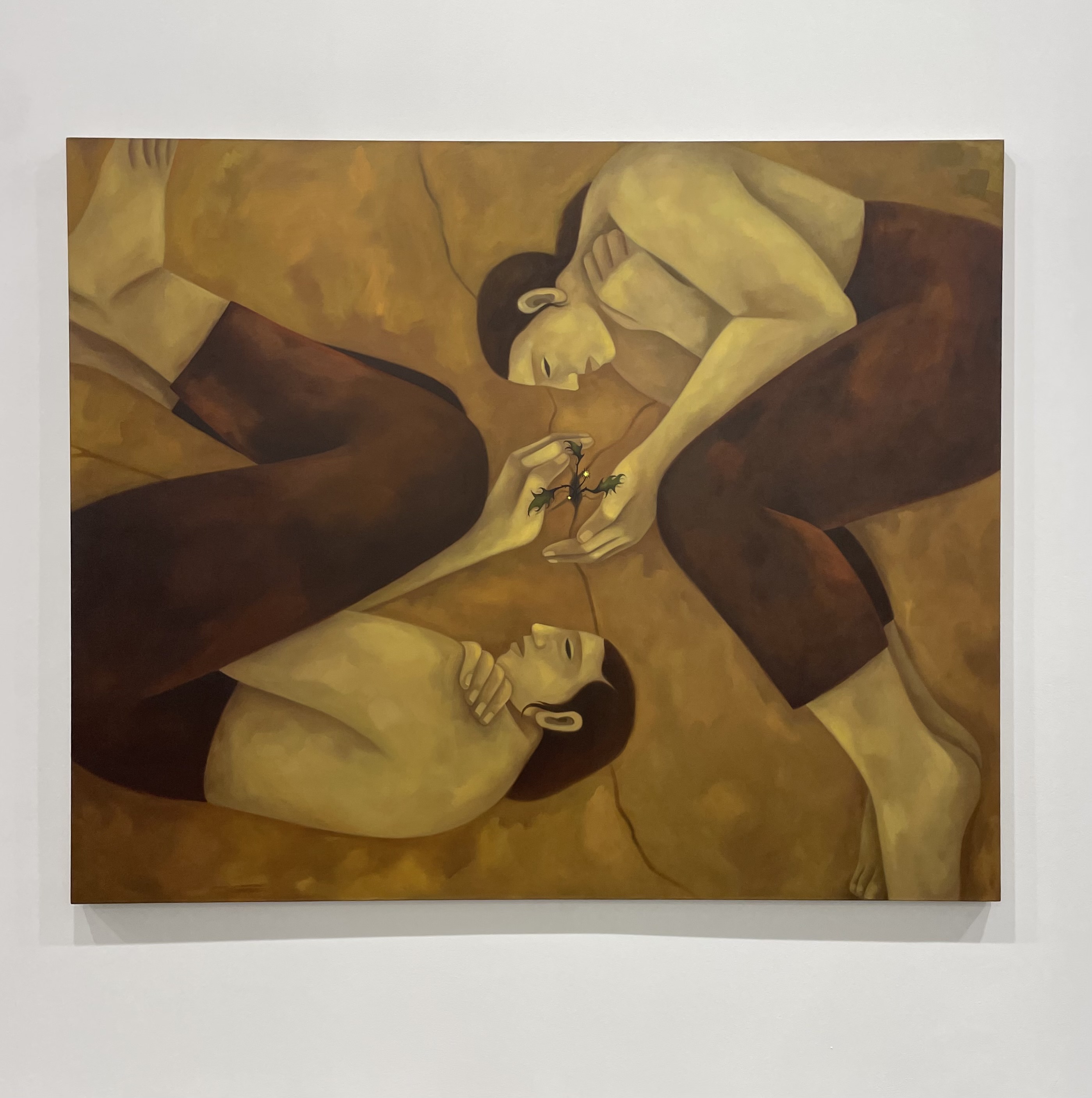 Susurros I, 2025, Oil on linen, approximately 70 x 86 x 1 inches
In a contemporary moment shaped by hyper-individualism and ecological alienation, Palafox’s work feels increasingly urgent. As modern life continues to fracture our understanding of ourselves as part of a living system, De Tierra y Susurros reasserts the necessity of relational ways of being by proposing an alternative, feminized mode of connection to the world around us. Through this reorientation, Hilda Palafox redefines how human agency operates, positioning it as inseparable from our relationship to the natural world. WM
Sophie Barfod
Sophie Barfod is an independent curator, art advisor and writer from Amsterdam, the Netherlands, currently based in New York City. Her practice operates at the intersection of curatorial work and cultural strategy, with a focus on exhibitions in found and public spaces grounded in feminist theory and social practice. She currently heads strategic development and curation at SaveArtSpace. Her writing has appeared in The Curatorial and Whitehot Magazine.
view all articles from this author