Whitehot Magazine
November 2026
"The Best Art In The World"
"The Best Art In The World"
November 2026
Robert Colescott’s Racial Reckoning at Gladstone Gallery
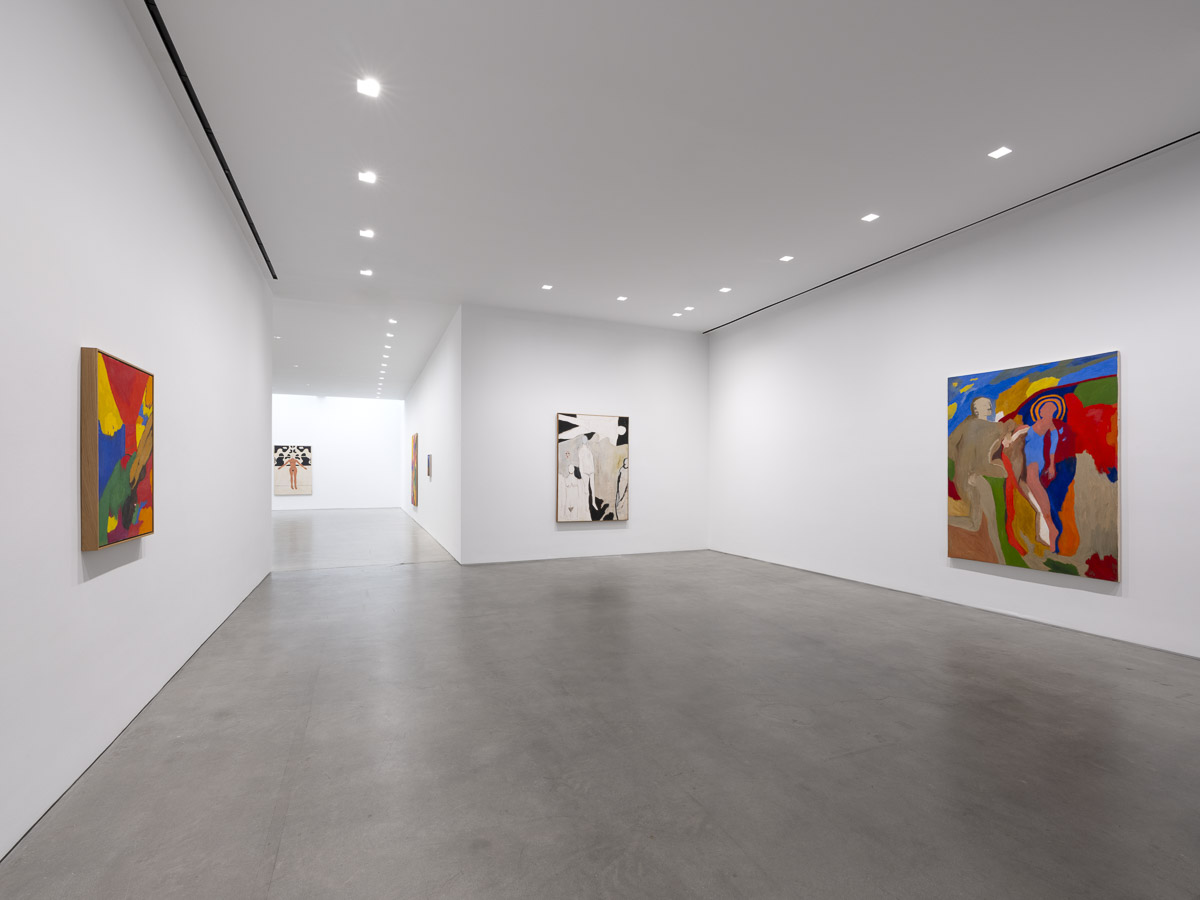 Installation View of Cairo, Photo courtesy of Gladstone Gallery
By MILES FUCCI, November 23, 2026
What is a racial reckoning? What does it mean to come out or step into the color of oneself and one's practice? I recently visited the Cairo exhibition at Gladstone Gallery, which touches on a particular period in Robert Colescott's life that resulted in his “coming out” as Black. Colescott was born in Oakland, California, to two Creole parents who advised him and his brother, Warrington, to identify as white. Given that both parents were light enough to pass as white, and considering the racism they likely experienced or witnessed in New Orleans, their move to Oakland seemed to solidify their identification with whiteness. It wasn't until Colescott received a fellowship at the American Research Center in Cairo, where he spent roughly four years, that we begin to see him come to terms with his Black identity.
When discussing racial reckoning in relation to Colescott, I feel we must first look at W.E.B. Du Bois's concept of “Double Consciousness,” presented in The Souls of Black Folk. In the context of being Black American, double consciousness boils down to developing a sense of self while also being aware of how an anti-black society perceives and stereotypes us. It's a negotiation between the internal self, the external self, and the tension between the two.
In Cairo, Colescott visits the Valley of the Queens in Thebes, where he encounters wall paintings inside the tombs. The female figures seem to emerge from the red and brown stones, sparking an interest in the female figure, fragmented historical memory, the surrounding landscape, and storytelling. These encounters, alongside material constraints, also lead him to reconsider his color palette. We begin to see this in works like Imagine the Valley of Queens, Imagine Acrobats, and Fencing Women, where Egyptian visual culture and African artistic histories outside the European art canon begin to inform his practice.
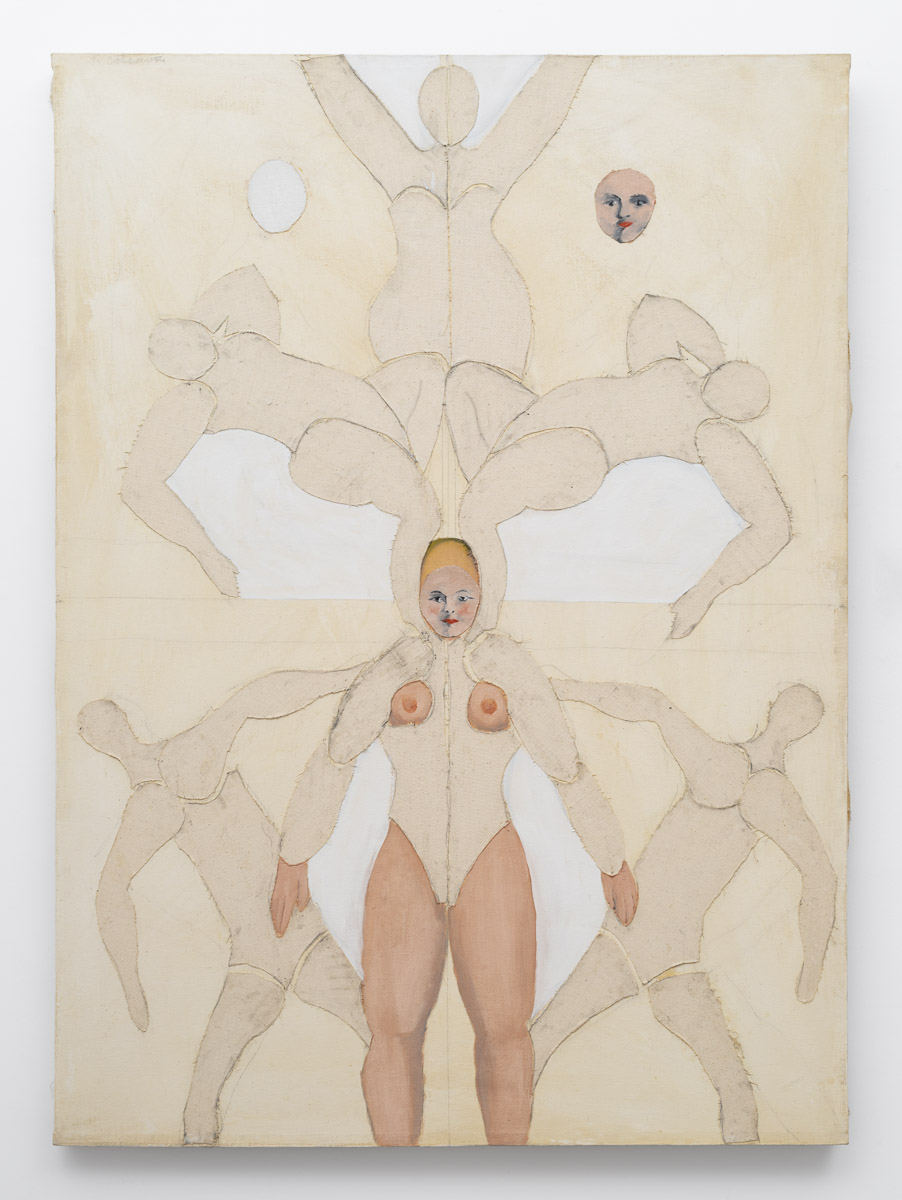
Robert Colescott, IMAGINE ACROBATS, 1964, Photo courtesy of Gladstone Gallery
As Colescott becomes more immersed in his day-to-day life in Cairo, he experiences a displacement of the racial gaze he was so accustomed to in the United States. Maybe displacement isn't quite the right word here. Rather, I would argue that what Colescott experiences is a merging of the two consciousnesses Du Bois proposes. In Chapter 1 of The Souls of Black Folk, Du Bois alludes to this possibility when he writes, “In this merging he wishes neither of the older selves to be lost.” James Baldwin touches on a similar realization in his essay The Discovery of What It Means to Be American, writing, “I wanted to find in what way the specialness of my experience could be made to connect me with other people instead of dividing me from them.” Both writers speak to the possibility of understanding oneself beyond the racial expectations that have shaped one's experience in the United States.
Leaving a heavily racialized society and entering one with different racial expectations can shift how one comes to understand oneself. Colescott was uniquely privileged in his ability to leave the country and explore his racial identity. His family's ability to pass as white afforded him a particular relationship to racial identity and mobility that was not available to many Black Americans, whose experiences were shaped by the ways they were consistently racialized by the society around them. Racism does not simply disappear outside of the United States, but the histories and social expectations through which Blackness is understood differ depending on where one is situated. Based on the shifts in Colescott's practice and his subsequent identification as Black, Cairo seems to have disrupted the particular racial gaze that shaped his American experience.
It's important to distinguish between being Black, identifying as Black, and understanding oneself through Blackness. These are not necessarily interchangeable experiences. I don't necessarily think Colescott became Black in Egypt. Rather, I think he began to understand and position himself in relation to a Black identity that had already been part of his inheritance. Much of our understanding of ourselves is shaped by the places we occupy and the histories we encounter there.
We begin to see a material shift in Colescott's work around 1965, as he moves away from the earthy brown tones of his earlier work toward more colorful compositions. This shift becomes more pronounced after he returns to Egypt as a professor in 1966. While this development can be understood through the material possibilities available to him, I also think it speaks to a larger shift in his artistic practice. His mother dies while he is away in Egypt. Given her own Black ancestry and her role in the family dynamic surrounding racial passing, her absence adds another layer to this period of transition. I wouldn't draw a direct connection between her death and his racial reckoning, but I do think it's very much worth considering.
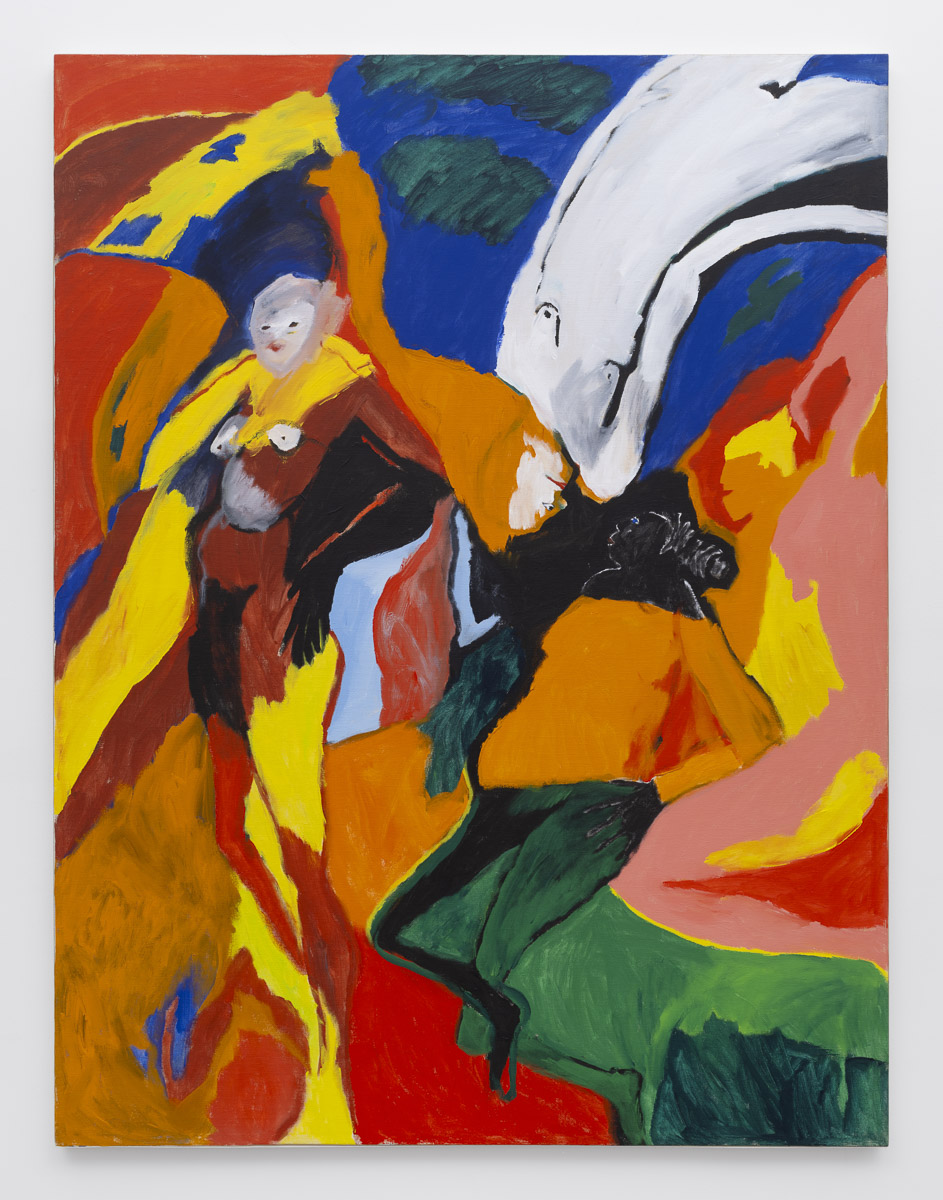
Robert Colescott, Untitled, 1966, Photo courtesy of Gladstone Gallery
One work that really spoke to this merging of identities was Untitled (above), displayed alone on a large wall within the gallery. A particular detail immediately caught my attention: a Black figure with blue eyes and a white figure with black eyes gazing at one another. I think this detail embodies Du Bois's Double Consciousness through a figurative meeting of two racial identities. I'm particularly interested in the reversal of these physical characteristics, which disrupts the visual expectations through which we have come to understand Blackness and whiteness. It also brings me back to Colescott's upbringing and the history of racial passing within his family. What does it mean to look at these figures and question the very characteristics we use to identify race? Perhaps this is where the internal and external selves meet, not necessarily in complete reconciliation, but in the possibility of developing a new understanding, a new relation.
The arrangement of the works is particularly interesting. Rather than following a strict chronological sequence, the installation allows different moments in Colescott's practice to speak to one another. We can make connections between his earlier, more earthy works and the increasingly colorful compositions that emerge during this period, while also considering how these shifts anticipate the visual language of his paintings from the 1970s and 1980s, with their political commentary and racial stereotypes. This arrangement encourages us to consider Colescott's artistic development as something more layered than a linear progression.
Ultimately, Cairo offers a glimpse into a period in which Colescott was developing a more concrete understanding of himself. His racial reckoning represents not only a material shift in his practice but also an identity shift, raising the larger question of how our Blackness shapes us and the things we produce. The exhibition is on view until December 19th. WM

Myles Fucci
Myles Fucci is a curator, writer, and model based in Brooklyn, New York. His interdisciplinary practice explores discontinuous Black diasporic narratives and the ways memory, kinship, and archives shape our understanding of the past and possibilities for the future. While grounded in an interest in Black diasporic life and cultural production, his work remains attentive to broader questions of history, relation, belonging, and symbolism.
view all articles from this author