Whitehot Magazine
August 2026
"The Best Art In The World"
"The Best Art In The World"
August 2026
African Queens: Carol Beckwith & Angela Fisher
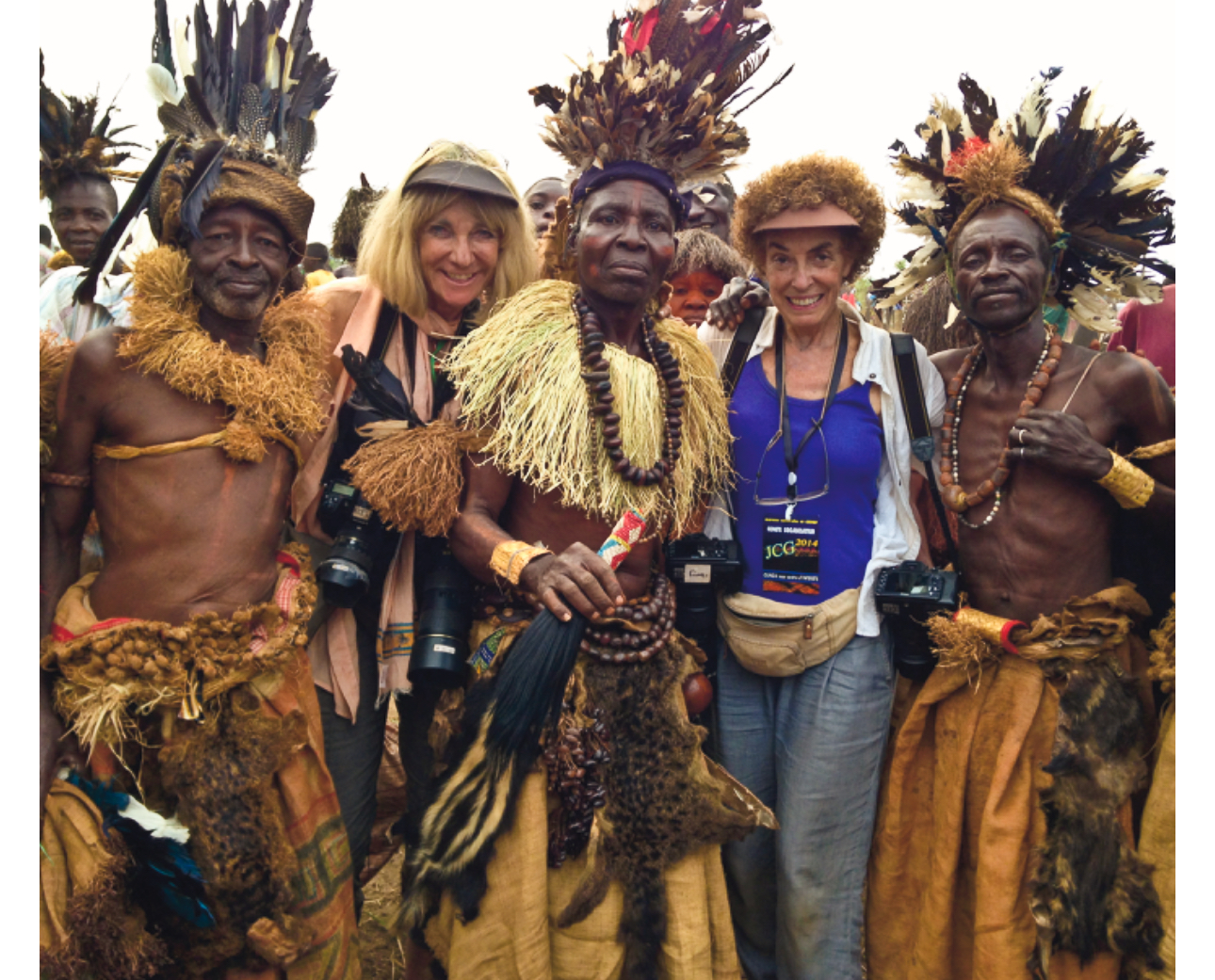
Angela Fisher and Carol Beckwith
By DAVID JAGER April 19th, 2026
Nothing provokes our imagination more than Africa. Start with its baffling scale. Covering close to 20% of the earth’s landmass, it ranges from desert to savannah to rainforest, housing a significant share of the world’s biodiversity. Add 3000 ethnic groups and 2000 languages, from the most ancient hunter gatherer societies to bleeding edge urbanity, and you’ll begin to understand why it defies every attempt at categorization.
This has not, however, daunted two photographers who have spent the last 47 years documenting its tribal cultures. Angela Fisher and Carol Beckwith, two travellers with backgrounds in ethnography, photography and art, met in Kenya in 1978. They have since produced the most detailed record of African tribal culture ever assembled, in an attempt to cover the entire continent, or all 54 countries. It is one of the most extensive and detailed surveys of human culture ever attempted. A show featuring highlights of their work is currently on view at Painted Pictures Gallery at 136 East 73d street through June 10th. And just recently, the National Museum of African Art at the Smithsonian has announced its formal acquisition of their photographic archive. The two explorers will discuss the historic acquisition this Thursday, April 23rd at the Museum's lecture hall in Washington D.C. from 11:30-1:00 pm.
It has been a long, if not grueling, journey towards recognition.The subjects they have chosen to record are elusive, remote and very difficult to find. The Africa they are looking for is timeless, beyond its all too familiar catastrophes and conflicts. “We’ve always wanted to tell the stories behind the news headlines” they once told the LA Times. “the stories that go way beyond contemporary political upheaval... The modern stories are very important, but ours is a more ancient story.”
Finding the thread of this story requires covering immense distances through jungles and forests, up mountains, and beyond any known roads. Angela and Carol have paddled across South Sudan in dugout canoes in search of the Dinka nomads. They have mule trained over ten-thousand-foot mountains in Southwest Ethiopia in search of the Surma. A Jeep jostled them across the sweltering Danakil depression at 410 feet below sea level, where they finally reached the notoriously elusive Afar nomads. They went deep into the mountains of Ethiopia to spend a length of time with the Orthodox Christians and an isolated community of African Jews known as the Falasha, or the Beta Israel. Pushing into Africa’s remotest corners, they have succeeded in witnessing dozens of rituals, ones generally hidden or conducted in secret. They are very often the first to have done so.
Finessing a tribal culture takes time. It can take years to fully know a people, requiring unheard of persistence, resourcefulness, and resilience. It is through this patient and exhaustive process of documenting 150 different cultures across the continent, Angela and Carol have produced 17 books, a testament to the unfathomable variety, diversity and richness of the African continent.
Their focus is the documentation of life transitions, or as they put it, ‘Rituals that carry individuals from birth to death’. In visit after visit and tribe after tribe, they meticulously record the cycle of circumcision and initiation, warrior status, courtship, marriage, and birth. They also have covered royal coronations, seasonal rituals, healing exorcisms and death. They are looking to document human truths at culture’s inception from 150 different tribal groups so far, recording ceremonies from pre-recorded history that open onto a world that many of us have forgotten.
“Rites of passage tell an individual what is expected of him at each stage of life which makes the transition through life much smoother” they explained during a recent lecture on their book ‘African Twilight’. It is a form of social ordering that not only aligns individuals within the community. It also places them within the welcoming narrative of a larger world, a natural and cosmic narrative that both welcomes them and embeds them within its own mythos. “Ceremonies and rituals put us in touch with nature and with the environment...” they say often “as well as putting us in touch with our own Spirit worlds."
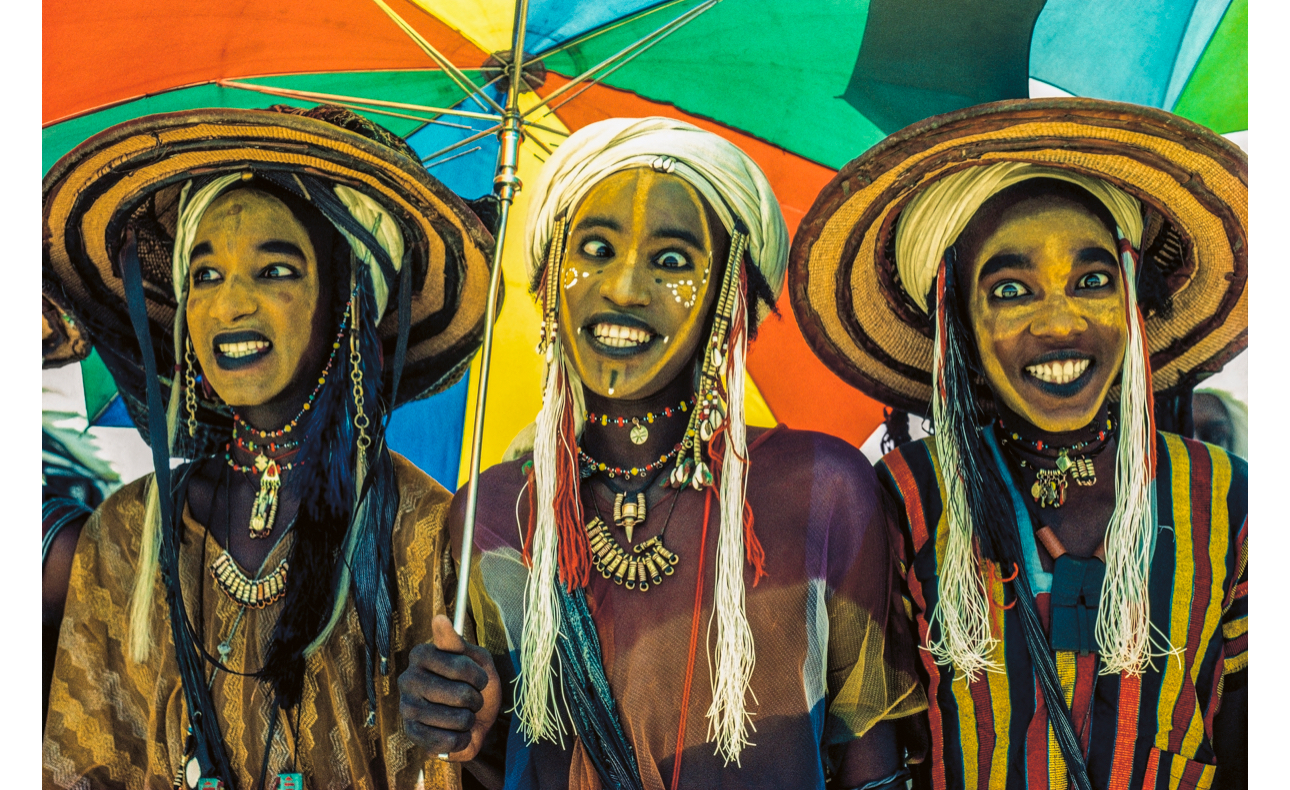
Three Wodaabe Male Charm Dancers, Niger, 1981
****************
When I meet with Carol and Angela at a café table in the West Village they have just returned from Tanzania. Just into their seventh decade they are undiminished and elegant, projecting the well-seasoned toughness of women used to walking days between water holes. Angela is willowy and blond, while Carol, equally slender, can be identified a profusion of chestnut curls. They are adorned with many pieces of African flair. Bright beaded bracelets, earrings, broaches and necklaces, which they wear in near Iris Apfel profusion.
Sitting down they excitedly tell me they are in the process of building a new museum in the city of Arusha in Tanzania, fifty miles Southwest of Mount Kilimanjaro. Their sponsor, a fourth generation South Asian African, is dedicating his fortune to the preservation of African culture. They tell me he had just shown them plans for the main museum, an 800 square meter arena. “I would like you to make this your African Ceremonies home in Africa.” He told them.
It is welcome news. However, it is underscored by a troubling reality. Traditional ways of life are disappearing rapidly. The pace has only accelerated since they began their work, with ceremonies changing drastically or vanishing entirely. Both women state that 40%, if not more of the rituals and practices they have documented are already gone. “If one doesn’t record Africa now, it won’t really be there to record.” they tell me, “Many of the ceremonies we have recorded since then no longer exist.”
What is it that drives both women? As a child, Carol dug for lore of foreign and nomadic peoples with the help of a giant set of World Encyclopedias, where she devoured information on tribal cultures. She was known for standing alone and staring dreamily at the horizon, a tin globe of the world in her hand. Angela’s father, who instructed her in outdoorsmanship and chess, took her often on remote treks to the outback. They camped under the open stars with a fire and a rifle to keep the dingoes at bay.
Both women found themselves in Kenya, unbeknownst to each-other, both to document the Maasai. Carol had enlisted Angela’s brother, a balloonist, to help her take aerial photographs. Halfway through the shoot, he turned to her and said ‘Carol, I think you really need to meet my sister Angela.’”
Their similarities were remarkable. The were both young women, fearless adventurers, and deeply fascinated with tribal societies. Even so, they were underwhelmed at their first meeting. “We thought the other was far too posh looking” they confessed, laughing. “We were expecting the other to be some Amazonian bush women.”
Nevertheless, they were photographing the Maasai side by side shortly after. They found their skills and aesthetics were complimentary. Both have an astonishing eye for framing and color. They also found that their generally unthreatening demeanour made their approach to forbidding societies much easier. They have succeeded where many other anthropologists and ethnographers have failed.
Part of their success lies in their knack for feeling their way into their subjects. Their portraits show deep observational and psychological acumen. They are adept at capturing the beauty of their subjects, who are often spectacularly adorned. Yet common humanity shines through. Especially touching are their photos of courtship rituals, such as their photos of adorned and flirtatiously smiling young Surma women, or the peacocking prowess of the Wodaabe men. Decorated with ochre and charcoal pigment, beads and feathers, jumping cross eyed and flashing their gleaming white teeth, they are intensely charming. They could also be any young men romping and preening for the attention of women anywhere, just as they would on a Brooklyn corner or in Rome.
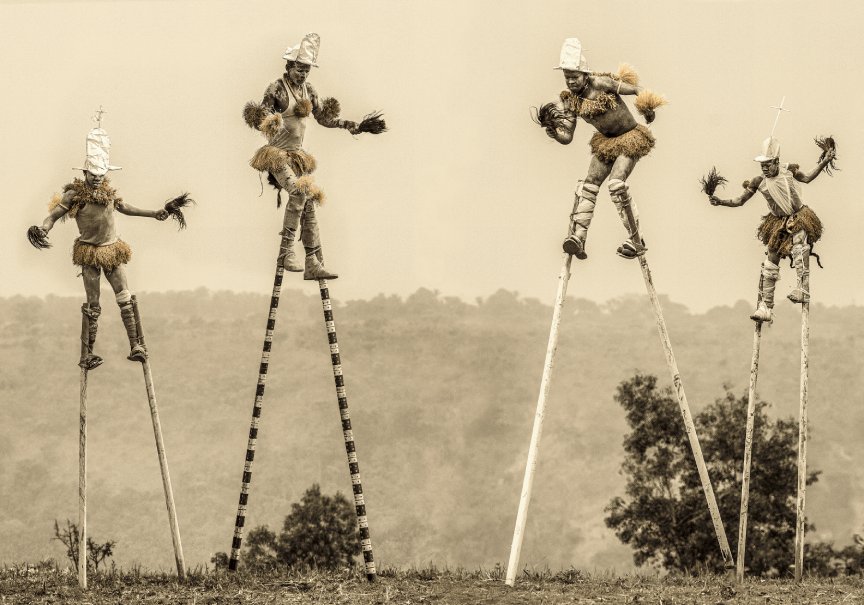
Pende "Tall Men Walking" Stilt Dancers, Gungu, DR Congo, 2014
Their insistence on deep immersion is what makes their subjects so at ease before the camera. “We join them for a good length of time” Angela explains “So that you become more than an observer of the tribe. We become companions, fellow travelers, soul mates”. This included two years spent with the Wodaabe, nomadic pastoralists of the West African Sahel, where she learned the local language and its dialects, participating in daily life.
Once settled into a community, their stay follows a predictable rhythm. Long days of participation, investigation and photography, capped by evenings of exhaustive field journaling. The journals themselves are already a trove of information. Heavily illustrated by both women, they include beautiful sketches of subjects and their costumes, along with detailed maps, calendars and diagrams. There are over two hundred in their studio in London.
The long periods of sojourn are punctuated by moments of extreme urgency. In between trips in Madagascar, they were given a 48-hour window to capture a Maasai elderhood ceremony. It was one that occurs only once every14 years. Within hours they had hopped a flight to South Africa, then to Kenya. They then drove 17 hours to the ceremony site in Tanzania. As they hadn’t had time to acquire visas, they snuck over the Tanzanian border at night. They arrived just in time and spent the next five days recording and taking notes. It was included in their book.
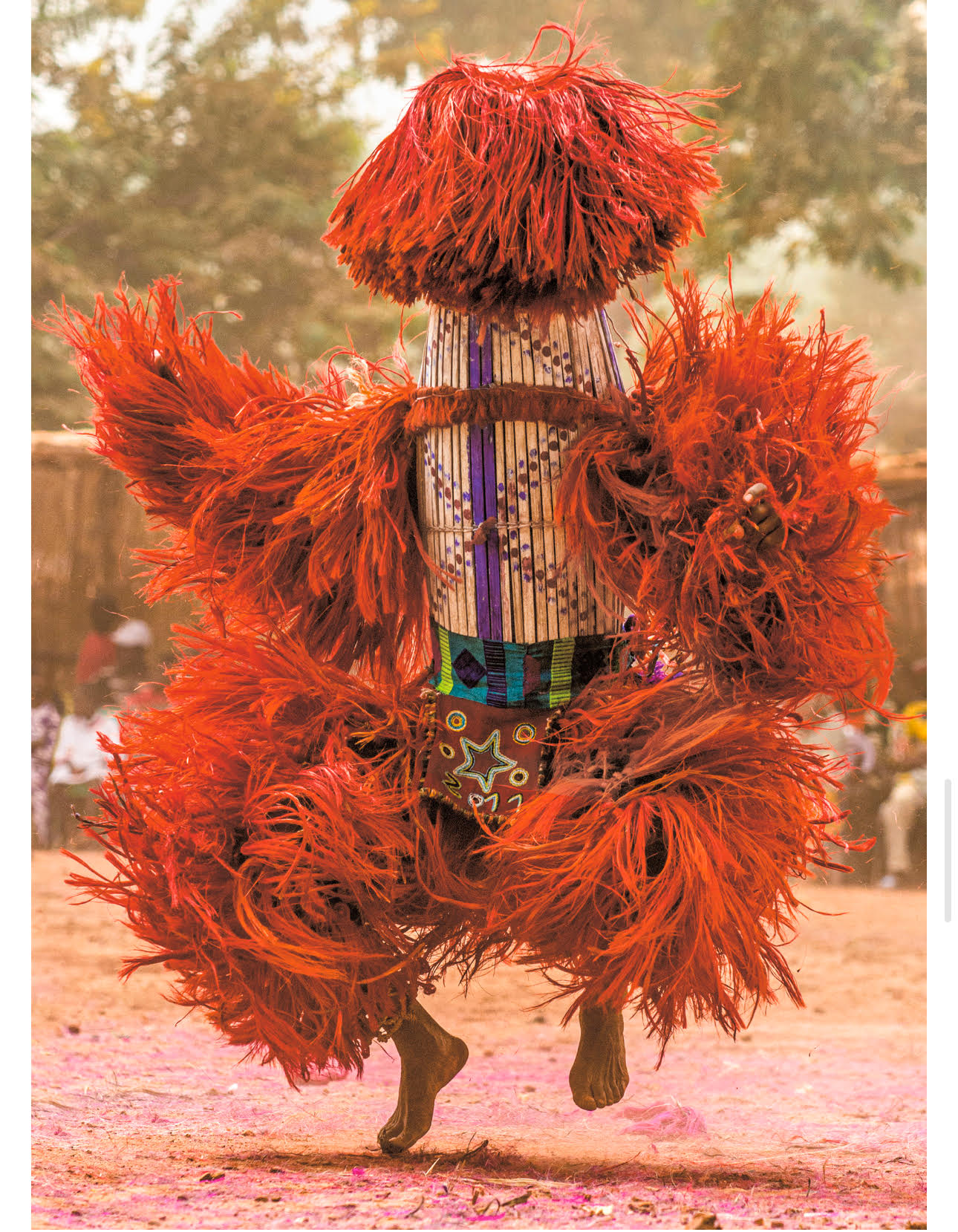
Raffia Harvest Mask, Burkina Faso, 2014
Their deep fascination with religious culture and rites of passage have also allowed them to witness practices that are far more ancient than any Abrahamic religion, where animist beliefs in the spirit world manifest forgotten ways of communing with nature. They have attended many ceremonies where trance, drumming, and masking unlock extraordinary feats “We have seen people in trance states perform feats that seem physically impossible” In addition to their stay with the Wodaabe in West Africa they have visited tribes in Benin, Togo, and Ghana- witnessing devotees of the deity Koku roll on cactus spines, eat glass, and carry flaming urns without injury during the Kokuzahn ceremony. While submerged in these cultures, they recounted feeling the present of something distinct and ancient, feeling themselves “180 degrees from normal awareness.” This included attending the secret, once in a generation coronation of a vodun ‘King’ in Ouidah, Benin. Photographers had previously been barred.
As timeless as these rituals are, the photographic richness of their work situates all of this in a vivid contemporary frame. No ritual or natural accent, no detail of painted or woven ornamentation, ever goes unremarked or ignored in their work. They excel at catching movement at its dynamic peak, combined with a pungent sense of color that fairly shocks and dazzles the eye. Their shot of Pende Stilt walkers- a rite of passage for young men- is almost modernist and formal in its symmetry, its four figures backgrounded as they are by the low-lying scrubland of the DR Congo. Other shots, with dancers arranged nearly geometrically, is nearly suprematist in its composition, while another shot of an initiate, frenetically dancing body completely concealed in woven costume exploding tufts of scarlet fringe, resembles a Nick Cave sound suit. The relevance of African art to our most contemporary visual practices has never been more evident.
Their work is not only an aesthetic record for so called developed world however. It is also a powerful reminder for the peoples they have documented. On one of their return visits to the Wodaabe chief Mokao, they presented their magnificent two volume copy of ‘African Twilight’, which featured many photographs of his tribe and their most important ceremonies. As a preliterate, semi nomadic pastoralist, he had perhaps seen three actual books in his entire life. He leafed through the volumes very carefully, nodding, commenting. Then he looked up and solemnly declared the books “ powerful medicine not to forget.”

David Jager
David Jager is an arts and culture writer based in New York City. He contributed to Toronto's NOW magazine for over a decade, and continues to write for numerous other publications. He has also worked as a curator. David received his PhD in philosophy from the University of Toronto in 2021. He also writes screenplays and rock musicals.
view all articles from this author