Whitehot Magazine
October 2026
"The Best Art In The World"
"The Best Art In The World"
October 2026
New York Painter Rick Prol on Painting His History
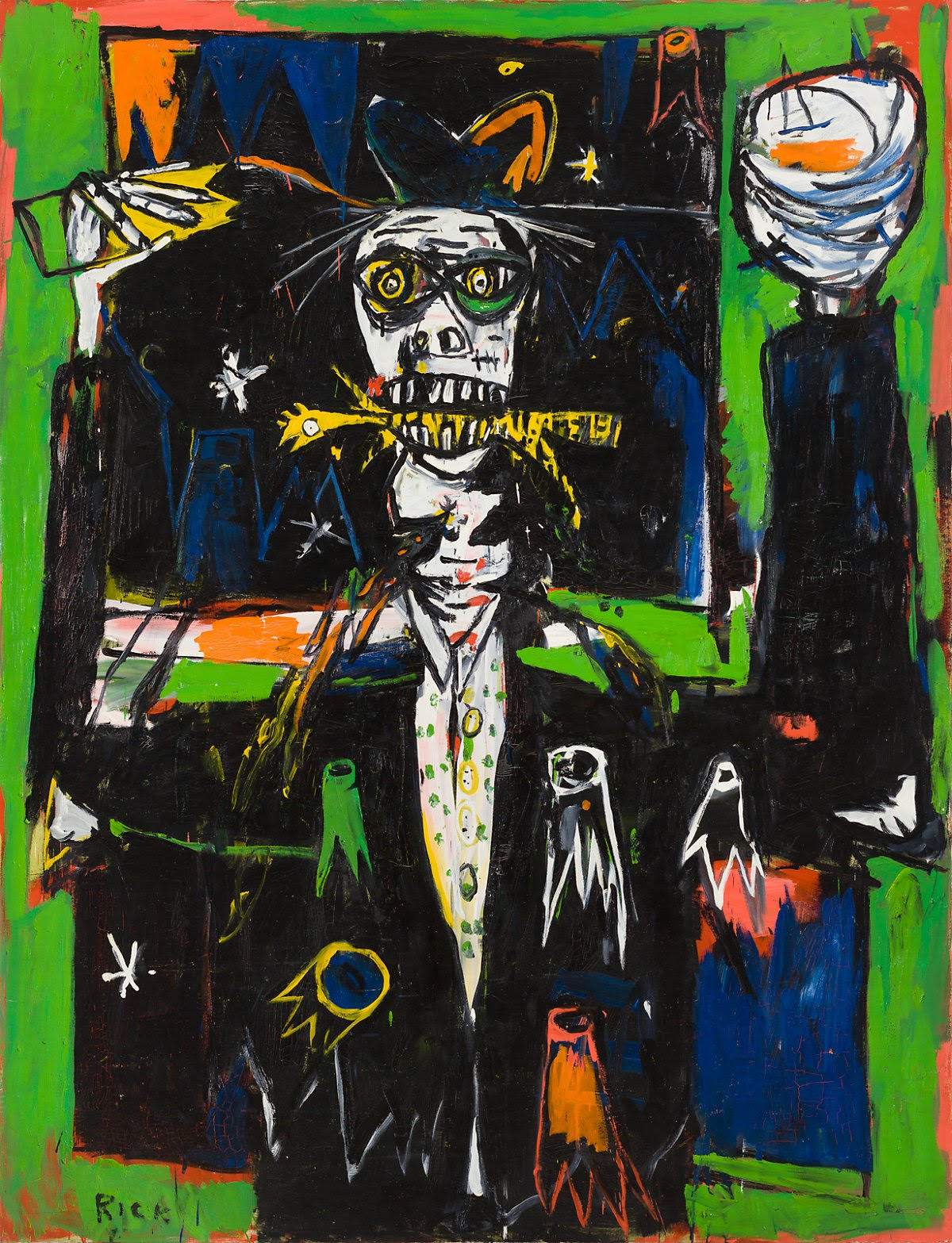 Rick Prol, Bandage, oil on canvas, 88X68, 1983, Courtesy Leeahn Gallery Seoul
By ANTHONY HADEN-GUEST August 28th, 2026
Rick Prol references the pictorial language of comic strips when making his remarkable art. Pop had fed upon just such a rich commercial trove natch, but the Popists’ treatment had usually been positive, indeed sometimes celebratory, the raw energy of the images having been much of the point. Prol’s use of the material is other, utterly his own, and his work is jagged, suggestive, dark.
There is personal history here. Prol, who was born in New York in 1958, volunteers childhood experiences that fed into his art. “We had a book called Ghosts along the Mississippi,” he told me. “Photographs of old plantations. And there were scary movies my mother was always looking at. Carnival of Souls, The Haunted. My brother was five years old. He always liked creepy, scary things and that had a big influence on me.”
Such were the prompts that decided Prol to himself become an artist in his teens. He went to Cooper Union and plunged right in. “The New York of the 70s was everything I absorbed,” he says. So it went with the art making too. “I worked through many artists,” he says. “De Kooning, Egon Schiele. I didn’t copy them, I emulated them.” Emil Nolde was another such presence in his work, but the artist whose work impacted him most was another he had discovered in his childhood, Francisco Goya, whose The Disasters of War is a body of work which is a forerunner of much today in the way it confronts one with in-your-face real horrors.
Such were Prol’s models, but the darkness in his work came from elsewhere: Real life. He was one of five children, his father’s only son. “He wanted me to be a painter,” he says. “Julio was a concert classical guitarist. Played flamenco in Spain.” But home life was not romantic. “I know where the violence in my work came from,” he says. “It came from my parents. They should have broken up. I blamed my father when I was a child. Because he was the more vocal. My mother seemed like the victim. And as I got older I saw that it was kind of the other way around. He began drinking a lot more. And my mother too. And it all affected me. I went through a lot of really horrible phases. I wasn’t heard, I wasn’t noticed. At the most important moments he wasn’t there for me. My mom probably wouldn’t have cared either.”
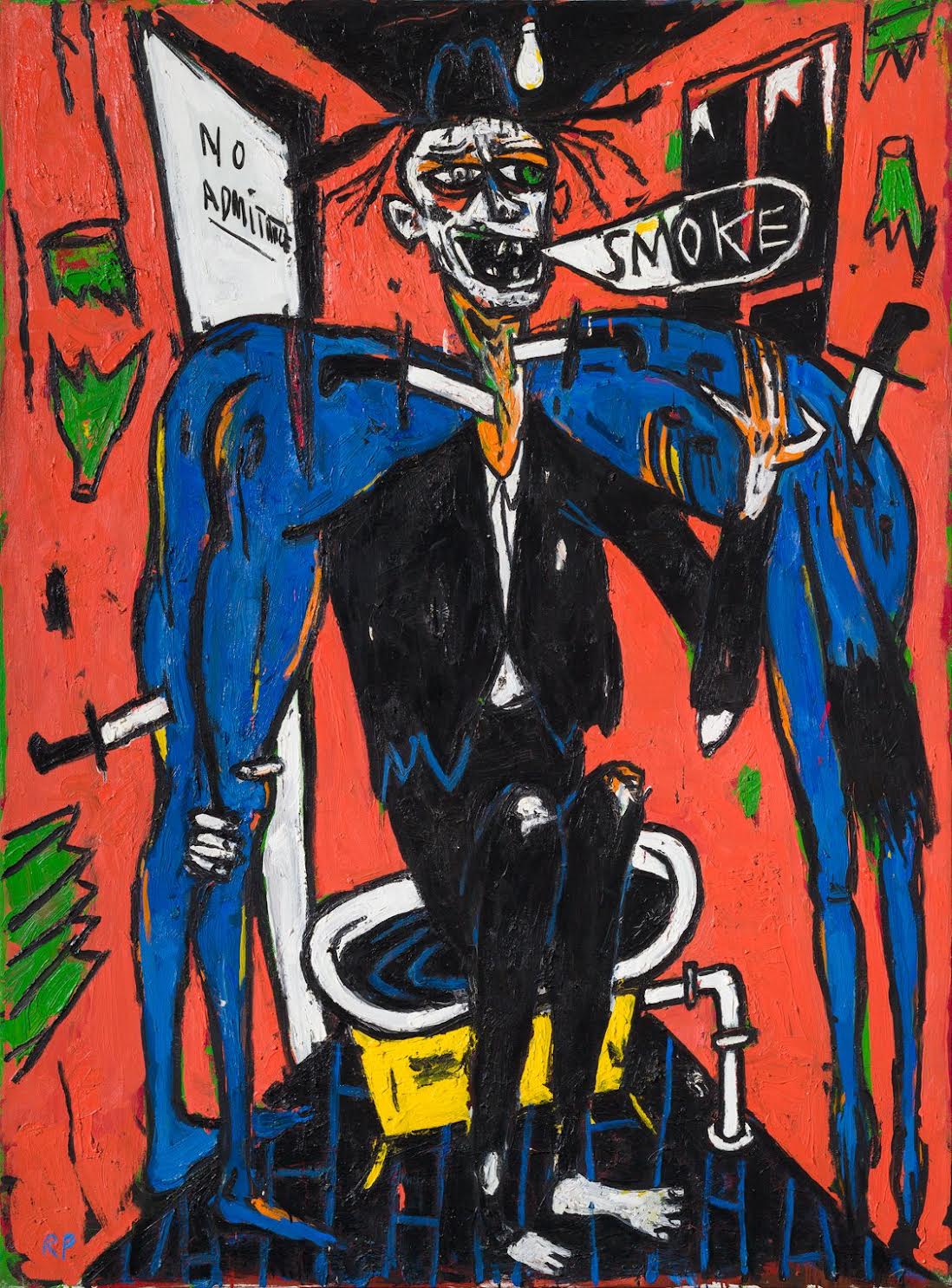 Rick Prol, Smoke, oil on canvas, 66X50, 1982-3
Prol experienced some violence too, as when his school complained he had been disruptive in class. He was nine or ten. His father hit him with a belt. It wasn’t until his final years at Cooper Union, though, that Prol felt he had developed the power to use brush on canvas to represent the inner turbulence produced by such past experience. “That had never had a voice in my work yet. It wasn’t about my anguish,” he says. “That took a long time.” He hadn’t gotten into the art scene yet. “But I was painting like a mother fucker. Because I had inherited a little bit of money. I put it all into my work and all of a sudden I had got all the paint I wanted,” he says. “Before I ever showed I experimented and experimented and experimented.”
Prol had been greatly encouraged by the emergence of the Neo-Expressionists. “Amazing!” he says. “They were like the Punk movement in music. I thought Wow! I cannot believe this. Painting was never dead! Joseph Beuys, when he said it, meant it’s no longer an avant garde. It had to be reinvented. And painting came back with a vengeance.” The Neo-Expressionists included the Germans, Georg Baselitz and Anselm Kiefer, the three Italian Cs, Sandro Chia, Enzo Cucchi, Francesco Clemente, and also a young American, Jean-Michel Basquiat.
Prol and Basquiat became close. “He would call me out of the blue,” Prol says. “He would call me from Hawaii. He left very very nice messages on my machine. I was in a group show at the Tony Shafrazi Gallery the previous summer and Jean called me to say, ‘I like your wood usage in your show.’” He helped out Basquiat with several canvases in the studio he rented from Warhol, such as working on the backgrounds of a dozen large canvases that went into his solo show at the Vrej Baghoomian gallery in 1988, which would be his last show in his lifetime. “But I didn’t invent anything,” Prol stresses. “I was there as a friend, to give moral support.”
Where had Basquiat first seen Prol’s work, I wondered?
“I think one of the first times was at the Red Bar,” he said. “I had a one man show there when I was 26, 27. Michael Markos did it. He ran the East 7th Street gallery, where I had a solo show and curated shows. That was how I got my name out there. It was the curated shows I did. I did like five.”
Did Prol make graffiti on the street himself back then? Yes. It had been on Pier 34, alongside David Wojnarowicz and Mike Bidlo, fellow figures on the vibrant Lower East Side art scene, a time he speaks of with delight and regret. “Unfortunately it ended way too quickly. It’s such a shame that that happened,” he says. So why did it end? Well, that piece of artworld history had been smooshed by its own success. “It was just the money,” he says. “The rents went up. People like Gracie Mansion were doing very well but I guess nobody could afford anything anymore all of a sudden. Everybody started jumping ship. And then by ’88 it was really over. It’s such a shame.”
Prol, though, was moving on, though into what was not immediately clear. “I’m always trying to experiment with something,” he says. “Have I created a … what do they call it when you’re labeled with something? A brand! Rothko had a brand. I don’t know if I have a brand. I don’t play for a team. Sometimes something wrong is happening. And that is usually when I have tried to repeat myself. But I’m compelled to get something out of my system. And it happens to turn out the way that it does. Sometimes I need to see how far I can go.”
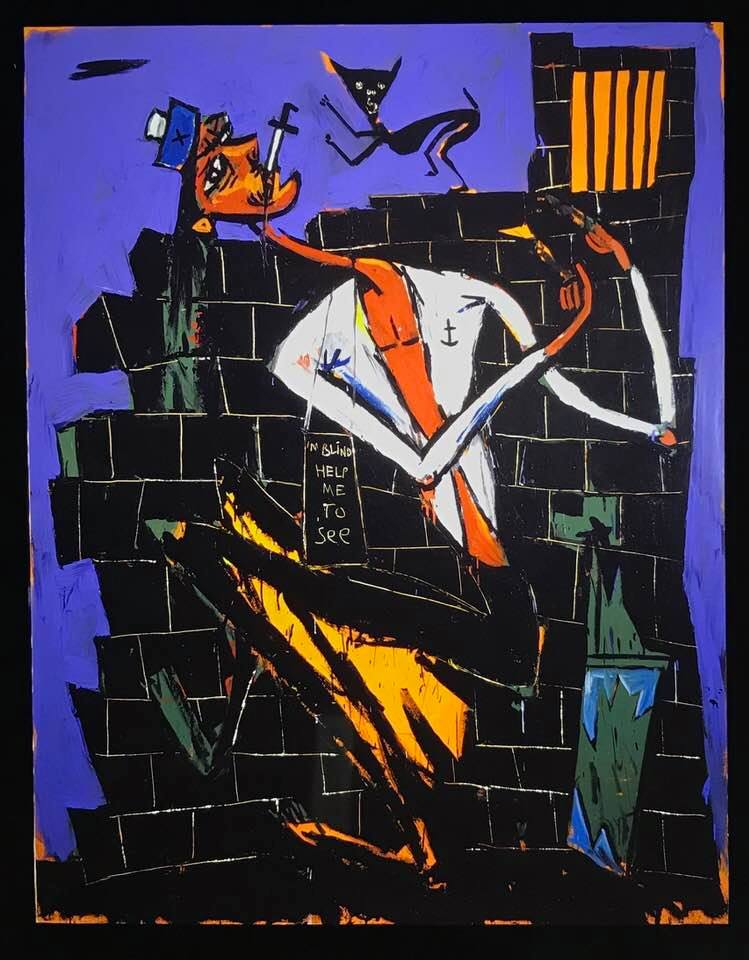 I'm Blind, Help Me To See, acrylic on canvas, 96X72, 1984
Which can be pretty far. The work created from borrowed images by the Popists tend to be, as said, positive, as unthreatening as Warhol’s Marilyn. Not so the creatures on Prol’s comicstrip-scapes. His cast of characters—the skeletal humanoids, the octopussies, the insect-legged cats or their various combos—may seem vicious or victims, though sometimes presented with a touch of pitch-dark humor, as with Ahora, in which the central figure is sitting dressed in a full bathtub, gesturing and looking alert, with three knives sticking into his body. But unthreatening is not the word for the cat’s head crowning a neck as slender as a strand of spaghetti atop an octopus body, which went onto an Elvis Costello album cover. Nor the male figure dressed in black, uplifting two sinister devices in Cracked Window. So just what is the messaging?
“The cats are about oppression, people being bought and sold,” Prol says. “Something like that. People being slaves or tortured. I’m not going to put a human being in that situation. I find it more poetic to use a cat. Or a cat/octopus often. The surveillances team I paint is a cat/octopus. Is it good or evil? That’s what I find interesting in movies that I like. Who’s the good guy, who’s the bad guy? It’s very hard to tell sometimes. I just read somewhere that Lucian Freud said everything is portraiture. Look at a photograph of Francis Bacon next to one of his paintings. He looks just like his paintings. I think my paintings are all me.”
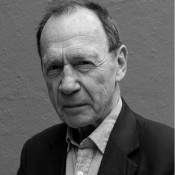
Anthony Haden-Guest
Anthony Haden-Guest (born 2 February 1937) is a British writer, reporter, cartoonist, art critic, poet, and socialite who lives in New York City and London. He is a frequent contributor to major magazines and has had several books published including TRUE COLORS: The Real Life of the Art World and The Last Party, Studio 54, Disco and the Culture of the Night.
view all articles from this author