Whitehot Magazine
October 2026
"The Best Art In The World"
"The Best Art In The World"
October 2026
“Sacred leftovers and all that is left behind” Cass (Haozhong) Yao's Errant Progeny at Baba Yaga Gallery
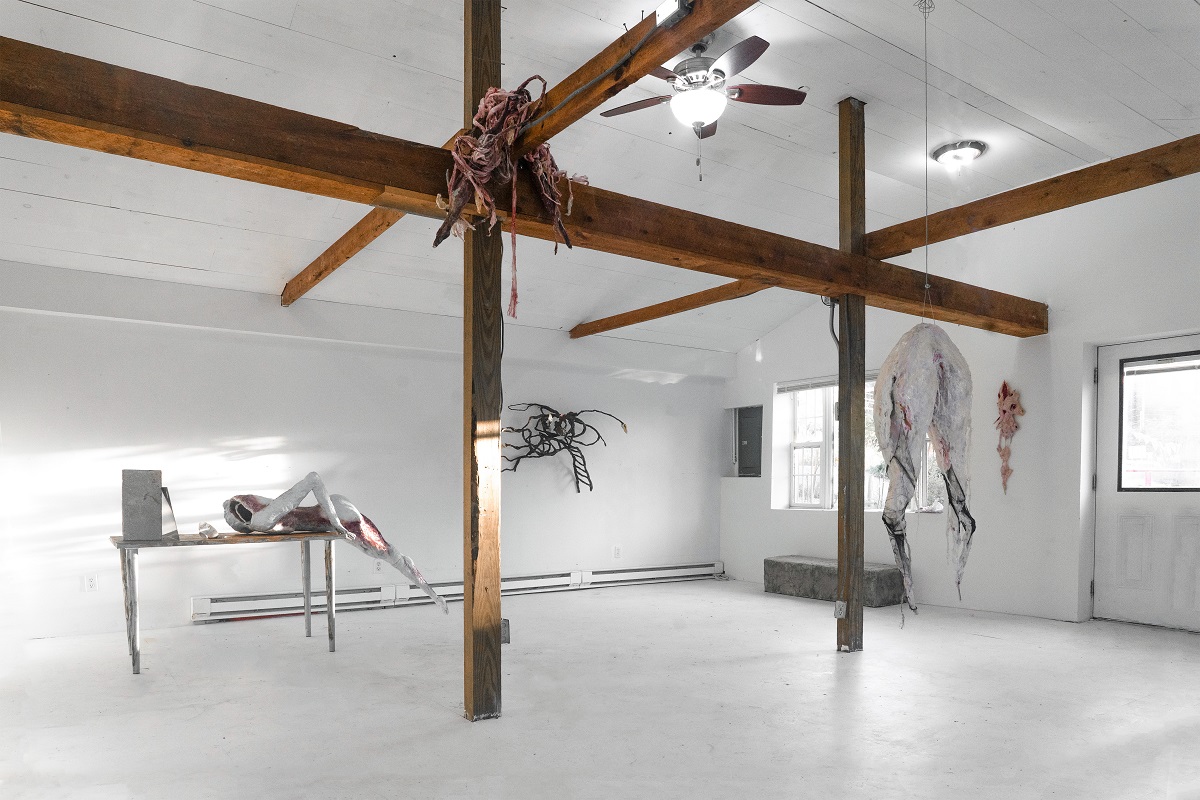 Installation view of Errant Progeny at Baba Yaga Gallery (on view through November 16).
Image Courtesy of the artist Cass (Haozhong) Yao and Baba Yaga Gallery.
By STEPHANIE HUBER November 19, 2025
In the bitterly cold cube of the Baba Yaga Gallery just off of NY-9G in Hudson, New York, Cass (Haozhong) Yao’s solo exhibition Errant Progeny, curated by Rui Jiang, lets dangle lumps, heaps, and wads of sagging atomized “flesh” framed by wooden trusses. Despite the butcher-shop-like conditions of this space, these corporeal riddles exhibit none of the neat, deliberate slicing reserved for meats going to market. Unceremoniously, and even violently separated from an implied, but undefined whole, the sculptures on display look like the casualties of war, or cast-offs of a surgical procedure. Remarkably, there is no flesh here at all. As the title suggests—these errant beings rove astray, seeking definition through the anatomical forms that might have inspired them, but which they can never be.
The scent in the room is not putrid, exactly. But it sticks with you. Antiseptic, even clinical notes recall a more transient experience of anxiety—like the endless wait to leave the hospital. Keeping humanity at a distance, this body of work consistently teases at what it is and is not. Fleeting moments of corporeal recognition slyly divert expectations. A brief scan of the materials reveals that this is not flesh at all, but rather synthetic surrogates consisting of silicone, wax, and epoxy clay. Any organic materials included come not from a human, but an animal source—including the wiry horsehair hanging from the expansively-titled In Concentrated Hypnotic Ingredients, Dead Dreams, Like that Arched Luminous Body Suspending Over The inspect, Emit a Strange Odor. Lamb ears that could easily double as calla lilies listen to us from the ends of the kelp-like tendrils in Anatomy 3. Silicone literally drips onto the floor from the sculpture’s pits and crevices. It becomes clear that there is nothing human about these bodies other than the method of their manufacture.
Seeking, but never achieving certainty, the titles do a great deal of heavy lifting. Anatomy 1, Anatomy 2, Anatomy 3—exploit the banality of their names to sever any specific relationship to the body part, human or otherwise. Existing between categories, the spindly frame of Anatomy 2 pushes into boundaries of the tactile and auditory without ever actually breaching them. Red velvet flocking coats its stiff tendrils like a moldy overgrowth. Jingle bells could—logically—contribute a sound component to this sculpture, but being affixed to the wall as it is, the work cannot perform to its potential. Impotence is a guiding principle here—denying completion while persistently rendering bodily malfunction the subject of our aesthetic contemplation.
Shared Meal is, in fact, the most anthropomorphic of the works on display—ironic, considering that it is, in actuality, a replica of an image generated from Artificial Intelligence, then interpreted by a human hand. As the byproduct of nonsense sentences fed into the Stable Diffusion image generator, Shared Meal is more of an output, its wrongness invokes a visceral reaction to the hand of AI slop in this monstrous corpse. Only one of its limbs is fully defined: the left arm with five fingers articulated. Both the lower left calf and right arm, however, are mere abbreviations of the body parts that they represent, while the right leg flips inside of itself, forming a cavity. The torso, meanwhile, doubles as a gaping mouth of a manta ray and an empty human rib cage. Maybe because of its status as the most complete body in the room, Shared Meal is also the least human of them all—an abject corpse that inspires the desire to reject any identification with it.
Another work stands apart from the rest, but for very different reasons. Shrunken Gland is modest in scale, surrounded by a custom resin frame. Delicate, even precious in its presentation, it is veiled by shorn black pantyhose whose intricate holes recreate the airy fragility of lace. Iridescent pearls—a reference to Śarīra, the sanctified deposits of a Buddhist monk’s body left behind in the ashes after cremation—emerge from the fabricated muscle and gristle. Doing the work suggested by its name, this “gland” secretes a substance of spiritual significance. Under close, attentive inspection of its glistening crevices a divine clarity arises—a revelation made possible through the implied violence of this synthetic body.
Much like the thrill of recognition associated with filmmaker David Cronenberg’s body horror, Yao offers a fully immersive version of the genre. Visceral visuals and synthetic scents mingle to create an affective experience that penetrates the body. Glistening surfaces and a fleshy palette stage a confrontation with our physique as an incontrovertible fact; the only certainty left is that it becomes harder to feign ignorance of our own mortality. Such a heightened consciousness changes the relationship that we have with our physical form as something viewable from the outside—even arbitrary or fungible. Small inklings of the sacred remain, however. Much like the pearls in Śarīra are left behind, so are a thread of questions about the meanings of our bodies and what they represent to ourselves and to the larger world.
 Installation view of Errant Progeny at Baba Yaga Gallery (on view through November 16).
Image Courtesy of the artist Cass (Haozhong) Yao and Baba Yaga Gallery.
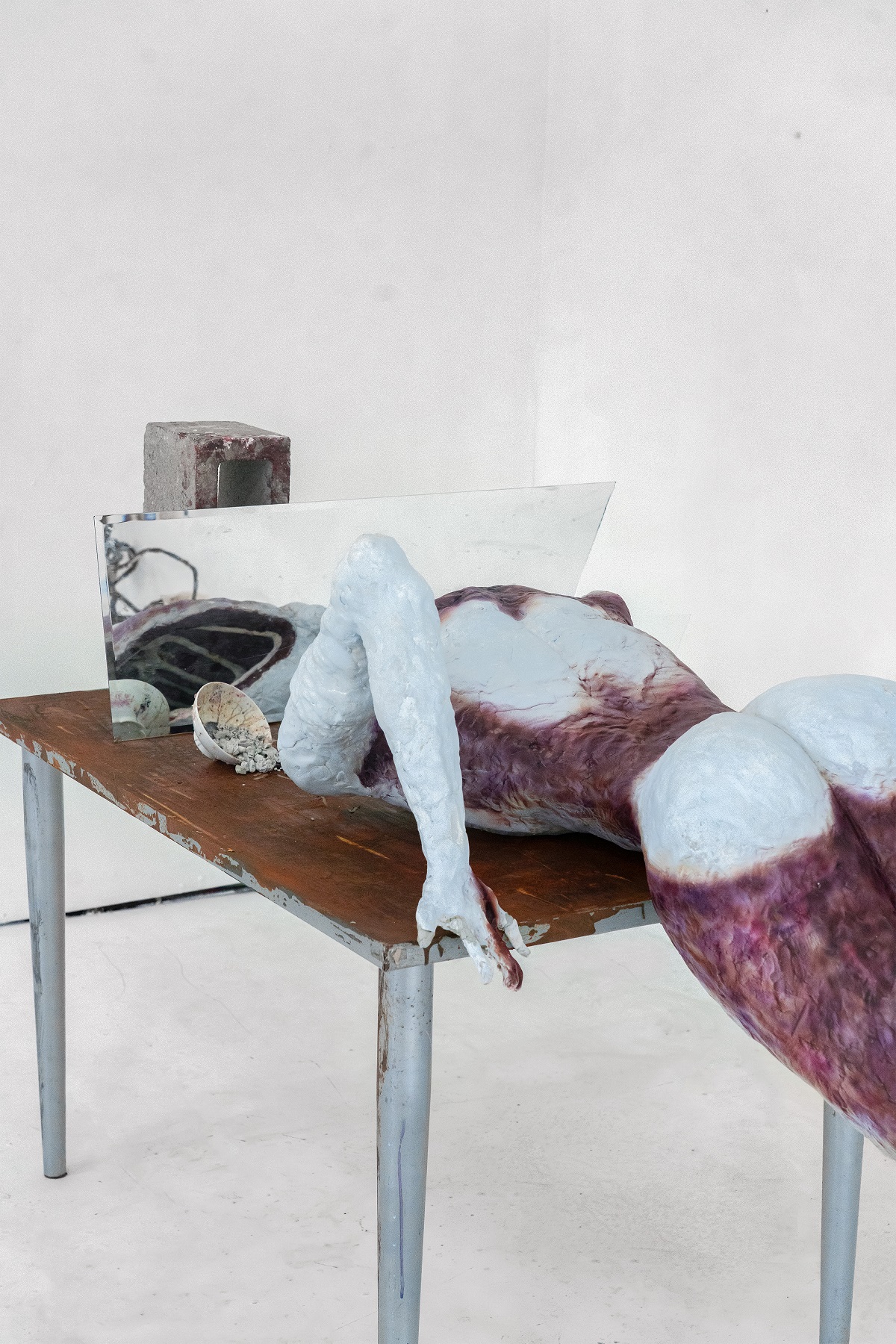 Installation view of Shared Meal at Baba Yaga Gallery (on view through November 16). Image
Courtesy of the artist Cass (Haozhong) Yao and Baba Yaga Gallery.
 Axis, 2025 at Baba Yaga Gallery (on view through November 16). Image Courtesy of the artist
Cass (Haozhong) Yao and Baba Yaga Gallery.
“Sacred leftovers and all that is left behind” Cass (Haozhong) Yao, Errant Progeny, Baba Yaga Gallery, 5821 NY-9G, Hudson, New York, October 25-November 16, 2025

Stephanie Huber
Specializes in twentieth century painting and film history. Her writing has been appeared in Zeitschrift für Kunstgeschichte, Moving Image Review and Art Journal, Burlington Magazine, Hyperallergic, and ARTMargins.
view all articles from this author