Whitehot Magazine
September 2026
"The Best Art In The World"
"The Best Art In The World"
September 2026
Displaced: Ellen K. Levy at 68 Prince Street Gallery, Kingston,NY
By KATHLEEN CULLEN September 17th, 2026
Ellen K. Levy’s “Displaced: Tears in the Fabric of the Universe,” on view at 68 Prince Street Gallery in Kingston through September 27, gathers two decades of the artist’s ongoing negotiation with outer space—not as spectacle, but as a problem of perspective.
As curator Barbara London writes in her catalogue essay, Levy “is an interdisciplinary artist who moves resolutely between art and science.” She is trained in both: a zoologist by undergraduate degree, a painter by training, and a Ph.D. in art and neuroscience. That hybrid background is legible in every work on view, none more so than the four large painted prints that anchor the show. In previous conversations with curator Alan Goolman, emphasis was placed upon the works’ titles and the performative nature of the installation.
Space Nets (2026) includes many satellites from distant nations. It led Levy to the thought that the sculptural “nets” built by spiders and artists - e.g., Janet Echelman and Tomás Saraceno—might be training mankind for space.
The newest and largest piece plunges the viewer into a convex, fisheye distortion of the International Space Station’s interior - a golden, bulging sphere crammed with railings, cables, and hardware, ringed by satellite fragments and a sliver of Earth’s curved limb glowing at the bottom edge. London’s essay names this warping directly: Levy is picturing “topological perspective,” a way of seeing that privileges connectivity and structural relationships over fixed distance or angle. The painting doesn’t just depict non-Euclidean space; its very geometry enacts it.
Simulator (2019) trades the fisheye for a looping wireframe funnel rendered in acid yellow, spiraling downward like a mechanical drain or a training capsule. A ghostly astronaut floats at upper left, while a page of patent diagrams - the kind of appropriated government imagery London identifies as central to Levy’s process—is collaged directly onto the canvas, its numbered figures legible beneath layers of paint. The effect recalls Rauschenberg’s combines or Kiefer’s palimpsests, artists London cites as touchstones, where documentary source material and gestural paint remain in visible tension rather than resolving into illusionism.
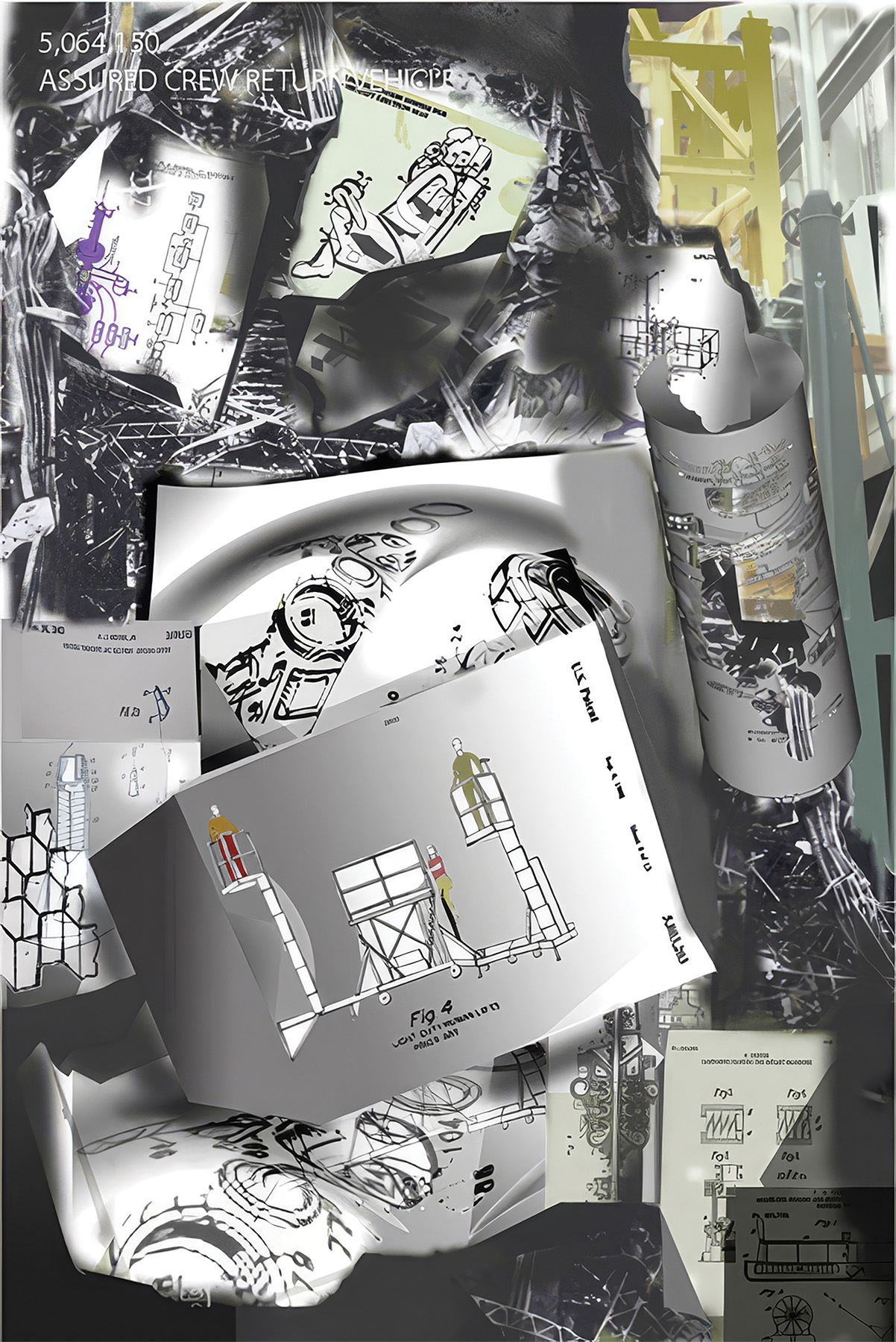 Structure and Failure (2003)
The aftermath of the catastrophic Challenger explosion in 1986 yielded many attempts at explanation. Notably, physicist Richard Feynman demonstrated on television to a wide audience that freezing temperatures caused the O-ring seal that ignited the booster to lose all resiliency. Feynman placed a piece of clamped O-ring rubber in ice water and, after a few minutes, attempted without success to expand it after removing the clamp.
Structure and Failure includes some of the patents subsequently filed by NASA, including “Insured Passenger Return Vehicle.” The earliest of the four works is darker in both palette and implication. Girders and scaffolding crosshatch the upper register, while a black patent diagram—a parachute descent sequence, numbered and dotted like a technical manual—anchors the lower right. Wireframe cones tumble across the bottom edge, evoking instability rather than the triumphant hardware of the space program. It reads as Levy’s clearest statement on risk: invention’s shadow side.
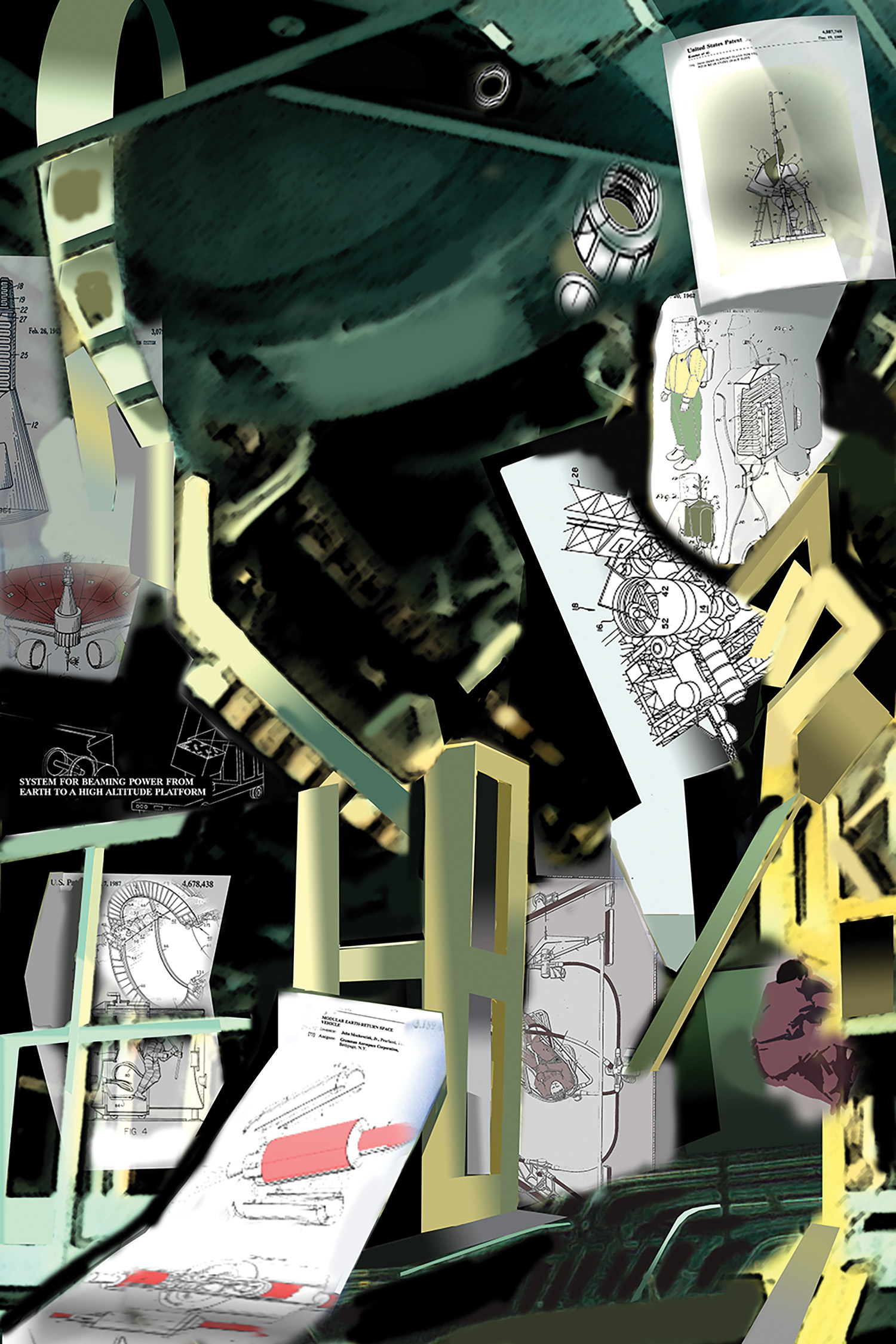 VAB (Vehicle Assembly Building) (2004–2005)
VAB is the vertiginous building where the then-futuristic space shuttle was assembled. Alligators have been found roaming the nearby grounds. Location is everything for all species.
A massive orange satellite dish dominates the left half of the composition, with a Mars rover’s skeletal frame drifting in at upper right. Patent numbers and structural notations—“2,835.54,” fragments of a “satellite structure” schematic—are scattered like signage across the painting’s surface, reinforcing London’s point that Levy treats patents as “a time-based inventory,” a record of how invention accumulates.
Across all four works, the recurring vocabulary London describes—circles, nets, spheres, and the astronaut’s zero-gravity tear that pools rather than falls—recurs and mutates. What holds the show together isn’t a single image of space but Levy’s insistence that space is first a way of seeing: displaced, layered, and stubbornly unresolved.
Gallery Art Talk with the artist and Eleanor Heartney, Sunday, September 20.
For further information, call curator Alan Goolman at (917) 509-7156.
Gallery hours: Friday, 12 to 5; Saturday, 11 to 6; Sunday, 12 to 5; Thursday by appointment.
Email: info@68princestgallery.com
Website: 68princestgallery.com
Instagram: @68princegallery
Kathleen Cullen
Kathleen Cullen is a New York–based arts writer covering contemporary art, sculpture, museums, biennials, and visual culture. Her work has appeared in Sculpture and Art & Object, where she writes about artists and exhibitions through the lens of material innovation, cultural history, and the evolving role of museums. She is particularly interested in the intersections of sculpture, spirituality, ecology, technology, and contemporary craftsmanship. Her reporting spans museum exhibitions, international biennials, artist interviews, and emerging trends shaping the global art world.
view all articles from this author